

Weathering the K-Storm: How El Niño & La Niña Changed Korean Small Talk
Phase 1: Immersive Hook
Hello! This is your Daily Hangul Editor.
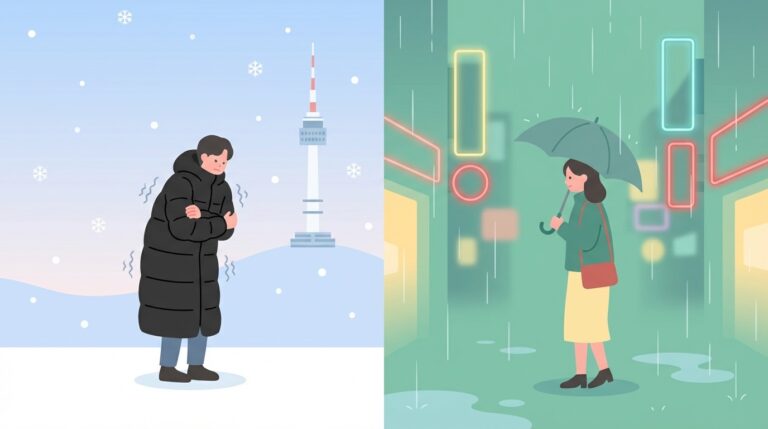
Picture this: You are walking down the fashionable streets of Garosu-gil in mid-December. You packed your bags expecting the biting Siberian winds you saw in K-Dramas—where the lead characters share a scarf and their breath creates romantic clouds in the air. Instead, it’s raining. It’s humid. People are holding umbrellas instead of wearing ear muffs. You feel cheated.
Or perhaps it’s the opposite. You’re in Seoul, and everyone—literally everyone—is wearing a black, floor-length puffer coat that looks like a sleeping bag. They look like an army of penguins. The news says it’s the “Coldest Snap in 40 Years.”
Welcome to the chaos of El Niño (엘니뇨) and La Niña (라니냐) in Korea. These aren’t just scientific terms here; they dictate the price of your pork belly lettuce wrap, the cancellation of your ski trip, and the very fabric of Korean small talk. If you want to sound like a true C2-level insider, you need to move beyond “It’s cold (추워요)” and start discussing “abnormal climate patterns (이상 기후).”
Today, we aren’t just learning weather words; we are learning how to complain about the weather with the sophistication of a Seoulite.
Phase 2: Deep Dive — Advanced Vocabulary
Since we are targeting C2 (Advanced), let’s skip the basics and look at how Koreans intellectually process these weather anomalies.
1. 이상 기후 [Isang Gihu]
- Pronunciation: Isang Gihu [ee-sang ghee-hoo]
- Meaning: Abnormal Climate / Extreme Weather Events
- K-Culture Moment: Turn on any Korean news channel (YTN, KBS) during a weird weather week. The anchor, looking very serious, will start the segment with this phrase. It’s the “opening credits” to a disaster report.
- Editor’s Insight: This is a formal, slightly intellectual term. Using this shows you are aware of the broader context, not just the temperature.
- Situation Spectrum:
[🚫 Casual Chat w/ Kids] ———— [⚠️ Friends] ———— [✅ Intellectual/Formal]- 🤔 Think About It: Why does Korean society react so sensitively to climate changes? (Hint: Korea has historically been an agrarian society where weather equals survival.)
2. 널뛰기하다 [Neolttwigi-hada]
- Pronunciation: Neolttwigi-hada [null-twwi-ghee-ha-da]
- Meaning: To fluctuate wildly / To seesaw (Literal: To play the traditional standing seesaw game)
- K-Culture Moment: You might hear an office worker sigh, “The weather is seesawing lately (요즘 날씨가 널뛰기를 하네).” One day it’s spring, the next day it’s the ice age.
- Editor’s Insight: This is a beautiful idiom. Neolttwigi is a traditional Korean game played on holidays. Applying it to weather (or stock prices) adds a vivid, chaotic nuance that mere “change” (변화) lacks.
- Situation Spectrum:
[🚫 Formal Report] ———— [⚠️ Business] ———— [✅ Casual/Semi-formal]3. 삼한사온 [Samhan-saon] (The Lost Norm)
- Pronunciation: Samhan-saon [sam-han-sa-on]
- Meaning: Three cold days, four warm days (Traditional Korean winter cycle)
- K-Culture Moment: This is often used negatively now. “Samhan-saon is dead.” (삼한사온은 옛말이다.) because of climate change (El Niño/La Niña).
- Editor’s Insight: Knowing this idioms proves you understand Korea’s historical climate identity versus its current reality. It’s a lament for the predictable past.
- Situation Spectrum:
[🚫 Kids] ———— [⚠️ Casual] ———— [✅ General Conversation]
Phase 3: Textbook vs. Real Life
How do Koreans really react when El Niño brings a warm winter or La Niña freezes the Han River?
| Situation | 📖 Textbook Korean | 🗣️ Real Korean (C2/Native) | 💡 The Context |
|---|---|---|---|
| Sudden Cold Snap (La Niña) | 날씨가 갑자기 추워졌어요. (The weather suddenly became cold.) | 살이 에이는 듯한 추위예요. (It’s a cutting/biting cold.) | “Eida” (에이다) means to be cut or carved. It emphasizes the physical pain of the wind. |
| Weird Warm Winter (El Niño) | 겨울인데 따뜻하네요. (It is warm for winter.) | 이게 겨울인지 봄인지 모르겠네요. (I don’t know if this is winter or spring.) | Koreans often use rhetorical confusion to express dissatisfaction with unnatural weather. |
| Extreme Temperature Swing | 기온 차이가 커요. (The temperature difference is big.) | 날씨가 변덕이 죽 끓듯 하네요. (The weather is fickle like boiling porridge.) | “Boiling porridge” bubbles unpredictably. This idiom is used for fickle people or weather. |
Bottom Note: At the C2 level, you shouldn’t just describe the temperature; you should describe the sensation or the confusion caused by the weather.
Phase 4: Cultural Deep Dive — The Ripple Effect
4-1. The “Long Padding” Phenomenon (La Niña’s Uniform)
When La Niña hits and the temperature drops below -10°C, the streets of Seoul transform. Everyone wears “Long Padding” (롱패딩 – ankle-length puffer coats).
– The Vibe: It’s not about fashion; it’s about survival. If you see someone wearing a stylish wool coat in -15°C, Koreans will think, “Ah, they must be new here” or “They care more about looks than life (멋 부리다 얼어 죽겠다).”
– Nunchi Tip: If your Korean friends suggest wearing “padding” for a meetup, do not show up in a trench coat. You will worry them, and they will spend the whole night asking if you are cold.
4-2. The “Geum-chi” Crisis (El Niño’s Cost)
El Niño often brings heavy rain during harvest seasons. This leads to “Geum-chi” (금치)—a portmanteau of Geum (Gold) and Kimchi.
– The Scenario: You go to a BBQ restaurant. You ask for more lettuce. The owner looks hesitant or gives you only three leaves.
– Why: The strange weather destroyed the crops. Lettuce is now as expensive as gold.
– Critical Insight: In Korea, side dishes (banchan) are usually free and refillable. But during climate crises, demanding endless refills of expensive vegetables shows a lack of Nunchi regarding the economic situation.
Phase 5: Immersive Roleplay
Scenario: It is mid-January, but due to a strong El Niño effect, it is raining heavily instead of snowing. You are at a cafe with your colleague, Min-ji (30s, dramatic but realistic), looking out at the gray, wet street.
Min-ji: 와, 1월에 비 오는 거 실화예요? 스키장 예약한 거 다 취소해야겠어요.
(Wa, 1-wore bi oneun geo silhwayeyo? Seukijang yeyakhan geo da chwisohaeyagesseoyo.)
Wow, is rain in January for real? I guess I have to cancel all my ski resort reservations.
YOU: ________________________.
🔀 Your Turn! How do you respond?
- A) “네, 기상청에서 엘니뇨 영향이라고 했어요.” (Yes, the meteorology administration said it is the El Niño effect.)
- B) “그러게요. 날씨가 미쳤나 봐요. 완전 동남아 날씨 같아요.” (I know. The weather must be crazy. It’s totally like Southeast Asia weather.)
- C) “비 오면 파전에 막걸리 어때요?” (If it rains, how about Pajeon and Makgeolli?)
✅ Best Choice: B + C hybrid.
– Analysis: Option A is too factual (Dry). Option B provides the emotional validation (Empathy) Koreans love in conversation. Comparing Korean summer/weird winter to “Southeast Asia” is a very common local trope. Option C is the perfect “Plan B” that shows cultural fluency.
Roleplay Continuation (If you chose C):
Min-ji: 오! 대박. 역시 OO씨는 뭘 좀 아시네요. 그럼 스키 대신 낮술 하러 갈까요?
(Oh! Daebak. As expected, you know what’s up. Then shall we go for day-drinking instead of skiing?)
Phase 6: 10-Second Shadowing Drill
Let’s practice complaining about the weird weather naturally.
Situation: Stepping outside thinking it’s spring, but the wind is freezing (Kkotsaem Chuwi – Spring Cold Snap).
😤 Sentences:
날씨가 / 왜 이래? / 봄이 온 줄 알았는데 / 다시 겨울이야!
(Nalssiga / wae irae? / Bomi on jul aranneunde / dasi gyeouriya!)
Why is the weather / like this? / I thought spring had come / but it’s winter again!
💡 Performance Tip: Emphasize “wae irae” with annoyance, and drop your pitch at “dasi gyeouriya” to show despair.
Phase 7: K-Culture Glossary (Climate Edition)
| Korean | Romanization | English Meaning | Cultural Context |
|---|---|---|---|
| 꽃샘추위 | Kkotsaem Chuwi | Spring Cold Snap | Lit. “The cold that is jealous of the flowers.” Poetical term for sudden cold in March/April. |
| 한파 주의보 | Hanpa Juuibo | Cold Wave Advisory | You will get a loud emergency alert on your phone. Wrap up! |
| 열대야 | Yeoldaeya | Tropical Night | Nights when the temp doesn’t drop below 25°C. Causes collective insomnia in Korea. |
| 롱패딩 | Long Padding | Long Puffer Coat | The unspoken uniform of Korean survival during La Niña winters. |
Phase 8: Traveler’s Survival Kit
Traveling to Korea during erratic weather?
🆘 Survival Expression: The “Feels Like” Temp
– 🇰🇷 “체감 온도가 몇 도예요?” (Chegam ondoga myeot doyeyo?)
– 🗣️ Meaning: “What is the sensible temperature (wind chill)?”
– 📍 Why use it: In Korean winter, the wind chill matters more than the actual number. The forecast says -5°C, but the wind makes it feel like -15°C.📌 Editor’s Travel Note
– Emergency Alerts: Don’t panic if your phone screeches. It’s usually a “Safety Disaster Text” (안전안내문자) about heavy rain, heatwaves, or fine dust. Translate it with Papago immediately.
– Convenience Stores: In sudden rain, every CU or GS25 sells high-quality umbrellas (5,000~10,000 KRW). Don’t get wet!
Phase 9: Think Deeper — “Climate & Language”
The Death of “Four Distinct Seasons” (사계절이 뚜렷하다)
For decades, Korean textbooks proudly taught that Korea has “four distinct seasons.” It was a source of national pride. However, with the intensifying El Niño and La Niña cycles, you will often hear Koreans cynically joke that Korea now only has two seasons: “Mega-Summer and Ultra-Winter,” with very brief transitions.
🧠 Think Deeper:
Does your country have a “national pride” regarding weather or nature? How is climate change altering the vocabulary you use to describe your home? In Korea, the phrase “distinct four seasons” is slowly becoming a historical reference rather than a current reality.
Phase 10: FAQ & Troubleshooting
Q: Can I talk about the weather to my boss?
A: Yes! It is the safest C2-level small talk. Complaining about the extreme weather creates a sense of “comradeship” (we are suffering together).
Q: What is ‘Yellow Dust’ (Hwangsa)? Is it related?
A: While not directly El Niño, atmospheric stagnation can make air quality worse. If people are wearing masks on a sunny day, check the Fine Dust (미세먼지) levels, not just the temperature.
❌ Common Mistake:
Don’t just say “The weather is bad” (날씨가 나빠요). It sounds childish.
✅ Upgrade: Say “The weather is gloomy/depressing” (날씨가 찌뿌둥해요) to sound like a native.
Phase 11: Wrap-up & Mission
One-Liner: Weather in Korea isn’t just background noise; it’s a conversation starter, a dining cue, and a survival game.
🚀 Action Mission:
– 🥉 Bronze: Check the weather in Seoul right now using a Korean site (Naver Weather) and read the sensible temperature (체감 온도).
– 🥈 Silver: Post a comment below describing your current local weather using the idiom “널뛰기하다” (fluctuate/seesaw).
– 🥇 Gold: Next time it rains unexpectedly, suggest “Pajeon and Makgeolli” to a Korean friend. Watch their eyes light up.
💬 Editor’s Question: How does the weather affect your mood today? Let me know in the comments!
Frequently Asked Questions (FAQ)
Q: What does "이상 기후 [Isang Gihu]" mean in Korean and how do you pronounce it?
A: In Korean, "이상 기후 [Isang Gihu]" is pronounced [Isang Gihu [ee-sang ghee-hoo] and means: Abnormal Climate / Extreme Weather Events
Q: What does "널뛰기하다 [Neolttwigi-hada]" mean in Korean and how do you pronounce it?
A: In Korean, "널뛰기하다 [Neolttwigi-hada]" is pronounced [Neolttwigi-hada [null-twwi-ghee-ha-da] and means: To fluctuate wildly / To seesaw (Literal: To play the traditional standing seesaw game)
Q: What does "삼한사온 [Samhan-saon] (The Lost Norm)" mean in Korean and how do you pronounce it?
A: In Korean, "삼한사온 [Samhan-saon] (The Lost Norm)" is pronounced [Samhan-saon [sam-han-sa-on] and means: Three cold days, four warm days (Traditional Korean winter cycle)







