

Hiking in Korea? Why You Need to Know ‘Yaksu-teo’ (Plus: The Magic Word for Cold Water)
Phase 1: The Immersive Hook
안녕하세요! (Hello!) This is your Daily Hangul Editor.
Imagine this: You are hiking up a beautiful mountain in Seoul (maybe Bukhansan or Namsan). You are tired, sweating, and thirsty. Suddenly, you see a gathering of energetic older Koreans—Ajumma and Ajusshi—clapping their hands against trees or walking backward.
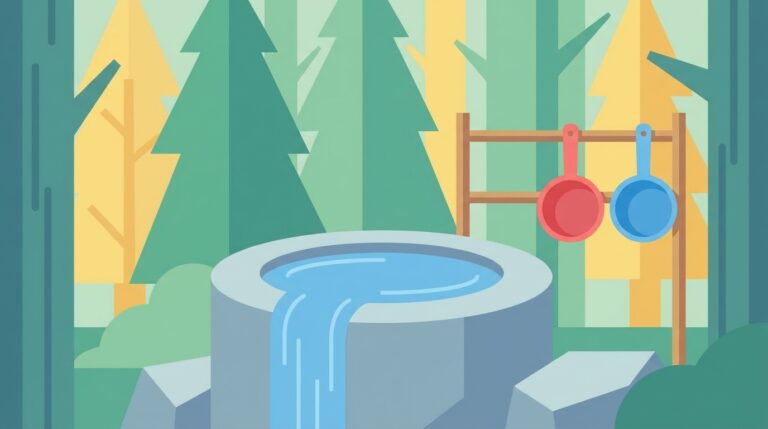
In the center of this scene, there is a stone basin with fresh water flowing out of a pipe, and colorful plastic ladles hanging nearby.
This is the Yaksu-teo (약수터), or “Mineral Spring.”
In K-Dramas, you’ve seen characters drink water here after a dramatic run, or gossip while filling up huge jugs. But if you just grab a ladle and drink… STOP! 🛑 You might be making a huge cultural mistake.
Today, let’s learn how to hydrate like a local and the one word that describes that perfect feeling of relief.
Phase 2: Deep Dive into Core Expressions
Here are the must-know phrases for your hiking survival.
1. 시원해요 (It’s refreshing! / It’s cool!)
- Pronunciation: [Si-won-hae-yo] Sounds like “She-won-hair-yo”
- Meaning:
- Literal: It is cool (temperature).
- Real Nuance: “Ah, this feels amazing!” (It relieves my stress/thirst).
- K-Culture Moment: You will hear this EVERYWHERE. In a sauna (Jimjilbang), eating hot soup, or drinking cold water at the Yaksu-teo.
- Editor’s Insight: If you drink the mountain water and say “Ah~ Siwonhada!” (informal monologue), the locals will look at you with proud eyes. You are now one of them.
- Situation Spectrum:
[🚫 Formal Speech] ———— [⚠️ Polite] ———— [✅ Casual/Self-talk]
- Use “Siwonhaeyo” (Polite) with strangers.
- Use “Siwonhada!” (Exclamation) to yourself.
- 🤔 Think About It: Koreans use this word for hot soup and cold water. Why do you think both are described as “cool”? (Hint: It’s about the feeling inside your body!)
2. 마셔도 돼요? (Can I drink this?)
- Pronunciation: [Ma-syeo-do dwae-yo?]
- Meaning: Is it okay to drink?
- Editor’s Insight: Not all mountain water is safe. Use this to ask a local hiker if the water is drinkable.
- Situation Spectrum:
[🚫 Rudeness] ———— [⚠️ Careful] ———— [✅ Essential]
- Always ask if you don’t see a testing sign!
Phase 3: Textbook vs. Real Life
| Situation | 📖 Textbook Korean | 🗣️ Real Korean (Hiking Mode) | 💡 Why the difference? |
|---|---|---|---|
| Greeting Hikers | 안녕하세요 (Annyeonghaseyo) | 안녕하세요~ (Annyeonghaseyo~) | On the mountain, everyone is a friend. Elongate the end! |
| Asking about water | 이 물을 마실 수 있습니까? (Can I drink this water?) | 이거 마셔도 돼요? (Can I drink this?) | Hiking is physical; shorter sentences are easier to say while breathing hard. |
| Saying goodbye | 안녕히 가세요 (Goodbye) | 수고하세요 (Good work / Keep going) | Hiking is “work.” We acknowledge the effort! |
💡 Bottom Note: In the mountains, strangers greet each other constantly. If someone nods at you, just smile and say “Annyeonghaseyo!”
Phase 4: Cultural Deep Dive — The ‘Bagaji’ Etiquette
4-1. Non-verbal Rule: The Ladle (Bagaji)
At the Yaksu-teo, you will see plastic ladles (often red or blue).
🚫 HUGE MISTAKE: Do NOT put your mouth directly on the ladle.
✅ CORRECT WAY: Use the ladle to pour water into your own cup or bottle. Or, pour water from the ladle into your hand to drink (if you have clean hands!). Touching the communal ladle with your lips is a hygiene disaster and will shock the locals.
4-2. K-Drama Connection: The “Health Clap”
If you see people at the spring hitting their backs against trees or clapping loudly, don’t be scared. They are exercising! In Korean culture, mountains are not just for walking; they are open-air gyms for the elderly.
Phase 5: Immersive Roleplay Scenario
Setting: Sunday morning, 9 AM. A spring halfway up Mt. Achasan. Fresh air, birds chirping. An older man (Ajusshi) is filling a huge water jug.
Characters:
* YOU: Thirsty hiker.
* Ajusshi: Friendly local hiker.
Dialogue:
YOU: (Pointing to the water) 이거 마셔도 돼요?
(Igeo masyeodo dwaeyo?)
[Can I drink this?]
Ajusshi: (Smiling) 네, 물 진짜 시원해요! 드세요.
(Ne, mul jinjja siwonhaeyo! Deuseyo.)
[Yes, the water is really refreshing! Go ahead.]
YOU: (Pouring water into your bottle and drinking) 와… 진짜 시원해요!
(Wa… jinjja siwonhaeyo!)
[Wow… it’s really refreshing!]
🔀 Decision Point! The Ajusshi offers you a cucumber (classic hiking snack). What do you say?
- A) “No.” (Walk away)
- B) “아, 괜찮아요.” (Ah, it’s okay/I’m fine.) — Polite Refusal
- C) “감사합니다!” (Thank you!) — Accepting
✅ Best Choice: C. Hiking food is about sharing (Jeong/Bond). Accepting a slice of cucumber or an orange is a great way to experience Korean kindness.
Phase 6: 10-Second Shadowing Drill
Let’s practice the reaction when the cold water hits your throat!
- Emotion: Relieved and happy 😊
- Drill:
와 / 이 물 / 진짜 / 시원해요!
(Wa / i mul / jinjja / siwonhaeyo!)
Wow / this water / is really / refreshing!
Phase 7: K-Culture Mini Glossary
| Korean | Romanization | Meaning | Context |
|---|---|---|---|
| 약수터 | Yaksu-teo | Mineral Spring | Literally “Medicine Water Place.” |
| 바가지 | Bagaji | Plastic Ladle | The iconic tool for scooping water. |
| 등산 | Deungsan | Hiking | The national pastime of Korea. |
| 정상 | Jeongsang | Peak/Summit | The goal of your hike! |
Phase 8: Traveler’s Survival Kit (Hiking Edition)
🆘 Survival Expression: Checking Safety
Before you drink, look for the Water Quality Report (수질검사성적서) sign nearby.
– Look for: The big colored circle or text.
– 🔵 Blue / ‘적합’ (Jeok-hap): Suitable (Safe to drink).
– 🔴 Red / ‘부적합’ (Bu-jeok-hap): Unsuitable (Do NOT drink).💡 Pro Tip: If you see “부적합” (Red), wash your hands only!
Phase 9: Think Deeper — Why Free Water?
Community vs. Individualism:
In many Western countries, you bring your own water. In Korea, Yaksu-teo implies that water is a shared public resource, a gift from nature that belongs to everyone. This connects to the Korean concept of ‘Gongdongche’ (Community). We maintain the ladles together, we wait in line, and we share the space.
💬 Your Turn: Does your country have public places to drink natural water? Or do you always buy bottled water? Share in the comments!
Phase 10: FAQ & Troubleshooting
- Q: Can I hike in jeans?
- A: You can, but Koreans take hiking gear seriously. Even on small hills, you will see people in full professional gear (North Face, Black Yak). If you want to blend in, wear sportswear!
- Q: Do I have to pay for the water?
- A: No! Yaksu (Medicinal Water) is free for everyone.
❌ Common Mistake: Washing your face directly in the drinking basin.
✅ Do this: Scoop water with the ladle, move away from the basin, pour it into your hands, and then wash your face. Don’t splash the clean water source!
Phase 11: Wrap-up & Action Mission
One-Liner: Yaksu-teo is more than a water fountain; it’s a community gym and a place to share Jeong (affection).
🏆 Action Missions:
* 🥉 Bronze: Say “Siwonhaeyo” next time you drink cold water at home.
* 🥈 Silver: Go to a park or trail and nod/bow slightly to an older person walking past you.
* 🥇 Gold: Hike a Korean mountain, find a Yaksu-teo, check the sign for the Blue Circle, and drink (properly)!
K-Culture Mission: Watch a K-Drama scene involving hiking (often business trips or family bonding) and spot the colorful hiking fashion!
Phase 12: Interactive Quiz
- True or False? It is polite to put your mouth on the plastic ladle to drink water.
- Scenario: You see a sign that says ‘부적합’ (Red Text) at the spring. What should you do?
- A) Drink it anyway.
- B) Don’t drink it.
- Fill in the blank: When the water feels cold and refreshing, you say: “Ah, ______-haeyo!”
Answers:
1. False! (Gross! Use a cup or your hands.)
2. B) Bu-jeok-hap means “Unsuitable.”
3. Siwon (Siwonhaeyo).
Frequently Asked Questions (FAQ)
Q: What does "시원해요 (It's refreshing! / It's cool!)" mean in Korean and how do you pronounce it?
A: In Korean, "시원해요 (It's refreshing! / It's cool!)" is pronounced [Si-won-hae-yo] and means: Literal: It is cool (temperature).
Q: What does "마셔도 돼요? (Can I drink this?)" mean in Korean and how do you pronounce it?
A: In Korean, "마셔도 돼요? (Can I drink this?)" is pronounced [Ma-syeo-do dwae-yo?] and means: Is it okay to drink?







