

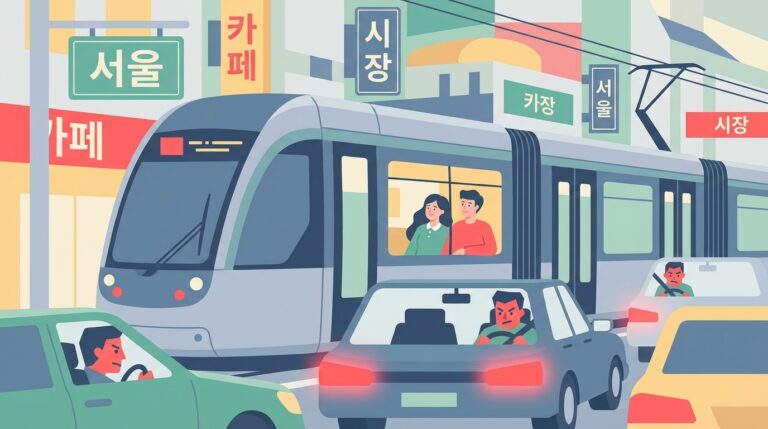
Phase 1: The Romantic Tram vs. The Gridlock Reality (Immersive Hook)
안녕하세요! This is your Daily Hangul Editor, reporting from a bustling cafe in Seoul.
Picture this: A scene from a K-Drama. The lead couple is sitting by the window of a sleek, modern tram (트램), watching the city lights of Daejeon or Wirye glide by. Romantic music plays. It looks peaceful, eco-friendly, and futuristic. ✨
CUT TO REALITY.
You are in a taxi behind that tram construction site. The driver is sighing deeply. The meter is ticking up. The road has narrowed from four lanes to two. The driver mutters, “Ah, seriously? Who came up with this idea?”
Welcome to the C2 level, where we stop asking “Where is the bus stop?” and start debating “Is this infrastructure project actually economically viable?” Today, we dive into the heated debate surrounding the reintroduction of trams in Korea—a topic that perfectly blends economic terminology, social complaints, and high-level argumentative structures.
Whether you’re discussing urban planning with a Korean colleague or just trying to understand the angry comments on a news article, this unit will make you sound like a local intellectual.
Phase 2: Deep Dive into Debate Vocabulary
Let’s arm you with the heavy hitters used in news editorials and heated dinner table discussions.
1. 찬반이 팽팽하다 (Chanbani paengpaenghada)
- Pronunciation: [Chan-ba-ni paeng-paeng-ha-da] + Think of a rubber band stretched tight (‘paeng-paeng’) between two opposing sides.
- Meaning: Arguments for and against are evenly matched / It’s a neck-and-neck controversy.
- K-Culture Moment: Every time a new policy is announced in a political K-Drama (like Chief of Staff), the news anchor says this. It means the society is divided.
- Editor’s Insight: This is a high-level collocation. You don’t just say “people disagree.” You say the pros and cons are tightly stretched.
- Situation Spectrum:
[🚫 Casual Slang] ———— [✅ News/Debate] ———— [✅ Intellectual Chat]🤔 Think About It: Why does Korean society often value consensus, yet uses such high-tension words like ‘팽팽하다’ (taut) to describe disagreement?
2. 탁상공론 (Taksang-gongnon)
- Pronunciation: [Tak-sang-gong-non] + Sounds like ‘Talk’ + ‘Song’ (sung at a desk).
- Meaning: Armchair theory / Paper talk / Impractical plan created by bureaucrats who don’t know reality.
- Literal: “Empty discussion on a desk.”
- Editor’s Insight: This is the ultimate C2 weapon. If you want to criticize a government policy (like a tram causing traffic jams) without being rude, you use this idiom. It implies, “Ideally it works, but realistically? No.”
- Situation Spectrum:
[🚫 To your Boss] ———— [⚠️ At Work] ———— [✅ Political Rants]3. 교통 대란 (Gyotong daeran)
- Pronunciation: [Gyo-tong dae-ran]
- Meaning: Traffic chaos / A massive traffic crisis.
- Nuance: ‘체증’ (Chejeung) is just congestion. ‘대란’ (Daeran) is a catastrophe. Use this when you are 30 minutes late to a BTS concert because of construction.
Phase 3: Textbook vs. Real Life (The Cynic’s Edition)
| Situation | 📖 Textbook Korean | 🗣️ Real Korean (The “Local” Vibe) | 💡 Why different? |
|---|---|---|---|
| Questioning Feasibility | 경제적 타당성을 검토해야 합니다. (We must review economic feasibility.) |
이거 다 세금 낭비 아니에요? (Isn’t this all just a waste of tax money?) |
Koreans are very sensitive to how their taxes (세금) are spent on public projects. |
| Complaining about Traffic | 공사 때문에 교통이 혼잡합니다. (Traffic is congested due to construction.) |
아, 길 막혀서 죽겠네, 진짜! (Ah, I’m dying because the road is blocked, seriously!) |
Standard C2 emotion: exaggerating suffering (‘dying’) emphasizes the frustration. |
| Skeptical View | 트램이 도시 미관을 개선할 것입니다. (Trams will improve the cityscape.) |
예쁘기만 하고 실용성은 꽝이죠. (It’s only pretty; practicality is a bust/zero.) |
‘꽝’ (Kkwang) is a sound of drawing a blank in a lottery—used for total failure. |
Phase 4: Cultural Context — The “Balli-Balli” vs. “Romance” Clash
4-1. The Non-Verbal “Sigh” (Hansum)
In Korea, expressing frustration about traffic isn’t just about words. It involves the Hansum (한숨). When discussing the tram, if someone says it causes traffic, you don’t just nod. You make a short, sharp clicking sound with your tongue (tsk) followed by a deep exhale. This signals, “I understand the pain of the commute.”
4-2. K-Drama vs. Rush Hour Reality
- The K-Drama Trope: Trams are often portrayed as romantic, European-style additions to the city where leads meet fatefully.
- The Reality: Korea has incredibly high population density. The “Balli-Balli” (Hurry Hurry) culture clashes with the slow nature of trams. Taking away car lanes for trams in cities like Seoul or Daejeon is viewed by many not as “eco-friendly progress” but as an “attack on efficiency.” Using the word ‘전시행정’ (Show-off administration) fits perfectly here—implying politicians built it just to look good, not to solve problems.
Phase 5: Immersive Roleplay — The Heated Lunch Debate
Setting: A bustling Jjigae (stew) restaurant in Yeouido (financial district). You are having lunch with Manager Kim (40s, pragmatic) and Associate Lee (20s, idealist).
Characters:
– YOU: An expat who has lived in Seoul for 5 years.
– Manager Kim: Hates traffic, drives a car.
– Associate Lee: Loves eco-friendly trends, takes the subway.
Dialogue:
Manager Kim: (Slamming down his spoon) 아니, 위례선 트램 공사 때문에 출근길이 주차장이 됐어. 진짜 탁상공론의 전형이라니까.
(Ani, Wiryeseon teuraem gongsa ttaemune chulgeungiri juchajangi dwaesseo. Jinjja taksang-gongnonui jeonhyeongiranikka.)
(No, seriously, because of the Wirye Tram construction, the commute road became a parking lot. It’s truly the epitome of armchair theory.)
Associate Lee: 에이, 과장님. 그래도 완공되면 친환경적이고 지역 상권도 살아나지 않을까요? 외국처럼 멋있잖아요.
(Ei, gwajangnim. Geuraedo wan-gong-doemyeon chin-hwan-gyeong-jeogigo jiyeok sang-gwondo saranaji anheulkkayo? Oeguk-cheoreom meositjannayo.)
(Ay, Manager. But once it’s finished, won’t it be eco-friendly and revive the local commercial area? It looks cool, like in foreign countries.)
🔀 Decision Point: Who do you side with?
- A) Side with Manager Kim (The Realist): “맞아요. 한국 도로 사정에 트램은 좀 시기상조인 것 같아요.” (Right. Trams seem a bit premature for Korean road conditions.)
- B) Side with Associate Lee (The Idealist): “장기적으로 보면 대중교통 분담률을 높여서 더 좋을 수도 있죠.” (In the long run, it might be better by increasing the public transport modal share.)
- C) The Neutral Diplomat: “취지는 좋은데, 교통 체증 해결책이 먼저 나와야 할 것 같아요.” (The intent is good, but a solution for traffic congestion needs to come first.)
✅ Editor’s Choice: C. In a Korean business setting, strict polarization can be risky. Option C uses the high-level grammar “~는 데, ~아야 할 것 같다” (acknowledging A, but emphasizing necessity of B), showing you are a thoughtful intellectual.
Manager Kim: (Nods at you) 역시! 교통 대책 없이 도로만 줄이면 그게 바로 예산 낭비지.
(Yeoksi! Gyotong daechaek eopsi doroman jurimyeon geuge baro yesan nangbiji.)
(Exactly! If you reduce roads without traffic measures, that is precisely a waste of budget.)
Phase 6: 10-Second Shadowing Drill
Let’s practice the rhythm of a logical argument. Focus on the pause after ‘좋지만’ (good, but).
😤 Emotion: Skeptical yet Logical
“도심 재생도 / 좋지만, / 현실적인 / 교통 대책이 / 우선입니다!”
(Dosim jaesaengdo / jotjiman, / hyeonsiljeogin / gyotong daechaegi / useonimnida!)
“Urban regeneration is good, but realistic traffic measures must come first!”
Phase 7: K-Culture Mini Glossary (Debate Edition)
| Korean | Romanization | English | Context |
|---|---|---|---|
| 지옥철 | Jiok-cheol | Hell Subway | Portmanteau of Hell + Subway. Used to describe rush hour. Trams are pitched as a solution to this. |
| 배차 간격 | Baecha gan-gyeok | Dispatch Interval | The time between trams/buses. A crucial factor in ‘economic feasibility’ debates. |
| 님비 현상 | Nimbi hyeon-sang | NIMBY (Not In My Backyard) | Used when residents want the tram station, but not the noise or construction dust. |
Phase 8: Traveler’s Survival Kit (Transport Chaos Edition)
Even as a traveler, you might get caught in construction traffic or a protest about new infrastructure.
🆘 Survival Phrase #1
– 🇰🇷 “여기 공사 언제 끝나요?” (Yeogi gongsa eonje kkeunnayo?)
– 🗣️ Meaning: When does the construction end here?
– 📍 Use when: Your taxi isn’t moving near a construction site.📌 Editor’s Travel Note
If you are visiting cities like Daejeon or Wirye (satellite city of Seoul), you will see tram rails being laid. Do not walk on them! Also, KakaoMap often updates construction zones faster than Google Maps. If a road is red on the map, take the subway (Jiha-cheol) instead of a taxi, or you’ll be experiencing the “Traffic Hell” firsthand.
Phase 9: Think Deeper — “Innovation vs. Inconvenience”
🧠 Think Deeper: The Psychology of ‘Ppali-Ppali’
Why is the tram debate so fierce in Korea? It touches the core of the ‘Ppali-Ppali’ (Fast-Fast) culture. Trams are inherently slower than subways and take up road space, slowing down cars. While Europe values the aesthetic and leisure of trams, modern Korean urban planning has historically prioritized speed and volume.
The introduction of trams challenges the Korean definition of “efficiency.” Is efficiency moving as many people as possible underground (invisible), or creating a walkable, visible city surface?
💬 Your Turn: Does your country prioritize speed (subways/highways) or accessibility (trams/bikes)? How would your city react to losing two car lanes for a tram?
Phase 10: FAQ & Troubleshooting
Q: Can I use the word ‘탁상공론’ (Armchair theory) with my professor?
A: Maybe. If you are discussing a third party’s policy (like the government), yes, it shows high intellect. But NEVER use it to describe the professor’s own ideas. That would be catastrophic.
Q: Is ‘찬반’ (Pros/Cons) only for formal debates?
A: Mostly, yes. In casual speech with friends, you might just say “호불호가 갈린다” (Likes and dislikes are divided). ‘찬반’ implies a more logical, societal disagreement.
❌ Common Mistake: Confusing ‘교통 체증’ (Traffic jam) with ‘교통 사고’ (Traffic accident).
✅ Fix: “체증” is about volume/flow. “사고” is a crash. If you are late, usually it’s “체증,” hopefully not “사고.”
Phase 11: Wrap-up & Action Mission
One-Liner: Trams in Korea are a battleground between romantic aesthetics and ruthless efficiency—and now you have the words to fight in that battle.
🏆 Action Missions:
– 🥉 Bronze: Read a Korean news headline about “트램” (Tram) and find the word “논란” (Controversy).
– 🥈 Silver: Leave a comment on a YouTube video about Korean city planning: “트램도 좋지만 교통 체증이 걱정되네요.” (Trams are good, but I’m worried about traffic jams.)
– 🥇 Gold: Next time you are stuck in traffic with a Korean friend, sigh deeply and say, “이거 완전 탁상공론 아니야?” (Isn’t this total armchair theory?)
Phase 12: Interactive Quiz
1. Which phrase is best to describe a policy that looks good on paper but fails in reality?
– A) 일석이조 (Killing two birds with one stone)
– B) 탁상공론 (Armchair theory)
– C) 금상첨화 (Icing on the cake)
2. True or False (Culture):
– “Most Koreans prefer trams over subways because they are more romantic.”
– Answer: False. While deemed romantic in dramas, most commuters prefer subways (Subway) because they guarantee arrival times without traffic jams.
(Correct Answer for #1: B)
Frequently Asked Questions (FAQ)
Q: What does "찬반이 팽팽하다 (Chanbani paengpaenghada)" mean in Korean and how do you pronounce it?
A: In Korean, "찬반이 팽팽하다 (Chanbani paengpaenghada)" is pronounced [Chan-ba-ni paeng-paeng-ha-da] and means: Arguments for and against are evenly matched / It's a neck-and-neck controversy.
Q: What does "탁상공론 (Taksang-gongnon)" mean in Korean and how do you pronounce it?
A: In Korean, "탁상공론 (Taksang-gongnon)" is pronounced [Tak-sang-gong-non] and means: Armchair theory / Paper talk / Impractical plan created by bureaucrats who don't know reality.
Q: What does "교통 대란 (Gyotong daeran)" mean in Korean and how do you pronounce it?
A: In Korean, "교통 대란 (Gyotong daeran)" is pronounced [Gyo-tong dae-ran] and means: Traffic chaos / A massive traffic crisis.







