

Phase 1: The “May Madness” Survival Guide
안녕하세요! (Annyeonghaseyo!) It’s your Daily Hangul editor.
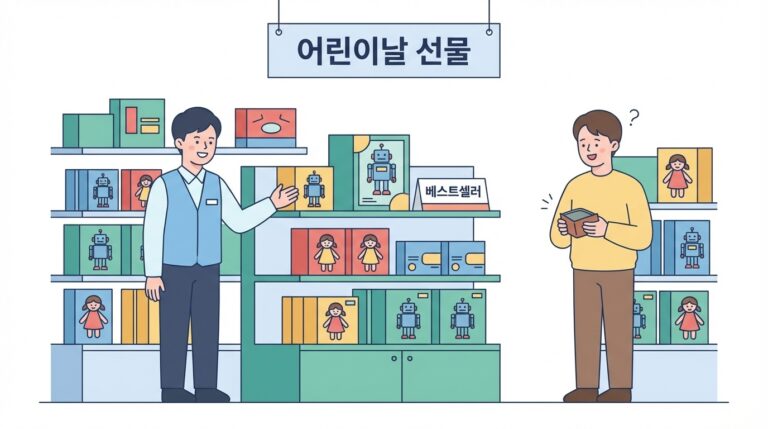
Picture this: It’s early May in Seoul. You walk into a large department store or a chaotic toy alley in Dongdaemun. The air is tense. Parents are running with boxes of robots and dolls. Why? It’s Children’s Day (어린이날, Eorini-nal), one of the most important holidays in Korea.
In K-Dramas, you’ve probably seen the “cool rich aunt/uncle” (often called ‘Gold Miss’ or ‘Gold Mister’) walking into a room with a tower of beautifully wrapped gifts, instantly becoming the hero. You want to be that hero.
But here’s the problem: The clerk is busy, the popular toys are disappearing fast, and you don’t know how to ask, “Is this suitable for a 5-year-old?” or “Do you have the pink one?”
Don’t panic. Today, I’ll teach you the survival phrases to navigate the Korean toy aisle like a local, ensuring you become the favorite aunt, uncle, or friend. Let’s go shopping!
Phase 2: Deep Dive — 3 Key Expressions
1. 요즘 뭐가 제일 잘 나가요? (Yojeum mwoga jeil jal nagayo?)
- Pronunciation: [yo-jeum mwo-ga je-il jal na-ga-yo]
- Sound analogy: “Na-ga-yo” sounds a bit like “Nag a yo” (but softer ‘g’).
- Meaning:
- Literal: What goes out the best these days?
- Real nuance: What is the #1 best-seller/trendiest item right now?
- K-Culture Moment: You see this in variety shows when celebs ask shop owners for recommendations. Koreans love trends. Buying what is “popular” is the safest bet to avoid disappointment.
- Editor’s Insight: Use this when you are clueless. If you buy the “best-seller,” even if the kid doesn’t like it, you can say, “But all the kids in Gangnam have this!”
- Situation Spectrum:
[🚫 Formal Boss] ———— [⚠️ Polite/Clerk] ———— [✅ Casual]- (This phrase is perfect for clerks/shop owners: ⚠️/✅)
- 🤔 Think About It: Why is “popularity” (trends) so important in Korean gift-giving culture compared to “uniqueness” in Western cultures?
2. 이거 포장해 주세요. (Igeo pojang-hae juseyo.)
- Pronunciation: [i-geo po-jang-hae ju-se-yo]
- Sound analogy: “Pojang” sounds like “Po” (as in Poland) + “Jang” (rhymes with Gang).
- Meaning: Please wrap this for me.
- K-Culture Moment: In K-Dramas, a gift is never just handed over in a plastic bag. It’s wrapped in beautiful paper or a ribbon box. The presentation is half the gift.
- Editor’s Insight: In Korea, giving a naked item can seem insincere. Even a small sticker or a ribbon makes a difference. Most department stores offer this service for free or a small fee.
- Situation Spectrum:
[🚫 Friends] ———— [⚠️ Shop Clerk] ———— [✅ Standard]- (Standard polite request: ✅)
- 🤔 Think About It: How does the effort of wrapping reflect the concept of Jeong (affection/bond) in Korea?
3. 몇 살한테 인기 많아요? (Myeot sal-hante ingi manayo?)
- Pronunciation: [myeot sal-han-te in-gi ma-na-yo]
- Sound analogy: “Sal” sounds like “Sal” in Salmon.
- Meaning: For what age is this popular?
- K-Culture Moment: Korean society is very age-conscious, even for kids. A toy for a 5-year-old might be “boring” for a 6-year-old. You don’t want to offend the child!
- Editor’s Insight: Use this to filter your choices. Korean clerks are experts at this. They will tell you, “Oh, that character is over. 7-year-olds like this now.”
- Situation Spectrum:
[🚫 Formal] ———— [⚠️ Standard] ———— [✅ Casual]- (Standard question: ⚠️)
Phase 3: Textbook vs. Real Life
| Situation | 📖 Textbook Korean | 🗣️ Real Korean (In the Toy Aisle) | 💡 Why? |
|---|---|---|---|
| Asking for a recommendation | 이것을 추천합니까? (Do you recommend this?) | 요즘 애들 뭐 좋아해요? (What do kids like these days?) | “Recommend” is too formal. Asking about “kids’ preferences” gets better results. |
| Asking about age | 이것은 몇 살을 위한 것입니까? (For what age is this?) | 이거 5(오)살이 좋아해요? (Will a 5-year-old like this?) | Direct and specific questions get faster answers in a busy store. |
| Saying it’s too expensive | 너무 비쌉니다. (It is too expensive.) | 좀… 비싸네요. 😅 (It’s a bit… expensive.) | Koreans rarely say a blunt “No.” They soften it with “a bit…” (Jom…). |
💡 Editor’s Note: Use the Real Korean phrases to sound like a local resident, not a tourist reading a guidebook!
Phase 4: Cultural Deep Dive — The Art of the “Joka” (Niece/Nephew)
4-1. Non-verbal: The “Gaze of Hesitation”
When asking about prices or looking at expensive toys, Koreans don’t just ask. They often touch the item, look at the price tag, look at the clerk, and make a hesitant sound: “Eum…” (음…). This signals to the clerk, “I like it, but convince me,” or “Do you have a discount?”
4-2. K-Culture Connection: The “Gold Aunt/Uncle”
- K-Drama Context: In dramas, the single aunt/uncle who spoils the nieces/nephews is a beloved trope. They compensate for not having kids by buying the most expensive robot (Tobot/Carbot) or the biggest doll house.
- The “Sold Out” Nightmare: Just like trying to get tickets to a BTS concert, popular toys (like Teenieping or Pokemon items) sell out weeks before May 5th. If you see a line in front of a toy store at 6 AM, it’s the “Open Run” culture—not for Chanel bags, but for limited edition toys!
Phase 5: Roleplay Scenario — At the “Toy Kingdom”
Setting: A bustling toy section in a Mart (E-Mart/Lotte Mart). Kids are screaming in joy. K-Pop is playing in the background. You are looking for a gift for your friend’s 6-year-old son.
Characters:
* YOU: A confused but determined “Samchon/Imo” (Uncle/Aunt term for friends too).
* Clerk (Ajumeoni): An experienced sales lady wearing a vest, very fast-talking.
Start Dialogue:
Clerk: (Sorting boxes) 찾으시는 거 있으세요?
(Cha-jeu-si-neun geo i-sseu-se-yo?)
(Are you looking for something in particular?)
YOU: 네, 제 조카 선물 사려고요. 요즘 뭐가 제일 잘 나가요?
(Ne, je joka seonmul saryeogoyo. Yojeum mwoga jeil jal nagayo?)
(Yes, buying a gift for my nephew. What’s the best-seller these days?)
Clerk: (Points to a blue robot) 이게 요즘 1등이에요. ‘헬로카봇’ 신제품!
(Ige yojeum il-deung-i-e-yo. ‘Hello Carbot’ sin-je-pum!)
(This is #1 these days. The new ‘Hello Carbot’!)
YOU: 오, 멋있네요. 그런데… 6(육)살한테 괜찮을까요?
(O, meo-sin-ne-yo. Geureonde… yuk-sal-hante gwaen-chan-eul-kka-yo?)
(Oh, looks cool. But… will it be okay for a 6-year-old?)
Clerk: 딱이죠! 6살 남자애들은 이거 없으면 울어요.
(Ttag-i-jyo! Yuk-sal namja-ae-deur-eun igeo eop-seu-myeon ur-eo-yo.)
(It’s perfect! 6-year-old boys cry if they don’t have this.)
🔀 Decision Point: It’s 80,000 KRW ($60). A bit pricey. What do you say?
- Option A: “너무 비싸요! 안 사요.” (Too direct/rude)
- Option B: “아… 좀 비싸네요. 다른 건 없나요?” (Polite refusal)
- Option C: “주세요! 포장해 주세요!” (The Flex)
✅ Best Choice: B or C. If it’s too expensive, use Option B. “Jom bissaneyo” (It’s a bit expensive) is the magic phrase to see cheaper options without losing face.
Phase 6: 10-Second Shadowing Drill
Let’s practice the magic spell to get the gift wrapped perfectly. Focus on the polite tone!
“Can you please wrap this prettily?”
😊 이거 / 예쁘게 / 포장해 주세요!
(I-geo / ye-ppeu-ge / po-jang-hae ju-se-yo!)
- Emotion: 🥺 Use a little “Aegyo” (cute pleading) voice to get extra ribbons!
- Key: Stress on ‘Ye-ppeu-ge’ (prettily).
Phase 7: K-Culture Mini Glossary
| Korean | Romanization | Meaning | Context |
|---|---|---|---|
| 조카 | Joka | Niece/Nephew | Can be real family or your close friend’s kid. |
| 어린이날 | Eorini-nal | Children’s Day | May 5th. A national holiday in Korea. |
| 장난감 | Jang-nan-kam | Toy | The general word for all toys. |
| 품절 | Pum-jeol | Sold Out | The word you dread seeing on the shelf. |
| 득템 | Deuk-tem | Getting a rare item | Slang: “Deuk” (Gain) + “Tem” (Item). Used when you find the last toy! |
Phase 8: Traveler’s Survival Kit (Toy Store Edition)
Walking into a huge “Toy Lotte Mart” or “Starfield” toy section? Here is your cheat sheet.
🆘 Survival Phrases
1. “세일해요?” (Se-il hae-yo?) – Is this on sale?
2. “건전지 포함이에요?” (Geon-jeon-ji po-ham-i-e-yo?) – Are batteries included? (Crucial! Don’t be the uncle who forgot batteries!)
3. “교환 환불 돼요?” (Gyo-hwan hwan-bul dwae-yo?) – Are exchange/refunds possible?📌 Editor’s Travel Note
* Payment: Almost all places take international cards. But if you go to Dongdaemun Toy Market, cash might get you a small discount!
* Shopping Bags: You must pay for paper/plastic bags (usually 100-500 KRW). Bring an eco-bag if you can.
Phase 9: Think Deeper — The Economics of Affection
The Price Tag of Love?
In Korea, Children’s Day isn’t just about fun; it’s a measure of Jeong (affection) shown through tangible gifts. You might notice grandmothers slipping distinctively thick envelopes of cash to their grandkids, or parents queuing for hours for a “Ping” character toy.
🧠 Think Deeper: Why does modern Korean society place such high emphasis on specific, trendy branded gifts rather than handmade or unique ones? Does this reflect the intense collectivist culture where “fitting in” (having what others have) starts from childhood?
💬 Your Turn: In your country, is it better to give a trendy gift or a unique gift? Tell me in the comments!
Phase 10: FAQ & Troubleshooting
Q: Can I just give cash (money) to a child?
A: Yes! Actually, as kids get older (elementary school and up), they often prefer cash. Put it in a nice envelope. But for younger kids (under 7), a big toy box is visually more exciting.
Q: Do I need to buy gifts for my friend’s kids if I visit?
A: It’s not mandatory, but if you visit around May 5th, bringing a small item (even a bag of popular jelly or chocolate) makes you an instant “Angel Aunt/Uncle.”
❌ Common Mistake:
* Mistake: Buying a toy with Japanese text on the package (unless it’s a specific anime character they love).
* Fix: Check the package. Korean parents generally prefer toys localized in Korean for educational purposes.
Phase 11: Wrap-up & Action Mission
One-Liner: To survive Children’s Day shopping, ask for what’s trendy (Jal nagayo?) and don’t forget the wrapping (Pojang)!
🚀 Action Missions:
* 🥉 Bronze: Look in the mirror and practice the “Hesitant Gaze” while saying “Jom… bissaneyo.” (It’s a bit pricey).
* 🥈 Silver: Go to a Korean website (like Coupang or Gmarket), search for “어린이날 선물” (Children’s Day gift), and see what the #1 item is.
* 🥇 Gold: Visit a stationary store (Artbox/Daiso) and ask, “Igeo ingi manayo?” about a cute pen or doll.
K-Culture Mission: Watch a clip of the show “The Return of Superman” (슈퍼맨이 돌아왔다) on YouTube. Search for “Gift” or “Toy” and see how the kids react!
Phase 12: Quiz — Are You Ready for May 5th?
- Situation: You see a toy you like, but you aren’t sure if a 4-year-old can play with it safely. What do you ask?
- a) 이거 얼마예요? (How much is this?)
- b) 몇 살한테 좋아요? (What age is this good for?)
- c) 포장해 주세요. (Please wrap this.)
- True or False (Culture): In Korea, it is considered rude to ask the shop clerk for a recommendation because it bothers them.
- ( True / False )
- Fill in the Blank: “My niece/nephew” in Korean is [ ______ ].
(Scroll down for answers)
.
.
.
Answers:
1. b) Always check the age!
2. False. Korean clerks are active helpers. They expect you to ask!
3. Joka (조카)
Frequently Asked Questions (FAQ)
Q: What does "요즘 뭐가 제일 잘 나가요? (Yojeum mwoga jeil jal nagayo?)" mean in Korean and how do you pronounce it?
A: In Korean, "요즘 뭐가 제일 잘 나가요? (Yojeum mwoga jeil jal nagayo?)" is pronounced [yo-jeum mwo-ga je-il jal na-ga-yo] and means: a key conversational Korean expression covered in this lesson.
Q: What does "이거 포장해 주세요. (Igeo pojang-hae juseyo.)" mean in Korean and how do you pronounce it?
A: In Korean, "이거 포장해 주세요. (Igeo pojang-hae juseyo.)" is pronounced [i-geo po-jang-hae ju-se-yo] and means: a key conversational Korean expression covered in this lesson.
Q: What does "몇 살한테 인기 많아요? (Myeot sal-hante ingi manayo?)" mean in Korean and how do you pronounce it?
A: In Korean, "몇 살한테 인기 많아요? (Myeot sal-hante ingi manayo?)" is pronounced [myeot sal-han-te in-gi ma-na-yo] and means: a key conversational Korean expression covered in this lesson.







