

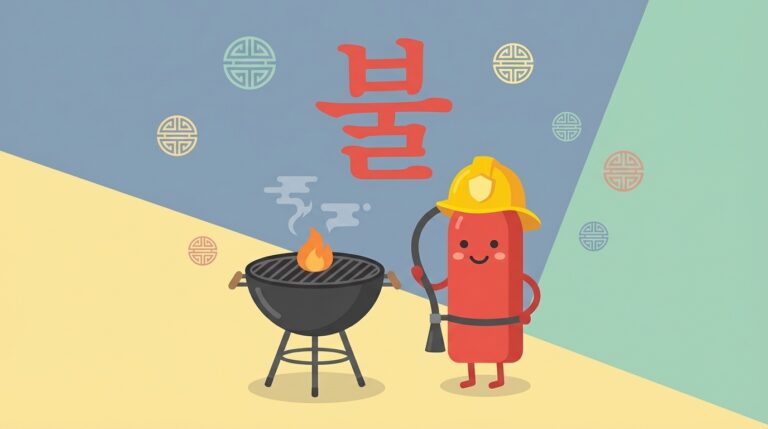
Phase 1: The ‘Hot’ K-Drama Moment You Hope Never Happens
Hello! This is your Daily Hangul Editor.
Picture this: You are in a crowded Samgyeopsal (pork belly) restaurant in Gangnam. The K-Pop hits are blasting, the soju is flowing, and the atmosphere is electric. Suddenly, the grill at the next table flares up. It’s not just a little smoke—it’s actual flames. ὒ5
In a K-Drama, this is the moment the main character heroically grabs a fire extinguisher and saves the day in slow motion. But in real life? You freeze. You want to yell “Fire!” or ask for a fire extinguisher, but your brain is searching for the words in English.
Don’t worry. Today, we aren’t just learning vocabulary; we are learning survival. Knowing these three phrases might just make you the hero of your own Seoul story (or at least keep your eyebrows safe).
This isn’t just a textbook lesson. This is based on real safety protocols taught in Korea, simplified for YOU, the absolute beginner.
Phase 2: Deep Dive into Survival Korean
Here are the 3 most critical phrases you need when things get too hot to handle.
1. “불이야!” (Fire!)
- Pronunciation:
[Bul-i-ya!]- Sound Analogy: Think of a bull (the animal) + the letter E + Ya (like ‘See ya!’). Say it fast and loud!
- Meaning: “It’s a fire!” (Literal: Fire it is!)
- K-Culture Moment: In historical dramas (Sageuk), when a lantern falls, someone screams this to alert the whole village. It’s the universal alarm.
- Editor’s Insight: You don’t whisper this. You scream it. In Korea, alerting the community is the first step of safety. Don’t be shy.
- Situation Spectrum:
[🚫 Silence] ———— [⚠️ Whisper] ———— [✅ SCREAM] - 🤔 Think About It: Why does Korean add “-iya”? It emphasizes the state of the situation immediately. It’s not just the noun “fire,” it’s the situation of fire.
2. “소화기 어딤어요?” (Where is the fire extinguisher?)
- Pronunciation:
[So-hwa-gi eo-di-sseo-yo?]- Sound Analogy: So (So what?) + Hwa (Hwa-t? / What?) + Gi (Key). So-Hwa-Gi.
- Meaning: “Fire extinguisher, where is it?”
- K-Culture Moment: You’ll see red fire extinguishers in every Korean subway station, often with gas masks. It’s a common background prop in zombie movies like Train to Busan.
- Editor’s Insight: If you can’t remember the full sentence, just yell “So-hwa-gi!!” People will understand and point.
3. “핀을 뽑아요” (Pull the pin)
- Pronunciation:
[Pin-eul ppo-ba-yo]- Sound Analogy: Pin (Safety pin) + ul + Ppo-ba (Sounds like ‘Bubble’ without the ‘le’).
- Meaning: “Pull out the pin.”
- Editor’s Insight: This is the Step 1 instruction on every Korean extinguisher. Even if you don’t say it, you need to recognize the word 뽑아요 (Pull/Extract).
Phase 3: Textbook vs. Real Life
When the alarm bells ring, politeness goes out the window.
| Situation | 📖 Textbook Korean | 🗣️ Real Survival Korean | 💡 Why the difference? |
|---|---|---|---|
| Seeing Fire | 화재가 발생했습니다. (A fire has occurred.) | 불이야!!!!! (Fire!!!) | In emergencies, speed beats grammar. |
| Giving Orders | 안전핀을 제거하십시오. (Please remove the safety pin.) | 핀 뽑아! (Pull the pin!) | Drop the honorifics (요/습니다) to save time. |
| Calling 911 | 소방서에 전화해 주세요. (Please call the fire station.) | 119(일일구) 전화해! (Call 119!) | Everyone knows 119. Short commands work best. |
💡 Editor’s Note: In a real disaster, you can drop the “Yo” (요) at the end. Survival comes first, politeness comes second!
Phase 4: Cultural Deep Dive — The ‘Ppalli-Ppalli’ Safety Culture
4-1. Non-verbal: The “Multitude” Instinct
Korea is a collective society. In a subway or crowded street, if you see Koreans running in one direction, don’t ask why—just run with them. This is the ultimate form of Nunchi (reading the room). Your survival instinct should be synced with the crowd.
4-2. K-Food Connection: The BBQ Vent 🍖
In K-Food culture, fire safety is most relevant at Korean BBQ restaurants. You’ll see a long, silver tube hanging over your table. This is the vent.
* Scenario: Sometimes the fat from the pork belly drips into the charcoal, causing a huge flame.
* Action: Don’t panic! The staff usually comes running with a lid or lettuce to smother it. Don’t spray a fire extinguisher on your dinner unless the staff tells you to!
Phase 5: Immersive Roleplay — Gangnam BBQ Crisis
Setting: Friday night, 8 PM. A noisy BBQ restaurant in Gangnam. You are with your Korean friend, Min-su. The table next to you catches fire because someone spilled soju on the grill.
Characters:
* YOU: A hungry traveler who just wants to eat Samgyeopsal.
* Min-su: Your Korean friend who is currently in shock.
⭐ Dialogue Start
Min-su: (Eyes wide open) 어? 어? 저기 봐! 😨
(Eo? Eo? Jeogi bwa!) [Uh? Uh? Look over there!]
YOU: (You see flames rising high)
🔀 Decision Point: What do you shout?
- A) “Excuse me, waiter?”
- B) “불이야!” (Bul-i-ya!)
- C) “맛있겠다!” (Looks delicious!)
✅ Best Choice: B — Immediate alert. The staff needs to know NOW.
⚠️ Choice A: Too polite. They can’t hear you over the K-Pop.
🚫 Choice C: …Are you trying to eat the fire?
(Dialogue Continues)
YOU: 불이야!!! 🗣️
Staff: (Running over) 비켰세요! (Get out of the way!)
YOU: (Pointing to the red canister on the wall) 소화기 여기 있어요!
(Sohwagi yeogi isseoyo!) [The extinguisher is here!]
Min-su: 와… 너 한국사람 다 됐네. 👍
(Wa… neo hanguk-saram da dwaenne.) [Wow… you’ve basically become Korean.]
Phase 6: 10-Second Shadowing Drill
Let’s practice for the moment we hope never comes. Focus on the Urgency!
- Emotion: 😨 Panic & Loud / 😠 Authoritative
- 불이야! / 대피하세요!
(Bul-i-ya! / Dae-pi-ha-se-yo!)
[Fire! / Evacuate please!] -
소화기 / 가져오세요!
(So-hwa-gi / ga-jyeo-o-se-yo!)
[Fire extinguisher / bring it please!]
Phase 7: K-Culture Mini Glossary
| Korean | Romanization | English | Context |
|---|---|---|---|
| 119 | Il-il-gu | Emergency Number | Korea’s 911 for Fire & Ambulance. (Police is 112). |
| 소방관 | Sobang-gwan | Firefighter | The heroes you see in news and dramas. |
| 비상구 | Bisang-gu | Emergency Exit | Look for the green running man sign! |
| 전원 차단 | Jeon-won Cha-dan | Power Off | Often the first step in electrical fires. |
Phase 8: Traveler’s Survival Kit (Disaster Edition)
If you are traveling in Korea, safety comes first.
🆘 Survival Card: Calling for Help
* 🇰🇷 Expression: “여기 불 났어요!” (Yeogi bul nasseoyo!)
* 🗣️ Pronunciation: [Yeo-gi / Bul / Na-sseo-yo]
* 📝 Meaning: “A fire started here!”
* 💡 Pro Tip: When you call 119, they can track your location, but saying a nearby landmark (like a subway station name or store name) helps them arrive faster.
📌 Editor’s Travel Note:
Most Korean hotels and Airbnbs have a 완강기 (Descending Life Line) box near the window. It looks like a metal arm with a rope. It’s for escaping from high floors. You don’t need to know how to use it now, just know that it exists!
Phase 9: Think Deeper — Language & Safety
Why 119 and not 911?
Have you noticed that the emergency number in Korea (and Japan/China) is 119? Historically, this number was chosen because on the old rotary dial phones, ‘1’ and ‘9’ were far apart, preventing accidental dials, but ‘1’ was quick to spin. Also, it’s easy to remember: 1 (Il) + 1 (Il) + 9 (Gu) = Save (Gu) one life after another.
🧠 Your Turn: What is the emergency number in your country? Do people shout specific words like “불이야” or just scream? Share in the comments!
Phase 10: FAQ & Troubleshooting
- Q: Can I use “불이야” (Fire!) to describe spicy food?
- A: Haha, creative! But no. For spicy food, we say “입에서 불 나요” (Fire is coming out of my mouth). If you just scream “불이야” in a restaurant, people will panic and run away!
- Q: Is it okay to speak Banmal (casual language) to older people in a fire?
- A: YES. In a life-or-death situation, hierarchy disappears. Screaming “나가!” (Get out!) is better than politely whispering “나가주시겠습니까?” and dying together.
❌ Common Mistake:
Don’t confuse 소화기 (Fire Extinguisher) with 소화제 (Digestive Medicine). They sound very similar! Asking for digestion medicine during a fire would be a tragic comedy.
Phase 11: Wrap-up & Mission
One-Liner: When you see fire, forget grammar—scream “불이야!” and find the “소화기”!
🎯 Action Mission:
- 🥉 Bronze: Say “불이야!” loudly 3 times in your room (warn your roommates first!).
- 🥈 Silver: Locate the fire extinguisher in your house/office and point to it saying “소화기!”
- 🥇 Gold: Next time you go to a Korean BBQ place (or watch a drama scene in a restaurant), spot the vent and the extinguisher and name them in Korean.
🎥 K-Culture Mission: Watch the movie “Exit” (2019) starring Yoona and Jo Jung-suk. It’s a hilarious but educational disaster movie that will teach you more about Korean rooftop safety than any textbook!
Phase 12: Interactive Quiz
- Situation: You see smoke coming from the subway train. What do you shout?
- a) 이모님! (Auntie!)
- b) 불이야! (Fire!)
- c) 점기밥 주세요. (Give me gimbap please.)
- Vocabulary: Which object do you need to put out a fire?
- a) 소화제 (Digestive medicine)
- b) 소화기 (Fire extinguisher)
- c) 소주 (Soju)
- Culture (True/False): In a Korean BBQ restaurant, if the meat catches a small fire, you should immediately spray the fire extinguisher on the food.
- (True / False)
🔑 Answers:
1. b) 불이야! (Please don’t ask for gimbap during a fire.)
2. b) 소화기. (Soju might make the fire bigger!)
3. False. Usually, the staff will handle it with a lid or lettuce. Using an extinguisher ruins everyone’s dinner unless it’s a real emergency.
Frequently Asked Questions (FAQ)
Q: What does "“불이야!” (Fire!)" mean in Korean and how do you pronounce it?
A: In Korean, "“불이야!” (Fire!)" is pronounced [Bul-i-ya!] and means: a key conversational Korean expression covered in this lesson.
Q: What does "“소화기 어딤어요?” (Where is the fire extinguisher?)" mean in Korean and how do you pronounce it?
A: In Korean, "“소화기 어딤어요?” (Where is the fire extinguisher?)" is pronounced [So-hwa-gi eo-di-sseo-yo?] and means: a key conversational Korean expression covered in this lesson.
Q: What does "“핀을 뽑아요” (Pull the pin)" mean in Korean and how do you pronounce it?
A: In Korean, "“핀을 뽑아요” (Pull the pin)" is pronounced [Pin-eul ppo-ba-yo] and means: a key conversational Korean expression covered in this lesson.







