

Phase 1: The Immersive Hook
Greeting: 안녕하세요! (Hello!) This is your Daily Hangul Editor.
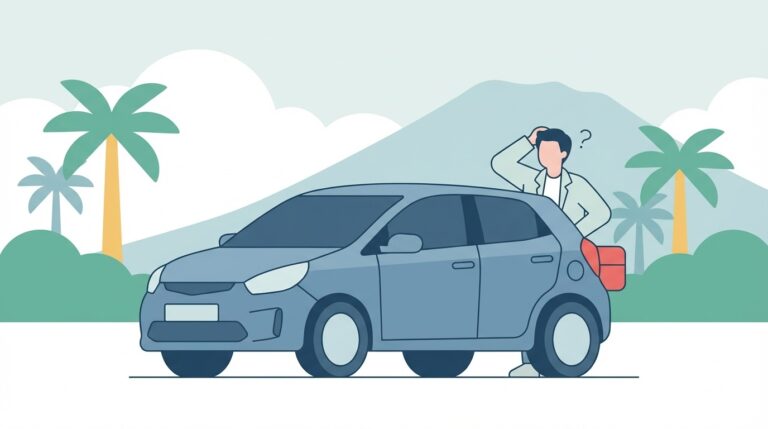
Picture this: You’ve just landed on Jeju Island, the Hawaii of Korea. You picked up your rental car—maybe a sleek electric vehicle because that’s the trend there. You have your bags, the sea breeze is blowing, and you feel like the main character in a healing K-Drama.
But there’s a problem. You’re standing at the back of the car, pressing every button on the remote, but the trunk won’t budge. The parking lot attendant is looking at you, waiting. You need help, but pointing and grunting isn’t exactly the “cool traveler” vibe you want.
In K-Dramas, the male lead usually effortlessly tosses the luggage into the back. In reality? We struggle with hidden buttons and heavy bags. Today, we’ll learn the magic phrase to get that trunk open and start your trip without breaking a sweat.
Transparency Note: This guide is based on real struggles my students faced at Jeju International Airport rental lots!
Phase 2: Deep Dive into Key Expressions
1. 트렁크 열어 주세요 (Please open the trunk)
- Pronunciation: [Teu-reong-keu yeol-eo ju-se-yo]
- Sound Analogy: Teu (like ‘t’ in ‘too’ but softer) + reong (like ‘lung’) + keu (like ‘coo’ in ‘cool’) + yolo (without the last ‘o’) + ju-se-yo.
- Meaning:
- Literal: Trunk open give please.
- Real Nuance: “Could you please pop the trunk for me?”
- K-Culture Moment: Think of a variety show like Running Man. The members rush to the car to escape, screaming “Trunk!!” to throw their gear in. This is the polite version of that urgency.
- Editor’s Insight: The word “Trunk” is essentially English with a Korean accent (Konglish). You already know 50% of this sentence!
- Situation Spectrum:
[🚫 Formal Boss] ———— [✅ Semi-formal/Stranger] ———— [✅ Friend]
(Use this with rental staff, taxi drivers, or hotel bellhops.) - 🤔 Think About It: Why does Korean use the English word “Trunk” instead of a pure Korean word? It shows how modern transportation terms were imported directly into the language during Korea’s rapid modernization.
2. 어떻게 열어요? (How do I open this?)
- Pronunciation: [Eo-tteo-ke yeol-eo-yo?]
- Sound Analogy: Ot-toke (sounds like ‘Otto-K’) + yolo (without ‘o’) + yo.
- Meaning: “How do I open it?”
- K-Culture Moment: In K-Dramas, the clueless rich heir often struggles with common tasks. Imagine a Chaebol trying to open a cheap rental car trunk. That’s you right now.
- Editor’s Insight: This is a lifesaver not just for trunks, but for hotel doors, bottle caps, or those complicated Korean digital door locks.
- Situation Spectrum:
[⚠️ Formal Boss] ———— [✅ Semi-formal/Stranger] ———— [✅ Friend]
3. 짐이 많아요 (I have a lot of luggage)
- Pronunciation: [Jim-i man-a-yo]
- Sound Analogy: Jim (like the name Jim) + e + man (like ‘man’) + ah-yo.
- Meaning: “The luggage is a lot.”
- Editor’s Insight: In Korean culture, stating a fact (“I have a lot of luggage”) often acts as an indirect request for help (“Please help me load this”). It’s less demanding than saying “Help me!”
- Situation Spectrum:
[✅ Formal Boss] ———— [✅ Semi-formal/Stranger] ———— [✅ Friend]
Phase 3: Textbook vs. Real Life
| Situation | 📖 Textbook Korean | 🗣️ Real Korean | 💡 Why the difference? |
|---|---|---|---|
| Asking to open | 트렁크를 열어 주십시오. (Please open the trunk.) | 트렁크 좀… (Trunk, please…) | Koreans often trail off (use ellipsis) to sound softer and less demanding. |
| Can’t find the button | 버튼이 어디에 있습니까? (Where is the button?) | 이거 버튼 어디 있어요? (Where’s the button for this?) | ‘이거’ (this) makes it immediate and specific to the object you are touching. |
| Thanking after help | 도와주셔서 감사합니다. (Thank you for helping.) | 감사합니다! (Thank you!) | In busy situations, short and sweet is preferred. |
Bottom Note: Stick to “트렁크 열어 주세요” for now. It’s polite, clear, and works everywhere.
Phase 4: Cultural Deep Dive
4-1. Nunchi (눈치) at the Rental Lot
When you are struggling with the trunk, don’t just stand there silently. In Korea, if you make eye contact with a staff member and look confused (a little bit of acting helps!), they will likely come over. This is Nunchi—they read the air and see you need help. If you just stand there looking at your phone, they might think you are just waiting for someone.
4-2. K-Travel Connection: The “Full Option” Rental
If you rent a car in Korea (especially Jeju), you’ll notice many are “Full Option” (high trim). This means buttons are everywhere.
* Smart Trunks: Many Korean cars (Hyundai/Kia) have a feature where the trunk opens automatically if you stand behind it with the key for 3 seconds.
* Critical Tip: If you stand there and it beeps 3 times, step back if you don’t want it to hit you! This is a classic “foreigner startled by technology” moment.
Phase 5: Immersive Roleplay
Scenario: Jeju International Airport Rental Car House. It’s windy. You have two large suitcases. A busy staff member is checking the car condition with you.
Characters:
* YOU: Excited tourist, A2 Korean level.
* Staff (Min-su): Efficient, wearing a windbreaker, holding a tablet.
The Dialogue:
Min-su: 차량 확인 다 되셨죠? 사인 여기에 해주세요.
(Cha-ryang hwagin da doesyeotjjo? Sain yeogi-e haejuseyo.)
(Car check is done, right? Please sign here.)
YOU: 네, 여기요. 저기… [ 1 ]?
(Ne, yeogiyo. Jeogi… [ 1 ]?)
(Yes, here. Excuse me… [ 1 ]?)
Min-su: 아, 짐 실으시게요? 잠시만요.
(Ah, jim sireusigeyo? Jamsimanyo.)
(Ah, loading luggage? One moment.)
(🎭 Stage Direction: Min-su presses a hidden button under the steering wheel.)
YOU: 와! 감사합니다. 그런데 [ 2 ]?
(Wa! Gamsahamnida. Geureonde [ 2 ]?)
(Wow! Thank you. But [ 2 ]?)
Min-su: 차 키에 버튼 꾹 누르시면 돼요.
(Cha ki-e beoteun kkuk nureusimyeon dwaeyo.)
(Just press and hold the button on the car key.)
🔀 Decision Point: Fill in the blanks!
For [ 1 ] – Asking to open:
* A) 문 열어! (Open the door!) – Too rude!
* B) 트렁크 열어 주세요. (Please open the trunk.) – Perfect.For [ 2 ] – Asking how to do it later:
* A) 왜 안 열려요? (Why doesn’t it open?) – Sounds like a complaint.
* B) 어떻게 열어요? (How do I open it?) – Good learning attitude.
Phase 6: 10-Second Shadowing Drill
Repeat these sentences to get the rhythm right. Focus on the emotion!
- 🥺 (Polite & pleading): 트렁크 / 열어 / 주세요.
(Teu-reong-keu / yeol-eo / ju-se-yo.) - 🤔 (Confused): 이거 / 어떻게 / 열어요?
(I-geo / eo-tteo-ke / yeol-eo-yo?) - 😅 (Apologetic about heavy bags): 짐이 / 너무 / 많아요.
(Jim-i / neo-mu / man-a-yo.)
Phase 7: K-Culture Mini Glossary
| Korean | Romanization | English | Context |
|---|---|---|---|
| 짐 | Jim | Luggage/Load | Used for suitcases, bags, or emotional burden in K-Pop lyrics! |
| 차 키 | Cha ki | Car Key | A perfect example of Korean + English combination. |
| 렌터카 | Renteoka | Rental Car | Another Konglish word. Easy to remember. |
| 후방 카메라 | Hubang Camera | Backup Camera | Essential for parking in tight Korean spots. |
Phase 8: Traveler’s Survival Kit
🆘 Survival Expression #1
* 🇰🇷 “도와주세요!” (Do-wa-ju-se-yo!)
* 🗣️ Meaning: Please help me!
* 📍 Where to use: Anywhere you are stuck—trunk, flat tire, or lost.
* 💡 Pro Tip: Combine this with pointing at the heavy luggage. Koreans are generally very helpful to tourists.📌 Editor’s Travel Note: Rental Car GPS
* Most Korean rental car GPS systems work by Phone Number. You don’t need to type the address in Korean. Just find the phone number of your hotel or restaurant and punch it in!
Phase 9: Think Deeper — “Why Konglish?”
Language in the Global Era:
Did you notice we used “Trunk” (트렁크), “Key” (키), and “Handle” (핸들)? You might wonder, “Doesn’t Korea have its own words for these?”
Modern Korean automative culture developed rapidly alongside Western influence. Instead of inventing new words, Korea adopted the English terms but adapted them to Korean phonetics. This isn’t “bad” Korean; it’s efficient Korean. It lowers the barrier for you to learn! However, be careful—sometimes the meaning shifts (e.g., “Handle” in Korean means the “Steering Wheel,” not the door handle).
💬 Your Turn: Does your language use English words for car parts? Or do you have native terms? Share in the comments!
Phase 10: FAQ & Troubleshooting
Q: Can I use “Open the trunk” (트렁크 열어) with a taxi driver?
A: Only if you add “Yo” (요) or “Juseyo” (주세요). Saying just “Trunk yeol-eo” is Banmal (casual speech) and is considered rude to a driver who is likely older than you. Always add politeness particles.
Q: I’m at the airport. Can I leave the trunk open while I smoke/go to the bathroom?
A: No. Korea is safe, but leaving a rental car trunk wide open in a busy pickup zone is a nuisance to others. It blocks traffic. Quick loading is the etiquette.
❌ Common Mistake:
* Saying “Open!” (열어!) loudly because you think short words are easier.
* ✅ Fix: Always add “Juseyo”. It is the magic word that turns a command into a request.
Phase 11: Wrap-up & Action Mission
One-Liner: Knowing “Teu-reong-keu yeol-eo juseyo” saves you from awkward sign language battles at the airport.
🚀 Action Mission:
* 🥉 Bronze: Look at a box or bag in your room and say “Jim-i man-a-yo” (I have a lot of luggage) 3 times.
* 🥈 Silver: Watch a K-Drama scene involving a car and listen for the word “Cha” (Car) or “Ki” (Key).
* 🥇 Gold: Next time you take an Uber or Taxi (even in your country), try whispering “Trunk yeol-eo juseyo” to yourself before you get in.
K-Culture Mission: Go to Google Street View and drop yourself at Jeju International Airport. Look at the rental car shuttle buses. Imagine saying your phrase there!
Phase 12: Interactive Quiz
1. Situation: You have 3 huge suitcases and the taxi driver is just sitting in the car. You want to politely signal that you need the trunk opened. What do you say?
* A) 트렁크! (Trunk!)
* B) 짐이 많아요. 트렁크 열어 주세요. (I have a lot of luggage. Please open the trunk.)
* C) 문 열어! (Open the door!)
2. True or False (K-Culture):
* “If a Korean car beeps 3 times when you stand behind it, it is warning you to move away because it’s angry.”
* (Answer: False! It’s likely the Smart Trunk feature opening automatically for you!)
3. Fill in the Blank:
* “Excuse me, [ ] open the trunk?”
* Hint: The polite ending particle.
* (Answer: Juseyo)
Answers: 1-B, 2-False, 3-Juseyo
Frequently Asked Questions (FAQ)
Q: What does "트렁크 열어 주세요 (Please open the trunk)" mean in Korean and how do you pronounce it?
A: In Korean, "트렁크 열어 주세요 (Please open the trunk)" is pronounced [Teu-reong-keu yeol-eo ju-se-yo] and means: a key conversational Korean expression covered in this lesson.
Q: What does "어떻게 열어요? (How do I open this?)" mean in Korean and how do you pronounce it?
A: In Korean, "어떻게 열어요? (How do I open this?)" is pronounced [Eo-tteo-ke yeol-eo-yo?] and means: a key conversational Korean expression covered in this lesson.
Q: What does "짐이 많아요 (I have a lot of luggage)" mean in Korean and how do you pronounce it?
A: In Korean, "짐이 많아요 (I have a lot of luggage)" is pronounced [Jim-i man-a-yo] and means: a key conversational Korean expression covered in this lesson.







