

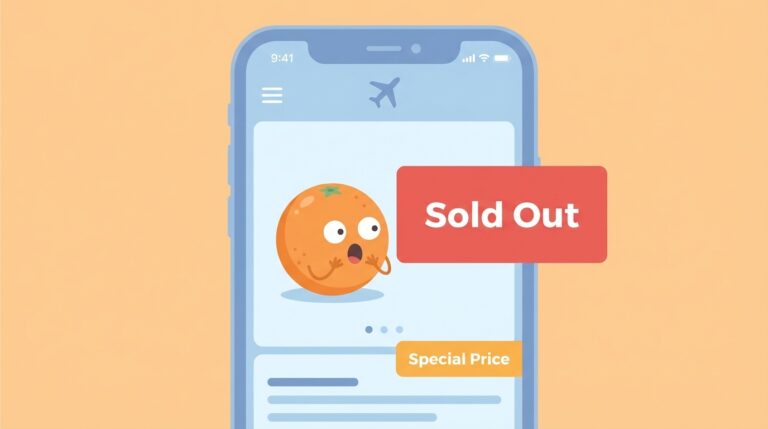
Phase 1: The Immersive Hook
Hello, Daily Hangul family! This is your editor, back with another survival guide.
Imagine this: You’ve just finished binge-watching a K-Drama set in Jeju Island (maybe Welcome to Samdal-ri?), and you are craving that emerald ocean and those sweet tangerines. You open a Korean flight booking app, ready to go. But wait… the screen is full of flashing numbers, red text, and words you’ve never seen in your textbook.
Suddenly, the price jumps up by 10,000 won while you’re hesitating! 😱
Booking a flight to Jeju is a competitive sport in Korea. It’s almost as intense as trying to get BTS concert tickets. If you don’t know the difference between ‘편도’ (One-way) and ‘왕복’ (Round-trip), or if you miss the ‘특가’ (Special price) sign, you might end up paying double the price of the person sitting next to you on the plane.
Don’t worry. Today, we’re going to decode the secret language of Korean flight booking so you can travel like a local pro.
Phase 2: Deep Dive into Key Expressions
1. 성수기 (Seong-su-gi)
- Pronunciation: [Seong-su-gi] + (Sounds like ‘Song’ + ‘Sue’ + the ‘Gi’ in ‘Give’)
- Meaning: Peak season / High season
- K-Culture Moment: In variety shows like Running Man, you often see members complaining that everything is too expensive during summer vacation. That nightmare period? That’s 성수기.
- Editor’s Insight: This isn’t just about weather. In Korea, prices skyrocket during ‘Golden Holidays’ (like Chuseok or Summer vacation). The opposite is 비수기 (Bi-su-gi)—the wallet-friendly off-season.
- Situation Spectrum:
[🚫 Formal] ———— [⚠️ Semi-formal] ———— [✅ Casual]
(✅ Safe to use everywhere, from news reports to chatting with friends) - 🤔 Think About It: Why does Korea have such distinct “Peak Seasons”? It relates to the intense work culture where everyone tends to take vacations at the exact same time (usually late July/early August).
2. 최저가 (Choe-jeo-ga)
- Pronunciation: [Choe-jeo-ga] + (‘Chweh’ sounds like a disgusted exhales + ‘Juh’ + ‘Ga’)
- Meaning: Lowest price / Best deal
- K-Culture Moment: You know those TV home shopping channels where the host shouts “Last chance!”? They are always screaming about the 최저가.
- Editor’s Insight: Koreans are master shoppers. We love comparing prices. If you see this word on a button, CLICK IT immediately. It implies the absolute bottom price available right now.
- Situation Spectrum:
[🚫 Formal] ———— [⚠️ Semi-formal] ———— [✅ Casual]
(✅ Used universally in commerce and daily life) - 🤔 Think About It: Does your culture value finding the “absolute lowest price” as a skill? In Korea, finding a choe-jeo-ga ticket is a bragging right.
3. 매진 (Mae-jin)
- Pronunciation: [Mae-jin] + (‘Mae’ like ‘May’ + ‘Jin’ like ‘Gin’)
- Meaning: Sold out
- K-Culture Moment: The most heartbreaking word for any K-Pop fan. When the ticketing screen for a fan meeting turns gray and says 매진, dreams are crushed.
- Editor’s Insight: In the context of flights, seeing 매진 means you were too slow. It adds a sense of urgency. You might also hear 만석 (Man-seok) specifically for “full seats” on a plane.
- Situation Spectrum:
[🚫 Formal] ———— [⚠️ Semi-formal] ———— [✅ Casual]
(✅ Standard terminology)
Phase 3: Textbook vs. Real Life
| Situation | 📖 Textbook Korean | 🗣️ Real Korean (In the Wild) | 💡 Why the difference? |
|---|---|---|---|
| Finding a ticket | 비행기 표를 예매하고 싶어요. (I want to book a plane ticket.) |
특가 떴어? (Did a special price pop up?) |
“Did it pop up?” (뜨다) reflects the real-time, fleeting nature of online deals. |
| Too expensive | 가격이 비싸네요. (The price is expensive.) |
완전 바가지네. (It’s a total rip-off.) |
바가지 (Gourd) is a classic idiom for being overcharged. Use carefully! |
| Urgency | 빨리 사세요. (Please buy it quickly.) |
광클해야 돼! (Gotta click madly!) |
광클 (Crazy Click) comes from gaming/ticketing culture. Speed is everything. |
Bottom Note: While “Mad Click” (광클) is fun slang, stick to “빨리 예매해야 돼요” (We need to book fast) with your boss!
Phase 4: Cultural Deep Dive
4-1. Non-verbal: The “Ppalli-ppalli” Eye Contact
When booking tickets with a Korean friend, don’t stare at them while discussing. Stare at the screen. In this context, “nunchi” means realizing that if you talk for too long, the ticket will disappear. Silence is okay; typing speed is respect.
4-2. K-Culture Connection: The “Ticketing War” (Pi-ket-ting)
In Korea, booking tickets for popular flights to Jeju during holidays is often called 피켓팅 (Pi-ket-ting). This is a portmanteau of “Blood” (Pi) and “Ticketing.” It implies a war-like atmosphere. Whether it’s for an EXO concert or a flight to Jeju on a Friday night, the mindset is the same: Have your credit card ready, check your internet connection, and do not hesitate.
Phase 5: Immersive Roleplay
Setting: Friday afternoon at a cafe in Hongdae. You and your Korean friend, Minji, are looking at her laptop to book a weekend trip to Jeju Island. The screen shows prices fluctuating.
Characters:
* YOU: Want to go to Jeju but have a limited budget.
* Minji (28): Experienced traveler, fast at typing, slightly impatient.
Minji: 와, 대박. 이번 주말 제주도 표 다 매진인데?
(Wa, daebak. Ibeon jumal Jejudo pyo da maejin-inde?)
(Whoa, crazy. All Jeju tickets for this weekend are sold out?)
(🎭 Minji frantically refreshes the page)
YOU: 진짜? 하나도 없어? 성수기라서 그런가?
(Jinjja? Hanado eopseo? Seong-su-gi-raseo geureon-ga?)
(Really? None at all? Is it because it’s peak season?)
Minji: 어! 잠깐만! 방금 5만 원짜리 표 하나 떴어! 완전 최저가야!
(Eo! Jamkkanman! Banggeum oman-won-jjari pyo hana tteosseo! Wanjeon choe-jeo-ga-ya!)
(Oh! Wait! A 50,000 won ticket just popped up! It’s totally the lowest price!)
🔀 Decision Point: What do you say?
- A) “음… 시간대가 언제야? 너무 이른 거 아니야?” (Hmm… What’s the time? Isn’t it too early?)
- B) “무조건 잡아! 결제해!” (Grab it unconditionally! Pay for it!)
- C) “더 싼 거 나올 수도 있잖아.” (Maybe a cheaper one will come out.)
✅ Best Choice: B) In the world of Korean flight booking, hesitation = failure. Even if the time is 6 AM, you book first, think later.
⚠️ Choice A Analysis: By the time you discuss the time, the ticket will be gone (Sold out/매진).
Minji: (Clicking furiously) 알았어, 내가 바로 잡을게! 광클 간다!
(Arasseo, naega baro jabeul-ge! Gwang-keul ganda!)
(Okay, I’ll grab it right away! Going for the mad click!)
Phase 6: 10-Second Shadowing Drill
Let’s practice the sentence that saves your wallet. Say this with a mix of excitement and relief!
Sentence: “I found the lowest price for a round-trip ticket!”
😊 Excited:
왕복 항공권 / 최저가로 / 찾았어요!
(Wang-bok hang-gong-gwon / choe-jeo-ga-ro / cha-ja-sseo-yo!)
Tips:
* Pause after “ticket” (hang-gong-gwon) and “lowest price” (choe-jeo-ga-ro).
* Stress the “Choe” in Choe-jeo-ga to emphasize how cheap it is.
Phase 7: K-Culture Mini Glossary
| Korean | Romanization | English | Context |
|---|---|---|---|
| 왕복 | Wang-bok | Round-trip | Essential for calculating total cost. |
| 편도 | Pyeon-do | One-way | Sometimes buying two one-ways is cheaper! |
| 특가 | Teuk-ga | Special Price | The red label you must look for. |
| 땡처리 | Ttaeng-cheo-ri | Last-minute clearance | Super cheap tickets sold just before departure. |
| 수하물 | Su-ha-mul | Baggage | Always check if this is included (포함) or excluded (불포함). |
Phase 8: Traveler’s Survival Kit (Jeju Edition)
When booking flights to Jeju, you are competing with the entire nation of Korea. Here is your survival gear.
🆘 Survival Expression #1
* 🇰🇷 “수하물 포함 가격이에요?” (Su-ha-mul po-ham ga-gyeo-gi-e-yo?)
* 🗣️ Sounds like: “Sue-ha-mool po-ham ga-gyuck-e-ay-yo?”
* Meaning: Is this price including baggage?
* Where to use: At the counter or when asking a Korean friend helping you book.
* 💡 Pro Tip: Many “Choe-jeo-ga” (lowest price) tickets do NOT include checked bags. Be careful!📌 Editor’s Travel Note
* Apps: Use Naver Flights (네이버 항공권) or Skyscanner to compare. Koreans usually trust Naver’s aggregation.
* ID: You need your Passport (or ARC if you are a resident) for domestic flights too! Don’t leave it at home.
Phase 9: Think Deeper — “Why so fast?”
Topic: The “Ppalli-ppalli” (Hurry-Hurry) Culture in Digital Life.
Koreans are famous for doing things fast, and this extends to flight booking. The interface of Korean apps is designed for speed—fewer clicks, instant payments (KakaoPay, NaverPay). This efficiency comes from a high-density society where resources (like seats on a plane to Jeju) are limited but demand is massive.
🧠 Think Deeper: In your country, is booking a trip a slow, leisurely process, or a race against time? Does the speed of the internet change how people plan their lives?
💬 Your Turn: How do you say “Sold Out” in your language? Tell me in the comments!
Phase 10: FAQ & Troubleshooting
- Q: Can I use “매진 (Sold out)” for a restaurant that is full?
- No! For a restaurant with no seats, say “자리가 없어요” (There are no seats) or “만석이에요” (It’s full/fully seated). “매진” is strictly for tickets or products.
- Q: Is it rude to ask a Korean friend how much they paid for their ticket?
- Actually, no. In this context, it’s information sharing. Koreans love comparing to see who got the better deal (the “Winner of the Choe-jeo-ga”).
❌ Common Mistake: Confusing 예약 (Reservation) and 예매 (Advance Purchase).
* 예약: Booking a table at a restaurant (payment later).
* 예매: Booking a movie or flight ticket (payment usually happens now).
Phase 11: Wrap-up & Mission
Today’s One-Liner: To save money in Korea, you must know ‘성수기’ (Peak season) and hunt for ‘최저가’ (Lowest price)!
🚀 Action Mission:
* 🥉 Bronze: Look in the mirror and shout “매진되기 전에 사야 해!” (I gotta buy it before it sells out!).
* 🥈 Silver: Go to a Korean flight booking site (like Jeju Air or Naver Flight) and find the button that says ‘특가’ or ‘이벤트’.
* 🥇 Gold: Try explaining the difference between ‘Wang-bok’ (Round trip) and ‘Pyeon-do’ (One way) to a friend in Korean!
Jeju Mission: Open a map of Jeju Island and pick one place you want to visit. Is it near the airport (Jeju City) or far south (Seogwipo)?
Phase 12: Interactive Quiz
- Situation Judgment: You see a ticket price that is unbelievably cheap (10,000 won). What is the first thing you should check?
- A) If the pilot is handsome.
- B) If 수하물 (Baggage) is included.
- C) If they serve kimchi on board.
- Fill in the Blank:
“Oh no! The tickets are all
_______! We should have booked earlier.”- A) 최저가 (Choe-jeo-ga)
- B) 성수기 (Seong-su-gi)
- C) 매진 (Mae-jin)
- True or False (K-Culture):
Comparing prices and asking “How much did you pay?” is considered very rude among close friends in Korea. (T/F)
Answers:
1. B (Cheap tickets often exclude bags!)
2. C (Mae-jin = Sold out)
3. False (We love sharing tips on how to save money! It’s called smart consuming.)
Frequently Asked Questions (FAQ)
Q: What does "성수기 (Seong-su-gi)" mean in Korean and how do you pronounce it?
A: In Korean, "성수기 (Seong-su-gi)" is pronounced [Seong-su-gi] and means: Peak season / High season
Q: What does "최저가 (Choe-jeo-ga)" mean in Korean and how do you pronounce it?
A: In Korean, "최저가 (Choe-jeo-ga)" is pronounced [Choe-jeo-ga] and means: Lowest price / Best deal
Q: What does "매진 (Mae-jin)" mean in Korean and how do you pronounce it?
A: In Korean, "매진 (Mae-jin)" is pronounced [Mae-jin] and means: Sold out







