

Phase 1: The Invisible Architecture of ‘Jeong’ (Empathy)
Hello! This is your Daily Hangul Senior Editor. 👋
Have you ever watched the K-Drama Extraordinary Attorney Woo (이상한 변호사 우영우)? There is a memorable scene where the protagonist struggles to pass through a revolving door. It wasn’t just a physical obstacle; it was a spatial metaphor for how the world is designed for the “average” person, often excluding others.
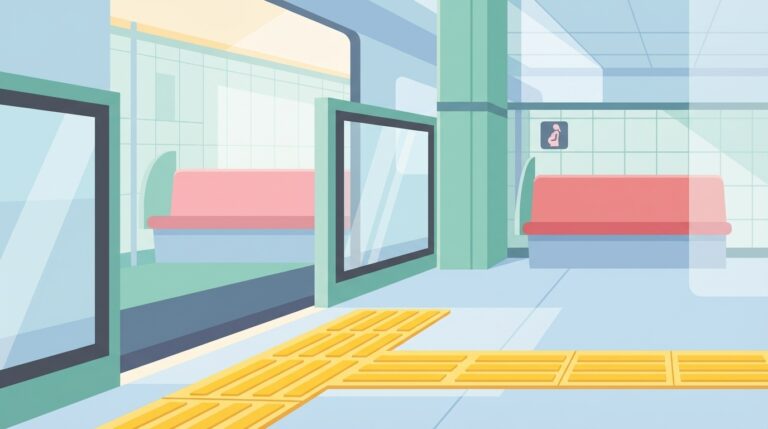
In Seoul, a city that never sleeps, the architecture speaks a language of its own. From the yellow tactile paving (braille blocks) guiding the visually impaired on every subway platform to the controversial ‘No Kids Zones’ in trendy cafes, Korean spaces are constantly negotiating between efficiency and inclusivity.
Today, we are moving beyond simple directions like “Where is the bathroom?” We are diving into Level C2 Korean: discussing Universal Design (유니버설 디자인) and the social etiquette that accompanies these spaces. Knowing these terms elevates you from a tourist to an intellectual observer of Korean society.
Phase 2: Deep Dive into Spatial Vocabulary
1. 교통약자 (Gyotong-yakja)
- Pronunciation: [Gyotong-yakjja] (Note: The ‘자’ hardens to ‘짜’ due to the preceding ‘약’)
- Meaning: The Transportation Vulnerable (Literally: Traffic Weak Person)
- Context: This encompasses the elderly, pregnant women, people with disabilities, and even travelers with heavy luggage. It is the official legal term used in architecture and public policy.
- K-Culture Moment: You will see this written on elevator signs in Seoul Metro stations. If you use the elevator when you are young and fit, you might get a piercing stare from a Halmeoni (grandma). The elevator is implicitly reserved for the Gyotong-yakja.
- Editor’s Insight: This word is much more dignified than saying “handicapped” or “old people.” It focuses on the situation of vulnerability in transit, not the identity of the person.
- Situation Spectrum:
[🚫 Casual Slang] ———— [⚠️ Daily Convo] ———— [✅ Official/Polite]- This is a formal, academic, or policy-related term. You use it when discussing rights or reading signs, not necessarily calling out to a friend.
- 🤔 Think About It: Why does Korean society group all these demographics under one umbrella of “vulnerability” regarding transit? How does this reflect the collective responsibility of the public?
2. 무장애 (Mujang-ae)
- Pronunciation: [Mujang-ae]
- Meaning: Barrier-Free (Literally: No Obstacle/Disability)
- Context: Used in “Mujang-ae Tour” (Barrier-free tourism) or “Mujang-ae Architecture.”
- Editor’s Insight: You might see travel brochures for “무장애 여행” (Barrier-Free Travel). This implies flat terrains, ramps instead of stairs, and voice guidance systems. It’s a key keyword for modern Korean urban planning.
- Situation Spectrum:
[🚫 Slang] ———— [⚠️ Spoken] ———— [✅ Written/Formal]- Mostly used in written descriptions of places or official guides.
3. 문턱을 낮추다 (Munteog-eul natchuda)
- Pronunciation: [Mun-teo-geul nat-chu-da]
- Meaning: To lower the threshold (Figurative: To make something more accessible)
- K-Culture Moment: In architecture, it literally means removing the raised door sills (traditional Hanoks have high ones) for wheelchairs. Metaphorically, K-Pop idols say they want to “lower the threshold” of classical music or high art for their fans.
- Editor’s Insight: Munteok (threshold) is a powerful symbol in Korea. Crossing a threshold signifies entering a new world. Lowering it is an act of invitation.
- 🤔 Think About It: Traditional Korean houses (Hanok) have high thresholds to block drafts and evil spirits. How does modern Universal Design clash with this traditional architectural logic?
Phase 3: Textbook vs. Real Life Nuances
| Situation | 📖 Textbook Korean | 🗣️ Real Korean (Socially Aware) | 💡 The Cultural Shift |
|---|---|---|---|
| Referring to the subway seat for elderly | 노약자석 (Seats for old/weak) | 배려석 (Care/Consideration Seat) | “Weak” (약자) can sound condescending. “Care” (배려) emphasizes the act of the sitter, not the weakness of the receiver. |
| Asking if a place has a ramp | 휠체어 갈 수 있어요? (Can a wheelchair go?) | 턱이 있나요? / 경사로가 있나요? (Is there a threshold/ramp?) | Asking about the architectural feature (threshold) is more specific and practical than asking about the ability to go. |
| Describing a kid-free zone | 아이들 출입 금지 (Kids entry forbidden) | 노키즈존 (No Kids Zone) | Koreans almost exclusively use the Konglish term “No Kids Zone” (and recently “Yes Kids Zone” or “Care Kids Zone”). |
💡 Editor’s Note: Using 배려석 (Baeryeoseok) instead of just “handicapped seat” shows you understand the nuance of voluntary consideration rather than just legal obligation.
Phase 4: Cultural Deep Dive — The Kiosk Challenge
4-1. The Digital Threshold (Digital Exclusion)
In Korea, “Architecture” isn’t just physical; it’s digital. The rapid rise of Unmanned Kiosks in cafes and fast-food joints has created a new barrier for the elderly.
- The Situation: You are at a busy cafe. An elderly person is hesitating in front of a touch-screen kiosk, holding up the line. The “Ppalli-Ppalli” (Hurry Hurry) culture creates tension.
- Non-verbal Nunchi: Do not sigh or check your watch. If you decide to help, approach gently from the side, not from behind (which can feel aggressive).
4-2. K-Drama Connection
Think of the drama Navillera (나빌레라). The elderly protagonist wants to pursue ballet but struggles with the simple act of ordering a burger at a kiosk. This scene broke hearts nationwide because it highlighted architectural exclusion in everyday life. In Korea, being “smart” (digitally literate) is a prerequisite for navigating modern spaces.
Phase 5: Immersive Roleplay — The Kiosk Intervention
Setting: A bustling burger franchise in Gangnam at lunch hour. A Halaboji (Grandfather) is staring at the Kiosk screen, his finger hovering uncertainly. The line behind him is getting restless.
Characters:
– YOU: A observant foreigner who speaks advanced Korean.
– Halaboji: 70s, dressed neatly, but flustered by the complex UI.
Dialogue:
(Halaboji keeps pressing the screen, but it doesn’t register)
YOU: (Approaching gently) 어르신, 혹시 주문 도와드릴까요? 메뉴가 좀 복잡하죠?
(Eoreusin, hoksi jumun dowadeurilkkayo? Menuga jom bokjaphajyo?)
(Sir [honorific], may I help you with the order? The menu is a bit complex, isn’t it?)
Halaboji: 아, 이게… 글씨가 작아서 잘 안 보이네. 나는 그냥 불고기버거 하나 먹고 싶은데.
(Ah, ige… geulssiga jagaseo jal an boine. Naneun geunyang bulgogibeogeo hana meokgo sipeunde.)
(Ah, this… the text is small so I can’t see well. I just want to eat one Bulgogi Burger.)
YOU: 네, 불고기버거요. 단품으로 드릴까요, 아니면 감자튀김이랑 콜라 같이 있는 세트로 드릴까요?
(Ne, bulgogibeogeoyo. Danpumeuro deurilkkayo, animyeon gamjatwigimirang colla gachi inneun set-ro deurilkkayo?)
(Okay, Bulgogi Burger. Would you like just the item (a la carte), or as a set with fries and cola?)
Halaboji: 세트로 줘요. 콜라는 사이다로 바꿔주고.
(Set-ro jwoyo. Collaneun saidaro bakkwojugo.)
(Give me the set. And change the cola to cider [Lemon-lime soda].)
YOU:
(🎭 Decision Point! How do you confirm the payment?)
🔀 Your Turn! Choose the best response:
- A) “카드 주세요. 제가 긁을게요.” (Give me your card. I’ll swipe it.)
- B) “여기 아래에 카드를 꽂아주시면 결제가 됩니다.” (If you insert the card down here, payment will be processed.)
- C) “제가 사드릴게요!” (I’ll buy it for you!)
✅ Best Choice: B — Dignity is key. Option A is efficient but takes control away from him. Option B guides him to do it himself, empowering him for next time (Universal Design in action!). Option C is kind but might make him feel uncomfortable or indebted.
Phase 6: 10-Second Shadowing Drill
Let’s practice a sentence you can use to advocate for accessibility or ask about it intelligently.
“Please make sure the entrance has a ramp for those with mobility issues.”
🇰🇷 거동이 불편하신 분들을 위해 / 입구에 경사로가 있는지 / 꼭 확인해 주세요.
(Geodongi bulpyeonhasin bundeureul wihae / ipgue gyeongsaroga inneunji / kkok hwaginhae juseyo.)
- Intonation:
- 😊 Requesting (Polite but firm): Stress on ‘위해’ (for the sake of) and ‘꼭’ (make sure/please).
- Pause: Pause after wihae and inneunji to make the logic clear.
Phase 7: K-Culture Glossary (Architecture Edition)
| Korean | Romanization | Meaning | Context |
|---|---|---|---|
| 점자 블록 | Jeomja block | Braille Block (Tactile Paving) | The yellow blocks on sidewalks. Seoul is covered in them. |
| 엘베 / 에스컬 | El-be / Es-keol | Elevator / Escalator (Slang) | Koreans love shortening words. Used frequently in text messages regarding meeting spots. |
| 키즈존 / 노키즈존 | Kids Zone / No Kids Zone | Kids Allowed / Forbidden | A highly debated spatial segregation in Korean cafes/restaurants. |
| 수유실 | Suyusil | Nursing Room | Often found in department stores and subway stations; a key part of family-friendly design. |
| 단차 | Dancha | Step difference / Gap | Architectural term for the height difference between floors. “단차가 있다” means there’s a tripping hazard. |
Phase 8: Traveler’s Survival Kit (Mobility Edition)
If you are traveling with a stroller, heavy luggage, or a wheelchair, Seoul can be a maze. Here is your survival kit.
🆘 Survival Expression #1: Finding the Elevator
– 🇰🇷 “엘리베이터가 있는 출구는 어디예요?”
– (Ellibeiteoga inneun chulguneun eodiyeyo?)
– Translation: Where is the exit with the elevator?
– 💡 Pro Tip: In Korean subway apps (KakaoMetro), look for the wheelchair icon next to the exit number. Not all exits have elevators!📌 Editor’s Travel Note: The “Pink Carpet”
– In parking lots, you will see Pink Painted Spots. These are “Women-Priority Parking” (여성전용주차장).
– Myth: It’s not because women can’t park.
– Fact: It’s a safety design (closer to entrances, better lighting) to prevent crime. As a traveler, you can park there if you are male, but it’s socially frowned upon if other spots are open.
Phase 9: Think Deeper — “Space and Exclusion”
The Debate on ‘No Kids Zones’ (노키즈존)
In recent years, many cafes in Jeju and Seoul have declared themselves “No Kids Zones.” This is a clash of rights: the business owner’s right to manage their atmosphere vs. the child’s right (and parent’s right) to access public space.
From a Universal Design perspective, this is a failure of space. Instead of designing spaces that absorb sound or having designated “Quiet Zones,” the solution has been total exclusion.
🧠 Think Deeper: In your country, how are crying babies or running children handled in high-end cafes? Is it a matter of architecture (soundproofing) or culture (parents taking them outside)?
Phase 10: FAQ & Troubleshooting
Q: Can I sit in the Priority Seat (Pink Seat) on the subway if it’s empty?
A:
– The Elderly/Disabled Seats (Ends of the car): NO. Even if the train is empty, young locals rarely sit here. It’s almost a sacred space.
– The Pregnant Women Seat (Pink seat): Maybe. Men sometimes sit here but usually stand up immediately if a woman approaches. However, there is a Bluetooth sensor system (Pink Light) that lights up if a pregnant woman with a badge is nearby. To be safe and “cultured,” just leave it open.
❌ Common Mistake:
– Assuming “Disabled Toilet” (장애인 화장실) is only for wheelchairs.
– Correction: It is often the only family restroom or spacious restroom. If you have a lot of luggage or children, it is culturally acceptable to use it, provided you give priority to those who physically need it.
Phase 11: Wrap-up & Mission
One-Liner: Universal Design in Korea is about “Baeryeo” (Consideration)—lowering the physical and digital thresholds so everyone can participate in the rhythm of the city.
🚀 Action Missions:
– 🥉 Bronze: Look at the nearest building entrance. Is there a “Munteok” (threshold)? Practice saying “문턱이 높아요” (The threshold is high).
– 🥈 Silver: Open Naver Map/Kakao Map and find a subway station. Locate the exit with the Elevator icon.
– 🥇 Gold: Next time you are at a Kiosk in Korea (or a Korean restaurant abroad), if you see someone struggling, use the magic phrase: “도와드릴까요?” (Shall I help you?)
💬 Your Turn: Does your city have “Tactile Paving” (yellow blocks) for the blind? What do you call them? Let me know in the comments!
Frequently Asked Questions (FAQ)
Q: What does "교통약자 (Gyotong-yakja)" mean in Korean and how do you pronounce it?
A: In Korean, "교통약자 (Gyotong-yakja)" is pronounced [Gyotong-yakjja] and means: The Transportation Vulnerable (Literally: Traffic Weak Person)
Q: What does "무장애 (Mujang-ae)" mean in Korean and how do you pronounce it?
A: In Korean, "무장애 (Mujang-ae)" is pronounced [Mujang-ae] and means: Barrier-Free (Literally: No Obstacle/Disability)
Q: What does "문턱을 낮추다 (Munteog-eul natchuda)" mean in Korean and how do you pronounce it?
A: In Korean, "문턱을 낮추다 (Munteog-eul natchuda)" is pronounced [Mun-teo-geul nat-chu-da] and means: To lower the threshold (Figurative: To make something more accessible)







