

Phase 1: Immersive Hook
Greeting: Hello there! This is your Daily Hangul Senior Editor. 👋
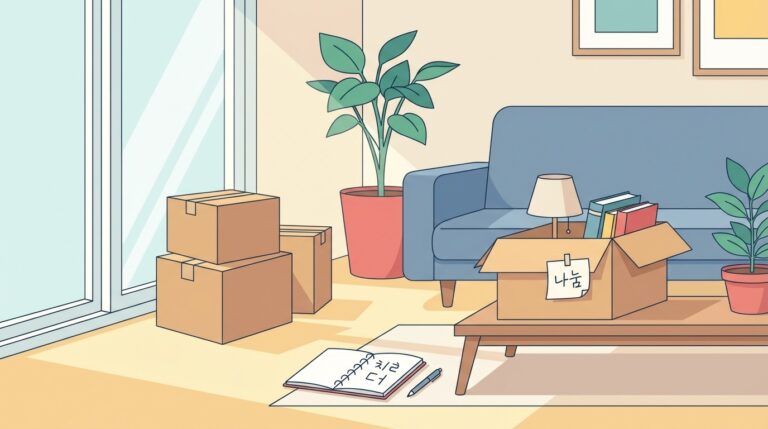
K-Culture Cold Open: Picture this scene from a slice-of-life K-Drama: The protagonist has just gone through a messy breakup or a major life change. What’s the first thing they do? They blast an upbeat ballad, open all the windows, and start furiously throwing things into boxes. They aren’t just cleaning; they are performing ‘bi-um’ (비움 – emptying).
But here’s the twist—instead of throwing everything in the trash, they take a photo of a perfectly good mood lamp and upload it to an app. Ding-dong! “Danggeun!” (The notification sound of Korea’s most popular second-hand app).
The ‘Why’: At an advanced level, talking about buying and selling is easy. But expressing the subtle sentiment of letting go for the sake of a simpler life, or the warmth of giving freely (sharing), requires a different emotional vocabulary. If you master this, you aren’t just a Korean learner; you’re a conscientious member of the local community.
Transparency: This guide is based on real interactions in Korea’s bustling ‘Minimal Life’ communities and the unspoken etiquette of ‘Karrot Market’ (Danggeun) users.
Phase 2: Deep Dive into Key Expressions
1. [무료 나눔합니다 / 나눔해요]
- Pronunciation: [Muryo nanum-hamnida / Nanum-haeyo] + Sound-alike: ‘Nanum’ sounds like ‘Na’ (me) + ‘Num’ (number).
- Meaning: “I am giving this away for free” / “Sharing for free.”
- K-Culture Moment: You’ll see this tag
#나눔frequently on social media or community apps. It’s not about charity in a pitiful sense; it’s about circulation and sustainability. - Editor’s Insight: While “공짜 (Gong-jja)” means free, it can sound cheap or lacking value. “나눔 (Nanum)” implies the item still has value, but you are choosing to share it. It elevates the act from disposal to benevolence.
- Situation Spectrum:
[🚫 Strict Formal] ———— [⚠️ Polite/Community] ———— [✅ Casual]- Business/Official: 🚫 (Use ‘기증’ – donation)
- Neighbors/Online Community: ✅
- Friends: ✅
- 🤔 Think About It: Why does Korean society prefer the word “Sharing (Na-num)” over “Free (Gong-jja)” in these contexts? It likely stems from the concept of Jeong (connection/affection)—keeping the item’s life cycle going through relationships.
2. [비우는 중이에요 / 미니멀 라이프 실천 중입니다]
- Pronunciation: [Bi-u-neun jung-i-e-yo] + Think: ‘Bi’ as in ‘Be’ gone + ‘u’ as in ‘woo’.
- Meaning: “I am in the process of emptying (decluttering)” / “I am practicing a minimal life.”
- K-Culture Moment: In reality TV shows like I Live Alone, celebrities often say “이번에 싹 비우려고요” (I plan to empty everything out this time) to signify a fresh start or mental reset.
- Editor’s Insight: The verb 비우다 (bi-u-da) is beautiful. It’s used for emptying a cup, emptying a room, or emptying one’s mind (meditation). Using this instead of “청소해요” (cleaning) shows you understand the philosophical aspect of decluttering.
- Situation Spectrum:
- Describing your lifestyle: ✅
- Explaining why you are selling cheap: ✅
- 🤔 Think About It: Is “emptying” considered positive or negative in your culture? In Korea, “empty space” (Yeobaek) is traditionally seen as essential for beauty and peace.
3. [좋은 주인 만났으면 좋겠어요]
- Pronunciation: [Jo-eun ju-in man-nass-eu-myeon jo-kess-eo-yo]
- Meaning: “I hope it meets a good owner.”
- K-Culture Moment: The standard closing line for a sentimental seller. Often accompanied by a generic emoji like 🍀 or 🙏 in chats.
- Editor’s Insight: This phrasing personifies the object. It’s not just “I want to get rid of this.” It suggests you cherished the item and want its journey to continue well. This builds immense trust with the buyer/receiver.
- Situation Spectrum:
- Selling/Giving beloved items: ✅
- Selling a broken toaster: 🚫 (Don’t be dramatic about trash!)
Phase 3: Textbook vs. Real Life
| Situation | 📖 Textbook Korean | 🗣️ Real Korean (C1 Level) | 💡 Why the difference? |
|---|---|---|---|
| Posting a free item | 이 물건을 무료로 드립니다. (I give this item for free.) | 이사 때문에 급처/나눔해요. 📦 (Quick disposal/sharing due to moving.) | Explains the reason (moving) to prove the item isn’t defective. |
| Handing over the item | 여기 있습니다. 안녕히 가세요. (Here it is. Goodbye.) | 잘 쓰세요! / 예쁘게 쓰세요! ✨ (Use it well / Use it prettily!) | “Use it prettily” is a uniquely Korean way to wish the item serves the new owner well. |
| Asking if it’s still available | 이거 아직 있나요? (Is this still here?) | 혹시 나눔 완료됐나요? (Has the sharing been completed?) | Using the passive voice “completed” sounds softer and less demanding. |
Bottom Note: At C1 level, using “급처 (Geup-cheo – Urgent disposal)” or “처분 (Cheo-bun – Disposal)” adds a layer of native-like urgency and pragmatism.
Phase 4: Cultural Deep Dive — The Art of ‘Moon-gori’
4-1. Non-verbal: Moon-gori Georae (문고리 거래)
Modern Koreans, especially the younger generation, value efficiency and mild anonymity even when sharing.
- The Act: Instead of meeting face-to-face to hand over a free book, you hang it on your front door’s doorknob (Moon-gori).
- The Text: “문고리에 걸어둘게요” (I’ll hang it on the doorknob).
- The Nunchi: Even if you are home, you often wait until the person takes it and leaves before opening the door. It saves both parties the awkwardness of small talk or bowing. It’s the height of introvert consideration.
4-2. K-Drama Connection: The “Clean Slate” Trope
In dramas, when a character decides to “live minimally,” it’s rarely just about aesthetics. It symbolizes cutting ties with the past.
– Scene: A character looks at a luxury bag given by an ex, sighs, and posts it for “Nanum” (Sharing) instead of selling it.
– Why? Selling it feels like profiting from the pain. Giving it away acts as a spiritual cleansing. If you say “비우는 중입니다” (I’m emptying) with a bittersweet smile, you are channeling this exact K-Drama energy.
Phase 5: Immersive Roleplay Scenario
Setting: A quiet residential alleyway in Mapo-gu. Sunday afternoon. You are giving away a gently used air fryer because you bought a newer model.
Characters:
– YOU: An expat practicing minimal life before moving apartments.
– Jisoo: (20s, a college student living alone, polite but shy).
Dialogue:
Jisoo: (Hesitantly approaching) 저기… 혹시 당근 ‘미니멀라이프’ 님 맞으신가요?
(Jeogi… hoksi Danggeun ‘Minimal Life’ nim majeusingayo?)
(Excuse me… are you perhaps ‘Minimal Life’ from Danggeun?)
YOU: 네, 맞아요! 나오시느라 고생하셨어요. 여기 에어프라이어예요.
(Ne, majayo! Naosineura gosaenghasyeosseoyo. Yeogi air fryer-yeyo.)
(Yes, that’s me! Thanks for coming all the way out. Here is the air fryer.)
Jisoo: 와, 상태 진짜 좋네요! 정말 그냥 받아도 되는 건지…
(Wa, sangtae jinjja jonneyo! Jeongmal geunyang badado doeneun geonji…)
(Wow, it’s in great condition! Are you sure I can just take this…?)
🔀 Decision Point: How do you respond to her hesitation?
Option A: “네, 그냥 가져가세요. 필요 없어요.” (Yes, just take it. I don’t need it.)
Option B: “저도 이사 준비하면서 비우는 중이라서요. 잘 써주시면 제가 더 감사하죠!”
Option C: “돈 주셔도 돼요!” (You can pay me if you want!)
✅ Best Choice: B
– Reason: It validates her acceptance. You frame it as her doing you a favor by taking it, which relieves her burden of debt. This is high-level Korean communication.
Jisoo: 감사합니다! (Rummaging through her bag) 저기… 이거라도 드세요. 오다 샀어요.
(Gamsahamnida! Jeogi… igeorado deuseyo. Oda sasseoyo.)
(Thank you! Um… please have this. I bought it on the way.)
(🎭 Stage Direction: She hands you a bottle of Vitamin C drink)
YOU: 어머, 아니에요. 괜찮은데… 잘 마실게요! 조심히 가세요.
(Eomeo, anieyo. Gwaenchande… jal masilgeyo! Josimhi gaseyo.)
(Oh my, no, you didn’t have to… but I’ll drink it well! Get home safe.)
Phase 6: 10-Second Shadowing Drill
Let’s practice the sophisticated sentiment of letting go.
Sentence:
“집을 좀 비우고 싶어서요, / 좋은 분이 가져가서 / 예쁘게 쓰셨으면 좋겠어요.”
Pronunciation:
[Jibeul jom bi-u-go si-peo-seo-yo, / jo-eun buni ga-jyeo-ga-seo / ye-ppeu-ge sseu-syeoss-eu-myeon jo-kess-eo-yo.]
Emotion & Guide:
– First part: 😌 Relieved/Calm (breath out on ‘seo-yo’)
– Second part: 😊 Warm/Hopeful (smile while saying ‘ye-ppeu-ge’)
Phase 7: K-Culture Mini Glossary (Resale & Sharing)
| Korean | Romanization | Meaning | Context |
|---|---|---|---|
| 득템 | Deuk-tem | Rare find / Scoring an item | Used when you get something good for free or cheap. “Item Get!” |
| 쿨거 | Kul-geo | Cool Deal (Quick trade) | Trading without haggling or asking too many questions. |
| 비대면 | Bi-dae-myeon | Non-face-to-face | The preferred method for shy traders (lockers, doorknobs). |
| 짐 정리는 마음 정리 | Jim jeong-ri-neun ma-eum jeong-ri | Decluttering is decluttering the mind | A common proverb/mindset in minimal life culture. |
Phase 8: Traveler’s Survival Kit (The “Sharing” Culture)
Even as a traveler, you experience “Nanum” culture, but in a commercial sense called “Service” (서비스).
🆘 Survival Expression: The “Service” Encounter
– Situation: You ordered fried chicken, but there are cheese balls you didn’t order.
– Server: “이건 서비스예요.” (This is ‘service’ / on the house.)
– YOU: “와, 감사합니다! 잘 먹겠습니다!” (Wow, thank you! I will eat it well!)
– 💡 Pro Tip: In Korea, “Service” = Freebie. It is the commercial version of “Nanum.” Do not try to pay for it!
📌 Editor’s Travel Note:
If you have luggage or clothes you want to discard before leaving Korea, look for 의류수거함 (Clothing Collection Bin). They are usually green or metal bins on street corners. Do not just leave clothes in the hotel room unless you leave a note saying “Please throw this away.”
Phase 9: Think Deeper — Materialism vs. Minimalism
The Paradox of Modern Korea:
Korea is fascinatingly contradictory. On one hand, there is the “Flex” culture (showing off luxury goods), driven by competitive social structures. On the other hand, the “Minimal Life” movement is growing rapidly as a counter-culture reaction to that very stress.
🧠 Think Deeper:
When Koreans say “비운다” (emptying), they are often trying to reclaim space in a country with high population density and expensive housing. In your country, is minimalism seen as a luxury (an aesthetic choice) or a necessity?
Phase 10: FAQ & Troubleshooting
Q: Can I resell something I got for free (Nanum)?
A: Absolutely NOT (🚫). This is a huge taboo in the Korean second-hand community. It’s called “re-selling freebies” (되팔이) and can get you banned from apps and shamed in communities. If you don’t need it anymore, you must “Re-Nanum” (re-share) it.
Q: Is it rude to inspect a free item thoroughly?
A: A little bit, yes. If it’s free, the etiquette is to accept it “as is” unless it’s clearly trash. Asking too many detailed questions about a free item is considered “Jin-sang” (nuisance).
❌ Common Mistake #1: Trying to pay money when someone says “Nanum.”
✅ Fix: Just accept it gratefully. If you feel bad, offer a small beverage (convenience store coffee/vitamin drink) as a gesture of thanks.
Phase 11: Wrap-up & Action Mission
One-Liner Summary: “Nanum” is not just shedding stuff; it’s a social ritual of passing on value and goodwill to a neighbor.
🚀 Action Missions:
– 🥉 Bronze: Look at one item in your room you don’t need. Say out loud: “이거 나눔해야겠다” (I should share this).
– 🥈 Silver: Go to a Korean community forum (or even Instagram) and search tag #무료나눔. See what people are giving away.
– 🥇 Gold: If you are in Korea, try listing a small item on Karrot Market as ‘무료나눔’ and leave it on your doorknob (Moon-gori) for someone!
💬 Your Turn: What is the hardest item for you to “empty” (let go of)? Emotional letters? Old clothes? Tell me in the comments!
Phase 12: Quiz — The Manner Check
- Situational Judgment: You received a free bookshelf via “Moon-gori” trade. What is the best message to send the giver after you pick it up?
- A) “가져갑니다.” (Taking it.)
- B) “물건 상태가 생각보다 별로네요.” (Condition is worse than I thought.)
- C) “잘 가져갔습니다! 예쁘게 잘 쓸게요. 감사합니다!” (Picked it up safely! I’ll use it beautifully. Thanks!)
- D) (Send nothing)
- K-Culture True or False:
- “It is socially acceptable to sell a ‘Service’ (freebie) item you received at a store.” (True/False)
Answers:
1. C. Gratitude and confirmation are key in non-face-to-face trades.
2. False. Selling freebies or service items is culturally frowned upon and often explicitly banned on platforms.
Frequently Asked Questions (FAQ)
Q: What does "[무료 나눔합니다 / 나눔해요]" mean in Korean and how do you pronounce it?
A: In Korean, "[무료 나눔합니다 / 나눔해요]" is pronounced [Muryo nanum-hamnida / Nanum-haeyo] and means: "I am giving this away for free" / "Sharing for free."
Q: What does "[비우는 중이에요 / 미니멀 라이프 실천 중입니다]" mean in Korean and how do you pronounce it?
A: In Korean, "[비우는 중이에요 / 미니멀 라이프 실천 중입니다]" is pronounced [Bi-u-neun jung-i-e-yo] and means: "I am in the process of emptying (decluttering)" / "I am practicing a minimal life."
Q: What does "[좋은 주인 만났으면 좋겠어요]" mean in Korean and how do you pronounce it?
A: In Korean, "[좋은 주인 만났으면 좋겠어요]" is pronounced [Jo-eun ju-in man-nass-eu-myeon jo-kess-eo-yo] and means: "I hope it meets a good owner."







