

Beyond the Caffeine Rush: Mastering the Art of Korean “Healing” & Tea Meditation
Phase 1: The Hook — Escaping the ‘Palli-Palli’ Matrix
Hello, Daily Hangul family! It’s your editor here.
Imagine this: You are in the middle of Gangnam. Neon signs are flashing, buses are honking, and everyone is walking at a pace that suggests they are late for a meeting with the President. This is the famous “Palli-Palli” (Hurry-Hurry) culture of Korea.
But then, you turn a corner into a narrow alley in Insadong or Bukchon. You step into a Hanok (traditional house), and suddenly… silence. The smell of old wood and mugwort fills the air. A K-Drama protagonist might come here after a dramatic breakup or a corporate betrayal to stare blankly at a teacup.
Today, we are not just learning how to order tea. We are diving into the C1-level concept of “Shim” (쉼, Rest) and “Healing” (힐링). If you can express the nuance of “emptying your mind” in Korean, you aren’t just a fluent speaker; you’re a culturally attuned insider.
Phase 2: Deep Dive — Expressions for the Soul
Since you are at an advanced (C1) level, we will move beyond simple descriptors like “tasty” or “hot.”
1. 멍 때리다 [meong ttae-ri-da]
- Pronunciation: [meong ttae-ri-da] (Think of the sound of a gong being struck—meong—and resonating.)
- Meaning: To space out / To zone out (state of blankness).
- Editor’s Insight: In Western culture, zoning out might look lazy. In modern Korea, this is a survival tactic. We have “Fire-meong” (staring at fire), “Water-meong,” and here, “Tea-meong.”
- K-Culture Moment: You’ve likely seen K-Pop idols on reality shows sitting by a window, doing absolutely nothing for 5 minutes. That is Meong.
- Situation Spectrum:
[🚫 Formal Meeting] ———— [⚠️ Colleagues (Break time)] ———— [✅ Friends/Solo]- 🤔 Think About It: Why has “spacing out” become a paid activity (like “Space-out competitions”) in Seoul? What does this say about the mental load of modern Koreans?
2. 은은하다 [eun-eun-ha-da]
- Pronunciation: [eun-eun-ha-da] (Soft and flowing, like a gentle wave.)
- Meaning: Delicate, subtle, faint (scent, light, or feeling).
- Editor’s Insight: This is the ultimate compliment for tea, perfume, or even a person’s vibe. Strong flavors are jinhada (진하다), but sophisticated tea is euneunhada.
- K-Drama Trope: The wise grandmother serves tea to the angry protagonist and says, “The scent is subtle, isn’t it? Just like how life should be.”
- Situation Spectrum:
[✅ Formal] ———— [✅ Descriptive] ———— [✅ Casual]3. 마음을 가라앉히다 [ma-eum-eul ga-ra-an-chi-da]
- Pronunciation: [ma-eum-eul ga-ra-an-chi-da]
- Meaning: To calm one’s mind / To compose oneself (Lit: To make one’s heart sink/settle down).
- Editor’s Insight: Think of tea leaves settling to the bottom of the cup. You are actively trying to suppress agitation or excitement.
- Situation Spectrum:
[✅ Self-reflection] ———— [✅ Advising others] ———— [✅ Literature]
Phase 3: Textbook vs. Real Life (C1 Edition)
| Situation | 📖 Textbook Korean | 🗣️ Real Korean (Advanced) | 💡 Why the difference? |
|---|---|---|---|
| Describing the tea | “이 차는 맛이 좋아요.” (This tea tastes good.) | “차 향이 참 그윽하네요.” (The tea scent is very deep/profound.) | C1 speakers focus on atmosphere and scent (hyang) rather than just taste. |
| Suggesting a break | “잠깐 쉴까요?” (Shall we rest a moment?) | “머리 좀 식힐 겸 차 한잔하실래요?” (Shall we have tea to cool off our heads?) | Koreans often justify the break as a means to regain efficiency (cooling the head). |
| Feeling stressed | “저는 스트레스가 많아요.” (I have a lot of stress.) | “요즘 기가 좀 허한 것 같아요.” (My energy/Qi feels empty/weak these days.) | Uses Traditional Medicine concepts (Qi) to describe mental exhaustion. |
Bottom Note: Using words like “그윽하다” (deep/profound) or “기(Qi)” instantly elevates your status from ‘foreigner learning Korean’ to ‘someone who understands the Korean soul.’
Phase 4: Cultural Deep Dive
4-1. Non-verbal: The Pouring Ritual
In a traditional tea setting, you never fill the cup to the brim. You fill it about 70-80%. This leaves space for the hyang (scent) to gather. Also, holding the cup with both hands (one hand supporting the bottom) is not just polite; it allows you to feel the warmth (on-gi) which is part of the healing process.
4-2. K-Culture Connection: The “Sageuk” (Historical Drama) Trope
Have you noticed in dramas like The Red Sleeve or Mr. Sunshine, high-tension political negotiations happen over tea?
- The Trope: The villain speaks aggressively. The hero pauses, slowly pours tea, takes a sip, and then speaks.
- The Lesson: In Korea, silence is a part of the conversation. That sip of tea is a power move. It says, “I am in control of my emotions.”
Phase 5: Immersive Roleplay
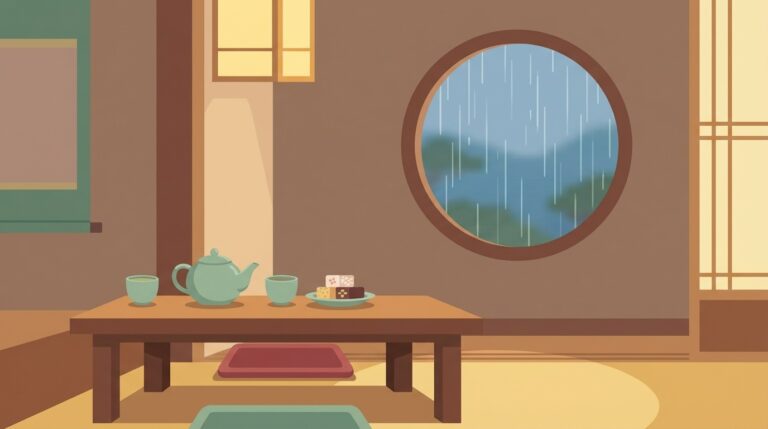
Setting: A rainy Tuesday afternoon at a traditional tea house in Ikseon-dong. The sound of rain hitting the Hanok roof is audible. You are with Min-ji, a friend who is exhausted from work.
Characters:
* YOU: An expat who loves Korean tea culture.
* Min-ji (30s): A corporate worker on the verge of burnout.
(Dialogue Start)
Min-ji: (Sighs heavily) 하… 이번 프로젝트 때문에 숨 쉴 틈도 없어. 진짜 도망가고 싶다.
(Ha… ibeon peurojekteu ttaemune sum swil teum-do eopseo. Jinjja domanggago sipda.)
(Ha… Because of this project, I don’t even have time to breathe. I really want to run away.)
YOU: (Pouring tea slowly) 일단 이거 마셔봐. 국화차인데, 머리 식히는 데 좋아.
(Ildan igeo masyeobwa. Gukhwa-cha-inde, meori sikineun de joa.)
(Drink this first. It’s Chrysanthemum tea, it’s good for cooling your head.)
Min-ji: (Holding the warm cup) 고마워. 따뜻한 걸 잡고 있으니까 좀 낫네. 향이 되게… 은은하다.
(Gomawo. Ttatteutan geol japgo isseunikka jom nanne. Hyang-i doege… eun-eun-ha-da.)
(Thanks. Holding something warm makes it better. The scent is very… subtle.)
YOU: 그치? 우리 오늘은 일 얘기 말고, 그냥 멍 때리자.
(Geuchi? Uri oneureun il yaegi malgo, geunyang meong ttaerija.)
(Right? Let’s not talk about work today, let’s just space out.)
Min-ji: 그래, 그러자. 근데 너 한국 사람 다 됐네. ‘멍 때리자’는 말도 알고.
(Geurae, geuroja. Geunde neo Hanguk saram da dwaenne. ‘Meong ttaerija’-neun mal-do algo.)
(Okay, let’s do that. But you’ve become totally Korean. Knowing the phrase ‘space out’ too.)
🔀 Decision Point: How do you respond to the compliment?
- A) “에이, 아직 멀었어요.” (Ey, I’m still far from it.) – Humble & Standard.
- B) “한국 살다 보니까 ‘비움’의 미학을 알게 됐죠.” (Living in Korea, I’ve learned the aesthetics of ‘emptying’.) – Sophisticated & Poetic.
- C) “내가 좀 쩔지?” (I’m kinda dope, right?) – Too slangy for this quiet mood.
✅ Best Choice: B. At C1 level, discussing abstract concepts like “Aesthetics of Emptying” (비움의 미학) fits the atmosphere perfectly. It shows intellectual depth.
Phase 6: 10-Second Shadowing Drill
Let’s practice the sophisticated vibe. Focus on the slow, calm intonation.
😢 Empathetic & Calming:
복잡한 생각은 / 잠시 내려놓고 / 차 향을 음미해 봐요.
(Bokjapan saenggageun / jamsi naeryeonoko / cha hyang-eul eummihae bwayo.)
“Put down your complex thoughts for a moment, and savor the tea’s scent.”
Phase 7: K-Culture Glossary (Tea Edition)
| Korean | Romanization | Meaning | Context |
|---|---|---|---|
| 다도 | Dado | Tea Ceremony/Way of Tea | The philosophy and etiquette of brewing and drinking tea. |
| 우려내다 | Uryeonaeda | To brew/infuse | Used for tea, but also metaphorically for “bringing out” deep emotions or results. |
| 씁쓸하다 | Sseupsseulhada | Bittersweet/Bitter | Used for tea taste, but often describes a “bitter” feeling about life. |
| 힐링 | Healing | Healing/Relaxation | A Konglish term essential for modern Koreans. Usually involves spending money to rest. |
Phase 8: Traveler’s Survival Kit (Traditional Tea House)
Unlike Starbucks, traditional tea houses (전통 찻집) have different rules.
🆘 Survival Expressions
1. “따뜻한 물 좀 더 주실 수 있나요?” (Could you give me some more hot water?)
* Tip: Traditional tea leaves can be steeped multiple times. Ask for a refill of water, not new tea.
2. “다식은 뭐가 나오나요?” (What tea snacks come with this?)
* Context: Dasik are traditional pressed sweets.
3. “좌식인가요, 입식인가요?” (Is it floor seating or table seating?)
* Critical: If you hate sitting on the floor cross-legged, ask this!📌 Editor’s Travel Note:
Try visiting Suyeonsanbang (수연산방) in Seoul. It’s the old house of a famous novelist. It’s quiet, expensive, and absolutely worth the C1-level atmosphere.
Phase 9: Think Deeper — The Paradox of “Healing”
The Commercialization of Rest:
In Korea, “Healing” is often something you do, not just a state of being. You go to a “Healing Cafe,” buy “Healing Books,” or take a “Healing Trip.”
🧠 Critical Question: Why do you think Korean society feels the need to label rest as “Healing”? Does calling it “Healing” imply that daily life is a form of “Sickness” or “Injury”? How does this compare to the concept of rest in your home country?
Phase 10: FAQ & Troubleshooting
Q: Is it rude to slurp tea in Korea?
A: Unlike Japan (where slurping noodles/tea can be a sign of enjoyment) or some Western etiquette (where silence is golden), Korea is somewhere in between. A gentle slurp to intake air and scent is acceptable in a connoisseur setting, but loud noises are generally frowned upon. Match the volume of the oldest person at the table!
❌ Common Mistake: Treating traditional tea like an espresso shot.
✅ Fix: It is about yeoyu (leisure). Take small sips. Comment on the flavor between sips. Rushing through a $15 cup of hand-picked Green Tea is considered wasteful of the experience.
Phase 11: Wrap-up & Action Mission
One-Liner: True Korean fluency isn’t just about speaking fast; it’s about knowing when to be quiet and meong.
Your Mission:
* 🥉 Bronze: Say “차 향이 은은하네요” while drinking your morning coffee/tea.
* 🥈 Silver: Post a photo of your drink on social media with the caption: “머리 식히는 중 (Cooling my head) #DailyHangul.”
* 🥇 Gold: Visit a tea house (or a quiet cafe), put your phone away, and practice Meong for 10 minutes. If someone asks what you are doing, say: “마음을 비우는 중이에요” (I’m emptying my mind).
See you in the next lesson, and don’t forget to breathe!
Phase 12: Interactive Quiz
1. Situation Judgment:
Your boss looks extremely stressed and angry. You hand them a cup of tea. What do you say?
* A) “이거 마시고 힘내세요! 파이팅!” (Drink this and cheer up! Fighting!)
* B) “차 한잔하시면서 머리 좀 식히세요.” (Have a cup of tea and cool your head a bit.)
Answer: B is better for C1 level/Healing context. ‘Fighting’ (A) can add pressure. B acknowledges their stress and offers a solution (cooling down).
2. True or False:
“In Korea, if you are sitting with an elder at a tea house, you should pour your own tea first to show initiative.”
* (True / False)
Answer: False. You pour for the elder first, using two hands. Waiting for them to pour yours (or offering to pour theirs) is the rule of nunchi.
Frequently Asked Questions (FAQ)
Q: What does "멍 때리다 [meong ttae-ri-da]" mean in Korean and how do you pronounce it?
A: In Korean, "멍 때리다 [meong ttae-ri-da]" is pronounced [meong ttae-ri-da] and means: To space out / To zone out (state of blankness).
Q: What does "은은하다 [eun-eun-ha-da]" mean in Korean and how do you pronounce it?
A: In Korean, "은은하다 [eun-eun-ha-da]" is pronounced [eun-eun-ha-da] and means: Delicate, subtle, faint (scent, light, or feeling).
Q: What does "마음을 가라앉히다 [ma-eum-eul ga-ra-an-chi-da]" mean in Korean and how do you pronounce it?
A: In Korean, "마음을 가라앉히다 [ma-eum-eul ga-ra-an-chi-da]" is pronounced [ma-eum-eul ga-ra-an-chi-da] and means: To calm one's mind / To compose oneself (Lit: To make one's heart sink/settle down).







