

Phase 1: Immersive Hook
Hello! This is your Daily Hangul Senior Editor.
Imagine this: You are reading a hit K-Webtoon (maybe the original version of a popular K-Drama like Marry My Husband or Solo Leveling). The villain is about to be revealed, the protagonist opens the door, their eyes widen in shock, and then…
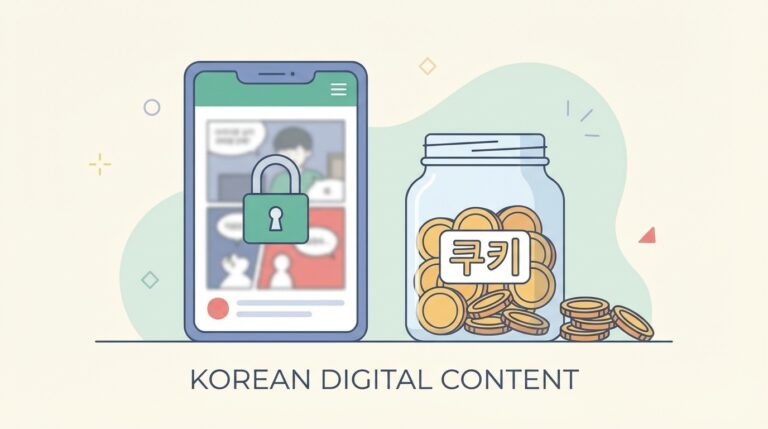
“다음 화를 보려면 쿠키 2개가 필요합니다.” (To see the next episode, you need 2 cookies.)
😱 The horror! The cliffhanger! This is the moment every K-Culture fan faces. You have two choices: wait a whole week for the free release, or succumb to the temptation and pay.
In the world of Korean webtoons and web novels, we don’t just “buy” episodes; we “bake cookies” or “charge cash.” If you want to survive the cliffhangers and discuss the latest plot twists with your Korean friends before the spoilers hit social media, you need to master the art of the “Paid Payment System.”
Let’s unlock this episode together!
Phase 2: Deep Dive (Key Expressions)
Here are the top 3 expressions you need when your curiosity conquers your wallet.
1. 충전하다 (Chungjeon-hada)
- Pronunciation: [chung-jeon-ha-da] (Think of a phone “charger” giving energy)
- Meaning: To top up / To recharge (money, coins, or cookies)
- K-Culture Moment: You open the app, your balance is ‘0’, and you click the yellow button to add money. It’s the same word used for recharging your T-Money card for the subway.
- Editor’s Insight: While the formal word is
결제하다(to make a payment), in the app ecosystem, we say we “recharge” our points. It feels less like spending money and more like fueling your hobby!- Situation Spectrum:
[🚫 Formal Biz] ———— [✅ Apps/Transport] ———— [✅ Casual]- 🤔 Think About It: Why do platforms use “Cookies” or “Coins” instead of direct currency (Won)? Does it make you spend more easily?
2. 소장 vs 대여 (Sojang vs Daeyeo)
- Pronunciation: [so-jang] vs [dae-yeo]
- Meaning: To Keep (Own) vs To Rent
- K-Culture Moment: When you click a paid episode, a popup asks: Do you want to keep it forever (
소장) for 3 cookies, or just watch it for 3 days (대여) for 2 cookies?- Editor’s Insight: Use
소장for your absolute favorite series that you’ll re-read 100 times. Use대여for a quick dopamine hit. Confusing these can cost you extra money!- Situation Spectrum:
[✅ Platform UI] ———— [✅ Shopping] ———— [✅ Library]3. 현질하다 (Hyeonjil-hada)
- Pronunciation: [hyeon-jil-ha-da]
- Meaning: To spend real cash on in-game items or digital content (Slang)
- K-Culture Moment: A friend asks, “Did you see the ending?” You reply, “Yeah, I did hyeonjil because I couldn’t wait.”
- Editor’s Insight: This comes from
현금(cash) +지르다(to splurge/bet). It implies spending money to save time or get an advantage.- Situation Spectrum:
[🚫 Elders/Boss] ———— [⚠️ Colleagues] ———— [✅ Friends]
Phase 3: Textbook vs. Real Life
| Situation | 📖 Textbook Korean | 🗣️ Real Korean (Slang/Native) | 💡 Why the difference? |
|---|---|---|---|
| Buying episodes | 결제했어요. (I made a payment.) | 쿠키 구웠어. (I baked cookies.) | Originates from Naver Webtoon’s currency system. |
| Spending a lot | 돈을 많이 썼어요. (I spent a lot of money.) | 완전 질렀어. (I totally splurged.) | 지르다 emphasizes the impulsive, “YOLO” nature of the action. |
| Waiting for free | 무료가 될 때까지 기다릴게요. | 기다무로 보고 있어. (Watching via ‘Wait-for-Free’.) | 기다무 is an abbreviation for Wait and it becomes Free (기다리면 무료). |
💡 Bottom Note: In the webtoon community, saying “I baked cookies” (
쿠키 구웠어) sounds much more like a true fan than “I paid” (결제했어).
Phase 4: Cultural Context — K-Culture Deep Dive
4-1. The Art of the “Preview” (미리보기)
In Korea, patience is a virtue, but “spoilers” (스포) are the enemy. Webtoon platforms exploit this by offering 미리보기 (Preview). This isn’t a trailer; it’s the actual next 3-5 episodes that are available only if you pay.
If you read the free version, you are technically living 3 weeks in the past compared to the “Preview” readers. This creates a cultural gap in conversations. If you talk to a friend who paid, you must ask:
“너 미리보기 했어?” (Did you watch the previews?) before discussing the plot.
4-2. The “Wait for Free” (기다무) Revolution
KakaoPage introduced the 기다무 (Gi-Da-Mu) system. It gives you a free pass every 12 or 24 hours. This changed Korean content consumption habits from “binge-reading” (정주행) to a disciplined daily routine. It reflects the “Palli-palli” (Hurry hurry) culture clashing with the desire for “Gaseongbi” (Cost-effectiveness).
Phase 5: Immersive Roleplay Scenario
Setting: A cafe in Hongdae. You are with Minji, a Korean friend who is obsessed with the same webtoon as you.
Characters:
* YOU: A foreign student, B2 level Korean, currently broke but curious.
* Minji: 24, college student, spends all her allowance on webtoons.
(Dialogue Start)
Minji: 야, 너 어제 올라온 웹툰 봤어? 주인공 죽는 줄 알았어! 😱
(Ya, neo eoje ollaon webtun bwasseo? Juingong jungneun jul arasseo!)
(Hey, did you see the webtoon uploaded yesterday? I thought the main character died!)
YOU: 잠깐만! 나 아직 무료 분량만 봤어. 스포 하지 마! ✋
(Jamkkanman! Na ajik muryo bunryangman bwasseo. Seupo haji ma!)
(Wait! I only watched the free portion. Don’t spoil it!)
Minji: 아 맞다, 너는 쿠키 안 굽지? 답답해서 어떻게 참아? ㅋㅋ
(A matda, neoneun kuki an gupji? Dapdapaeseo eotteoke chama? Kk)
(Ah right, you don’t bake cookies, right? How do you survive the frustration? lol)
🔀 Decision Point! How do you respond?
- A) “돈이 없어서 어쩔 수 없어.” (Honest and calm)
- B) “나도 충전할까 고민 중이야… 다음 내용 진짜 궁금해?” (Tempted)
- C) “기다리는 미학이 있는 거지!” (Proud of patience)
✅ Best Choice: B — This keeps the conversation going and allows Minji to react excitedly.
YOU (Option B): 나도 충전할까 고민 중이야… 다음 내용 진짜 궁금해?
(Nado chungjeonhalkka gomin jungiya… daeum naeyong jinjja gunggeumhae?)
(I’m thinking about topping up too… Is the next part really that curious?)
Minji: 완전! 그냥 딱 눈 감고 5천 원만 충전해. 신세계가 열릴 거야. ✨
(Wanjeon! Geunyang ttak nun gamgo ocheon wonman chungjeonhae. Sinsegyega yeollil geoya.)
(Totally! Just close your eyes and top up 5,000 won. A new world will open.)
Phase 6: 10-Second Shadowing Drill
Repeat this when you hit that paywall and feel the urge to spend money.
😤 (With determination/frustration)
아… / 다음 화가 / 너무 궁금해서 / 결제해 버렸어!
(A… / daeum hwaga / neomu gunggeumhaeseo / gyeoljehae beoryeosseo!)
[Translation] Ah… I was so curious about the next episode / that I ended up paying for it!
Phase 7: K-Culture Mini Glossary
| Korean | Romanization | English Meaning | Context |
|---|---|---|---|
| 정주행 | Jeong-ju-haeng | Binge-reading | Reading a completed series from Ep 1 to the end in one go. |
| 쿠키 | Ku-ki | Cookie | The currency used on Naver Webtoon. |
| 캐시 | Kae-si | Cash | The currency used on KakaoPage/Kakao Webtoon. |
| 짤 | Jjal | Meme/Image | Screenshots of webtoons used as memes. |
| 스포 | Seu-po | Spoiler | Short for Spoiler. A major taboo! |
Phase 8: Traveler’s Survival Kit (Digital Edition)
Even if you aren’t physically traveling, you are traveling through the Korean internet. Here is how to survive the payment maze.
🆘 Survival Expressions #1
– 🇰🇷 “결제가 안 돼요.” (Gyeoljega an dwaeyo.)
– 🗣️ Meaning: “The payment isn’t working.”
– 📍 Where to use: Customer service chat, asking a Korean friend for help.
– 💡 Pro Tip: Foreign credit cards often get blocked on Korean domestic apps. Look for “Foreign Card” (해외 카드) or use In-App Purchases (Google/Apple) which are easier for foreigners.📌 Editor’s Note:
If you want to gift webtoon episodes to a Korean friend, you can buy “Gift Cards” (기프트카드) at convenience stores like CU or GS25. It’s a very popular small gift!
Phase 9: Think Deeper — “Wait or Pay?”
Topic: The “Palli-palli” (Fast) Culture vs. Digital Patience
Korea is famous for its speed, yet the entire webtoon industry is built on a mechanism that forces you to wait—unless you pay. This monetization model creates a fascinating psychological divide. Those who pay (Time > Money) are often the “insiders” who drive the community discussions, while those who wait (Money > Time) must dodge spoilers for weeks.
In your country, are people willing to pay for small digital content like single comic episodes? Or is the subscription model (like Netflix) more dominant? Why do you think the “micro-transaction” model works so well in Korea?
Phase 10: FAQ & Troubleshooting
Q: Can I get a refund if I accidentally bought an episode?
A: Generally, No. Once you click 소장 (Keep) or 대여 (Rent) and open the viewer, it is considered “consumed” (사용함). Be very careful with your clicks!
Q: What is the difference between Webtoon and Manhwa?
A: Manhwa (만화) is the general Korean term for comics/manga. Webtoon (웹툰) specifically refers to the digital, vertical-scrolling comics optimized for smartphones.
❌ Common Mistake #1: Saying “I bought a cookie” (쿠키 샀어) when you mean you bought a real cookie to eat.
✅ Fix: Context is key! If talking about food, it’s fine. If talking about apps, clarify: “웹툰 보려고 쿠키 구웠어” (I baked cookies to watch a webtoon).
Phase 11: Wrap-up & Action Items
Summary: Today we learned how to 충전하다 (top up), choose between 소장 (keep) and 대여 (rent), and use slang like 쿠키 굽다 (bake cookies) to survive cliffhangers.
🚀 Action Mission:
– 🥉 Bronze: Say “기다무” (Wait for free) out loud three times to remember the abbreviation.
– 🥈 Silver: Go to a Korean webtoon site (Naver/Kakao) and find the button that says 충전하기 or 무료.
– 🥇 Gold: Find a Korean friend who reads webtoons and ask: “너는 쿠키 굽는 편이야, 아니면 기다리는 편이야?” (Are you the type to bake cookies, or the type to wait?)
Phase 12: Quiz — Interactive Challenge
1. Situational Judgment:
You want to read the latest episode forever because the art is beautiful. Which button do you click?
– A) 대여 (Rent)
– B) 소장 (Keep)
– C) 무료 (Free)
2. True or False:
Calling someone a “Spoiler” is a compliment in Korea.
– (True / False)
3. Missing Word:
“Oops, I spent too much money! I totally _____-ed.”
– A) 충전 (Chungjeon)
– B) 질렀 (Jilleot)
– C) 소장 (Sojang)
Answers:
1. B (Sojang means to own/keep).
2. False (People hate spoilers!).
3. B (Jilleot-eo means splurged/impulse bought).
Frequently Asked Questions (FAQ)
Q: What does "충전하다 (Chungjeon-hada)" mean in Korean and how do you pronounce it?
A: In Korean, "충전하다 (Chungjeon-hada)" is pronounced [chung-jeon-ha-da] and means: To top up / To recharge (money, coins, or cookies)
Q: What does "소장 vs 대여 (Sojang vs Daeyeo)" mean in Korean and how do you pronounce it?
A: In Korean, "소장 vs 대여 (Sojang vs Daeyeo)" is pronounced [so-jang] and means: To Keep (Own) vs To Rent
Q: What does "현질하다 (Hyeonjil-hada)" mean in Korean and how do you pronounce it?
A: In Korean, "현질하다 (Hyeonjil-hada)" is pronounced [hyeon-jil-ha-da] and means: To spend real cash on in-game items or digital content (Slang)







