

Phase 1: Immersive Hook
Hello, Daily Hangul family! This is your editor, back with another slice of real Korean life.
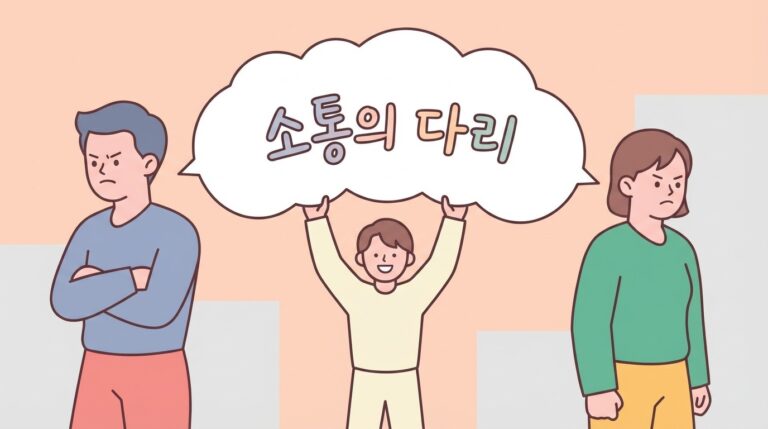
Imagine this: You are watching a intense K-Drama scene. The male lead and female lead had a huge fight. They are standing back-to-back, refusing to speak. The air is so thick you could cut it with a knife. Suddenly, the funny best friend runs between them, delivering messages back and forth like a ping-pong ball.
“He says he’s sorry!”
“She says she’s not hungry!”
In Korea, direct confrontation is often avoided to save face (Chaemyeon). Being the ‘middleman’ or asking for one is a survival skill. Whether you need to resolve a misunderstanding with a co-worker or just need someone to translate your request to a strict taxi driver, knowing how to ask for mediation is crucial.
Today, we learn how to say: “I need a mediator!”
Phase 2: Deep Dive Analysis
Here are the top 3 expressions you need when you’re stuck in the middle or need someone to step in.
1. 대신 말씀 좀 전해 주시겠어요?
- Pronunciation: [Daesin malsseum jom jeonhae jusigesseoyo?] + (Sounds like: Deh-shin mal-sum jom jun-heh ju-shi-gess-uh-yo?)
- Meaning: Could you please tell them for me? (Polite/Formal)
- K-Culture Moment: In a workplace K-Drama, a junior employee (Hoobae) often asks a senior (Sunbae) to convey a difficult request to the scary boss.
- Editor’s Insight: The word ‘대신 (daesin)’ means ‘instead’ or ‘on behalf of.’ This is your magic wand when you are too shy or afraid to speak directly. It implies, “My voice isn’t strong enough, can you lend me yours?”
- Situation Spectrum:
[🚫 Boss] ———— [⚠️ Colleague] ———— [✅ Stranger/Senior]- 🤔 Think About It: Why do Koreans prefer asking a third party rather than speaking directly to a superior? Is it cowardice, or a form of respect for hierarchy?
2. 중간에서 잘 좀 부탁해.
- Pronunciation: [Junggan-eseo jal jom butakae.] + (Sounds like: Jung-gan-eh-suh jal jom bu-tak-keh)
- Meaning: Please handle things well from the middle. (Casual/Semi-formal)
- K-Culture Moment: You’ll see this when two friends are fighting, and a third friend is trying to fix it. The person at fault might whisper this to the mediator.
- Editor’s Insight: This is a very “Korean” phrase. You aren’t just asking them to deliver a message; you are asking them to smooth things over using their Nunchi. You are trusting their social skills to fix the vibe.
- Situation Spectrum:
[🚫 Formal Meeting] ———— [⚠️ Close Colleague] ———— [✅ Friend]- 🤔 Think About It: “Just handle it well (Jal).” This vague word puts a lot of responsibility on the listener. Does your language have a word that relies heavily on context like ‘Jal’?
3. 오해가 있는 것 같아요.
- Pronunciation: [Ohaega inneun geot gatayo.] + (Sounds like: Oh-heh-ga it-nun got ga-ta-yo)
- Meaning: I think there is a misunderstanding.
- K-Culture Moment: The pivotal scene in every romance drama! Before asking for mediation, you must declare that the conflict wasn’t intentional.
- Editor’s Insight: Before asking someone to intervene, use this to soften the situation. It frames the problem as a “mistake” rather than a “fight.”
- Situation Spectrum:
[🚫 None] ———— [⚠️ Caution] ———— [✅ Everyone]
(Safe to use with almost anyone)
Phase 3: Textbook vs. Real Life
| Situation | 📖 Textbook Korean | 🗣️ Real Korean (Insa Style) | 💡 Why the difference? |
|---|---|---|---|
| Asking a friend to pass a message | 제 말을 그 사람에게 전해 주세요. (Please convey my words to that person.) | 야, 걔한테 내 얘기 좀 넌지시 해줘. (Hey, drop a hint about me to them.) | Textbook is too robotic. ‘넌지시 (Nonjeosi)’ adds the nuance of being subtle/indirect. |
| Asking a coworker to mediate | 우리 사이를 중재해 주세요. (Please mediate our relationship.) | 중간에서 다리 좀 놔주세요. (Please build a bridge for us.) | Koreans love metaphors. ‘Building a bridge’ sounds more constructive and less like a legal dispute. |
Bottom Note: If you use the word “중재 (Jungjae – mediation)” with friends, they might laugh because it sounds like a court case. Stick to “다리 놓다 (build a bridge)” or “도와주다 (help).”
Phase 4: Cultural Deep Dive — The Art of ‘Nunchi’
4-1. Non-verbal Communication: The “Pleading Eyes”
When asking someone to be a mediator, your eyes must do 50% of the work. You don’t demand mediation; you appeal for it. Slightly lowered head, worried eyebrows, and a polite two-handed gesture when pouring them a drink (if you are at a cafe/bar) creates the perfect atmosphere for persuasion.
4-2. K-Culture Connection: The “Ojakgyo” (Magpie Bridge)
In Korean folklore and dramas, the mediator is often called an Ojakgyo (오작교). This refers to the magpies that formed a bridge for the star-crossed lovers to meet.
- K-Drama: In Crash Landing on You, the squad members constantly acted as mediators between the leads, explaining cultural misunderstandings.
- Critical View: In dramas, the mediator always succeeds. In reality, getting involved in someone else’s fight is risky! That’s why people might say “끼어들기 싫어” (I don’t want to butt in). You have to convince them it’s worth their trouble.
Phase 5: Immersive Roleplay
Scenario: It’s Tuesday afternoon in the office break room. You (the foreign employee) accidentally offended Manager Kim yesterday by refusing a drink at dinner. The atmosphere is icy. You decide to ask Assistant Lee (Min-su), who is close to Manager Kim, for help.
Characters:
* YOU: Anxious but eager to fix the mistake.
* Min-su (NPC): 30s, kind but busy, knows the office politics well.
Start Dialogue:
Min-su: (Stirring coffee) 휴, 오늘 부장님 기분이 안 좋아 보이시네요. 조심해야겠어요.
(Hyu, oneul bujangnim gibuni an joa boisineyo. Josimhaeyagesseoyo.)
(Phew, Manager looks like he’s in a bad mood today. Better be careful.)
YOU: (Nervous) 사실… 어제 회식 때 제가 실수를 한 것 같아요.
(Sasil… eoje hoesik ttae jega silsureul han geot gatayo.)
(Actually… I think I made a mistake at the team dinner yesterday.)
Min-su: 아, 술 거절하신 거요? 부장님이 좀 서운해하시더라고요.
(Ah, sul geojeolhasin geoyo? Bujangnimi jom seounhaehasideoragoyo.)
(Ah, refusing the drink? He did seem a bit disappointed/hurt.)
🔀 Decision Point: How do you ask for help?
- A) “가서 제가 죄송하다고 말해 주세요.” (Go and tell him I’m sorry.)
- B) “제가 한국 문화를 잘 몰라서 그랬다고… 대신 말씀 좀 전해 주시겠어요?” (Could you tell him I did it because I didn’t know Korean culture well?)
- C) “부장님 왜 삐지셨어요? 민수 씨가 물어봐요.” (Why is he sulking? You ask him Min-su.)
✅ Best Choice: B
* Why? You provide a valid reason (culture) and politely ask Min-su to be the messenger using “대신 (Instead/On behalf of).” This gives Min-su “ammunition” to defend you.
* ⚠️ Choice A: Too demanding. Min-su is not your messenger boy.
* 🚫 Choice C: suicidal. Never use the word “삐지다 (sulk)” regarding a superior. It treats them like a child.
Min-su: (Nods) 알겠어요. 제가 커피 한 잔 드리면서 넌지시 말씀드려 볼게요. 너무 걱정 마세요!
(Algesseoyo. Jega keopi han jan deurimyeonseo nonjeosi malsseumdeuryeo bolgeyo. Neomu geokjeong maseyo!)
(Got it. I’ll drop a hint subtly while giving him coffee. Don’t worry too much!)
Phase 6: 10-Second Shadowing Drill
Let’s practice the “Soft Request” tone. Don’t sound demanding; sound desperate but polite!
🥺 The “Please Help Me” Tone:
저 대신 / 말씀 좀 / 잘 부탁드려요.
(Jeo daesin / malsseum jom / jal butak-deuryeoyo.)
(Please / speak on my behalf / and handle it well.)
Phase 7: K-Culture Mini Glossary
| Korean | Romanization | Meaning | Context |
|---|---|---|---|
| 오해 | Ohae | Misunderstanding | The root of all drama conflicts. |
| 중재 | Jungjae | Mediation | Formal term. Used in serious conflicts. |
| 넌지시 | Nonjeosi | Subtly/Indirectly | How Koreans prefer to give hints. |
| 다리를 놓다 | Darireul nota | To build a bridge | Idiom for connecting two people. |
| 눈치 | Nunchi | Social Awareness | The skill required to be a good mediator. |
Phase 8: Traveler’s Survival Kit
Even if you aren’t fighting with anyone, you need mediators in travel situations! (e.g., You can’t speak Korean, and the taxi driver can’t speak English).
🆘 Survival Phrase: Asking a Stranger for Help
* 🇰🇷 “한국말을 못 하는데, 통역 좀 부탁드려도 될까요?”
* (Hangungmareul mot haneunde, tongyeok jom butakdeuryeodo doelkkayo?)
* Meaning: I can’t speak Korean, could I ask you to translate?
* 📍 Where to use: When you are stuck at a ticket booth or in a taxi and a younger Korean person is nearby.
* 💡 Pro Tip: Look for university students. They are usually eager to help and practice their English!📌 Editor’s Travel Note
* Use Papago: If no human mediator is around, the Papago App is your digital mediator. Show the screen to the driver.
* 1330 Hotline: Call 1330 for a free travel interpreter on the phone. They are the ultimate professional mediators!
Phase 9: Think Deeper — Language & Face
Why is “Indirect Communication” so important?
In Western cultures, being “direct” is often seen as honest and efficient. In Korea, being too direct can cause someone to lose ‘Chaemyeon’ (Face). If you reject a request directly, you damage the relationship. If you criticize someone directly, you humiliate them.
A mediator acts as a buffer. If Min-su tells the boss you are sorry, the boss can accept the apology without looking soft. If the boss rejects the apology, he rejects Min-su, not you directly, which saves your face too. The mediator absorbs the shock of the social collision.
💬 Your Turn: In your culture, do you prefer to confront problems directly, or do you ask a friend to help? Tell us in the comments!
Phase 10: FAQ & Troubleshooting
- Q: Can I pay someone to be a mediator?
- A: In legal situations, yes (lawyers). In daily life? No! Buying them a meal or coffee afterwards is the proper “payment” for their emotional labor.
- Q: K-Pop Fan Question: Can I ask a Korean fan to give my letter to an idol?
- A: You can ask, “이 편지 좀 전해 주실 수 있나요?” (Can you pass this letter?), but be careful. Many fans are busy with their own mission. It’s better to put it in the official box.
❌ Common Mistake: Saying “너가 말해” (You say it) to a senior or stranger.
✅ Correction: Always use “~해 주시겠어요?” (Would you please do it?) or “부탁드립니다” (I ask a favor). “너가 말해” sounds like a command to a servant!
Phase 11: Wrap-up & Mission
One-Liner: When in doubt, don’t shout—ask a mediator to smooth it out!
🚀 Action Mission:
* 🥉 Bronze: Practice saying “오해가 있는 것 같아요” (There is a misunderstanding) with a sad puppy face.
* 🥈 Silver: Watch a K-Drama episode and identify the “Ojakgyo” character who carries messages between the main couple.
* 🥇 Gold: Next time you are at a Korean restaurant with friends, be the mediator! Ask the waiter for something on behalf of your shy friend using “제 친구가 ~라고 하네요.”
See you in the next lesson! Don’t let misunderstandings ruin your day!
Frequently Asked Questions (FAQ)
Q: What does "대신 말씀 좀 전해 주시겠어요?" mean in Korean and how do you pronounce it?
A: In Korean, "대신 말씀 좀 전해 주시겠어요?" is pronounced [Daesin malsseum jom jeonhae jusigesseoyo?] and means: Could you please tell them for me? (Polite/Formal)
Q: What does "중간에서 잘 좀 부탁해." mean in Korean and how do you pronounce it?
A: In Korean, "중간에서 잘 좀 부탁해." is pronounced [Junggan-eseo jal jom butakae.] and means: Please handle things well from the middle. (Casual/Semi-formal)
Q: What does "오해가 있는 것 같아요." mean in Korean and how do you pronounce it?
A: In Korean, "오해가 있는 것 같아요." is pronounced [Ohaega inneun geot gatayo.] and means: I think there is a misunderstanding.







