

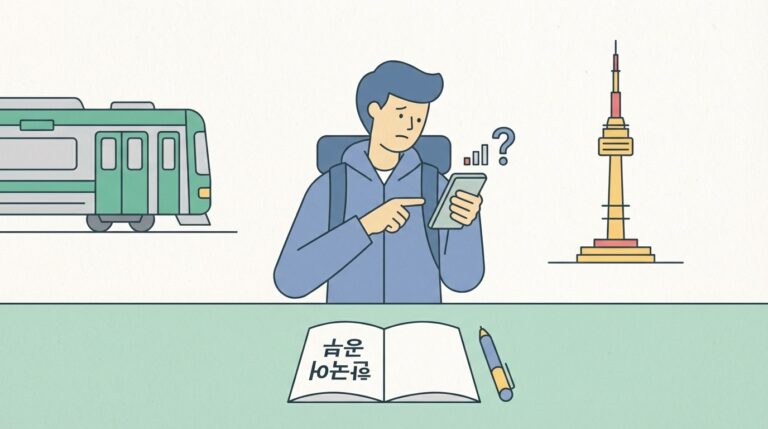
Phase 1: The Panic in the Tunnel 🚇
안녕하세요! This is your Daily Hangul Editor.
Picture this: You are watching a K-Drama. The main character finally gathers the courage to confess their love over the phone. “I actually… I love…” suddenly, the scene cuts to a subway tunnel. Static noise. The line goes dead. Frustrating, right?
Now imagine you are the main character. You’re in a bustling market in Seoul, or maybe in a noisy pocha (tent bar), and your Korean friend calls. You pick up, but all you hear is muffled noise. If you just hang up, they might think you’re rude. If you stay silent, it gets awkward.
Today, we are going to learn the “SOS phrases” for when technology fails us. These aren’t just words; they are your lifeline to keeping a conversation (and a friendship) alive when the connection dies.
Let’s keep it real and practical. Ready? 시작합시다! (Let’s start!)
Phase 2: Core Expressions (Deep Dive) 🗣️
Here are the top 3 phrases you need when your phone signal betrays you.
1. 여보세요? (Yeoboseyo?)
- Pronunciation: [Yeo-bo-se-yo?]
- Sound Analogy: Yeo (like ‘Yummy’) + bo (like ‘boat’) + se (like ‘say’) + yo (like ‘yogurt’).
- Meaning: Hello? (Used only on the phone)
- K-Culture Moment: You know that scene where the villain calls the hero, and the hero picks up aggressively saying “Yeoboseyo?!” It’s not just a greeting; it’s a way to check if someone is there.
- Editor’s Insight: This is the magic button. If the line is silent, you don’t say “Hello?” or “Hi?”. You say “Yeoboseyo?” repeatedly with a rising intonation. It means “Look here” or “Is anyone there?”
- Situation Spectrum:
[🚫 Formal Speech/Stage] ———— [✅ Phone Calls Only] - 🤔 Think About It: “Yeoboseyo” literally comes from “Yeogi boseyo” (Look here). Why do you think Koreans ask someone to “look” when they can only “hear” them on the phone?
2. 잘 안 들려요 (Jal an deullyeoyo)
- Pronunciation: [Jal an deul-lyeo-yo]
- Sound Analogy: Jal (like ‘Jolly’) + an (like ‘On’) + deul (rhymes with ‘Pool’ but with a ‘D’) + lyeo (Leo) + yo.
- Meaning: I can’t hear you well. / It’s not audible.
- K-Culture Moment: In variety shows like Running Man, when members play the “Headphone Challenge” (shouting words while wearing noise-canceling headphones), they scream this face: “An deullyeoyo!” (I can’t hear!)
- Editor’s Insight: This is a soft, polite way to say the problem is the connection, not your ears. It saves face for everyone.
- Situation Spectrum:
[🚫 To the King] ———— [⚠️ Senior/Boss] ———— [✅ Friends/Strangers]
3. 다시 말씀해 주시겠어요? (Dasi malsseumhae jusigesseoyo?)
- Pronunciation: [Da-shi mal-sseum-hae ju-shi-ge-sseo-yo?]
- Sound Analogy: It’s long, but break it down: Da-shi (Again) + Malsseum (Speak – Honorific) + Jusigesseoyo (Would you give?).
- Meaning: Could you please say that again?
- K-Culture Moment: Think of a junior employee talking to a scary CEO in a drama. They wouldn’t say “What?” (Mwo?). They would use this respectful phrase.
- Editor’s Insight: If this is too long, and you are speaking to a friend, just say “뭐라고?” (Mworago? – What did you say?). But sticking to the long version keeps you safe in 100% of situations.
- Situation Spectrum:
[✅ Boss/Stranger] ———— [✅ Teacher] ———— [⚠️ Best Friend (Too formal)]
Phase 3: Textbook vs. Real Life 🥊
| Situation | 📖 Textbook Korean | 🗣️ Real Street Korean | 💡 Why the difference? |
|---|---|---|---|
| Checking Connection | 연결 상태가 좋지 않습니다. (The connection condition is bad.) | 전화가 자꾸 끊겨요. (Jeonhwaga jakku kkeungyeoyo – The call keeps cutting out.) | “Condition is bad” sounds like a robot. “Cutting out” is what actually happens. |
| Can’t hear | 목소리가 들리지 않습니다. (Voice is not audible.) | 잘 안 들려! (Jal an deullyeo!) | In a panic or noisy place, we drop unnecessary words for efficiency (Palli-palli culture!). |
| Asking to Repeat | 다시 한 번 말씀해 주십시오. (Please say it once more.) | 네? / 예? (Ne? / Ye?) | “Ne?” with a rising tone is the universal Korean “Pardon?” It’s short and polite enough. |
Phase 4: Cultural Context — K-Culture Deep Dive 🎭
4-1. The “Ne?” (네?) Culture
In Western cultures, saying “What?” or “Huh?” can be considered rude. In Korea, saying “Ne?” (Yes?) with a sharp, rising intonation is the standard way to say “Pardon?” or “I didn’t hear you.” Don’t be offended if a Korean waiter says “Ne?” to you; they aren’t angry, they just couldn’t hear your order!
4-2. K-Drama Connection: The “Battery Death” Trope
Have you noticed in K-Dramas, right when the misunderstanding is about to be cleared up, the phone beeps and dies? In Korea, having a charged phone is essential for survival (payments, subway maps, translation). If you tell someone “배터리가 없어요” (Battery-ga eopseoyo), they will immediately understand why you might disappear. It’s a valid social excuse to end a call quickly!
Phase 5: Immersive Roleplay 🎬
Scenario: It is Friday night. You are at a noisy Gangnam subway station. Your Korean friend, Minji, is calling to ask where you are.
Characters:
* YOU: A tourist trying to meet a friend.
* Minji (27): Your excited Korean friend.
(Phone Rings 📲)
Minji: (Shouting over background noise) 야! 너 지금 어디야? 도착했어?
(Ya! Neo jigeum eodi-ya? Dochak-haesseo?)
(Hey! Where are you right now? Did you arrive?)
YOU: (It’s too loud, you can’t hear her clearly)
🔀 Your Turn! How do you answer?
A) “I’m sorry, I don’t understand.” (English)
B) “여보세요? 잘 안 들려요!” (Yeoboseyo? Jal an deullyeoyo!)
C) “다시 말씀해 주시겠어요?” (Dasi malsseumhae jusigesseoyo?)
✅ Best Choice (B): Option B is perfect. You check the line with “Yeoboseyo?” and state the problem clearly. Option C is too formal for a friend named Minji!
Minji: 아, 진짜? 지하철이라서 그런가 봐. 카톡 할게!
(Ah, jinjja? Jihacheol-iraseo geureonga bwa. Katok halge!)
(Ah, really? Must be because it’s the subway. I’ll send a KakaoTalk!)
YOU: (Relieved)
🔀 Your Turn! Finish the call.
A) “응, 카톡 해!” (Eung, Katok hae!) – OK, KaTalk me!
B) “안녕히 계세요.” (Annyeonghi gyeseyo.) – Goodbye (formal).
✅ Best Choice (A): Switch to text (KakaoTalk) is the Korean way to solve bad audio connections.
Phase 6: 10-Second Shadowing Drill 🎧
Practice this sentence with the emotion of frustration but politeness.
Sentence: 여보세요? / 죄송한데 / 잘 안 들려요!
Pronunciation: Yeoboseyo? / Joesonghande / jal an deullyeoyo!
Emotional Guide: 😟 (Worried face) -> 🗣️ (Speaking up) -> 😣 (Trying hard to listen)
Meaning: Hello? / I’m sorry but / I can’t hear you well!
Phase 7: K-Culture Mini Glossary 📖
| Korean | Romanization | English | Context |
|---|---|---|---|
| 여보세요 | Yeoboseyo | Hello (Phone) | Used ONLY on the phone. Do not say this to someone’s face unless you are jokingly asking “Are you crazy?” |
| 카톡 | Katok | KakaoTalk | The app used by 99% of Koreans. Often used as a verb: “Let’s Katok.” |
| 와이파이 | Waipai | Wi-Fi | Pronounced with a distinct ‘P’ sound. Korea has Wi-Fi everywhere! |
| 끊겨요 | Kkeun-gyeo-yo | Cutting out | Used when the voice is breaking up. |
Phase 8: Traveler’s Survival Kit 🧳
Situation: You are in a remote area (maybe hiking Seoraksan?) or an elevator, and the signal is weak.
🆘 Survival Phrases
1. “신호가 약해요.” (Sinhoga yakhaeyo.)
* The signal is weak.
2. “다시 걸게요.” (Dasi geolgeyo.)
* I’ll call you back. (Essential for ending a bad call politely!)
3. “문자로 보내주세요.” (Munjaro bonaejuseyo.)
* Please send it by text.📌 Editor’s Travel Note
* Subway Wi-Fi: Even deep underground in Seoul, you usually get full 5G. If you can’t hear, it’s likely the noise, not the signal. Use headphones!
* Quiet Zones: In Korean buses and subways, talking loudly on the phone is frowned upon. If you must talk, whisper or cover your mouth with your hand.
Phase 9: Think Deeper — “Why so fast?” 🧠
Topic: The Culture of ‘Palli-Palli’ (Hurry Hurry) in Communication
Why do Koreans immediately switch to “Katok” (KakaoTalk) if the phone connection is bad for even 5 seconds? It’s the Palli-Palli culture.
In Korea, efficiency is a virtue. Fighting with a bad connection is seen as a waste of time. Switching to text isn’t avoiding the person; it’s respecting their time by choosing the fastest communication method available.
💬 Your Turn: In your country, if the phone connection is bad, do you keep trying to talk, or do you hang up and text? Tell us in the comments!
Phase 10: FAQ & Troubleshooting 🛠️
Q: Can I say “What?” (Mwo?) if I can’t hear?
A: ❌ CAUTION! Saying “Mwo?” (뭐?) is very aggressive, like picking a fight. Even with friends, it can sound annoyed. Use “Mworago?” (What did you say?) for friends, or “Ne?” (Pardon?) for everyone else.
Q: Should I speak louder if they can’t hear me?
A: In public spaces (cafes, subways), NO. Koreans are sensitive to noise volume. It’s better to hang up and text than to shout “YEOBOSEYO?!” in a quiet cafe. You will get the “glare” from others!
❌ Common Mistake: Saying “Yeoboseyo” when you meet someone in person.
✅ Fix: Only use it on the phone! In person, say “Annyeonghaseyo.”
Phase 11: Wrap-up & Mission 🎁
Summary: When the line cuts, don’t panic. Say “Yeoboseyo? Jal an deullyeoyo!” and switch to Katok if needed.
🚀 Action Mission:
* 🥉 Bronze: Look at your phone screen and practice saying “Yeoboseyo?” with a rising tone 3 times.
* 🥈 Silver: Next time you call a friend (even in your own language), pretend the line is bad and whisper the Korean phrase to yourself before switching back.
* 🥇 Gold: Download KakaoTalk and send a voice note to a friend saying, “Can you hear me? Jal deullyeoyo?”
K-Culture Mission: Watch a K-Drama episode involving a phone call (there is always one). Listen for the word “Kkeun-eo” (Hang up) or “Yeoboseyo.” Catch the emotion!
Phase 12: Quiz — Did you hear that? 📝
1. You are on the bus and the connection is bad. What is the BEST thing to do?
* A) Shout “YEOBOSEYO!” until they hear you.
* B) Say “Jal an deullyeoyo, Katok halgeyo” (I can’t hear, I’ll Katok you) and hang up.
* C) Throw the phone away.
2. True or False?
* “Yeoboseyo” can be used to say hello to a shopkeeper when you enter a store.
* (Answer below)
🔑 Click for Answers
- B) Respect the public quiet zone and switch to text!
- False! It is only for the phone. (Or checking on an unconscious person… but let’s hope you don’t need that!)
Frequently Asked Questions (FAQ)
Q: What does "여보세요? (Yeoboseyo?)" mean in Korean and how do you pronounce it?
A: In Korean, "여보세요? (Yeoboseyo?)" is pronounced [Yeo-bo-se-yo?] and means: a key conversational Korean expression covered in this lesson.
Q: What does "잘 안 들려요 (Jal an deullyeoyo)" mean in Korean and how do you pronounce it?
A: In Korean, "잘 안 들려요 (Jal an deullyeoyo)" is pronounced [Jal an deul-lyeo-yo] and means: a key conversational Korean expression covered in this lesson.
Q: What does "다시 말씀해 주시겠어요? (Dasi malsseumhae jusigesseoyo?)" mean in Korean and how do you pronounce it?
A: In Korean, "다시 말씀해 주시겠어요? (Dasi malsseumhae jusigesseoyo?)" is pronounced [Da-shi mal-sseum-hae ju-shi-ge-sseo-yo?] and means: a key conversational Korean expression covered in this lesson.







