

Applying for Overseas Volunteering? Speak Like a K-Drama Hero
Phase 1: The Immersive Hook
안녕하세요! This is your Senior Editor at Daily Hangul.
Picture this: You’re watching the iconic K-Drama Descendants of the Sun (태양의 후예). The doctors and soldiers are in the fictional country of Urk, sweating under the sun, helping locals, and looking incredibly cool while doing it. There’s a scene where Dr. Kang Mo-yeon looks at the landscape and realizes why she’s there. It’s not just about duty; it’s about connection.
Now, imagine you are sitting in an interview room in Seoul, applying for a global volunteer program like KOICA or a university corps. The interviewer adjusts their glasses and asks, “Why do you want to go all the way there?”
If you answer with a simple “I like helping people,” it sounds… nice, but flat. Today, we’re going to learn how to express your passion with the depth of a K-Drama protagonist and the sophistication of a B2-level speaker. We aren’t just translating words; we are translating your sincerity (진심).
Let’s get you ready to spread some of that “Good Influence.”
Phase 2: Deep Dive — 3 Key Expressions
Here are three B2-level expressions that will make your application shine.
1. 보람을 느끼다 (Boram-eul neukkida)
- Pronunciation: [bo-ram-eul neu-kki-da] Sounds like ‘Bo-ram’ (a common name) + ‘ul’ + ‘new-key-da’.
- Meaning: To feel a sense of worth/rewarding (Literal: To feel fruitfulness).
- K-Culture Moment: In variety shows like Jinny’s Kitchen (서진이네), after a long day of serving customers abroad, the cast members wipe their sweat and say, “힘들지만 보람찼어” (It was hard, but rewarding).
- Editor’s Insight: This is the magic word in Korea. Koreans value hard work, but they value the emotional payoff of that work even more. Use this to describe your past experiences.
- Situation Spectrum:
[🚫 Formal Only] ———— [⚠️ Semi-Formal] ———— [✅ Universal]
(It’s safe to use almost anywhere, but crucial for interviews!)- 🤔 Think About It: Why does Korean have a specific noun (boram) just for the feeling of being rewarded by effort? Does your language have a single word for this unique satisfaction?
2. 견문을 넓히다 (Gyeonmun-eul neolpida)
- Pronunciation: [gyeon-mun-eul neol-pi-da]
- Meaning: To broaden one’s horizons/perspectives (Literal: To widen what one sees and hears).
- K-Culture Moment: Every K-Pop idol who returns from a world tour says this in interviews. “Through this tour, I was able to broaden my horizons (견문을 넓히다).”
- Editor’s Insight: This marks you as an intellectual learner. It shows you aren’t just there to “teach” or “give,” but to “learn” and “grow.” Humility is key!
- Situation Spectrum:
[🚫 Casual] ———— [⚠️ Friends] ———— [✅ Formal/Interview]
(Don’t say this to a close friend over soju; they might laugh at you for sounding like a textbook!)- 🤔 Think About It: In Western culture, volunteering is often framed as “saving the world.” In Korea, it’s often framed as “learning from the world.” Why the difference?
3. 작은 힘이나마 보태고 싶습니다 (Jageun him-inama botaego sipseumnida)
- Pronunciation: [ja-geun him-i-na-ma bo-tae-go sip-seum-ni-da]
- Meaning: I want to contribute, even if my strength is small.
- K-Culture Moment: This is classic award acceptance speech material. Actors often say they want to be a “small help” to the industry. It’s the ultimate expression of Korean modesty.
- Editor’s Insight: Memorize this. It kills two birds with one stone: it shows your willingness to work hard AND your extreme modesty. You aren’t saying “I will solve your problems.” You are saying “I will be a helpful gear in the machine.”
- Situation Spectrum:
[🚫 Friends] ———— [⚠️ Colleagues] ———— [✅ Seniors/Interviewers]- 🤔 Think About It: Why is it important to minimize your own contribution size (“small strength”) while maximizing your intent? How does this relate to Korean group harmony?
Phase 3: Textbook vs. Real Life
| Situation | 📖 Textbook Korean | 🗣️ Real Korean (Interview/Application) | 💡 Why the difference? |
|---|---|---|---|
| Explaining Motive | 도와주고 싶어서 지원했습니다. (I applied because I want to help.) |
나눔을 실천하고 싶어서 지원했습니다. (I applied to practice sharing.) |
“Helping” can sound condescending. “Sharing” (나눔) implies equality and mutual benefit. |
| Desired Outcome | 많은 것을 배우고 싶습니다. (I want to learn a lot.) |
현지 문화를 이해하며 성장하는 계기로 삼고 싶습니다. (I want to make this an opportunity for growth while understanding local culture.) |
Use nouns like ‘계기’ (opportunity/turning point) to sound more professional and B2 level. |
| Closing | 열심히 하겠습니다. (I will work hard.) |
선한 영향력을 전하는 봉사자가 되겠습니다. (I will be a volunteer who spreads good influence.) |
“Hard work” is default. “Good influence” is the trendy, culturally relevant goal (thanks to K-Pop fandoms!). |
Bottom Note: In a formal interview, stick to the Real Korean column. Informal slang isn’t appropriate here, but “Real Korean” means using the sophisticated vocabulary that educated native speakers actually use in professional settings.
Phase 4: Cultural Context — The “Nunchi” of Volunteering
4-1. Non-verbal Communication: The “Listener’s Nod”
When explaining your motivation in an interview, do not stare intensely at the interviewer’s eyes 100% of the time. Look at their nose or chin occasionally. Crucially, when they speak, give the gentle nod. It shows you are obedient and ready to listen—vital traits for a team player in overseas missions.
4-2. K-Culture Connection: “Sunhan Young-hyang-ryeok” (Good Influence)
You might hear this term constantly in K-Pop. When BTS fans (ARMY) donate to a cause for a member’s birthday, they call it 선한 영향력 (Good Influence).
In your application, if you mention that you want to spread “Good Influence,” you are tapping into a very modern, positive Korean cultural code. It suggests that your actions will create a ripple effect. It connects the individual action to the collective good.
Phase 5: Immersive Roleplay Scenario
Setting: A bright conference room in Seoul. You are interviewing for a university overseas volunteer corps dispatch to Vietnam. The interviewer is a middle-aged professor who looks strict but fair.
Characters:
* YOU: An enthusiastic but polite applicant.
* Prof. Kim: The interviewer.
(Dialogue Start)
Prof. Kim: 자기소개서에 보니까 한국어 튜터링 경험이 있네요? 베트남에서는 어떤 봉사를 하고 싶어요?
(I see in your cover letter you have Korean tutoring experience. What kind of volunteering do you want to do in Vietnam?)
YOU: 네, 맞습니다. 저는 제가 가진 재능으로 작은 힘이나마 보태고 싶습니다.
(Yes, that’s correct. I want to contribute, even if it’s a small strength, with the talents I have.)
Prof. Kim: (Nods) 흠, 좋은 자세네요. 하지만 현지 생활이 힘들 수도 있어요. 잘 견딜 수 있겠어요?
(Hmm, good attitude. But life there might be tough. Can you endure it?)
YOU: 물론입니다. 힘든 순간도 있겠지만, 그 과정에서 보람을 느낄 수 있다고 확신합니다.
(Of course. There will be hard moments, but I am sure I can feel a sense of reward in the process.)
Prof. Kim: 솔직히 말해서, 본인에게는 어떤 이득이 있다고 생각하나요?
(Honestly speaking, what benefit do you think there is for you?)
🔀 Your Turn! How do you answer this tricky question?
- A) “베트남 여행도 하고 맛있는 것도 먹고 싶습니다.” (I want to travel Vietnam and eat good food.)
- B) “다양한 사람들을 만나며 견문을 넓히고 싶습니다.” (I want to meet diverse people and broaden my horizons.)
- C) “이력서에 한 줄 넣기에 딱 좋은 기회라고 생각합니다.” (I think it’s a perfect opportunity to add a line to my resume.)
✅ Best Choice: B
* Why: Option A is too playful for an interview. Option C is too honest about “Spec” culture (even if it’s true, we don’t say it out loud!). Option B balances personal growth with a professional attitude.
(Roleplay continues with Option B)
YOU: 다양한 사람들을 만나며 견문을 넓히고 싶습니다. 저에게 큰 성장의 기회가 될 것 같습니다.
(I want to meet diverse people and broaden my horizons. I think it will be a huge growth opportunity for me.)
Prof. Kim: (Smiling) 좋아요. 같이 일해보고 싶네요.
(Good. I’d like to work with you.)
Phase 6: 10-Second Shadowing Drill
Let’s practice the “Golden Sentence” for your application. Repeat this until it flows like honey!
Sentence:
“I want to share my talents and broaden my horizons through this activity.”
😊 Passionate & Polite:
이번 활동을 통해 / 제 재능을 나누고 / 견문을 넓히고 싶습니다!
(Ibeon hwaldong-eul tonghae / je jaeneung-eul nanugo / gyeonmun-eul neolpigo sipseumnida!)
💡 Key Point: Pause slightly after “tonghae” and “nanugo” to show you are thinking about your words, not just reciting a script.
Phase 7: K-Culture Mini Glossary
| Korean | Romanization | English | Context |
|---|---|---|---|
| 재능 기부 | Jaeneung gibu | Talent Donation | Volunteering by using your specific skills (teaching, photography, coding) rather than just labor. Very popular concept in Korea. |
| 선한 영향력 | Seonhan yeong-hyang-ryeok | Good Influence | Positive impact on society. Often used by celebs and fans. |
| 스펙 | Spek | Spec (Specification) | Resume qualifications. Sadly, many students volunteer to build “specs,” but you should emphasize “growth” instead. |
| 봉사단 | Bongsa-dan | Volunteer Corps | The organized group you will travel with. |
| 단합 | Danhap | Unity/Teamwork | The most important thing in a Korean group. More important than individual skill. |
Phase 8: Traveler’s Survival Kit (Volunteer Edition)
You are overseas, and you meet a local Korean expat or fellow traveler. You need to explain why you are here.
🆘 Survival Expression #1
* 🇰🇷 “봉사활동 하러 왔어요.” (Bongsa-hwaldong ha-reo wasseoyo.)
* 🗣️ Pronunciation: [Bong-sa hwal-dong ha-ruh wa-ssuh-yo]
* 📍 Where to use: Immigration, hotels, meeting new people.
* 💡 Pro Tip: If they ask “Are you getting paid?”, just smile and say “아뇨, 좋은 마음으로 왔어요” (No, I came with a good heart/intention).📌 Editor’s Travel Note
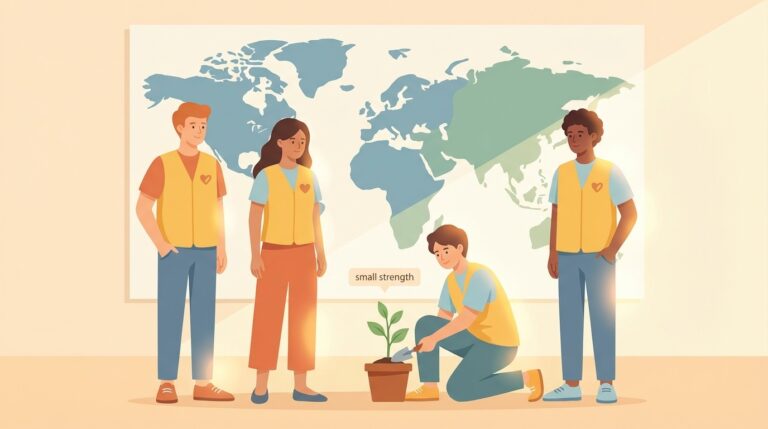
* The Vest: In Korea, volunteers almost ALWAYS wear a bright vest (yellow, orange, blue) with the organization’s name. It’s like a uniform. Wear it with pride; it commands respect from older Koreans!
* Photos: Koreans love documenting volunteer work. Expect to take many group photos holding a banner. Don’t be shy; jump in the photo and make a “fighting” pose!
Phase 9: Think Deeper — “Spec” Culture vs. Sincerity
Let’s dig a bit deeper.
In Korea, there is a concept called “Spec” (스펙)—short for specifications. It refers to the degrees, scores, and experiences needed to get a job. Ideally, volunteering is about altruism. But realistically, for many young Koreans, it is a crucial “Spec” to enter a top company.
Does this make the volunteering less valuable? Think about it. Even if the motivation starts as “building a resume,” the sweat shed and the help given are real. Korean society often accepts this dual nature: pragmatic motivation leading to positive action.
💬 Your Turn: In your country, is volunteering seen as a resume-builder or purely a charitable act? How would you express this balance in Korean?
Phase 10: FAQ & Troubleshooting
Q: Can I say I want to go to [Country Name] because I love their food?
A: Maybe, but be careful. If you say, “I applied for the Vietnam team because I love Pho,” you sound like a tourist. Instead say, “I am interested in Vietnamese culture (including food) and want to deepen my understanding while serving.”
Q: Should I use honorifics to the other volunteers?
A: YES. Until you agree to drop honorifics (말 놓기), always use polite language (-yo form). Overseas volunteer teams often have a strict hierarchy based on age or experience, similar to the military or a company.
❌ Common Mistake #1: Saying “I want to change the world.”
✅ Fix: Too ambitious/arrogant. Say “I want to share warmth” (따뜻한 마음을 나누고 싶습니다). Humble is always better.
Phase 11: Wrap-up & Action Items
One-Liner Summary: To succeed in a Korean volunteer application, combine humility (small strength) with ambition for growth (broadening horizons) and community spirit (good influence).
🚀 Action Mission:
* 🥉 Bronze: Look in the mirror and say “보람을 느끼고 싶습니다” with a genuine smile 3 times.
* 🥈 Silver: Write a 2-sentence self-introduction for a volunteer application using “재능 기부” and “견문을 넓히다” in the comments below.
* 🥇 Gold: Watch an episode of a Korean variety show like Jinny’s Kitchen or a documentary about overseas service (EBS has many!) and spot the word “힘들다” (hard) followed by “보람” (rewarding).
K-Culture Mission: Find a news article about your favorite K-Pop idol’s donation or volunteer work. Search for the keyword “선한 영향력” in the article title!
Phase 12: Quiz — Interactive Challenge
- Situational Judgment: You are asked in an interview: “Why should we pick you?”
- a) Because I am the smartest person here.
- b) Because I want to travel for free.
- c) Because I want to contribute my small strength to the team’s success.
- Fill in the Blank:
- “저는 이번 봉사를 통해 ______을/를 넓히고 싶습니다.” (I want to broaden my horizons.)
- Hint: Begins with ‘gyeo’ … [__________]
- True or False (Culture):
- It is considered arrogant to say you will “teach” the locals. Instead, you should say you will “share” with them. (T/F)
Answers:
1. c) (Humility + Teamwork is the winning combo)
2. 견문 (Gyeonmun)
3. True. Always frame it as a two-way exchange (sharing/learning), not a one-way instruction.
See you next time, and hope you spread your Good Influence to the world! 👋
Frequently Asked Questions (FAQ)
Q: What does "보람을 느끼다 (Boram-eul neukkida)" mean in Korean and how do you pronounce it?
A: In Korean, "보람을 느끼다 (Boram-eul neukkida)" is pronounced [bo-ram-eul neu-kki-da] and means: To feel a sense of worth/rewarding (Literal: To feel fruitfulness).
Q: What does "견문을 넓히다 (Gyeonmun-eul neolpida)" mean in Korean and how do you pronounce it?
A: In Korean, "견문을 넓히다 (Gyeonmun-eul neolpida)" is pronounced [gyeon-mun-eul neol-pi-da] and means: To broaden one's horizons/perspectives (Literal: To widen what one sees and hears).
Q: What does "작은 힘이나마 보태고 싶습니다 (Jageun him-inama botaego sipseumnida)" mean in Korean and how do you pronounce it?
A: In Korean, "작은 힘이나마 보태고 싶습니다 (Jageun him-inama botaego sipseumnida)" is pronounced [ja-geun him-i-na-ma bo-tae-go sip-seum-ni-da] and means: I want to contribute, even if my strength is small.







