

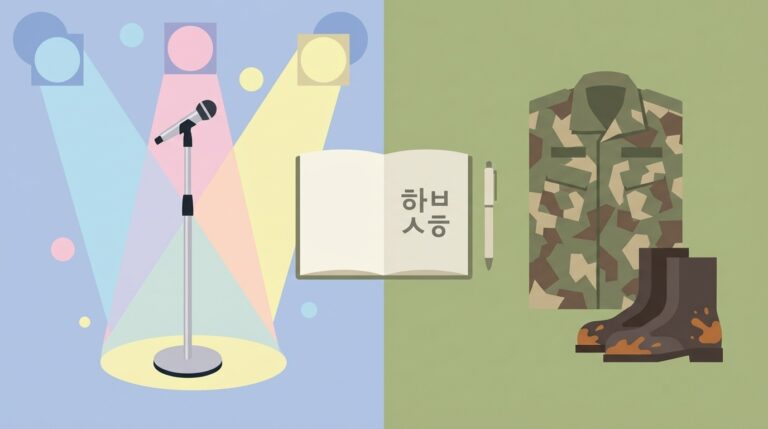
Why Do K-Pop Idols Become “Ajeossi” (Uncles) in Uniform? 🪖
Phase 1: The Immersive Hook
Greeting: 안녕하세요! This is your Daily Hangul Editor.
Picture this: You are watching a K-Drama. The male lead is a sharp, fashionable CEO who melts hearts with a single glance. But suddenly, the scene changes to a flashback. He is wearing a green camouflage uniform, slouching on a plastic chair, eating a Choco Pie with an intense, desperate face. He looks… different. He looks like an “Ajeossi” (middle-aged man).
Even your favorite K-Pop idol, known for his perfect hair and makeup, transforms when he enlists. There is a famous saying in Korea: “군복 입으면 아저씨 된다” (Wearing a military uniform turns you into an ajeossi).
Why does this magical piece of clothing strip away the “Oppa” vibe and replace it with a tired, hungry, and rugged aura? Today, we are decoding the language and culture of the Korean Military Service—a mandatory rite of passage that every Korean man (and his fans/friends) must go through.
Phase 2: Deep Dive into Core Expressions
To understand the “Army Ajeossi” transformation, you need these three words.
1. 군대 가다 [Gundae Gada]
- Pronunciation: [Gun-dae ga-da] + (Sounds like “Goon-day ga-da”)
- Meaning: To go to the army (To enlist)
- K-Culture Moment: In K-Dramas, this is the heartbreak moment. The couple cries at the training center gate. In K-Pop, it’s when the agency announces a “hiatus due to military service.”
- Editor’s Insight: This isn’t just “going to a place.” It implies a 1.5 to 2-year disappearance from society. The mood is usually heavy/sad.
- Situation Spectrum:
[🚫 Formal] ———— [✅ Casual/Polite] ———— [✅ Close Friend]- 🤔 Think About It: In many countries, joining the army is a career choice. In Korea, it’s a duty. How does this “force” change the way people talk about it?
2. 휴가 나오다 [Hyuga Naoda]
- Pronunciation: [Hyu-ga na-o-da] + (Think of “Hyu” as a sigh of relief + “Ga” like go)
- Meaning: To come out on leave (vacation)
- K-Culture Moment: The soldier runs to a BBQ restaurant or a PC Bang (internet cafe). He looks incredibly happy but slightly out of place in the city.
- Editor’s Insight: For a soldier, 휴가 is sweeter than honey. If you have a Korean friend who is “on leave,” treat them nicely. They are desperate for good food and civilian clothes.
- Situation Spectrum:
[✅ Casual] ———— [✅ Polite] ———— [✅ Close Friend]- 🤔 Think About It: Why do you think soldiers call it “coming out” (나오다) instead of just “taking a vacation”? (Hint: It feels like escaping a prison!)
3. 예비군 [Yebigun]
- Pronunciation: [Ye-bi-gun] + (Yeah-bee-goon)
- Meaning: Reserve Forces
- K-Culture Moment: You are on the Seoul subway. You see a group of men in uniform, boots unlaced, hats crooked, looking extremely bored and tired. They are not active soldiers; they are Yebigun.
- Editor’s Insight: This is the peak “Ajeossi” moment. Even if they are 24 years old, once they wear the reserve uniform, they lose all energy. It’s a cultural phenomenon!
- Situation Spectrum:
[✅ Casual] ———— [✅ Polite] ———— [✅ Close Friend]
Phase 3: Textbook Korean vs. Real Korean
| Situation | 📖 Textbook Korean | 🗣️ Real Korean | 💡 Why the difference? |
|---|---|---|---|
| Saying goodbye | 잘 다녀오세요. (Have a safe trip.) | 몸 조심해라. (Watch your body/health.) | Safety is the #1 priority in the army. formality matters less than survival. |
| Military speech | ~습니다 / ~입니다. (Formal ending) | ~지 말입니다. (Specific army slang) | Only used in the army (or by comedians parodying it). It sounds very stiff but iconic. |
| Discharge | 전역을 축하합니다. (Congrats on discharge.) | 민간인 다 됐네! (You’re a total civilian now!) | The highest compliment is acknowledging they are no longer a soldier. |
Phase 4: Cultural Deep Dive — K-Culture Connection
4-1. K-Drama: Fantasy vs. Reality
- The Fantasy: Think “Descendants of the Sun” (태양의 후예). Song Joong-ki looks perfect in uniform, sunglasses on, stepping out of a helicopter. This is the romanticized version.
- The Reality: Think “D.P.” or “Reply 1988” (Jung-hwan’s brother). The uniform is dirty, the food is bland, and the hierarchy is stressful. When Korean men say “Gunbok turns you into an Ajeossi,” they are talking about this gritty reality. The uniform removes your individuality.
4-2. K-Food: The Taste of Tears
- Choco Pie (초코파이): In the civilian world, it’s just a snack. In the army, it is a Michelin-star dessert. It represents the sweetness you miss from the outside world. If a Korean male friend sees a Choco Pie, he might have a nostalgic flashback.
Phase 5: Immersive Roleplay
Scenario: It is Friday night at a Samgyeopsal (Pork Belly) restaurant in Hongdae. Your friend Min-ho (23) is currently serving in the army but is out on leave (휴가). He is wearing his uniform because he didn’t have time to change.
Characters:
* YOU: An international student studying in Korea.
* Min-ho: Your Korean friend, currently a Private First Class. He looks sun-tanned and very hungry.
Dialogue:
Min-ho: 와… 삼겹살 냄새 미쳤다. 진짜 꿈같아.
(Wa… Samgyeopsal naemsae michyeotda. Jinjja kkum gata.)
(Wow… The smell of pork belly is crazy. It feels like a dream.)
(🎭 Stage Direction: Min-ho stares at the grill with tears in his eyes)
YOU: 많이 먹어! 군대에서 이런 거 못 먹지?
(Mani meogeo! Gundaeseo ireon geo mot meokji?)
(Eat a lot! You can’t eat stuff like this in the army, right?)
Min-ho: 응, 짬밥(army food)이랑 비교가 안 돼. 나 콜라 하나만 시켜도 돼?
(Eung, Jjambap-irang bigyoga an dwae. Na colla hanaman sikyeodo dwae?)
(Yeah, it can’t compare to army food. Can I order just one cola?)
🔀 Decision Point: How do you respond?
- A) “Of course! Order whatever you want. It’s on me!” (The “Angel” Friend)
- B) “Sure, but you pay for your own drink.” (The “Western Style” Friend)
- C) “Do you want Soju instead of Cola?” (The “Party” Friend)
✅ Best Choice: A
* Why? In Korean culture, when a soldier comes out on leave, civilian friends usually treat them to a meal. They have little money and limited time. Buying his meal will make you his “best friend for life.”
Phase 6: 10-Second Shadowing Drill
Let’s practice the feeling of relief!
- Context: Your friend just finished his 18 months of service. He is free!
- Emotion: 🎉 Ecstatic / Joyful / Loud
드디어 / 전역했다! / 나는 / 민간인이다!
(Deu-di-eo / jeon-yeok-haet-da! / Na-neun / min-gan-in-i-da!)
Finally / I’m discharged! / I am / a civilian!
Phase 7: K-Culture Mini Glossary
| Korean | Romanization | Meaning | Context |
|---|---|---|---|
| 입대 | Ip-dae | Enlistment | The day every Korean man dreads. |
| 제대 / 전역 | Je-dae / Jeon-yeok | Discharge | The happiest day of their life. |
| 고무신 | Gomusin | Rubber shoes | A slang for a girlfriend waiting for her boyfriend in the army. |
| 꽃신 | Kkotsin | Flower shoes | What the girlfriend wears when he finally finishes service (she successfully waited). |
| PX | P-X | Post Exchange | The convenience store inside the military base. A paradise for soldiers. |
Phase 8: Traveler’s Survival Kit
Scenario: You are riding the subway or bus in Seoul.
🆘 Survival Tip: Seeing Soldiers
* The Sight: You will see young men in camouflage uniforms everywhere in Korea (subways, terminals). Do not be alarmed. There is no war happening right now.
* The Vibe: If they look neat and nervous, they are active soldiers on leave. If they look messy, hat crooked, and sleepy, they are Reservists (Yebigun) going to training.
* Behavior: You don’t need to salute them or stare. Just treat them like regular commuters. If a soldier is carrying a heavy bag, offering a seat is a kind gesture, but not required.📌 Editor’s Travel Note
If you visit areas near the border like Paju or DMZ, you will see many more soldiers. It is strictly forbidden to take photos of military bases or checkpoints. You can get in serious trouble!
Phase 9: Think Deeper — “One Step Further”
Topic: Language & Hierarchy
Why does the Korean military use such strict language (Example: “~da/na/kka” endings)? In the military, hierarchy is everything. The language creates a clear line between superiors and subordinates. However, this culture sometimes spills over into Korean corporate culture. Have you noticed that in some Korean companies, junior staff use very formal language similar to the army? This is a unique trait of Korean society where age and rank dictate the grammar you use.
💬 Your Turn: Does your language change depending on who you are talking to? Share in the comments!
Phase 10: FAQ & Troubleshooting
- Q: Can I ask a Korean guy “Did you serve in the army?”
- A: Yes! Asking “군대 다녀오셨어요?” (Did you come back from the army?) is a great conversation starter for men. Most love to tell their “heroic” stories (even if they exaggerate a bit!).
- Q: Why is calling someone “Ajeossi” bad?
- A: Outside the army, “Ajeossi” means a middle-aged, uncool man. Calling a university student “Ajeossi” just because he is in uniform is a teasing joke. But be careful not to use it seriously!
❌ Common Mistake: Saluting a random soldier on the street as a joke.
✅ Do this instead: Just smile or ignore them. Saluting is a formal act of respect in the military, and doing it wrongly can be awkward or disrespectful.
Phase 11: Wrap-up & Mission
Summary: Wearing a uniform changes a “K-Pop boy” into a tired “Ajeossi” because of the hard training and mentality of the Korean military culture.
🔥 Action Mission:
* 🥉 Bronze: Look in the mirror and practice saying “충성!” (Chung-seong! – Loyalty/Salute) with a sharp hand motion.
* 🥈 Silver: Watch the trailer for the K-Drama “D.P.” on YouTube to see the real military vibe.
* 🥇 Gold: If you have a Korean male friend, ask him: “군대에서 뭐 먹었어?” (What did you eat in the army?) Be prepared for a 30-minute story about Choco Pies!
See you in the next lesson! 충성! (Chung-seong!)
Frequently Asked Questions (FAQ)
Q: What does "군대 가다 [Gundae Gada]" mean in Korean and how do you pronounce it?
A: In Korean, "군대 가다 [Gundae Gada]" is pronounced [Gun-dae ga-da] and means: To go to the army (To enlist)
Q: What does "휴가 나오다 [Hyuga Naoda]" mean in Korean and how do you pronounce it?
A: In Korean, "휴가 나오다 [Hyuga Naoda]" is pronounced [Hyu-ga na-o-da] and means: To come out on leave (vacation)
Q: What does "예비군 [Yebigun]" mean in Korean and how do you pronounce it?
A: In Korean, "예비군 [Yebigun]" is pronounced [Ye-bi-gun] and means: Reserve Forces







