

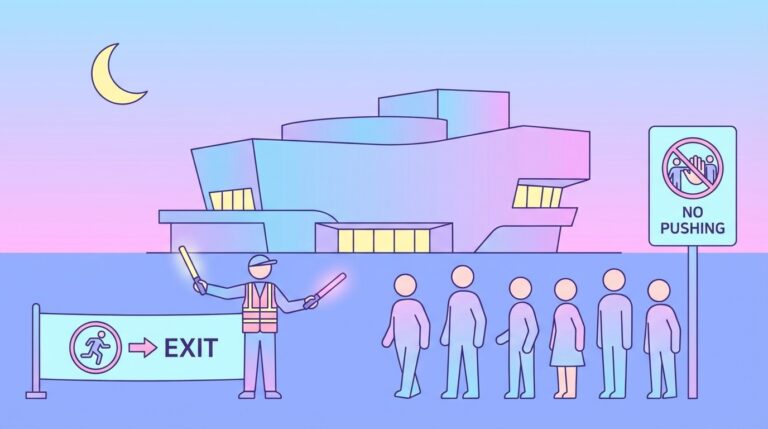
Beyond “Be Careful”: Commanding Safety at K-Events
Phase 1: The Immersive Hook
Hello! This is your Senior Editor at Daily Hangul.
Imagine this: You are part of the planning team for a massive K-Pop festival at the Gocheok Sky Dome. The lights dim, the bass drops, and 20,000 fans surge forward toward the stage. Suddenly, the barricade looks unstable. In this high-pressure moment, a soft “Excuse me” won’t work. You need the authority of a veteran security chief.
In K-Dramas like Producers or behind-the-scenes documentaries of idol concerts, have you noticed how staff members communicate? It’s sharp, loud, yet incredibly polite. They don’t just say “Don’t go there.” They use a specific register of Korean that commands respect while maintaining service etiquette.
Today, we aren’t just learning safety rules; we are learning the Language of Authority and Order essential for anyone interested in Korean Performing Arts Planning. Let’s ensure the show goes on—safely.
Phase 2: Deep Dive into Core Expressions
Since we are targeting C1 (Advanced), we will move beyond basic commands to professional, formal phrasing used in official announcements and on-site management.
1. [동선을 확보해 주십시오]
- Pronunciation: [dong-seon-eul hak-bo-hae ju-sip-si-o] (Sounds like: dong-sun-eul hak-bo-he ju-ship-she-oh)
- Meaning: Please clear the path / Please secure the movement route.
- Context: Literally “secure the movement line.” Used when artists, medical teams, or equipment need to move through a crowd.
- Editor’s Insight: This is far more professional than “비키세요” (Get out of the way). It implies, “We have a planned route, and you are currently blocking it.”
- Situation Spectrum:
[🚫 Casual Friends] ———— [⚠️ Colleagues] ———— [✅ Public/Crowd]- 🤔 Think About It: Why does Korean use the word “secure” (확보) instead of just “open” or “make” space? It treats space as a strategic resource.
2. [안전사고에 유의하시기 바랍니다]
- Pronunciation: [an-jeon-sa-go-e yu-ui-ha-si-gi ba-ram-ni-da]
- Meaning: Please pay attention to prevent safety accidents.
- Context: The standard closing line for almost every pre-show announcement in Korea.
- Editor’s Insight: The verb 유의하다 (to bear in mind/heed) is a step above 조심하다 (to be careful). It sounds intellectual and official. You will hear this incessantly in theaters.
- Situation Spectrum:
[🚫 Casual Friends] ———— [⚠️ Colleagues] ———— [✅ Public Announcements]3. [현장 스태프의 통제에 협조 부탁드립니다]
- Pronunciation: [hyeon-jang seu-tae-peu-ui tong-je-e hyeop-jo bu-tak-deu-rim-ni-da]
- Meaning: We ask for your cooperation with the on-site staff’s control/direction.
- Context: Used when the crowd is getting rowdy or when lines need to be reformed.
- Editor’s Insight: Koreans value cooperation (협조) immensely in public spheres. By asking for “cooperation” rather than “obedience,” you frame the audience as partners in safety, not just subjects.
- 🤔 Think About It: How does phrasing a command as a “request for help” change the psychology of a crowd?
Phase 3: Textbook vs. Real Life (The Professional Cut)
In the high-stakes world of event planning, precision is key. Notice how “Real Korean” often uses Sino-Korean words (Hanja) for brevity and impact.
| Situation | 📖 Textbook / Basic | 🗣️ Professional Field Korean | 💡 Why the difference? |
|---|---|---|---|
| Telling people not to push | 밀지 마세요. (Please don’t push.) | 절대 밀지 마시고, 질서를 유지해 주십시오. (Never push, and please maintain order.) | Professional language appeals to collective order (질서) rather than individual action. |
| Clearing an area | 여기 있으면 안 됩니다. (You can’t be here.) | 이곳은 통제 구역입니다. 신속히 이동해 주십시오. (This is a restricted area. Please move swiftly.) | “Restricted area” (통제 구역) sounds objective and non-negotiable compared to “can’t be here.” |
| Emergency Evacuation | 빨리 나가세요! (Go out quickly!) | 비상구 유도등을 따라 침착하게 대피해 주십시오. (Please evacuate calmly following the emergency exit lights.) | Panic control. Specific instructions (follow lights) prevent chaos better than vague speed commands. |
Phase 4: Cultural Deep Dive — The Art of “Fan Order”
4-1. Non-verbal: The “Light Stick” Baton
In Western concerts, security guards use hands or flashlights. In Korea, staff often use the same light sticks (kyung-gwang-bong) used by traffic police. The way they wave them—rhythmic, repetitive motions—signals “keep moving” without a word spoken. If a staff member crosses their arms in an “X” shape, it is a universal, non-negotiable sign for “No Entry” or “Stop.”
4-2. K-Culture Connection: The Self-Policing Fandom
Have you noticed how organized K-Pop fans are? This is called “Total Order” (질서 정연). In Korean event culture, the audience often polices itself. If someone breaks the rule, other fans will whisper, “Let’s keep manners” (매너 지킵시다).
Critical Perspective: Why is this “order” so intense? It stems from the collective mindset that “My bad behavior reflects badly on my artist.” Safety isn’t just about not getting hurt; it’s about protecting the artist’s reputation. As a planner, you leverage this. You don’t just say “It’s dangerous”; you imply “This causes trouble for the performance.”
Phase 5: Immersive Roleplay Scenario
Setting: A frantic Friday night at an outdoor music festival in Seoul. It started raining, and the floor is slippery. You are the Safety Team Lead.
Characters:
* YOU: Safety Team Lead (Foreigner, fluent in professional Korean).
* Jimin: A passionate fan trying to climb a slippery fence to see better.
Dialogue:
Jimin: (Climbing the fence) 조금만 더 올라가면 보일 것 같은데…
(Just a little higher and I think I can see…)
YOU: (Approaching quickly but calmly) 잠시만요! 그곳은 기대시면 위험합니다.
(Excuse me! It is dangerous to lean there.)
Jimin: 아, 저 진짜 딱 한 번만 보고 내려갈게요!
(Ah, I’ll just look once and come down!)
🔀 Decision Point! How do you respond?
A) “안 된다니까요! 빨리 내려오세요!” (Irritated tone)
B) “고객님, 안전상의 이유로 통제하고 있습니다. 즉시 내려와 주십시오.” (Firm, objective, polite)
C) “다치면 오빠들이 슬퍼해요.” (Emotional appeal)
✅ Best Choice: B
* Why? Option A creates conflict. Option C is patronizing. Option B uses “Safety reasons” (안전상의 이유)—the magic phrase in Korean service that ends arguments. It depersonalizes the refusal.
YOU: 고객님, 안전상의 이유로 통제하고 있습니다. 즉시 내려와 주십시오.
(Customer, we are restricting this for safety reasons. Please come down immediately.)
Jimin: (Reluctantly hopping down) 넵… 알겠습니다.
(Yes… understood.)
Phase 6: 10-Second Shadowing Drill
Practice the authoritative yet polite announcement voice. Pitch your voice slightly lower and speak clearly.
😤 (Firm & Professional)
관람객 여러분은 / 안전 요원의 안내에 따라 / 질서 있게 / 이동해 주시기 바랍니다.
(Gwan-ram-gaek yeo-reo-bun-eun / an-jeon yo-won-ui an-nae-e tta-ra / jil-seo it-ge / i-dong-hae ju-si-gi ba-ram-ni-da.)Translation: Audience members, please move in an orderly fashion following the safety staff’s guidance.
Phase 7: K-Culture Mini Dictionary (Event Planning Edition)
| Korean | Romanization | English | Context |
|---|---|---|---|
| 동선 | dongseon | Movement Route | The holy grail of event planning. “Blocking the dongseon” is a major mistake. |
| 스탠딩석 | seutaending-seok | Standing Area | The most dangerous yet energetic zone. Requires the most safety protocols. |
| 압사 사고 | apsa sago | Crush Injury | A heavy word. Safety briefings often start with preventing this. |
| 대피로 | daepiro | Evacuation Route | Must be clearly marked. |
| 진행 요원 | jinhaeng yowon | Event Staff | Literally “progress agent.” Respectful title for staff. |
Phase 8: Traveler’s Survival Kit (The Concert Goer Edition)
Even if you aren’t planning the event, you might be attending one. Here is how to survive the crush.
🆘 Survival Phrase #1
– 🇰🇷 “너무 밀지 마세요! 숨 막혀요!” (Neomu milji maseyo! Sum makhyeoyo!)
– 🗣️ Meaning: “Don’t push too hard! I can’t breathe!”
– 📍 Use: In the standing pit when the crowd surges.🆘 Survival Phrase #2
– 🇰🇷 “나가는 길 어디예요?” (Naganeun gil eodiyeyo?)
– 🗣️ Meaning: “Where is the exit/way out?”
– 📍 Use: When the venue is confusing and you need fresh air.📌 Editor’s Note: Korean venues often have “Left Baggage” (물품 보관소). Use them. Carrying bags into a standing pit is a safety hazard and frowned upon.
Phase 9: Think Deeper — “Safety” as a Collective Duty
Language & Society:
In English, safety warnings often focus on the individual: “Watch your step,” “Mind your head.” In Korean, safety messages often appeal to the collective atmosphere: “쾌적한 관람을 위해” (For a pleasant viewing experience [for everyone]) or “질서를 유지합시다” (Let’s maintain order together).
This reflects a society where individual safety is intrinsically linked to group harmony. Breaking a safety rule isn’t just risky for you; it’s rude to us. When you speak Korean at a C1 level, adopting this “We” mindset in your phrasing makes you sound much more persuasive and culturally fluent.
💬 Your Turn: How are safety announcements made in your country? Are they commands or requests? Share in the comments!
Phase 10: FAQ & Troubleshooting
- Q: Can I use “Banmal” (casual language) if the audience members are younger than me?
- No. As staff, you represent the organization. Even if dealing with middle schoolers, use polite language (해요체 or 하십시오체). Using Banmal can be seen as “Gapjil” (abuse of power) and escalate the situation.
- Q: What if someone refuses to listen?
- Do not get physical. Call for “경호 팀” (Security Team). Your phrase is: “경호 팀 지원 바랍니다.” (Requesting support from the security team.)
- ❌ Common Mistake: Shouting “비켜!” (Move!)
- ✅ Correction: “잠시 길 좀 터 주시겠습니까?” (Could you please open up the path for a moment?)
Phase 11: Wrap-up & Action Mission
One-Liner: Professional safety language is about balancing Authority (통제) with Empathy (협조).
🏆 Action Missions:
* 🥉 Bronze: Stand in front of a mirror and practice the “X” arm sign while saying “이곳은 통제 구역입니다.”
* 🥈 Silver: Watch a K-Pop concert video on YouTube. Listen for the announcer’s voice before the show starts. Can you hear “유의하시기 바랍니다”?
* 🥇 Gold: Next time you are in a crowded place in Korea (subway, festival), mentally map out the “Dongseon” (flow) and imagine how you would direct people.
Phase 12: Quiz — Interactive Challenge
1. Situational Judgment:
There is a fire alarm. You need to evacuate 500 people. Which phrase is best?
* A) 불이야! 다 나가! (Fire! Everyone get out!)
* B) 당황하지 마시고 안내에 따라 대피해 주십시오. (Do not panic, please evacuate following instructions.)
* C) 집에 가세요. (Please go home.)
2. Fill in the Blank:
“For a safe performance, please ______ with the staff.”
* “안전한 공연을 위해 스태프에게 [ ________ ] 부탁드립니다.”
* (Hint: Cooperation / hyeop-jo)
3. True or False (Culture):
In Korea, it is considered polite for staff to physically push people to make them move faster. (T/F)
Answers:
1. B (A causes panic, C is unclear).
2. 협조 (Cooperation).
3. False. While light touching happens in extreme crowds, intentional pushing is rude and dangerous. Verbal control is prioritized.
Frequently Asked Questions (FAQ)
Q: What does "[동선을 확보해 주십시오]" mean in Korean and how do you pronounce it?
A: In Korean, "[동선을 확보해 주십시오]" is pronounced [dong-seon-eul hak-bo-hae ju-sip-si-o] and means: Please clear the path / Please secure the movement route.
Q: What does "[안전사고에 유의하시기 바랍니다]" mean in Korean and how do you pronounce it?
A: In Korean, "[안전사고에 유의하시기 바랍니다]" is pronounced [an-jeon-sa-go-e yu-ui-ha-si-gi ba-ram-ni-da] and means: Please pay attention to prevent safety accidents.
Q: What does "[현장 스태프의 통제에 협조 부탁드립니다]" mean in Korean and how do you pronounce it?
A: In Korean, "[현장 스태프의 통제에 협조 부탁드립니다]" is pronounced [hyeon-jang seu-tae-peu-ui tong-je-e hyeop-jo bu-tak-deu-rim-ni-da] and means: We ask for your cooperation with the on-site staff's control/direction.







