

Phase 1: The ‘K-Vibe’ Hook – Are You a Math Robot or a Storyteller?
Hello! This is your Daily Hangul Editor.
Picture this: You are watching a variety show featuring your favorite K-Pop group. The MC asks the leader, “How many people are in your family?” The leader smiles and mentions their parents, a younger sister, and… their dog, Dubu.
But wait, when they count, they don’t use the numbers you learned in math class (Il, I, Sam). They use a completely different set of words.
If you use the wrong number system here, you won’t sound like a charming idol; you’ll sound like a calculator trying to solve an equation.
Today, we are going to fix that. We’re not just counting heads; we’re talking about your squad (family). This is one of the first questions Koreans will ask to get to know you personally. Let’s make sure you answer with the warmth and natural flow of a local.
(Transparency Note: This guide is based on real questions from students who got confused between the two number systems in Korea!)
Phase 2: Deep Dive – The Core Expressions
Here are the three golden phrases you need to master.
1. 가족이 몇 명이에요? (Gajogi myeon myeong-ieyo?)
- Pronunciation: [Gajog-i myeon myeong-ie-yo?]
- Tip: ‘Myeong’ sounds a bit like the start of ‘Meow’ but with an ‘ng’ at the end.
- Meaning: How many people are in your family?
- K-Culture Moment: This is the classic ‘profile check’ question on talk shows. It’s also a standard icebreaker on blind dates (sogeting) to see if you have many siblings (which implies personality traits in Korean culture!).
- Editor’s Insight: The key word is ‘Myeong’ (↓). This is the ‘counter’ specifically for people. You cannot just say the number; you must attach ‘myeong’.
- Situation Spectrum:
[✅ Casual] ———— [✅ Semi-formal] ———— [☐ Formal (Use ‘Bun’ instead of ‘Myeong’)]- 🤔 Think About It: Why does Korean have a specific word just for counting people? It separates humans from objects. Using the object counter (gae) for people is extremely rude!
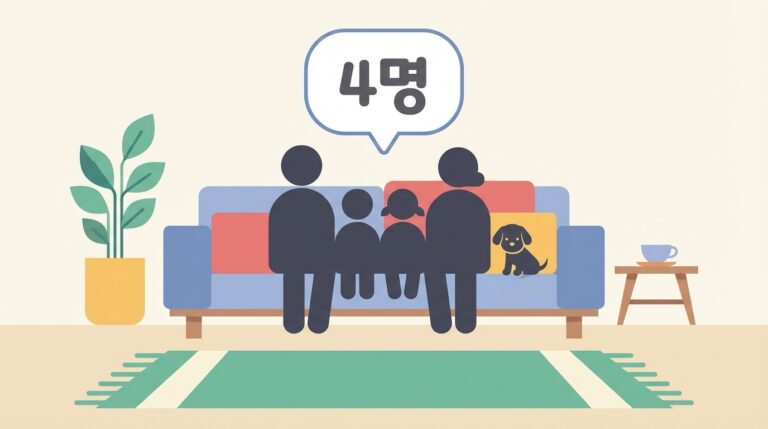
2. 저희 가족은 네 명이에요. (Jeohui gajogeun ne myeong-ieyo.)
- Pronunciation: [Jeo-hui gajog-eun ne myeong-ie-yo]
- Tip: ‘Ne’ sounds like the ‘Ne’ in ‘Net’ or ‘Neck’.
- Meaning: My (our) family is four people.
- K-Culture Moment: In K-Dramas, the ‘family of four’ (Mom, Dad, Son, Daughter) used to be the ‘golden standard.’ Nowadays, smaller families are common, but this answer is still the textbook classic.
- Editor’s Insight: Notice we used ‘Jeohui’ (humble ‘our’) instead of ‘My’. And we used ‘Ne’, which comes from the Native Korean number 4 (Net). When counting people, always use Native numbers (Hana, Dul, Set, Net…).
- 1 person: Han myeong
- 2 people: Du myeong
- 3 people: Se myeong
- 4 people: Ne myeong
- Situation Spectrum:
[✅ Casual] ———— [✅ Semi-formal] ———— [✅ Formal]3. 부모님하고 저, 세 명이에요. (Bumonimhago jeo, se myeong-ieyo.)
- Pronunciation: [Bumo-nim-hago jeo, se myeong-ie-yo]
- Meaning: Parents and me, (so) three people.
- K-Culture Moment: This is how you explain who they are. In a K-Pop live stream, an idol might list their family members on their fingers like this.
- Editor’s Insight: ‘Hago’ means ‘and’ or ‘with’. It’s a very spoken-style connector. It connects the members to form the total sum.
- Situation Spectrum:
[✅ Casual] ———— [✅ Semi-formal] ———— [⚠️ Formal]- 🤔 Think About It: Koreans rarely just say the number. They usually list the composition (e.g., “Mom, Dad, and me”). Why? Because who fits into the hierarchy is often more important than the total count.
Phase 3: Textbook vs. Real Life
Let’s see how this sounds in the classroom versus a BBQ restaurant in Seoul.
| Situation | 📖 Textbook Korean | 🗣️ Real Life Korean | 💡 Why the difference? |
|---|---|---|---|
| Asking | 가족이 몇 명입니까? (Gajogi myeon myeong-imnikka?) |
가족이 어떻게 되세요? (Gajogi eotteoke doeseyo?) |
The textbook version is too interrogative. The real version asks “How is your family formed?” which is softer and politer. |
| Answering | 저는 형이 한 명 있습니다. (Jeoneun hyeongi han myeong iss-seumnida) |
형 하나 있어요. (Hyeong hana isseoyo.) |
Spoken Korean drops particles and formalities for speed. ‘Hana’ (one) is sometimes used without ‘myeong’ in very casual speech. |
💡 Editor’s Note for A2 Learners: Stick to “~myeong isseoyo” for now. It’s the perfect balance of polite and natural!
Phase 4: Cultural Deep Dive – The “Uri” (Us) Mindset
4-1. Non-verbal Cue: The Finger Count
When listing family members, Koreans often fold their fingers inwards (starting from the thumb) rather than pointing them out. Also, when talking about parents, use both hands or a polite nod. Never point your index finger at a photo of your parents when introducing them!
4-2. K-Culture Connection: K-Drama & The ‘Nuclear’ vs. ‘Big’ Family
In K-Dramas like Reply 1988, you see the Da-gajok (Big family) where everyone shares food, noise, and space. In modern dramas featuring young professionals in Seoul, you see the 1-in gagu (Single-person household).
When you say “I live alone” (Honja sarayo), Koreans might react with “Really? Are you lonely?” or “Wow, freedom!” depending on their generation. The concept of family size is tied closely to the idea of Jeong (affection/attachment). A small number isn’t just a statistic; it implies the density of your relationships.
Phase 5: Immersive Roleplay – The Cafe Chat
Setting: It’s a lazy Sunday afternoon at a trendy cafe in Seongsu-dong. You are having an iced americano with Minji (25, your new language exchange partner).
Minji: (Showing a phone screen) 이게 우리 언니야. 진짜 웃기지?
(Ige uri eonni-ya. Jinjja utgiji?)
(This is my older sister. She’s really funny, right?)
YOU: 와, 예뻐요! 민지 씨는 형제가 어떻게 돼요?
(Wa, yeppeoyo! Minji-ssi-neun hyeongjega eotteoke doeyo?)
(Wow, she’s pretty! How about your siblings? / What’s your sibling situation?)
Minji: 언니 한 명, 남동생 한 명 있어요. 총 다섯 식구예요.
(Eonni han myeong, namdongsaeng han myeong isseoyo. Chong daseot sikgu-yeyo.)
(I have one older sister and one younger brother. Total 5 family members.)
📝 Vocabulary Check: Sikgu (식구) literally means “mouths to feed.” It’s a very warm word for family living together.
Minji: XX 씨는요? 가족이 몇 명이에요?
(XX-ssi-neunyo? Gajogi myeon myeong-ieyo?)
(How about you? How many in your family?)
🗠️ YOUR TURN! Choose your answer:
Option A: “세 명이에요. 부모님하고 저요.”
(Se myeong-ieyo. Bumonimhago jeoyo.)
– “Three people. Parents and me.”Option B: “저는 혼자 살아요.”
(Jeoneun honja sarayo.)
– “I live alone.”Option C: “강아지 두 마리랑 살아요!”
(Gangaji du marirang sarayo!)
– “I live with two puppies!”
✅ Best Choice Analysis:
– Option A is the standard, safe answer.
– Option C is a great conversation starter! In Korea, pets are increasingly considered family (Banryeo-dongmul). Minji would likely ask to see photos immediately.
Phase 6: 10-Second Shadowing Drill
Practice these lines to get the rhythm right. Pay attention to the pauses!
- 😊 Brightly: 저희 가족은 / 네 명이에요.
(Jeo-hui ga-jogeun / ne myeong-ie-yo.) -
🤔 Thinking: 음… 부모님하고 / 누나 한 명 / 있어요.
(Eum… Bumo-nim-hago / nuna han myeong / isseo-yo.) -
🐶 Excited: 저는 / 고양이랑 / 살아요!
(Jeo-neun / go-yangi-rang / sara-yo!)
Phase 7: K-Culture Mini Glossary
| Korean | Romanization | Meaning | Context |
|---|---|---|---|
| 우리 | Uri | Us/Our | Koreans say “Our Mom” instead of “My Mom”. It shows the collective spirit. |
| 식구 | Sikgu | Family member | Lit. “Mouth to eat.” implies people who share meals together. |
| 외동 | Oedong | Only child | “저 외동이에요” (I’m an only child). |
| 막내 | Maknae | Youngest | The youngest in the family/group. K-Pop groups always have a Maknae! |
| 반려견 | Banryeogyeon | Companion Dog | A more respectful term for pet dogs than just gae. |
Phase 8: Traveler’s Survival Kit
While this unit is about family, the counting skill directly transfers to Restaurant Survival!
🆘 Survival Phrase: Getting a Table
🇰🇷 You: “두 명이에요.” (Du myeong-ieyo)
– Meaning: “We are two people.”
– Use at: Restaurant entrance when the server looks at you.
– 💡 Pro Tip: You can just hold up two fingers and say “Du myeong!” (Two people!). Just make sure to smile so it doesn’t look rude.📌 Editor’s Travel Note:
Never use Sino-Korean numbers (Il, I, Sam) for people! If you say “I myeong” (Two people using the math number 2), the server will understand, but they might giggle because it sounds very unnatural. Stick to Hana, Dul, Set!
Phase 9: Think Deeper – “My” vs. “Us”
Let’s talk about “Uri” (Our).
When you introduce your mom in English, you say “My Mom.” But in Korean, if you say “Nae eomma” (My Mom), it sounds a bit childish or too individualistic. Most adults say “Uri eomma” (Our Mom), even if they are the only child standing there talking to you.
🧠 Why? This reflects Korea’s collectivist history. The family belongs to the ‘whole,’ not just to ‘me.’ This extends to “Our country” (Uri nara) and “Our house” (Uri jip).
💬 Your Turn: Does your language have a distinction like this? Or would saying “Our Mom” sound super weird? Share in the comments!
Phase 10: FAQ & Troubleshooting
Q: Can I count my cat as a family member?
A: YES! Absolutely. Modern Korea loves pets. You can say “세 식구예요” (Three family members) and clarify: “저, 남편, 그리고 고양이요” (Me, husband, and cat). It’s very acceptable and shows you are a loving pet owner.
Q: I forgot the Native numbers (Hana, Dul…). Can I use One, Two, Three?
A: If you panic, use English numbers or finger gestures! It’s better than using Sino-Korean (Il, I, Sam) for people, which really confuses the listener’s brain because those numbers are for dates, minutes, and money.
❌ Common Mistake Alert:
Don’t say: “가족이 두 개 있어요.” (I have two items of family.)
Gae is the counter for inanimate objects (apples, pencils). Using this for parents sounds like you bought them at a store!
✅ Always use: “가족이 두 명 있어요.”
Phase 11: Wrap-up & Action Mission
Summary: Use Native numbers (Hana, Dul, Set, Net) + Myeong to count people. Use Uri (Our) instead of My.
🚀 Action Mission:
– 🥉 Bronze: Stand in front of a mirror and say how many family members you have 3 times.
– 🥈 Silver: Post a photo of your family (or pet) on your social media with the caption: “우리는 O명이에요!” (We are O people!)
– 🥇 Gold: Go to a Korean restaurant. When they ask “Myeot bun-iseyo?” (How many people?), answer confidently: “Du myeong-ieyo!”
K-Culture Mission: Watch a K-Pop group interview (like ‘Knowing Bros’). Wait for the introductions. Try to catch the word ‘Maknae’ (youngest) or hear them counting members!
Phase 12: Quiz – Are You Ready?
1. Which is the CORRECT way to say “Two people”?
A) I myeong (이 명)
B) Du gae (두 개)
C) Du myeong (두 명)
2. True or False?
Koreans often use the word “Uri” (Our) even when talking about their own individual mother.
3. Situation Check:
You are at a restaurant with 3 friends (Total 4). The server looks at you. You say:
A) “Net!” (Four!)
B) “Ne myeong-ieyo.” (We are four people.)
C) “Sa myeong-ieyo.” (Four people – using Sino number)
🔑 Answers:
1. C (Native number ‘Du’ + Person counter ‘Myeong’)
2. True (The collective mindset!)
3. B (Polite and uses the correct counting system.)
Frequently Asked Questions (FAQ)
Q: What does "가족이 몇 명이에요? (Gajogi myeon myeong-ieyo?)" mean in Korean and how do you pronounce it?
A: In Korean, "가족이 몇 명이에요? (Gajogi myeon myeong-ieyo?)" is pronounced [Gajog-i myeon myeong-ie-yo?] and means: a key conversational Korean expression covered in this lesson.
Q: What does "저희 가족은 네 명이에요. (Jeohui gajogeun ne myeong-ieyo.)" mean in Korean and how do you pronounce it?
A: In Korean, "저희 가족은 네 명이에요. (Jeohui gajogeun ne myeong-ieyo.)" is pronounced [Jeo-hui gajog-eun ne myeong-ie-yo] and means: a key conversational Korean expression covered in this lesson.
Q: What does "부모님하고 저, 세 명이에요. (Bumonimhago jeo, se myeong-ieyo.)" mean in Korean and how do you pronounce it?
A: In Korean, "부모님하고 저, 세 명이에요. (Bumonimhago jeo, se myeong-ieyo.)" is pronounced [Bumo-nim-hago jeo, se myeong-ie-yo] and means: Parents and me, (so) three people.







