

Phase 1: Immersive Hook — The “K-Drama” Moment 🎬
“Hello! This is your Daily Hangul Editor.”
Picture this: You are watching a tense scene in a K-Thriller like Squid Game or All of Us Are Dead. The main character is running from a zombie (or a debt collector!), trips over, and reaches out their hand screaming one specific word.
Subtitles say: “Help me!”
But then, switch the channel to a romance drama. The heroine drops her heavy stack of papers, and a handsome stranger stops to assist. She says, “Help me?”
Wait a minute. In Korean, these are two totally different words! 😲
If you scream the “Zombie Word” when you just need help finding a bathroom, people will panic. If you whisper the “Paper Drop Word” when you are in real danger, no one might hear you.
Today, we are going to learn how to save your own life (literally) and how to ask for a helping hand without scaring the locals. Let’s get you safe and sound in Seoul!
Phase 2: Deep Dive — 3 Ways to Cry for Help 🆘
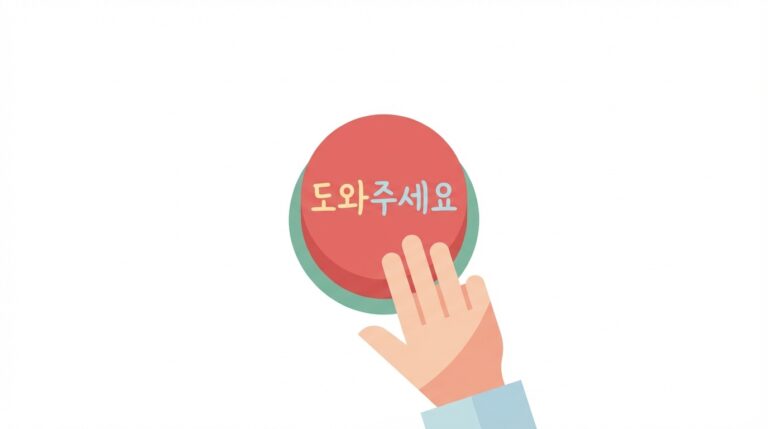
1. 도와주세요 (Dowajuseyo)
- Pronunciation: [Do-wa-ju-se-yo]
- Sound-alike: Dough-wah-Juice-say-yo.
- Meaning: Please help me. (General assistance)
- K-Culture Moment: Think of a variety show like Running Man. A member is stuck on a mission and asks a passerby for directions. They say, “Please help me!”
- Editor’s Insight: This is your Swiss Army Knife. Lost passport? Heavy bag? Can’t read the menu? Use this. It implies you need assistance with a task.
- Situation Spectrum:
[🚫 Boss] ———— [⚠️ Stranger (Polite)] ———— [✅ Friendly]
(Use this safely with strangers!) - 🤔 Think About It: In English, “Help” covers everything. Why does Korean distinguish between “assisting with a task” and “saving a life”? What does this say about the intensity of words?
2. 살려주세요 (Sallyeojuseyo)
- Pronunciation: [Sal-lyeo-ju-se-yo]
- Sound-alike: Sal (like ‘Sal’mon) – lyeo – Juice – say – yo.
- Meaning: Please save me. (Life or death)
- K-Culture Moment: Train to Busan. The zombies are breaking the glass. The character screams this. It means “I don’t want to die!”
- Editor’s Insight: ⚠️ WARNING! Do not use this if you just lost your wallet. People will think you are being kidnapped or having a heart attack. Use ONLY in real emergencies.
- Situation Spectrum:
[🚫 Casual] ———— [⚠️ Urgent Only] ———— [✅ Life/Death]
3. 저기요 (Jeogiyo)
- Pronunciation: [Jeo-gi-yo]
- Sound-alike: Jug-ee-yo.
- Meaning: Excuse me / Hey over there.
- K-Culture Moment: Every restaurant scene ever. You need water? You raise your hand and say “Jeogiyo!”
- Editor’s Insight: Before you ask for help, you need to get attention. You can’t just start talking to a stranger’s back. This is the “tap on the shoulder” word.
Phase 3: Textbook vs. Real Life 🗣️
| Situation | 📖 Textbook Korean | 🗣️ Real Street Korean | 💡 Why is it different? |
|---|---|---|---|
| Getting Attention | 실례합니다 (Sillyehamnida) | 저기요! (Jeogiyo!) | Sillyehamnida is very formal/polite. Jeogiyo is faster and louder for grabbing attention on the street. |
| Small Help | 도와주시겠습니까? (Dowajusigesseumnikka?) | 좀 도와주세요 (Jom dowajuseyo) | The textbook version sounds like a robot. Adding ‘Jom’ (a little) makes it softer and more natural. |
| Emergency | 구조 요청합니다 (Gujo yocheonghamnida) | 살려주세요!! (Sallyeojuseyo!!) | Nobody uses formal grammar when a zombie is chasing them. Short & desperate wins! |
💡 Editor’s Note: For A1 beginners, stick to “Jeogiyo, dowajuseyo” (Excuse me, please help). It works 99% of the time!
Phase 4: Cultural Deep Dive — The “Nunchi” of Help 🧠
4-1. Non-verbal: The “Emergency Eyes”
In Korea, Nunchi (eye-measure) is key. If you approach someone looking relaxed, asking for directions is fine. But if they are power-walking with headphones on, try to find someone else.
Tip: If you can’t speak, cross your arms in an ‘X’ shape above your head. This is a universal sign in Korea for “Something is wrong” or “No/Stop.”
4-2. K-Travel Connection: The “Citizen Hero”
Korea has a strong culture of Civic Duty. You will often see news stories of citizens lifting a car to save someone trapped underneath.
Think Deeper: Koreans might seem shy or indifferent on the subway (everyone looking at phones), but if you shout “Dowajuseyo!” loudly, the “Community Spirit” activates. The indifference is just a city shell; the helpfulness is underneath.
Phase 5: Immersive Roleplay 🎭
Scenario: It is 11:00 PM in Gangnam. You lost your friends, your phone battery is dead, and you don’t know where the subway station is. You see a university student walking by.
Characters:
* YOU: A lost tourist (Panic level: 70%)
* MINSU: A Korean student (Walking home, wearing headphones)
Dialogue:
(You approach Minsu and wave your hand)
YOU: 저기요! (Jeogiyo!)
(Excuse me!)
MINSU: (Takes off headphones) 네? (Ne?)
(Yes?)
YOU: 도와주세요. 길을 잃었어요. (Dowajuseyo. Gireul ireosseoyo.)
(Please help me. I am lost.)
MINSU: 아, 어디 가세요? (Ah, eodi gaseyo?)
(Ah, where are you going?)
🔀 Decision Point: How do you answer?
- A) “Subway?” (Just the word)
- B) “Gangnam Station, please.” (Polite English/Konglish)
- C) “Sallyeojuseyo!” (Save me!)
✅ Best Choice: B — Koreans usually understand station names. Adding “Please” shows manners.
⚠️ Why not C? — You are not dying! Minsu might call the police if you scream “Save me.”
Phase 6: 10-Second Shadowing Drill 🎤
Let’s practice! Read the slash / as a pause.
- To get attention (Polite/Urgent):
🙌 저기요! / 도와주세요!
(Jeo-gi-yo! / Do-wa-ju-se-yo!) -
To the taxi driver (Desperate):
😰 병원으로 / 가주세요!
(Byeong-won-eu-ro / ga-ju-se-yo!)
Translation: Please go to the hospital! -
Real Emergency (Loudly!):
📢 119에 / 전화해주세요!
(Il-il-gu-e / jeon-hwa-hae-ju-se-yo!)
Translation: Please call 119!
Phase 7: K-Culture Mini Glossary 📖
| Korean | Romanization | Meaning | Context |
|---|---|---|---|
| 112 | Il-il-i | Police 👮 | Call for theft, fighting, or crime. |
| 119 | Il-il-gu | Fire/Ambulance 🚑 | Call for fire or medical emergency. |
| 응급실 | Eunggeupsil | Emergency Room | Where K-Drama leads go after a car accident. |
| 파출소 | Pachulso | Police Box | Small police stations found in every neighborhood. Very helpful for directions! |
Phase 8: Traveler’s Survival Kit 🧳
Heading to Korea? Save this card to your phone!
🆘 SOS Cheat Sheet
- “I lost my passport.”
🇰🇷 여권을 잃어버렸어요. (Yeogwoneul ireobeoryeosseoyo.)- “Please call the police.”
🇰🇷 경찰을 불러주세요. (Gyeongchareul bulleojuseyo.)- “Does anyone speak English?”
🇰🇷 영어 하시는 분 계세요? (Yeong-eo hasineun bun gyeseyo?)💡 Pro Tip: If you dial 1330 in Korea, it is a Free Travel Helpline available in English 24/7. They can interpret for you over the phone!
Phase 9: Think Deeper — “Why so safe?” 🤔
Topic: Media vs. Reality
If you watch K-Thrillers, you might think Seoul is full of serial killers and zombies. But in reality, Korea is one of the safest countries in the world. You will often see people leaving laptops on cafe tables or walking alone at 2 AM.
The Paradox: Why is Korean media so dark when the country is so safe?
Perhaps art acts as an outlet for the stress of a highly organized society. Or maybe, because daily life is so safe, the “fear” in movies feels more thrilling. What do you think? How does this compare to your country?
Phase 10: FAQ & Troubleshooting 🛠️
Q: Can I just shout “HELP” in English?
A: Yes! “Help” is a very basic word that most Koreans understand. However, shouting “Dowajuseyo” shows you are trying, and people might react faster because it hits their “local language brain.”
Q: Is it rude to touch someone to ask for help?
A: Maybe. Try to avoid touching strangers. Use your voice (“Jeogiyo!”) or wave your hand. Tapping a shoulder is a last resort if they have headphones on.
❌ Common Mistake #1: Smiling while saying “Dowajuseyo.”
✅ Fix: If it’s an emergency, look urgent! If you smile, people might think you are a salesperson or a cult recruiter (yes, that happens on the streets!).
Phase 11: Wrap-up & Action Mission 🚀
Summary: Use “Dowajuseyo” for tasks, “Sallyeojuseyo” for saving your life, and “Jeogiyo” to get attention first.
🏆 Your Mission:
- 🥉 Bronze: Stand in front of a mirror and practice your “Urgent Face” while saying “Dowajuseyo!” 3 times.
- 🥈 Silver: Watch a K-Drama action scene. Can you hear the difference between Dowajuseyo and Sallyeojuseyo?
- 🥇 Gold: (If in Korea) Ask a stranger for directions using “Jeogiyo, dowajuseyo…” even if you have Google Maps!
💬 Question: In your country, if someone falls down on the street, do people rush to help, or do they give space? Tell me in the comments!
Phase 12: Quiz — Survival Check ✅
1. You are at a restaurant and dropped your chopsticks. You need the waiter. What do you say?
* A) Sallyeojuseyo! (Save me!)
* B) Jeogiyo! (Excuse me!)
* C) Sillyehamnida. (Formal Excuse me)
2. A zombie is chasing you in a train station. What do you scream?
* A) Jeogiyo!
* B) Dowajuseyo!
* C) Sallyeojuseyo!
3. True or False?
* Calling 112 in Korea connects you to the Pizza delivery service. (T/F)
Answers:
1. B (A is too dramatic, C is too stiff)
2. C (Though B works, C fits the “life or death” vibe better!)
3. False (112 is Police! Pizza is usually ordered via apps!)
Frequently Asked Questions (FAQ)
Q: What does "도와주세요 (Dowajuseyo)" mean in Korean and how do you pronounce it?
A: In Korean, "도와주세요 (Dowajuseyo)" is pronounced [Do-wa-ju-se-yo] and means: a key conversational Korean expression covered in this lesson.
Q: What does "살려주세요 (Sallyeojuseyo)" mean in Korean and how do you pronounce it?
A: In Korean, "살려주세요 (Sallyeojuseyo)" is pronounced [Sal-lyeo-ju-se-yo] and means: a key conversational Korean expression covered in this lesson.
Q: What does "저기요 (Jeogiyo)" mean in Korean and how do you pronounce it?
A: In Korean, "저기요 (Jeogiyo)" is pronounced [Jeo-gi-yo] and means: a key conversational Korean expression covered in this lesson.







