Phase 1: The “White Envelope” Mystery ✉️
Hello! This is your Daily Hangul Editor.
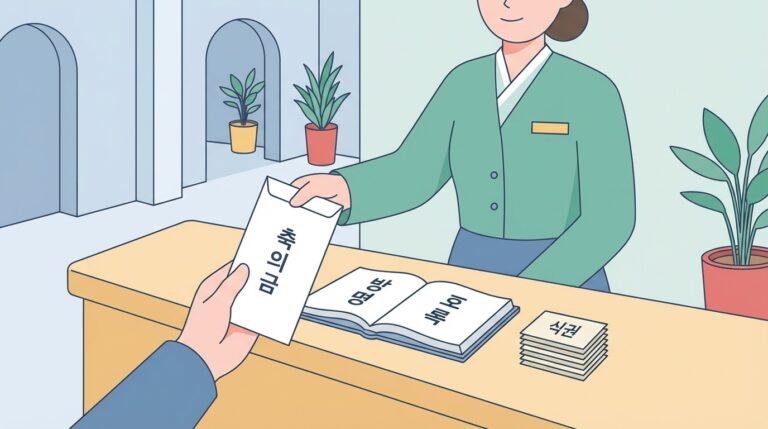
If you’ve watched enough K-Dramas, like What’s Wrong with Secretary Kim or My Liberation Notes, you’ve definitely seen this scene: A character wears a semi-formal suit, walks up to a desk, and hands over a crisp white envelope. They don’t carry a toaster or a set of wine glasses. Just that mysterious white envelope.
Is it a secret mission? A bribe? Nope. It’s the Korean language of “Jeong” (connection) expressed through cash.
In Korea, weddings and funerals are not just emotional events; they are community-funded milestones. As a foreigner working in Korea or interacting with Korean colleagues, knowing how to handle Gyeong-jo-sa-bi (Congratulatory and Condolence Money) is the ultimate test of your “Social IQ.”
Do it right, and you are instantly respected as “one of us.” Do it wrong (like giving an even number amount!), and things might get awkward. Don’t worry—I’ve guided hundreds of students through their first Korean wedding. Let’s open that envelope together.
Phase 2: Deep Dive into Key Expressions 🧐
Here are the three phrases that will save you in 90% of these situations.
1. 축하드립니다! (Chuk-ha-deu-rim-ni-da!)
- Pronunciation: [Chuk-ha-deu-rim-ni-da]
Tip: The ‘k’ in chuk and ‘h’ in ha blend to make a strong ‘K’ sound, like “Chu-Ka”.- Meaning: Congratulations (Formal)
- K-Culture Moment: Picture a wedding hall lobby. It’s loud, crowded, and chaotic. You bow slightly to the groom and say this loud and clear.
- Editor’s Insight: You might know “Chuk-ha-hae” (Casual), but at a wedding, even if you are close friends, use the formal ending “-deu-rim-ni-da” or “-hae-yo” when others are watching. It shows respect to the occasion, not just the person.
- Situation Spectrum:
[🚫 Casual Friend] ———— [⚠️ Colleague] ———— [✅ Formal/Senior]
(Note: Use “Chuk-ha-hae” only for close friends in private!)- 🤔 Think About It: Why does Korean emphasize “giving” congratulations (deu-rim-ni-da = literally “I give congratulations”) rather than just saying the word?
2. 삼가 고인의 명복을 빕니다 (Sam-ga go-in-ui myeong-bok-eul bim-ni-da)
- Pronunciation: [Sam-ga go-in-ui myeong-bok-eul bim-ni-da]
Tip: This is long. Break it down: Sam-ga / Go-in-ui / Myeong-bok-eul / Bim-ni-da.- Meaning: “I respectfully pray for the repose of the deceased.”
- K-Culture Moment: This is the text you see written on the ribbon of funeral flower wreaths in dramas like Move to Heaven. It is THE phrase for funerals.
- Editor’s Insight: Honestly? This is a tongue twister even for Koreans sometimes. If it’s too hard to say, a deep, silent bow and a sad expression are worth a thousand words. But writing this on the envelope is mandatory.
- Situation Spectrum:
[✅ All Situations](This is a fixed phrase. Do not change it.)- 🤔 Think About It: This phrase has Buddhist origins (Myeong-bok = happiness in the afterlife). How does religion shape the language of death in your culture?
3. 약소하지만 제 성의예요 (Yak-so-ha-ji-man je seong-ui-ye-yo)
- Pronunciation: [Yak-so-ha-ji-man je seong-ui-ye-yo]
Tip: ‘Yak-so’ sounds like ‘Yak’ (medicine) + ‘So’ (small).- Meaning: “It’s small/humble, but it’s my sincerity.”
- K-Culture Moment: You are handing the envelope to the person at the desk. You feel like 50,000 KRW isn’t enough, but it’s what you can afford. This phrase magically makes any amount sound polite.
- Editor’s Insight: Koreans love humility. Even if you put a million dollars in that envelope, you’d still say this. It shifts the focus from the money to your heart.
- Situation Spectrum:
[🚫 Friends] ———— [✅ Colleagues/Seniors] ———— [✅ Elders]
Phase 3: Textbook vs. Real Life 🥊
| Situation | 📖 Textbook Korean | 🗣️ Real Korean (Survival) | 💡 Why different? |
|---|---|---|---|
| Giving the money | “축의금을 준비했습니다.” (I prepared wedding money.) | (Just hand it over silently with a bow) OR “축하드려요!” | Actions speak louder than words. The envelope is the message. |
| Missed the wedding | “참석하지 못해서 죄송합니다.” (Sorry I could not attend.) | “계좌로 보냈어요! 축하해요!” (I sent it to your account! Congrats!) | Digital banking (KakaoPay) changed everything. It’s efficient. |
| Signing Guestbook | (Full name and sentence) | (Name) + (Company Name) | Usually, the line is long. Speed is key! |
💡 Bottom Note: In 2024, sending money via KakaoTalk with a cute “Wedding Envelope” emoticon is perfectly acceptable for friends and close colleagues!
Phase 4: Cultural Deep Dive — The Rules of the Envelope 🧧
4-1. The “Odd Number” Rule (Important!)
Unlike Western cultures where you might give a gift from a registry, in Korea, cash is King. But you can’t just give any amount.
* The Golden Rule: Give in odd numbers (3, 5, 7) or clean tens (10, 20, 30).
* Why? Odd numbers (Yang) are considered lucky and complete in East Asian philosophy. Even numbers (Yin) can imply bad luck (except 10, which is seen as a full number).
* The Standard:
* 30,000 KRW: (Rarely used now due to inflation) Student or distant acquaintance.
* 50,000 KRW: Standard for colleagues you aren’t super close with.
* 100,000 KRW+: Close friends, team members, or if you bring a guest to eat at the buffet.
4-2. K-Food Connection: The “Meal Ticket” (Sik-gwon)
In K-Dramas, after handing over the envelope, the guest receives a small paper ticket. That is the Sik-gwon (Meal Ticket).
* Buffet Culture: Korean weddings are famous for their buffets. If you don’t take the meal ticket (because you’re busy), the host might give you a small return gift (like wine or cookies) instead.
* Critical Thought: The money you give is often mentally calculated as “Cost of my meal + Congratulatory Gift.” If the hotel buffet costs 80,000 won and you give 50,000 won, you might feel a bit “Noticeable” (Nunchi-bo-da).
Phase 5: Immersive Roleplay 🎬
Setting: A bustling Wedding Hall in Gangnam on a Saturday afternoon. You are attending your colleague Min-su’s wedding. There is a long line at the reception desk.
Characters:
* YOU: International Employee (B1 Level Korean).
* Receptionist: Min-su’s cousin (Busy, collecting money).
[Dialogue Start]
Receptionist: (Looking down at the list) 안녕하세요, 신랑 측 손님이세요?
(An-nyeong-ha-se-yo, sillang cheuk son-nim-i-se-yo?)
(Hello, are you a guest for the groom’s side?)
YOU: 네, 민수 씨 직장 동료예요. 여기 축의금입니다.
(Ne, Minsu-ssi jik-jang dong-ryo-ye-yo. Yeogi chuk-ui-geum-im-ni-da.)
(Yes, I’m Minsu’s coworker. Here is the congratulatory money.)
Receptionist: (Takes envelope, writes name) 감사합니다. 식사하고 가시나요?
(Gam-sa-ham-ni-da. Sik-sa-ha-go ga-si-na-yo?)
(Thank you. Are you staying for the meal?)
🔀 Your Turn! The line is moving fast. Decide!
- A) “네, 먹고 갈게요!” (Yes, I’ll eat and go!)
- B) “아니요, 바빠서 얼굴만 보고 가려고요.” (No, I’m busy so I’ll just see his face and leave.)
- C) “밥 맛있나요?” (Is the food good?)
✅ Best Choice: A or B
* Why A: Weddings are a feast! Grab that ticket and enjoy the K-Buffet.
* Why B: If you give a smaller amount (50k) at a luxury hotel, some people choose B to be considerate, but A is standard.
* ⚠️ Analysis of C: Too direct! You can’t ask the host if the food is good. 😂
[Scenario Continues – Choosing A]
Receptionist: 네, 여기 식권입니다. 연회장은 3층입니다.
(Ne, yeogi sik-gwon-im-ni-da. Yeon-hoe-jang-eun sam-cheung-im-ni-da.)
(Okay, here is the meal ticket. The banquet hall is on the 3rd floor.)
YOU: 감사합니다. 수고하세요!
(Gam-sa-ham-ni-da. Su-go-ha-se-yo!)
(Thank you. Keep up the good work!)
Phase 6: 10-Second Shadowing Drill 🗣️
Practice this until it flows naturally. Focus on the polite hesitation.
- Context: Handing the envelope to a senior colleague at a funeral.
- Emotion: 😢 Respectful & Solemn (Low voice)
약소하지만 / 제 성의입니다. / 기운 내세요.
(Yak-so-ha-ji-man / je seong-ui-im-ni-da. / Gi-un nae-se-yo.)
It’s small / but it’s my sincerity. / Please cheer up.
Phase 7: K-Culture Mini Glossary 📖
| Korean | Romanization | Meaning | Context |
|---|---|---|---|
| 축의금 | Chuk-ui-geum | Congratulatory Money | Money given at weddings or 1st birthdays (Dol-jan-chi). |
| 조의금 | Jo-ui-geum | Condolence Money | Money given at funerals. Also called Bujogeum. |
| 식권 | Sik-gwon | Meal Ticket | The currency of the wedding buffet. Don’t lose it! |
| 방명록 | Bang-myeong-rok | Guestbook | Where you write your name to prove you came. |
| 봉투 | Bong-tu | Envelope | White envelopes are standard for everything. |
Phase 8: Traveler’s Survival Kit 🧳
Even if you are just traveling, you might get invited to a Korean wedding! It happens more than you think.
🆘 Survival Expression #1: Finding the ATM
* 🇰🇷 “이 근처에 현금 인출기 있어요?” (I geun-cheo-e hyeon-geum in-chul-gi i-sseo-yo?)
* 🗣️ Pronunciation: [Ee geun-cho-ay hyun-gum in-chul-gi ee-so-yo?]
* 📍 Where: Wedding Hall Lobby, Subway Station.
* 💡 Pro Tip: Most wedding halls have ATMs, but the lines are long. Withdraw cash before you arrive to look like a pro.📌 Editor’s Note:
* The Envelope: If you forgot an envelope, don’t panic. The reception desk always has a stack of free envelopes and pens. Just bring cash.
Phase 9: Think Deeper — Money vs. Meaning 🧠
Topic: Food & Identity (The “Meal” is the Thank You)
In many Western cultures, you send a “Thank You Card” after the wedding. In Korea, the Buffet (Meal) is the immediate thank you. There is a saying, “Have you eaten noodles?” which literally means “When are you getting married?” (because noodles were traditionally served at weddings).
This is why the Sik-gwon (Meal Ticket) exchange is so important. By feeding you, the hosts are repaying your time and contribution immediately. It’s a transactional yet deeply communal exchange of care.
💬 Your Turn: In your culture, is cash an acceptable gift? Or is it considered lazy or impersonal? How do you “repay” guests? Share in the comments!
Phase 10: FAQ & Troubleshooting 🚑
- Q: Can I wear black to a wedding?
- Maybe. For men, black suits are fine. For women, avoid all-white (bride’s color). In the past, bright colors were preferred, but nowadays, navy, beige, or black is acceptable if not too gloomy.
- Q: I don’t have Korean won. Can I give USD?
- No. Please exchange it. Giving foreign currency creates a chore for the newlyweds (they have to go to the bank). It can be seen as inconsiderate.
- ❌ Common Mistake: Using a colorful/fancy envelope for a funeral.
- ✅ Fix: Use the plain white vertical envelopes provided at the convenience store or the funeral home. Funerals are strictly conservative.
Phase 11: Wrap-up & Mission 🎁
One-Liner: “At Korean weddings and funerals, the white envelope speaks louder than words—just make sure the amount is an odd number!”
🚀 Action Missions:
* 🥉 Bronze: Say “축하드립니다” out loud 3 times with a slight bow.
* 🥈 Silver: Look up a picture of a “Korean Wedding Envelope” on Google Images and see where the name goes (usually vertical on the back, bottom left).
* 🥇 Gold: Next time you owe a colleague lunch money, hand it to them in an envelope (or joke about it) saying “제 성의예요” (It’s my sincerity)!
K-Culture Mission:
Watch the drama Reply 1988 (Episode 1 or 2) to see how neighbors share food and money during funerals. It captures the community spirit perfectly.
Phase 12: Quiz — Are You “Nunchi” Master? 🧐
- Situational Judgment: You are attending the wedding of a close team member. You want to bring your boyfriend/girlfriend. How much money should you put in the envelope?
- A) 30,000 KRW
- B) 50,000 KRW
- C) 100,000 KRW
- D) Nothing, just bring a gift.
- True or False: At a funeral, you should say “축하드립니다” to the family.
- (True / False)
- Roleplay Check: If the receptionist asks “Sik-sa-ha-go ga-si-na-yo?”, what are they asking?
- A) Did you bring money?
- B) Are you the groom’s friend?
- C) Are you staying to eat?
Answers:
1. C (If you bring a guest, you cover two meal costs. 100k is the polite minimum.)
2. False (Omg no! That means “Congratulations.” Use “Sam-ga go-in-ui…”)
3. C
Frequently Asked Questions (FAQ)
Q: What does "축하드립니다! (Chuk-ha-deu-rim-ni-da!)" mean in Korean and how do you pronounce it?
A: In Korean, "축하드립니다! (Chuk-ha-deu-rim-ni-da!)" is pronounced [Chuk-ha-deu-rim-ni-da] and means: Congratulations (Formal)
Q: What does "삼가 고인의 명복을 빕니다 (Sam-ga go-in-ui myeong-bok-eul bim-ni-da)" mean in Korean and how do you pronounce it?
A: In Korean, "삼가 고인의 명복을 빕니다 (Sam-ga go-in-ui myeong-bok-eul bim-ni-da)" is pronounced [Sam-ga go-in-ui myeong-bok-eul bim-ni-da] and means: "I respectfully pray for the repose of the deceased."
Q: What does "약소하지만 제 성의예요 (Yak-so-ha-ji-man je seong-ui-ye-yo)" mean in Korean and how do you pronounce it?
A: In Korean, "약소하지만 제 성의예요 (Yak-so-ha-ji-man je seong-ui-ye-yo)" is pronounced [Yak-so-ha-ji-man je seong-ui-ye-yo] and means: "It's small/humble, but it's my sincerity."