

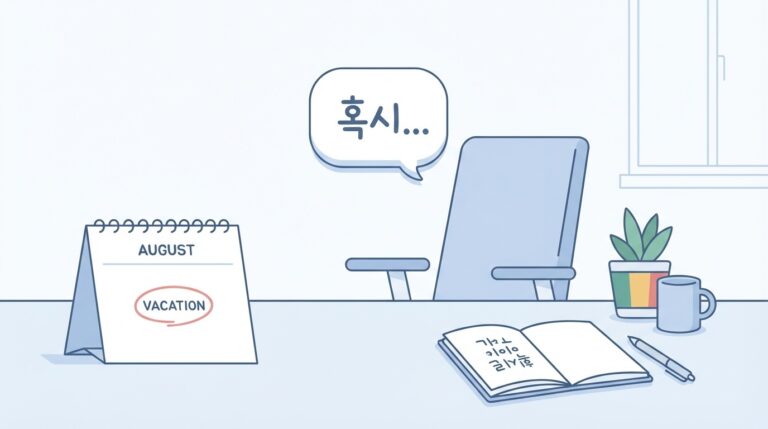
Phase 1: Immersive Hook — The “Nunchi” Game 🕵️♂️
Hello! This is your Daily Hangul Editor.
Picture this scene from a K-Drama: It’s 4 PM on a Tuesday. The team leader (Teamjang-nim) is sighing loudly while typing furiously. The protagonist needs to book a flight for next month’s trip to Jeju Island, but they are frozen in their chair, staring at the boss’s back.
In Western corporate culture, you might just send a calendar invite saying, “OOO (Out of Office): Oct 12-15.” But in Korea? That could be a one-way ticket to the “naughty list.”
Asking for time off in Korea isn’t just an administrative task; it’s a high-stakes game of Nunchi (눈치)—the art of sensing the atmosphere. Today, we aren’t just learning how to say “I want a vacation.” We are learning how to say, “I am terribly sorry to inconvenience the team, but if it pleases the court, may I briefly disappear?” while sounding professional and charming.
Let’s master the art of the Soft Ask.
Phase 2: Deep Dive into Key Expressions 🧠
In B2 level, we move beyond simple grammar to strategic language. Here are the three weapons you need.
1. 혹시 [시간]에 연차 좀 쓸 수 있을까요?
(Hoksi [time]-e yeoncha jom sseul su isseulkkayo?)
- Pronunciation: Hok-shi (like ‘hawk’ + ‘she’) … yeon-cha (soft ‘ch’ like ‘church’) …
- Meaning: “By any chance, could I use some annual leave at [time]?”
- K-Culture Moment: You hear “Hoksi” everywhere in K-Dramas when someone is about to ask a favor or confess a secret. It’s the ultimate softener.
- Editor’s Insight: Starting a sentence with
혹시(by any chance) instantly lowers your posture. It signals, “I know you are busy, and I am not demanding this.” Dropping the좀(a little) makes it sound too direct. Keep the좀!- Situation Spectrum:
[🚫 Boss to Subordinate] ———— [✅ Subordinate to Boss]
(Bosses don’t say “Hoksi.” They just say, “I’m out next week.”)- 🤔 Think About It: Why is hesitation considered polite in Korea? In some cultures, confidence is key. In Korea, hesitation shows you care about the group’s harmony.
2. 다름이 아니라, 개인적인 사정이 있어서요.
(Dareumi anira, gaein-jeogin sajeong-i isseoseoyo.)
- Pronunciation: Da-reu-mi a-ni-ra (connect the sounds smoothly) … sa-jeong (sounds like ‘sah-jung’).
- Meaning: “Actually/The reason is… I have a personal matter.”
- K-Culture Moment: In office dramas like Misaeng, vague excuses are an art form. You rarely hear, “I want to go to a K-Pop concert.”
- Editor’s Insight:
다름이 아니라is a magical phrase used to transition from small talk to your main point. And개인적인 사정(personal matter) is your shield. You don’t need to overshare. It implies family, health, or private business that shouldn’t be questioned.- Situation Spectrum:
[✅ Formal/Semi-Formal] ———— [⚠️ Casual Friends]
(Too stiff for close friends. Just say “I have a thing to do.”)3. 업무에 지장 없도록 미리 조율하겠습니다.
(Eommue jijang eopdorok miri joyul-hagetseumnida.)
- Pronunciation: Eom-mu (business/work) … Ji-jang (hindrance/obstacle).
- Meaning: “I will coordinate beforehand so there is no disruption to the work.”
- K-Culture Moment: This is the sentence that gets your leave approved. It shows Responsibility. It tells your boss, “My absence won’t be your headache.”
Phase 3: Textbook vs. Real Life 🥊
| Situation | 📖 Textbook Korean | 🗣️ Real Office Korean | 💡 Why the difference? |
|---|---|---|---|
| Starting the convo | 부장님, 할 말이 있습니다. (Manager, I have something to say.) |
부장님, 지금 잠깐 시간 괜찮으세요? (Manager, is now a good time?) |
“할 말 있다” sounds like you’re either quitting or confessing a crime. Check timing first! |
| Asking for leave | 휴가를 신청하고 싶습니다. (I want to apply for vacation.) |
다음 주에 연차를 좀 써도 될까 해서요. (I was wondering if I could use leave next week.) |
Ending with -a/eo yo or -ulkkayo invites the other person’s opinion, rather than stating a demand. |
| Reason | 콘서트에 갑니다. (I am going to a concert.) |
집안일이 좀 있어서요. (I have some family matters.) |
Professionalism. Unless you are very close, “fun” isn’t viewed as a priority over work. |
Bottom Note: B2 learners often sound too grammatically correct, which makes them sound robotic. Softening endings (~해서요, ~거든요) makes you sound more human.
Phase 4: Cultural Deep Dive — The Art of “No Surprise” 🎭
4-1. Non-verbal: The Timing (Timing is Everything)
In Korea, when you ask is as important as how you ask.
* Do not ask: Monday morning (everyone is busy), Friday afternoon (everyone wants to leave), or right after the boss got scolded by their boss.
* Do ask: After lunch when blood sugar is high and the mood is mellow.
* Body Language: Approach the desk quietly. Do not stand too tall; slouch slightly to show humility. Use two hands if handing over a document.
4-2. K-Culture Connection: The “Hoe-sik” (Company Dinner) Effect
In many K-Dramas, you see employees trying to bond with the boss during Hoe-sik (drinking parties). Sometimes, a smart employee waits for the boss to be in a good mood after a few drinks to casually mention, “Oh, by the way, I might need to visit home next month…”
* Critical View: Is this manipulative? Maybe. But in a high-context culture, leveraging emotional bonding moments is a recognized soft skill.
Phase 5: Immersive Roleplay 🎬
Setting: Tuesday, 2 PM. Post-lunch food coma. Your Manager (Kim Bujang-nim) looks relatively calm, sipping an Iced Americano.
Characters:
* YOU: An expat employee who wants next Friday off to go to Busan.
* Manager Kim: Mid-40s, traditional but kind. Stressed about upcoming deadlines.
(Dialogue Start)
YOU: (Knocking on the partition lightly) 부장님, 혹시 지금 잠깐 시간 괜찮으세요?
(Bujang-nim, hokshi jigeum jamkkan sigan gwaenchaneuseyo?)
Manager Kim: 어, 그래요. 무슨 일이에요? 앉아요.
(Oh, sure. What’s up? Sit down.)
YOU: 다름이 아니라, 다음 주 금요일에 연차를 좀 쓸 수 있을까 해서요.
(Dareumi anira, I was wondering if I could use annual leave next Friday.)
Manager Kim: (Looking at the calendar) 음… 금요일? 그때 우리 마감 있지 않나? 바쁠 텐데.
(Hmm… Friday? Don’t we have a deadline then? It’ll be busy.)
🔀 DECISION POINT: How do you respond?
- Option A: “제 권리니까 쓰겠습니다.” (It is my right, so I will use it.)
- Option B: “아, 네. 그래서 제 업무는 목요일까지 다 끝내놓겠습니다.” (Ah, yes. So I will finish all my work by Thursday.)
- Option C: “그럼 안 갈게요.” (Then I won’t go.)
✅ Best Choice: Option B.
Why? Option A is technically true but social suicide in a Korean office. Option C makes you a pushover. Option B addresses the boss’s fear (work not getting done) and offers a solution.
(Dialogue Continue – if you chose B)
Manager Kim: 목요일까지요? 확실해요?
(By Thursday? Are you sure?)
YOU: 네, 업무에 지장 없도록 확실히 해두겠습니다.
(Yes, I will make sure there is no disruption to the work.)
Manager Kim: 알겠어요. 그럼 결재 올리세요.
(Alright. Then submit the request.)
Phase 6: 10-Second Shadowing Drill 🗣️
Practice these lines with the specific emotion tags. Don’t just read; act.
- 🥺 The Hesitant Approach:
부장님 / 혹~~~시 / 시간 괜찮으세요?
(Bujang-nim / hok~~~shi / sigan gwaenchaneuseyo?)Tip: Stretch the “Hok” to sound extra polite and cautious.
- 😤 The Professional Promise:
업무에 / 지장 없도록 / 하겠습니다!
(Eommue / jijang eopdorok / hagetseumnida!)Tip: Say “Hagetseumnida” with a crisp, downward intonation. Trustworthiness is key.
Phase 7: K-Culture Mini Glossary 📘
| Korean | Romanization | English | Context |
|---|---|---|---|
| 눈치 | Nunchi | Sense/Wit | The ability to read the room. Crucial when asking for favors. |
| 연차 | Yeoncha | Annual Leave | The standard term for paid leave in companies. |
| 결재 | Gyeol-jae | Approval | The formal act of a superior signing off on your request. |
| 징검다리 휴일 | Jing-geom-dari Hyuil | Sandwich Day | Lit. “Stepping stone holiday.” A workday sandwiched between two holidays. Everyone fights for leave on this day! |
Phase 8: Traveler’s Survival Kit (The “Asking” Logic) 🧳
Even if you aren’t working in Korea, the logic of “Hoksi + Polite Request” applies perfectly to travel situations.
🆘 Survival Pattern: Requesting at a Hotel/Airport
* Structure:혹시 + [Noun] + 가능할까요?(By any chance, is [Noun] possible?)
* Example: “혹시 얼리 체크인 가능할까요?” (Is early check-in possible?)
* Example: “혹시 창가 자리 가능할까요?” (Is a window seat possible?)
* 💡 Pro Tip: Just asking “Give me a window seat” can sound rude. Adding “Hoksi” and “Ganeunghalkkayo” makes the staff want to help you.
Phase 9: Think Deeper — Individual vs. Collective 🧠
Why do Koreans apologize for taking a vacation?
In many Western cultures, a contract is a contract. “I have 15 days off, I use them.” In Korea, the company is often viewed as an extension of the family or a collective body. If one part is missing, the others must carry the weight.
Therefore, the language reflects this: you aren’t just exercising a right; you are acknowledging the burden you might shift onto your colleagues.
💬 Your Turn: Does your culture value “The Right of the Individual” or “The Harmony of the Group” more? How does your language reflect that? Share in the comments!
Phase 10: Troubleshooting & FAQ 🛠️
Q: Can I ask for leave via KakaoTalk/Text?
A: ⚠️ Risky. For a sick day? Yes, if you can’t talk. For a planned vacation? No. Always ask verbally first, then send the formal request or text. Asking via text can seem dismissive of the boss’s authority.
Q: How much detail should I give about my “Personal Matter”?
A: Less is more. If you say, “I’m going to a generic K-Pop concert,” an older boss might think, “They are skipping work to play?” Just stick to 가족 행사 (Family event) or 개인 사정 (Personal matter). It stops further questions.
❌ Common Mistake:
Saying “놀러 가요” (I’m going to play/hang out).
✅ Fix: Use “여행 다녀오겠습니다” (I will go on a trip) or simply “좀 쉬려고 합니다” (I intend to rest a bit).
Phase 11: Wrap-up & Mission 🚀
One-Liner: Asking for leave in Korea is 20% logistics and 80% emotional intelligence.
Your Mission:
* 🥉 Bronze: Look in the mirror and practice the “Hoksi…” face. (Slightly apologetic, eyebrows up).
* 🥈 Silver: Use 혹시... 가능할까요? next time you order coffee or ask for a favor at a Korean restaurant.
* 🥇 Gold: Watch a K-Drama episode (try Misaeng or What’s Wrong with Secretary Kim) and spot a scene where someone asks for approval. Did they use “Hoksi”?
See you next time, and hope your 결재 (approval) gets signed immediately! 👋







