

Phase 1: The Immersive Hook
Greeting: 안녕하세요! (Hello!) This is your Daily Hangul Senior Editor.
Imagine this scene: You are watching a K-Drama. The main character, running late for work, sprints towards a bus stop. The bus is pulling away. They wave frantically, the dramatic ballad music starts playing… and the bus stops! The driver opens the door.
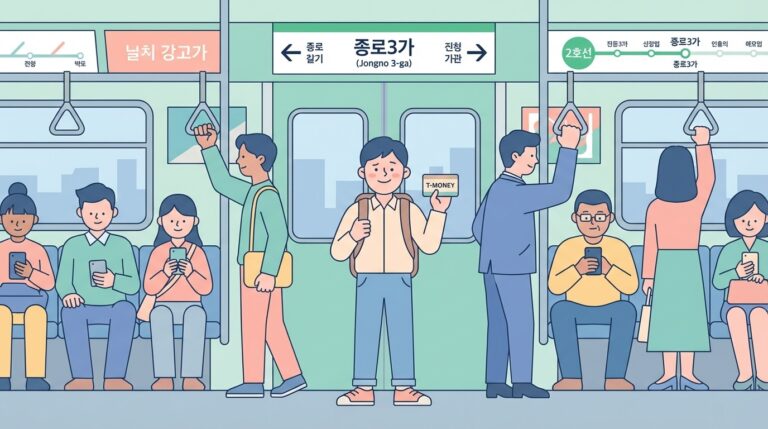
Well, welcome to reality! In Seoul, that bus might not stop, and the subway during rush hour isn’t a romantic scene—it’s a battlefield we call ‘Jiokcheol’ (Hell-subway). 😱
But don’t worry. Today, we are going to learn how to survive the Korean commute and, more importantly, how to talk about it. Asking “How do you get to work?” is one of the most common small talk topics in Korea. It’s not just about transportation; it’s about sharing the pain of the morning rush!
This guide is built from real questions my students asked after getting lost in Gangnam station. Let’s get you moving like a local.
Phase 2: Deep Dive into Key Expressions
Here are the top 3 expressions you need to describe your journey.
1. 어떻게 가요? (How do you go?)
- Pronunciation: [Eo-tteo-ke ga-yo?]
Sound-alike: “Uh-tuh-keh” (like uttering a confused sound) + “Ga-yo”- Meaning: Literal: How go? / Real Nuance: How do you get there? / By what means?
- K-Culture Moment: You’ll hear this constantly. Whether you are meeting a friend at Hongdae or a date at Namsan Tower, the first logistical question is always “Eotteoke gayo?”
- Editor’s Insight: This is the magic key. You can use it for work, travel, or finding a restaurant. It covers the method (bus/subway) and the route.
- Situation Spectrum:
[🚫 Formal Speech/Army] ———— [⚠️ Semi-Formal] ———— [✅ Casual/Polite]
- Friend (Casual): ✅ “어떻게 가?” (Drop the ‘yo’)
- Colleague (Polite): ✅ “어떻게 가요?”
- Boss (Formal): ⚠️ Better to use “어떻게 가십니까?” (But ‘gayo’ is usually acceptable for A2 learners!)
- 🤔 Think About It: In English, we might ask “Do you drive?” or “Do you take the train?” Why does Korean focus on the method of “going” (how) rather than the specific vehicle first?
2. [Transport] 타고 가요. (I go by [Transport].)
- Pronunciation: [~ ta-go ga-yo]
Sound-alike: “Ta-go” (Like ‘Ta’ in Target + ‘Go’)- Meaning: I ride [transport] and go.
- Structure:
Noun (Bus/Subway) + riding (tago) + go (gayo)- K-Culture Moment: In K-Pop lyrics, you often hear “Tada” (to ride). It implies movement and action.
- Editor’s Insight: Don’t just say “Subway.” Say “Subway tago gayo.” It makes you sound active and natural.
- Example: “지하철 타고 가요.” (I go by subway.)
- Example: “버스 타고 가요.” (I go by bus.)
3. [Time] 걸려요. (It takes [Time].)
- Pronunciation: [~ geol-lyeo-yo]
Sound-alike: “Girl-yuh-yo” (Think of a girl saying yo!)- Meaning: It takes [amount of time].
- Editor’s Insight: Koreans love efficiency (
Frequently Asked Questions (FAQ)
Q: What does "어떻게 가요? (How do you go?)" mean in Korean and how do you pronounce it?
A: In Korean, "어떻게 가요? (How do you go?)" is pronounced [Eo-tteo-ke ga-yo?] and means: Literal: How go? / Real Nuance: How do you get there? / By what means?
Q: What does "[Transport] 타고 가요. (I go by [Transport].)" mean in Korean and how do you pronounce it?
A: In Korean, "[Transport] 타고 가요. (I go by [Transport].)" is pronounced [~ ta-go ga-yo] and means: I ride [transport] and go.
Q: What does "[Time] 걸려요. (It takes [Time].)" mean in Korean and how do you pronounce it?
A: In Korean, "[Time] 걸려요. (It takes [Time].)" is pronounced [~ geol-lyeo-yo] and means: It takes [amount of time].






