

Beyond K-Drama Mansions: Decoding Korea’s “Speculative Overheated Districts”
Phase 1: Immersive Hook
Greeting: 안녕하세요! Daily Hangul’s Senior Editor here.
The K-Drama Moment: Picture this: You’re watching a tense family drama. The ambitious mother is screaming into her phone, “Did the policy change? Is Gangnam still a ‘Speculative Overheated District’? My down payment is stuck!” The subtitles just say, “Is the area still restricted?” but the sheer panic in her voice suggests something life-threatening. Why?
Because in Korea, Real Estate (부동산) isn’t just about finding a place to sleep. It is the ultimate badge of status, the primary vehicle for wealth, and a national obsession that rivals K-Pop. Understanding terms like “Speculative Overheated District” (투기 과열 지구) is the key to understanding the news, the economy, and the anxious conversations happening at every dinner table in Seoul.
The ‘Why’: If you plan to live in Korea long-term or just want to understand the deep sighs of your Korean colleagues, you need to master this C2-level topic. It transforms you from an “outsider” to someone who truly grasps the Han (resentment/longing) of modern Korean life.
Phase 2: Deep Dive into Core Expressions
1. 투기 과열 지구 (Speculative Overheated District)
- Pronunciation: [Tugi gwayeol jigu] (Sounds like: Too-ghee gwa-yuhl jee-goo)
- Meaning: Officially, it’s an area designated by the government to curb real estate speculation. Culturally, it means “This place is so hot, the government is trying to dump ice water on it.”
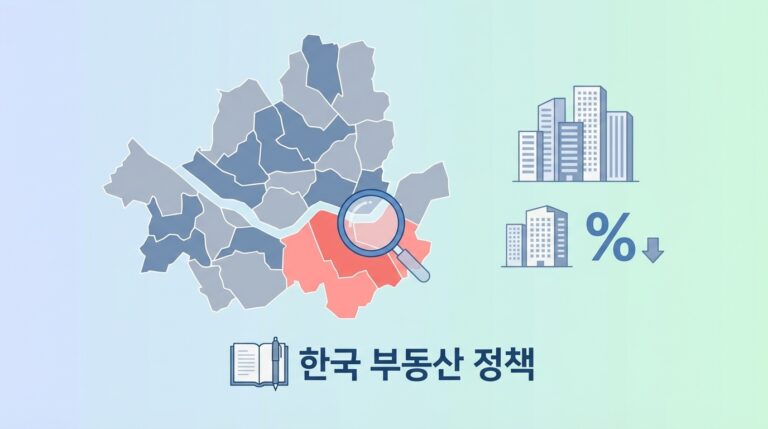
- K-Culture Moment: In news broadcasts, maps of Seoul often turn red. These red zones are where everyone wants to live, but buying there is made deliberately difficult (strict loan limits, ban on reselling rights).
- Editor’s Insight: This term carries a dual nuance: Danger (regulations are tight) and Desire (it’s a guaranteed prime location). It’s the “VIP section” that’s hard to get into.
- Situation Spectrum:
[🚫 Taboo] ———— [⚠️ Caution] ———— [✅ Freely]
- Casual Chat: ✅ (Discussing news)
- Business/Investment: ✅
- To a struggling renter: ⚠️ (Can sound insensitive)
- 🤔 Think About It: Why does the Korean government intervene so aggressively in the market compared to Western countries? Is housing seen more as a public good or a private asset here?
2. 지정 및 해제 (Designation and Lifting)
- Pronunciation: [Jijeong mit haeje] (Sounds like: Jee-jung mit heh-jeh)
- Meaning: “Designation and Lifting.” These are the legal triggers. Jijeong turns the restrictions on; Haeje turns them off.
- Editor’s Insight: The word 해제 (Lifting) is often met with cheers (from investors) or groans (from people hoping prices would drop). It’s a highly emotional switch.
- Example Usage: “이번에 규제 지역에서 해제될까요?” (Will it be lifted from the regulated area this time?)
3. 전매 제한 (Resale Restriction)
- Pronunciation: [Jeonmae jehan]
- Meaning: A ban on selling your winning housing subscription (ownership right) for a certain period (e.g., 3-10 years).
- K-Culture Context: This aims to stop “flippers.” In dramas, you might see characters signing secret, illegal contracts (called Dwan-gye-seo) to bypass this, which usually leads to their downfall.
Phase 3: Textbook vs. Real Life
| Situation | 📖 Textbook Korean | 🗣️ Real Korean (In the Streets) | 💡 Why the difference? |
|---|---|---|---|
| Discussing a hot market | 부동산 시장이 과열되었습니다. (The real estate market is overheated.) | 완전 불장이네. (It’s a total ‘fire market’.) | Koreans love utilizing visual metaphors for market trends (Bull/Bear is boring; Fire is better). |
| Buying with max loans | 대출을 최대한 받았습니다. (I received the maximum loan.) | 영끌 했어. (I pulled my soul.) | 영혼까지 끌어모으다 (Gathering even one’s soul) reflects the desperation of the housing crisis. |
| Buying unsold units | 미분양 아파트를 샀습니다. (I bought an unsold apartment.) | 줍줍 했어. (I picked it up/scavenged.) | 줍줍 (Jup-jup) mimics the sound/action of picking up dropped items, implying luck and speed. |
Phase 4: Cultural Deep Dive — The “Apartment Republic”
4-1. Non-verbal Communication: The “Real Estate Face”
When discussing property prices or policy changes (Designation/Lifting), Koreans often exhibit a specific mix of emotions: envy, resignation, and intense curiosity. If someone mentions they live in a Tugi Gwayeol Jigu, the listener might widen their eyes slightly—a silent acknowledgement of wealth. Conversely, talking about rising rent involves a lot of communal sighing and head-shaking.
4-2. K-Drama Connection: The “Penthouse” Trope
In dramas like Penthouse or Sky Castle, the villains often obsess over redevelopment zones (재개발 구역). They utilize inside information to buy land before the “Designation” (Jijeong) happens. This reflects a real societal belief: Information is Power. The protagonist is usually the victim of these policies or the one pushed out to the suburbs.
🤔 Critical Perspective: Why are apartments (brand complexes like Raemian, Xi) preferred over detached houses in Korea? It’s about community security, convenience, and resale value. A detached house is seen as a “depreciating asset,” while an apartment in a regulated district is “gold.”
Phase 5: Immersive Roleplay Scenario
Setting: A quiet Izakaya in Yeouido (Financial District), Tuesday 8 PM. You are having drinks with Min-ho (40, Team Leader, deeply interested in investment).
Characters:
* YOU: An expat executive interested in buying a home in Seoul.
* Min-ho: Your pragmatic Korean colleague.
Dialogue:
Min-ho: 부장님, 뉴스 보셨어요? 강남 3구 빼고 투기 과열 지구가 다 해제된대요.
(Bujang-nim, nyuseu bosyeosseoyo? Gangnam sam-gu ppaego tugi gwayeol jiguga da haeje-doendaeyo.)
(Manager, did you see the news? They say all Speculative Overheated Districts are being lifted, except for the 3 Gangnam districts.)
YOU: 정말요? 그럼 대출 규제도 좀 풀리겠네요?
(Jeongmalyo? Geureom daechul gyujedo jom pulligenneyo?)
(Really? Then loan regulations should loosen up a bit too, right?)
Min-ho: 네, LTV가 70%까지 늘어날 거예요. 지금이 기회라니까요. 혹시 봐둔 곳 있으세요?
(Ne, LTV-ga 70-peosenteukkaji neureonal geoyeyo. Jigeumi gihoeranikkayo. Hoksi bwadun got isseuseyo?)
(Yes, LTV [Loan-to-Value] will increase to 70%. I’m telling you, now is the chance. Do you have a place in mind?)
🔀 Decision Point! How do you respond?
- A) “아직 잘 모르겠어요. 시장을 좀 더 지켜보려고요.” (Cautious & Standard)
- B) “용산 쪽을 보고 있는데, 거기는 아직 규제 지역이라서요.” (Knowledgeable & Sophisticated)
- C) “집값이 너무 비싸서 포기했어요.” (Honest & Relatable)
✅ Best Choice: B. It shows you understand the geography and the specific policy nuances (Yongsan is often grouped with Gangnam in regulations). Min-ho will respect your insight.
⚠️ Choice C Analysis: Acceptable, but ends the investment conversation. In a business context, showing market awareness (even if not buying) is better.
YOU (Option B): 용산 쪽을 보고 있는데, 거기는 아직 규제 지역이라서요. 갭투자는 힘들 것 같아요.
(Yongsan jjogeul bogo inneunde, geogineun ajik gyuje jiyeogiraseoyo. Gaeptujaneun himdeul geot gatayo.)
(I’m looking at the Yongsan area, but it’s still a regulated district. I think ‘gap investment’ would be difficult.)
Min-ho: (Nodding impressively) 와, 역시! 갭투자까지 고려하시다니… 한국 사람 다 되셨네요.
(Wa, yeoksi! Gaeptujakkaji goryeohasidani… Hanguk saram da doesyeonneyo.)
(Wow, as expected! Considering gap investment… You’ve become a total Korean.)
Phase 6: 10-Second Shadowing Drill
Context: Expressing frustration about sudden policy changes.
Sentence:
😓 정부가 / 투기 과열 지구를 / 갑자기 지정하는 바람에 / 대출이 막혔어요.
Romanization:
Jeongbu-ga / tugi gwayeol jigu-reul / gapjagi jijeonghaneun barame / daechuri makyeosseoyo.
Translation:
Because the government / suddenly designated it a Speculative Overheated District / my loan got blocked.
Emotions: 😓 Frustrated & Disappointed (Sigh deeply at ‘makyeosseoyo’)
Phase 7: K-Culture Mini Glossary
| Korean | Romanization | English | Context |
|---|---|---|---|
| 임장 | Imjang | Field Visit | Going to see a property/neighborhood in person. Serious investors go every weekend. |
| 역세권 | Yeoksegwon | Station Area | An area close to a subway station. The most important factor for price. |
| 초품아 | Chopuma | Elementary School Apt | Short for “Apartment holding an elementary school.” Huge premium for parents. |
| 갭투자 | Gaep-tuja | Gap Investment | Buying a house with a tenant (Jeonse) already in it, paying only the difference (gap). |
| 로또 청약 | Lotto Cheongyak | Lotto Subscription | A new apartment offering where the price is so much lower than market value, it’s like winning the lottery. |
Phase 8: Traveler’s & Expat’s Survival Kit
Even if you aren’t buying a skyscraper, you need to know how to rent. Here is the Real Estate Survival Guide.
🆘 Survival Terms for Renting
1. 전세 (Jeonse): A large lump-sum deposit (50-80% of house value) with no monthly rent. You get the money back when you leave. Unique to Korea.
2. 월세 (Wolse): Standard monthly rent with a smaller deposit.
3. 관리비 (Gwallibi): Maintenance fee. Always ask about this! It can be surprisingly high in fancy buildings.📌 Editor’s Note:
If you see a banner on the street saying “평당 2천만 원!” (20 million won per pyeong!), don’t panic. A Pyeong is about 3.3 square meters. Real estate in Korea is still officially measured in square meters, but everyone speaks in Pyeong.
Phase 9: Critical Thinking — “Think Deeper”
Topic: The Irony of “Anti-Speculation”
🧠 Think Deeper:
The Korean government designates “Speculative Overheated Districts” to cool down prices. However, many Koreans view this designation as a “Government-Certified Good Investment Zone.” Paradoxically, designation can sometimes make an area more desirable because it confirms the location’s value.Compare this to your country: Does your government actively restrict where you can buy or how much loan you can get based on the neighborhood’s heat? Or is it left entirely to the free market?
Phase 10: FAQ & Troubleshooting
- Q: Can a foreigner buy an apartment in a Speculative Overheated District?
- A: Yes! Foreigners are generally subject to the same regulations as Koreans regarding taxes and loans. However, getting a loan might be harder without a long credit history. Discrimination in policy is rare, but scrutiny is high.
- Q: Why do Koreans ask, “Do you own your home?” so early?
- A: It’s not just being nosy. In Korea, homeownership is the primary marker of adult stability. It’s often a prerequisite for marriage. Don’t be offended; they are assessing your “settled-down” status.
❌ Common Mistake: Confusing 평 (Pyeong) and Square Meters.
✅ Fix: Always divide the square meters by 3.3 to get the Pyeong (rough estimate) to understand the size locals are talking about. 84㎡ is the standard “National Size” (approx 25 pyeong).
Phase 11: Wrap-up & Action Items
One-Liner Summary: Understanding “Speculative Overheated Districts” is understanding the Korean desire for stability and asset growth.
Action Missions:
* 🥉 Bronze: Go to a Korean news site (Naver/Daum) and search “투기 과열 지구.” See which areas are red on the map.
* 🥈 Silver: Ask a Korean friend, “Do you prefer Jeonse or Wolse?” and listen to their reasoning.
* 🥇 Gold: Walk into a local real estate agent (Budongsan) just to look at the map on the wall. Read the prices and try to find a “Yeoksegwon” (Station Area).
K-Culture Mission: Watch the movie “Concrete Utopia” (콘크리트 유토피아). It is a dark satire about how the “Apartment” becomes the only thing that matters in a post-apocalyptic Seoul.
Phase 12: Interactive Quiz
- Situational Judgment: You are at a business dinner. Your boss complains about the new “DTI regulations.” What is the best response?
- A) “What is DTI?” (Too basic for C2)
- B) “I know! It’s really making it hard to leverage assets right now.” (Correct – shows empathy and knowledge)
- C) “You should just rent then.” (Rude)
- True or False (Culture): If an area is designated as a “Speculative Overheated District,” no one is allowed to buy houses there.
- Answer: False. You can buy, but loans are restricted, taxes are higher, and you cannot resell immediately.
- Fill in the Blank: “I couldn’t buy the house because I didn’t have enough cash, and the bank refused the loan because of the ______ designation.”
- Answer: 투기 과열 지구 (Speculative Overheated District)
(Scroll down for answers)
💬 Your Turn: Does your country have a concept like Jeonse? Or is rent money just “gone forever”? Tell me in the comments!
Frequently Asked Questions (FAQ)
Q: What does "투기 과열 지구 (Speculative Overheated District)" mean in Korean and how do you pronounce it?
A: In Korean, "투기 과열 지구 (Speculative Overheated District)" is pronounced [Tugi gwayeol jigu] and means: Officially, it's an area designated by the government to curb real estate speculation. Culturally, it means "This place is so hot, the government is trying to dump ice water on it."
Q: What does "지정 및 해제 (Designation and Lifting)" mean in Korean and how do you pronounce it?
A: In Korean, "지정 및 해제 (Designation and Lifting)" is pronounced [Jijeong mit haeje] and means: "Designation and Lifting." These are the legal triggers. Jijeong turns the restrictions on; Haeje turns them off.
Q: What does "전매 제한 (Resale Restriction)" mean in Korean and how do you pronounce it?
A: In Korean, "전매 제한 (Resale Restriction)" is pronounced [Jeonmae jehan] and means: A ban on selling your winning housing subscription (ownership right) for a certain period (e.g., 3-10 years).







