

Phase 1: The Immersive Hook
👋 안녕하세요! (Hello!) I’m your Daily Hangul Editor.
Picture this: You’re watching your favorite K-Drama. The male lead lingers at the office door, watching the female lead pack her bag. He hesitates, clears his throat, and finally asks, “Bap meogeosseoyo?” (Did you eat?)
Wait, is he really just curious about her calorie intake? No. In Korea, asking someone to eat isn’t just about food—it’s the ultimate social glue. It’s how we make friends, how we date, and how we solve business problems.
But here’s the scary part for beginners: If you say it wrong, you might sound like a robot from a 1990s textbook, or worse, rude to your boss.
Don’t worry. Today, we are going to learn how to ask someone out for dinner like a true Seoulite—smooth, polite, and with just the right amount of Nunchi.
Phase 2: Deep Dive into Core Expressions
Here are the 3 golden phrases you need to secure that dinner date.
1. 시간 있어요? (Sigan isseoyo?)
- Pronunciation: [She-gan e-ssuh-yo?]
- Tip: ‘Si’ sounds like ‘She’, and ‘gan’ sounds like ‘Khan’.
- Meaning: Do you have time?
- K-Culture Moment: Before asking for the date, you must check availability. In K-Dramas, this is the moment the music stops and the camera zooms in.
- Editor’s Insight: This is a soft opener. It gives the other person a chance to say “No” without feeling guilty.
- Situation Spectrum:
[🚫 Boss/Elders] ———— [⚠️ Colleagues] ———— [✅ Friends/Juniors]- 🤔 Think About It: Why do Koreans ask “Do you have time?” before saying why they need time? It’s about saving face—if they are busy, you don’t have to reveal your invitation.
2. 저녁 같이 먹을래요? (Jeonyeok gachi meogeullaeyo?)
- Pronunciation: [Juh-nyuk ga-chee muh-guel-lay-yo?]
- Tip: ‘Gachi’ implies ‘together’. It sounds like ‘Ga-chee’.
- Meaning: Shall we have dinner together?
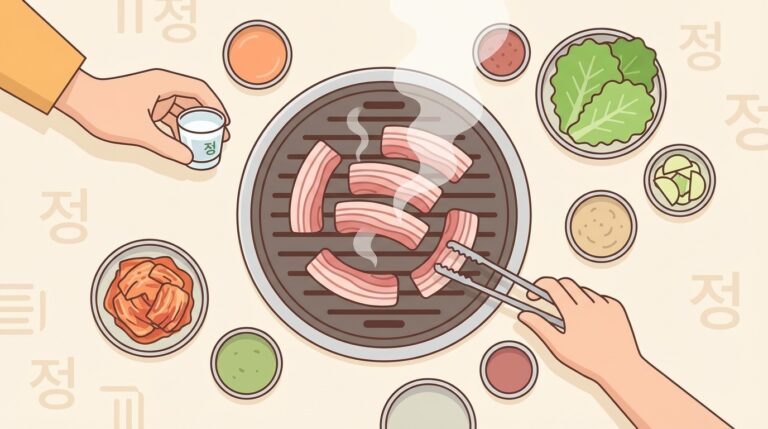
- K-Culture Moment: The classic “Samgyeopsal” (pork belly) invitation scene. It implies bonding, not just eating.
- Editor’s Insight: The ending -(으)ㄹ래요? is magical. It translates to “Do you want to…?” but it’s much softer and friendlier than a direct command or question.
- Situation Spectrum:
[🚫 Formal Speech] ———— [⚠️ Strangers] ———— [✅ Friendly Neighbors/Peers]3. 제가 살게요! (Jega salgeyo!)
- Pronunciation: [Je-ga sal-gay-yo!]
- Meaning: I’ll buy! / It’s on me!
- K-Culture Moment: You’ve seen the fight at the cashier in every drama? Koreans physically fight to pay the bill. It’s a sign of caring.
- Editor’s Insight: If you invited them, you are generally expected to pay (or at least offer to!).
- Situation Spectrum:
[✅ EVERYONE LOVES THIS]
Phase 3: Textbook vs. Real Life
| Situation | 📖 Textbook Korean | 🗣️ Real Korean (Daily Hangul Style) | 💡 Why the difference? |
|---|---|---|---|
| Asking for time | 시간 있으십니까? (Sigan isseusimnikka?) | 시간 괜찮으세요? (Sigan gwaenchaneuseyo?) | The textbook version sounds like a police interrogation. ‘Gwaenchaneuseyo’ (Is it okay?) shows more consideration. |
| Let’s eat | 우리 밥을 먹읍시다. (Uri babeul meogeupsida.) | 밥 먹으러 갈래? (Bap meogeureo gallae?) | ‘-(eup)sida’ is extremely formal and old-fashioned. Use ‘-(eu)llae?’ for friends. |
| After eating | 안녕히 가세요. (Annyeonghi gaseyo.) | 들어가세요~ (Deureogaseyo~) | Literally “Go inside (home).” It sounds much warmer and caring than a generic goodbye. |
Phase 4: Cultural Context — The Art of ‘Nunchi’
👀 Non-verbal Tip: The Hesitation
If you ask, “Do you have time?” and they say, “Well… a little bit…” or hesitate for more than 2 seconds—that means NO.
Don’t push it. Koreans rarely say a direct “No” to an invitation because they don’t want to hurt your feelings.
🍚 K-Food Connection: “Have you eaten?”
In Korea, asking “Bap meogeosseoyo?” (Did you eat?) is often used just like “How are you?”. If you are making plans, make sure they know this is a real invitation, not just a greeting!
Phase 5: Immersive Roleplay
🎬 Scenario: It’s Friday, 6:00 PM. You are packing up your laptop at a co-working space in Seoul. You want to ask Min-su, a friendly Korean you met recently, to grab some Korean BBQ.
Min-su: (Stretching his arms) 와, 오늘 진짜 힘들었다. (Wa, oneul jinjja himdeureotda. / Wow, today was really hard.)
YOU: 민수 씨, 고생했어요. 저기… 시간 있어요?
(Min-su ssi, gosaenghaesseoyo. Jeogi… sigan isseoyo?)
(Min-su, good job. Umm… do you have time?)
Min-su: 네? 시간 있죠. 왜요?
(Ne? Sigan itjyo. Waeyo? / Yes? I have time. Why?)
🔀 Decision Point! How do you ask him out?
- A) 밥 먹자! (Bap meokja!)
- B) 저녁 같이 먹을래요? (Jeonyeok gachi meogeullaeyo?)
- C) 식사 하셨습니까? (Siksa hasyeotseumnikka?)
✅ Best Choice: B
Why? Option A is too casual (Panmal) unless you agreed to be close friends. Option C is too formal. Option B is polite yet friendly—perfect for a new acquaintance.
(Continuing with Choice B…)
YOU: 오늘 삼겹살 어때요? 저녁 같이 먹을래요?
(Oneul samgyeopsal eottaeyo? Jeonyeok gachi meogeullaeyo?)
Min-su: 오! 좋죠! 제가 맛집 알아요. 가시죠!
(Oh! Good! I know a delicious place. Let’s go!)
Phase 6: 10-Second Shadowing Drill
Repeat after me. Focus on the intonation!
- Checking availability (Softly 😊):
저기… / 혹시 / 시간 / 있어요?
(Jeogi… / hoksi / sigan / isseoyo?) -
Suggesting dinner (Cheerfully 😃):
오늘 / 저녁 / 같이 / 먹을래요?
(Oneul / jeonyeok / gachi / meogeullaeyo?) -
Paying the bill (Confidently 😎):
걱정 마세요. / 제가 / 살게요!
(Geokjeong maseyo. / Jega / salgeyo!)
Phase 7: K-Culture Mini Glossary
| Word | Romanization | Meaning | Context |
|---|---|---|---|
| 밥약 | Bap-yak | Rice Appointment | Slang for “Making plans to eat together,” especially popular among university students. |
| 맛집 | Mat-jip | Delicious House | A trendy or highly-rated restaurant. Knowing a Mat-jip makes you popular. |
| 1차 / 2차 | Il-cha / I-cha | Round 1 / Round 2 | Dinner is Round 1. Going to a cafe or bar afterwards is Round 2. |
| 더치페이 | Deochi-pei | Dutch Pay | Splitting the bill. Becoming more common, but taking turns treating is still preferred. |
Phase 8: Traveler’s Survival Kit
So you got the date! Now, where do you meet?
🆘 Survival Phrases for Meeting Up
– “Where shall we meet?”
🇰🇷 어디서 만날까요? (Eodiseo mannalkkayo?)
– “See you at Exit 9.”
🇰🇷 9번 출구에서 봐요. (Gu-beon chulgu-eseo bwayo.)
– “I’m a little late!”
🇰🇷 조금 늦어요! (Jogeum neujeoyo!)📌 Editor’s Travel Note
– Navigation Apps: Google Maps often fails in Korea. Download Naver Map or KakaoMap for accurate walking directions to that hidden BBQ spot.
– Wifi: Most restaurants have free Wifi. Look for the password on the receipt or the wall!
Phase 9: Critical Thinking — Food & Identity
🧠 Think Deeper:
In Western cultures, asking “Shall we have dinner?” might imply a formal date or a specific event. In Korea, eating together is the primary way of building ‘Jeong’ (deep emotional bond). Notice how Korean side dishes (Banchan) are shared in the middle of the table, not served individually.
By saying “Let’s eat together,” you are essentially saying, “I want to share my life with you, starting with this Kimchi.”
💬 Your Turn: In your culture, does sharing food have a special meaning, or do people prefer individual plates? Share in the comments!
Phase 10: FAQ & Troubleshooting
Q: Can I use “같이 먹을래요?” with my boss?
A: Maybe, but be careful. Ideally, use “식사 하셨습니까?” (Have you eaten?) or “저녁 식사 대접하고 싶습니다” (I would like to treat you to dinner) which is very formal. “-(으)ㄹ래요” might sound too casual for a high-ranking superior.
Q: If they say they are busy, should I ask “When are you free?”
A: Wait. If they want to meet, they will suggest an alternative time. If they just say “I’m busy” and stop there, take the hint with a smile.
❌ Common Mistake:
Don’t say “You buy!” (니가 사! / Ni-ga sa!) unless you are best friends. Even if it’s a joke, money matters can be sensitive.
Phase 11: Wrap-up
📝 Summary:
Today we learned to ask “Do you have time?” (Sigan isseoyo?), suggest dinner (Jeonyeok gachi meogeullaeyo?), and offer to pay (Jega salgeyo).
🚀 Action Missions:
– 🥉 Bronze: Look in the mirror and practice asking your reflection out for dinner 3 times. Smile!
– 🥈 Silver: Text a friend who likes K-pop/Drama: “Jeonyeok gachi meogeullaeyo?”
– 🥇 Gold: Find a Korean restaurant in your city and say “Jega salgeyo” when paying for your group!
Phase 12: Interactive Quiz
1. Which phrase is the BEST way to ask a new colleague for dinner?
a) 밥 먹자! (Bap meokja!)
b) 밥을 드십시오. (Babeul deusipsio.)
c) 저녁 같이 먹을래요? (Jeonyeok gachi meogeullaeyo?)
2. True or False (K-Culture):
If a Korean person says “Let’s eat sometime” but doesn’t set a date, they are definitely lying to you.
3. Fill in the blank:
You want to pay the bill. You shout: “______ salgeyo!”
⬇️ Click to see Answers
- c) (a is too rude, b is too weird/formal)
- False. It’s not a “lie,” it’s a polite greeting/pleasantry. Don’t take it personally!
- Jega (제가) – “I will pay!”
Frequently Asked Questions (FAQ)
Q: What does "시간 있어요? (Sigan isseoyo?)" mean in Korean and how do you pronounce it?
A: In Korean, "시간 있어요? (Sigan isseoyo?)" is pronounced [She-gan e-ssuh-yo?] and means: a key conversational Korean expression covered in this lesson.
Q: What does "저녁 같이 먹을래요? (Jeonyeok gachi meogeullaeyo?)" mean in Korean and how do you pronounce it?
A: In Korean, "저녁 같이 먹을래요? (Jeonyeok gachi meogeullaeyo?)" is pronounced [Juh-nyuk ga-chee muh-guel-lay-yo?] and means: a key conversational Korean expression covered in this lesson.
Q: What does "제가 살게요! (Jega salgeyo!)" mean in Korean and how do you pronounce it?
A: In Korean, "제가 살게요! (Jega salgeyo!)" is pronounced [Je-ga sal-gay-yo!] and means: I'll buy! / It's on me!







