

Phase 1: Immersive Hook
Greeting: 안녕하세요! (Hello!) This is your Daily Hangul Editor, back with another survival guide.
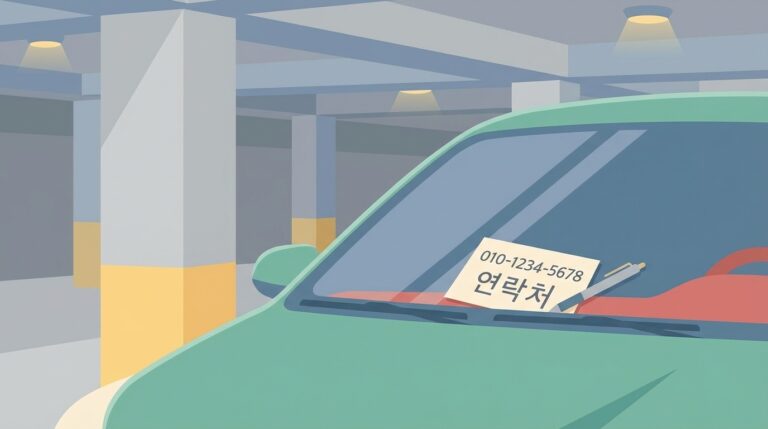
K-Culture Cold Open: Picture this: You’re watching a thriller K-Drama. The protagonist runs into the underground parking lot (지하 주차장), breathless. They reach their car, but… wait! Another car is blocking them! 😱 Do they scream? Do they call the police? No. They calmly walk to the blocking car, put their hands on the trunk, and push it aside like it weighs nothing.
The ‘Why’: Welcome to the wild world of Korean Parking Culture. If you live in a Korean apartment (euphoniously called “Apart”), the underground parking lot is not just a place for cars—it’s a battlefield of space, etiquette, and physics. If you don’t know the rules, you might get a frantic call at 6 AM asking you to move your car!
Transparency: This guide is based on real panic moments from my students who rented cars in Jeju or moved to Seoul, only to face the dreaded “Double Parking” wall.
Phase 2: Deep Dive into Core Expressions
Here are the 3 phrases you need to survive the parking jungle.
1. 자리 있어요? (Jari isseoyo?)
- Pronunciation: [Jari is-suh-yo?]
- Jari sounds like ‘Jar’ + ‘E’.
- Isseoyo sounds like ‘E-saws-yo’.
- Meaning:
- Literal: “Is there a seat/spot?”
- Real Nuance: “Can I park here?” or “Is this space taken?”
- K-Culture Moment: You will hear this everywhere. Not just in parking lots, but in crowded K-BBQ restaurants or cafes in Hongdae. It is the magic question to find your space.
- Editor’s Insight: Koreans value speed. Instead of asking a long sentence like “Is it possible for me to park my automobile here?”, we just ask, “Spot exists?”
- Situation Spectrum:
[🚫 Formal] ———— [✅ Semi-formal/Polite] ———— [✅ Casual]
(Safe to use with security guards or strangers)- 🤔 Think About It: Why is the word “Jari” used for both a parking spot and a chair in a cafe? What does this say about the concept of “personal space” in Korea?
2. 차 좀 빼주세요 (Cha jom ppae-juseyo)
- Pronunciation: [Cha jom bbae-ju-say-yo]
- Cha means Car (like ‘Cha-cha-cha’).
- Ppae sounds like the ‘Pe’ in ‘Pet’ but stronger.
- Meaning:
- Literal: “Please take out the car a little.”
- Real Nuance: “Please move your car (so I can get out).”
- K-Drama Moment: The moment the villain blocks the hero’s car. The hero calls the number on the dashboard and says this line with a deep, angry voice.
- Editor’s Insight: Use “Jom” (a little/please) to soften the blow. Without it, you sound like a police officer ordering a tow truck.
- Situation Spectrum:
[🚫 To Elders (Too direct without 'Jom')] ———— [⚠️ Strangers] ———— [✅ Standard]3. 중립 (Jung-rip)
- Pronunciation: [Jung-nip]
- Meaning: Neutral (Gear).
- K-Culture Moment: If a security guard points at your tires and crosses his arms, he’s checking if you left your car in Neutral Gear. Why? So others can push your car if you are blocking them!
- Editor’s Insight: This is unique to Korea’s high-density apartments. “Double Parking” (blocking someone else) is allowed, BUT only if you leave the car in Neutral.
- 🤔 Think About It: In many Western countries, touching someone else’s car is a crime. In Korea, pushing someone’s car is a daily morning routine. What does this require from a society? (Hint: Trust).
Phase 3: Textbook vs. Real Life
| Situation | 📖 Textbook Korean | 🗣️ Real Korean | 💡 Why different? |
|---|---|---|---|
| Asking to park | 주차할 공간이 있습니까? (Is there space to park?) | 여기 자리 있어요? (Spot here?) | Speed is key. “Jari” covers everything. |
| Asking someone to move | 차를 이동해 주시겠습니까? (Would you move the car?) | 차 좀 빼주세요. (Pull car out, please.) | Passive voice is rare; we focus on the action (Pull out). |
| Apologizing for blocking | 죄송합니다. (I am sorry.) | 아, 잠시만요! (Ah, just a moment!) | “Just a moment” implies “I’m moving it right now!” |
💡 Bottom Note: A1 Beginners, stick to “Jari isseoyo?” It’s the Swiss Army Knife of Korean phrases!
Phase 4: Cultural Deep Dive
4-1. The “Nunchi” of Parking
In a Korean apartment underground lot, eye contact with the Security Guard (Gyeongbi-nim) is crucial. If he waves a glowing stick frantically, use your Nunchi (quick situational judgment). He isn’t dancing; he’s telling you a delivery truck is coming!
4-2. K-Drama Connection: The “Dashboard Phone Number”
Have you noticed in dramas, when a character wants to call their crush, they sometimes steal the number from the car dashboard?
* Reality: Every Korean car has a mobile number visible on the dashboard. It’s not for flirting; it’s so people can call you to say “Cha jom ppae-juseyo” (Move your car). If you rent a car, check if there’s a temporary number card!
Phase 5: Immersive Roleplay
Setting: Friday night, 8 PM. A crowded underground parking lot in a Seoul apartment complex. You are driving a rental car.
Characters:
* YOU: A tired traveler looking for a spot.
* Guard (Ahjeossi): A busy security guard in a uniform, holding a glowing stick.
Dialogue:
Guard: (Waving stick) 거기 안 돼요! 꽉 찼어요.
(Geogi an-dwaeyo! Kkwak chass-eoyo.)
[No! Not there. It’s full.]
YOU: (Confused, rolling down window)
🔀 Your Turn! What do you say?
- A) “Hello.” (Too simple, he might ignore you)
- B) “여기 자리 있어요?” (Perfect! Direct and clear)
- C) “Help me!” (A bit dramatic)
✅ Best Choice: B
YOU: 여기 자리 있어요? (Yeogi jari isseoyo?)
Guard: 저기 뒤에… 이중 주차 하세요.
(Jeogi dwi-e… Ijung jucha haseyo.)
[Over there in the back… please double park.]
YOU: (Nodding) 네, 알겠습니다! (Ne, al-get-seumnida!)
(🎭 Stage Direction: You park behind another car. Now, the most important part!)
Guard: (Shouting) 기어 중립! (Gieo Jung-rip!)
[Gear Neutral!]
YOU: 네! (Ne!)
Phase 6: 10-Second Shadowing Drill
Let’s practice the magic spell to get people to move their cars.
- Emotion: 🥺 Polite but Urgent (You are late for work!)
- Drill:
저기요... / 차 좀 / 빼주세요.
(Jeogiyo… / cha jom / ppae-juseyo.)
[Excuse me… / car (please) / pull out.]
Phase 7: K-Culture Mini Glossary
| Korean | Romanization | Meaning | Context |
|---|---|---|---|
| 아파트 | Apateu | Apartment | Not just a flat, but high-rise complexes with brands (Raemian, Xi, etc.). |
| 경비실 | Gyeongbisil | Security Office | The command center of the apartment. |
| 이중 주차 | Ijung jucha | Double Parking | Parking in front of another car because the lot is full. |
| 차 | Cha | Car / Tea | Context matters! Don’t drink a car. ☕️🚗 |
Phase 8: Traveler’s Survival Kit
Even if you don’t drive, you will walk through these parking lots to get to the elevator.
🆘 Survival Expression #1
– 🇰🇷 “나가는 길 어디예요?” (Naganeun gil eodi-yeyo?)
– 🗣️ Meaning: Where is the exit/way out?
– 📍 Use: When you get lost in the endless concrete maze.
– 💡 Pro Tip: Underground lots often connect to the Subway. Look for signs saying “지하철” (Jihacheol).📌 Editor’s Travel Note
– Walking Safety: Korean parking lots often don’t have sidewalks. Cars and people share the road. Watch out for hybrid/electric cars—they are silent assassins! 🤫
Phase 9: Think Deeper — “Trust & Space”
Why do Koreans put their phone numbers on their cars?
In many countries, leaving your personal phone number on a dashboard is a privacy risk. In Korea, it’s a social contract. Because the country is small and 50% of the population lives in the Seoul Capital Area, space is scarce. The “Phone Number” system allows high-density living to function. It shows a fascinating side of Korean society: High Trust (people won’t misuse the number) meets High Efficiency (solve the blocking problem instantly).
💬 Your Turn: Would you feel comfortable leaving your phone number on your car in your country? Why or why not?
Phase 10: FAQ & Troubleshooting
- Q: Can I push ANY car that is blocking me?
- Answer: NO! 🛑 Only push cars that are parallel parked in front of others and look “pushable” (usually the wheels are straight). If the brake lights are on, or it’s a luxury car in a designated spot, call the number on the dashboard first.
- Q: What if I scratch a car while pushing it?
- Answer: This is a nightmare scenario. Usually, the pusher is liable. That’s why many Koreans wear soft white gloves found in the trunk to push cars (just kidding about the gloves, but they do push carefully!).
❌ Common Mistake: Pulling the handbrake (emergency brake) when double parking.
✅ Fix: You MUST leave the car in Neutral (N) and release the handbrake so others can push it.
Phase 11: Wrap-up & Action Mission
One-Liner: To survive a Korean parking lot, learn to say “Jari isseoyo?” and always leave your car in Neutral if you double park.
🚀 Action Mission:
* 🥉 Bronze: Say “Cha jom ppae-juseyo” 3 times loud while imagining you are blocked.
* 🥈 Silver: Watch a K-Drama scene involving a car and spot the phone number on the dashboard.
* 🥇 Gold: If you are in Korea, walk through an apartment parking lot and count how many cars have phone numbers visible!
K-Culture Mission: Next time you are at a Korean restaurant and it’s crowded, ask the server: “Yeogi jari isseoyo?” instead of just pointing!
Phase 12: Interactive Quiz
1. Situation Judgment:
A security guard shouts “Jung-rip!” (Neutral). What should you do?
* a) Drive away fast.
* b) Put your car in Neutral gear so it can be pushed.
* c) Turn on the radio.
2. True or False:
In Korea, it is rude to leave your phone number on your car dashboard.
* (True / False)
⬇️ Answers
1. b) Jung-rip means Neutral gear. It’s essential for double parking.
2. False. It is rude NOT to leave it. If you block someone and they can’t call you, that is the ultimate rudeness!
Frequently Asked Questions (FAQ)
Q: What does "자리 있어요? (Jari isseoyo?)" mean in Korean and how do you pronounce it?
A: In Korean, "자리 있어요? (Jari isseoyo?)" is pronounced [Jari is-suh-yo?] and means: a key conversational Korean expression covered in this lesson.
Q: What does "차 좀 빼주세요 (Cha jom ppae-juseyo)" mean in Korean and how do you pronounce it?
A: In Korean, "차 좀 빼주세요 (Cha jom ppae-juseyo)" is pronounced [Cha jom bbae-ju-say-yo] and means: a key conversational Korean expression covered in this lesson.
Q: What does "중립 (Jung-rip)" mean in Korean and how do you pronounce it?
A: In Korean, "중립 (Jung-rip)" is pronounced [Jung-nip] and means: Neutral (Gear).







