

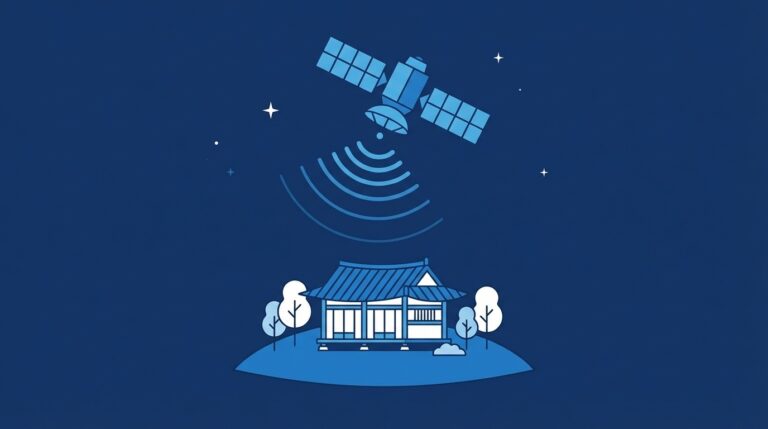
Unit: Bridging the Digital Divide via Satellite Networks
Phase 1: The Immersive Hook
안녕하세요! This is your Daily Hangul Editor.
Imagine this scene from a popular K-Drama: The CEO protagonist flees the pressures of Seoul to a remote island for a “digital detox.” But the moment a crisis hits the company, they are frantically running up a mountain, holding their phone to the sky, screaming, “Why is there no signal?!” (왜 안 터져?!)
In Korea, the land of “8282” (hurry, hurry) culture, a slow internet connection isn’t just an inconvenience—it’s an existential crisis. While Korea is an IT powerhouse, the geography (70% mountains and thousands of islands) creates natural “blind spots” (사각지대).
Today, we are stepping into the shoes of an aerospace engineer or policy maker. We aren’t just learning how to ask for Wi-Fi password; we are discussing how Satellite Internet (위성 인터넷) is the key to Bridging the Digital Divide (정보 격차 해소). This is C2-level Korean: sophisticated, professional, and deeply relevant to modern tech society.
Phase 2: Deep Dive into Core Expressions
1. 정보 격차를 해소하다 (Jeongbo gyeokchareul haesohada)
- Pronunciation: [Jeong-bo gyeok-cha-reul hae-so-ha-da] / Think of ‘hae-so’ like ‘has-sol’ without the ‘l’.
- Meaning: To bridge (resolve) the digital divide.
- 정보 (Information) + 격차 (Gap/Disparity) + 해소하다 (To resolve/relieve).
- K-Culture Moment: You’ll hear this in news reports about elderly people struggling with Kiosks in cafés, or rural students needing internet for online classes. It’s a term loaded with social responsibility.
- Editor’s Insight: Haesohada (해소하다) is a high-level verb. You don’t just “fix” the gap; you “dissolve” or “resolve” it, like stress or a grudge. It implies a systemic solution.
- Situation Spectrum:
[🚫 Casual Friends] ———— [⚠️ Colleagues] ———— [✅ Formal/Academic]
(Use this in presentations, news interviews, or serious debates. Too heavy for a pojangmacha.) - 🤔 Think About It: Why does Korea use the word “Gap” (격차) instead of “Divide”? Gyeokcha implies a difference in level or standard, hinting that one side is “behind” and needs to catch up to the standard.
2. 통신 사각지대 (Tongsin sagakjidae)
- Pronunciation: [Tong-sin sa-gak-ji-dae]
- Meaning: Communication blind spot / Dead zone.
- 사각 (Dead angle/Blind spot) + 지대 (Zone/Area).
- K-Culture Moment: Every time a variety show films in the deep countryside (like Three Meals a Day), the cast complains about being in a Sagakjidae.
- Editor’s Insight: This is a perfect term for aerospace contexts. LEO (Low Earth Orbit) satellites are specifically designed to eliminate these Sagakjidae.
- Situation Spectrum:
[✅ Casual Friends] ———— [✅ Colleagues] ———— [✅ Formal]
(You can use this metaphorically too: “Our marketing strategy has a blind spot.”)
3. 초연결 사회 (Choyeongyeol sahoe)
- Pronunciation: [Cho-yeon-gyeol sa-hoe]
- Meaning: Hyper-connected society.
- K-Culture Moment: Often mentioned in K-Pop concepts (like aespa’s ‘KWANGYA’ or metaverse themes) where physical and digital realities merge.
- Editor’s Insight: The prefix 초 (Cho) means “Super” or “Hyper” (like Superman = Cho-in). It signifies going beyond the normal limit.
Phase 3: Textbook vs. Real Life
| Situation | 📖 Textbook Korean | 🗣️ Real Korean (Pro) | 💡 Why the difference? |
|---|---|---|---|
| Explaining bad signal | 인터넷 연결이 원활하지 않습니다. (Internet connection is not smooth.) | 여기 데이터가 잘 안 터져요. (The data doesn’t “burst” well here.) | “Teojida” (burst/pop) is the vivid verb Koreans use for signals connecting. |
| Discussing slow speed | 속도가 느려서 답답합니다. (It is frustrating because the speed is slow.) | 버퍼링이 너무 심한데요? (The buffering is too severe.) | English loanwords like “Buffering” or “Lag” are standard in tech talk. |
| Talking about universal access | 누구나 인터넷을 쓸 수 있어야 합니다. (Everyone should be able to use internet.) | 보편적 접근권이 보장되어야죠. (Universal access rights must be guaranteed.) | C2 level requires Sino-Korean legal/formal terminology for precision. |
💡 Bottom Note: In a professional aerospace meeting, stick to the Textbook/Formal column. But when complaining to your colleague about the connection during a coffee break, use “Teojida.”
Phase 4: Cultural Context — The “Bali Pali” Infrastructure
4-1. Non-verbal: The “Signal Hunt”
In Korea, if a webpage takes more than 3 seconds to load, you might see people refreshing the page aggressively or holding their phone up high (as if altitude helps). In a business meeting, if a video conference lags, an immediate apology is expected. Silence is not golden; it’s a technical failure.
4-2. K-Culture Connection: The “PC Bang” Standard
Why is the “Digital Divide” such a hot topic? Because the baseline in Korea is the PC Bang (Internet Cafe) speed. Korean culture is built on real-time interaction—ticketing for K-Pop concerts (success is determined in milliseconds), signing up for university classes, or ordering food delivery.
Critical View: In dramas, rural connectivity is often romanticized as a chance to bond. In reality, for the aerospace sector, it represents a market failure that satellites must fix. The “Digital Divide” in Korea isn’t just about Netflix; it’s about being cut off from government services and banking, which are almost entirely digital now.
Phase 5: Immersive Roleplay
Setting: A strategic meeting at a satellite tech company in Pangyo (Korea’s Silicon Valley). You are presenting a plan to government officials.
Characters:
* YOU: Senior Engineer (Foreign Expert).
* Director Park: Government Official (Conservative, concerned about budget).
The Dialogue:
Director Park: 위성 발사 비용이 만만치 않은데, 굳이 저궤도 위성을 고집하는 이유가 뭡니까?
(Wiseong balsa biyongi manmanchi aneunde, guji jeogwedo wiseongeul gojiphaneun iyuga mwomnikka?)
(The launch cost is formidable. Why do you insist on Low Earth Orbit satellites?)
YOU: 비용 문제도 중요하지만, 도서 산간 지역의 정보 격차를 생각해야 합니다.
(Biyong munjedo jungyohajiman, doseo sangan jiyeok-ui jeongbo gyeokchareul saenggakhaeya hamnida.)
(Cost is important, but we must consider the digital divide in island and mountain areas.)
Director Park: 도서 산간 지역이요? 광케이블로도 충분하지 않나요?
(Doseo sangan jiyeok-iyo? Gwangkkeibullodo chungbunhaji annayo?)
(Islands and mountains? Isn’t fiber optic cable enough?)
🔀 Decision Point: How do you respond?
- A) “아니요, 산이 많아서 힘들어요.” (No, it’s hard because there are many mountains.) – Too simple for C2.
- B) “지형적 제약 때문에 광케이블은 한계가 있습니다. 위성이 유일한 대안입니다.” (Due to geographical constraints, fiber optics have limits. Satellites are the only alternative.) – Professional & Persuasive.
- C) “요즘 세상에 누가 땅을 파요? 위성 쏘시죠.” (Who digs the ground these days? Let’s just shoot satellites.) – Too aggressive/informal.
✅ Best Choice: B. You used 지형적 제약 (Geographical constraints) and 대안 (Alternative). This vocabulary commands respect.
Director Park: (Nodding) 지형적 제약이라… 일리가 있군요.
((Nodding) Geographical constraints… That makes sense.)
Phase 6: 10-Second Shadowing Drill
Practice this sentence to sound like a tech visionary.
“True innovation is about leaving no one behind in this hyper-connected era.”
😤 With Conviction (단호하게):
진정한 혁신은 / 초연결 시대에 / 그 누구도 / 소외되지 않게 / 하는 것입니다.
(Jinjeonghan hyeoksineun / choyeongyeol sidae-e / geu nugudo / so-oe-doe-ji an-ke / haneun geosimnida.)
Phase 7: K-Culture Mini Glossary (Aerospace & Tech Edition)
| Korean | Romanization | English | Context |
|---|---|---|---|
| IT 강국 | IT gangguk | IT Powerhouse | A title Koreans are very proud of. Korea ranks top in internet speed/access. |
| 얼리어답터 | Eollieodapteo | Early Adopter | Koreans love new tech. New phones/services spread instantly. |
| 인프라 | Inpeura | Infrastructure | Used broadly for internet, transport, and social systems. |
| 먹통 | Meoktong | Dead/Bricked | Slang for when a device or network completely stops working. (Lit: Ink stick) |
| 5G (오지) | O-ji | 5G Network | Pronounced “Oh-Ji”, not “Five-Gee”. |
Phase 8: Traveler’s Survival Kit (Remote Areas)
Even if you are an aerospace expert, you might travel to Jeju or Ulleungdo.
🆘 Survival Phrases for Connectivity
* 🇰🇷 “여기 와이파이 비번이 뭐예요?” (Yeogi waipai bibeoni mwoyeyo?)
* What is the Wi-Fi password here? (Essential everywhere in Korea).
* 🇰🇷 “데이터가 자꾸 끊겨요.” (Deiteoga jakku kkeunkyeoyo.)
* The data keeps cutting out. (Useful when reporting issues).
* 🇰🇷 “테더링 좀 켜 주실 수 있나요?” (Tedeoring jom kyeo jusil su innayo?)
* Could you turn on tethering (hotspot)?📌 Editor’s Travel Note:
If you go hiking in National Parks (like Seoraksan), look for “Wi-Fi Zones” even on the mountain trails! Korea installs transmitters even in high altitudes to prevent the very “blind spots” we discussed.
Phase 9: Think Deeper — Technology & Alienation
Topic: Digital Alienation (디지털 소외)
While we build satellite networks to connect the physical world, are we widening the generational gap? In Korea, elderly people often feel intimidated by the rapid pace of Digital Transformation (디지털 전환).
🧠 Think Deeper:
Korea has the world’s fastest internet, but it also has a high elderly poverty rate. When everything from banking to ordering groceries moves to an app (which requires high-speed internet), is technology serving everyone, or just the “Digital Natives”? The term 정보 격차 (Information Gap) isn’t just about where you live, but who you are.💬 Your Turn: Does your country have a program to help the elderly use high-tech infrastructure? How do you say “Digital Illiteracy” in your language?
Phase 10: FAQ & Troubleshooting
Q: Can I use the word ‘Dead Zone’ (사각지대) in a social context?
A: Yes! You can say “복지의 사각지대” (Blind spots in social welfare) or “법의 사각지대” (Loophole in the law). It’s a very intellectual metaphor.
Q: Is it rude to complain about slow internet in Korea?
A: Not rude, but it’s a shared bonding experience. Complaining about slow internet is a national pastime. However, don’t blame the person (e.g., the café owner); blame the network.
❌ Common Mistake:
* Mistake: Saying “Internet is broken” (인터넷이 부서졌어요 – literally physically broken).
* Correction: Say “인터넷이 안 돼요” (It doesn’t work) or “먹통이에요” (It’s dead/jammed).
Phase 11: Wrap-up & Action Mission
One-Liner: To be a true expert in Korea, you must advocate for connection (연결) that reaches every corner of the land.
🚀 Action Missions:
* 🥉 Bronze: Practice saying “정보 격차를 해소해야 합니다” three times clearly.
* 🥈 Silver: Watch a Korean news clip about “6G” or “Starlink in Korea” on YouTube and listen for the word “인프라” (Infrastructure).
* 🥇 Gold: Next time you have a bad signal, humorously tell a Korean friend, “I’m in a total Sagakjidae (Blind spot) right now!”
K-Culture Mission: Open “Naver Map” and look at Dokdo (독도). Check the street view. You will see full high-definition images. Think about the satellite and network infrastructure required to map even the farthest island of Korea!
Phase 12: Interactive Quiz
- Situational Judgment: You are writing a formal proposal for a satellite project. Which word fits best for “Bridging the gap”?
- a) 고치다 (Fix)
- b) 때우다 (Patch up)
- c) 해소하다 (Resolve/Dissolve)
- d) 연결하다 (Connect)
- Fill in the Blank: “Without satellites, deep mountains remain a communication [ ].”
- (Hint: Dead zone)
- Answer: [ 사각지대 ]
- True or False: In Korea, it is considered impossible to get Wi-Fi on a hiking trail.
- (False) – Korea prides itself on connectivity even in nature!
(Answers: 1-c, 2-사각지대, 3-False)
Frequently Asked Questions (FAQ)
Q: What does "정보 격차를 해소하다 (Jeongbo gyeokchareul haesohada)" mean in Korean and how do you pronounce it?
A: In Korean, "정보 격차를 해소하다 (Jeongbo gyeokchareul haesohada)" is pronounced [Jeong-bo gyeok-cha-reul hae-so-ha-da] and means: To bridge (resolve) the digital divide.
Q: What does "통신 사각지대 (Tongsin sagakjidae)" mean in Korean and how do you pronounce it?
A: In Korean, "통신 사각지대 (Tongsin sagakjidae)" is pronounced [Tong-sin sa-gak-ji-dae] and means: Communication blind spot / Dead zone.
Q: What does "초연결 사회 (Choyeongyeol sahoe)" mean in Korean and how do you pronounce it?
A: In Korean, "초연결 사회 (Choyeongyeol sahoe)" is pronounced [Cho-yeon-gyeol sa-hoe] and means: Hyper-connected society.







