

Don’t Get Ghosted! How to Nail Down a Time in Korea 📅
Phase 1: The “Let’s Eat Sometime” Trap 🎣
Annyeonghaseyo! It’s your Daily Hangul Editor.
You know that scene in every K-Drama? Two friends bump into each other on the street. They smile, wave, and say, “Bap hanbeon meokja!” (Let’s have a meal sometime!).
Then… they walk away. No date, no time, no restaurant.
Did they just lie?
Not exactly. In Korea, suggesting a meeting is often just a polite greeting, like “How are you?” in English. But you want to actually meet your Korean friends, right? To turn that polite greeting into a real plan involving fried chicken and beer, you need to know how to pin down the “When.”
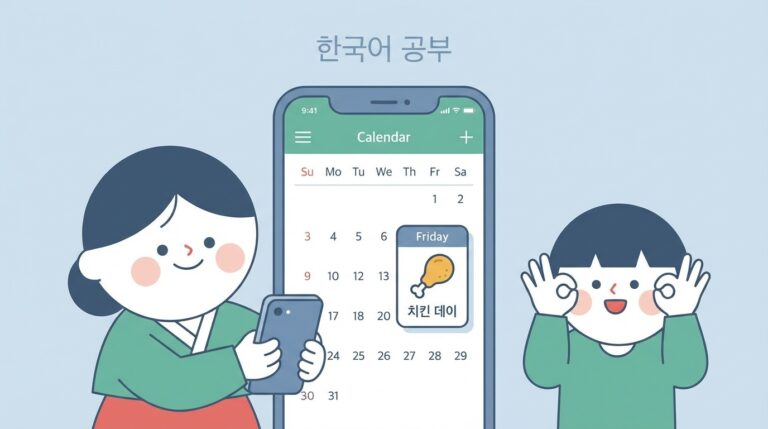
Today, we are going to learn how to move from “someday” to “Friday at 7 PM.” Let’s stop the vague texting game and get that appointment in the calendar!
Phase 2: Deep Dive into Key Expressions 🧐
1. 언제 만날까요? (Eonje mannal-kkayo?)
- Pronunciation: [Eon-je man-nal-kka-yo?]
- Sound-alike: On (switch) + Jay (Z) + Man + Nal + Ka (Car) + Yo
- Meaning: “When shall we meet?”
- K-Culture Moment: Think of a variety show like Running Man. The team needs to gather. The leader looks at the members and asks this to coordinate. It implies, “I want to meet, let’s decide together.”
- Editor’s Insight: The ending -l kkayo? is key here. It’s not a demand; it’s a suggestion. It’s the difference between “Meet me!” and “Shall we dance?” It shows you respect their schedule.
- Situation Spectrum:
[🚫 Formal Boss] ———— [⚠️ Colleagues] ———— [✅ Friends/Dates]- (Note: For bosses, you’d usually ask when they are available first, rather than suggesting “we” meet.)
- 🤔 Think About It: Why does Korean use a question form (“Shall we…?”) instead of a direct statement (“Let’s meet…”)? How does this reflect the Korean value of group harmony?
2. 시간 괜찮으세요? (Sigan gwaenchaneuseyo?)
- Pronunciation: [Si-gan gwaen-cha-neu-se-yo?]
- Sound-alike: She + Gun + Gwen (Gwen Stefani) + Cha (Cha-cha) + Neu + Say + Yo
- Meaning: “Is the time okay for you?” / “Do you have time?”
- K-Drama Context: The main character wants to ask their crush out but is too shy. They text this phrase and stare at their phone, waiting for the “1” (read receipt) to disappear.
- Editor’s Insight: This is the magic phrase to avoid rejection. Instead of saying “Let’s meet Friday,” you ask this first. It gives the other person an easy way out if they are busy.
- Situation Spectrum:
[✅ Formal Boss] ———— [✅ Colleagues] ———— [✅ Friends (drop 'yo')]
3. 그때 봐요! (Geuttae bwayo!)
- Pronunciation: [Geut-tae bwa-yo!]
- Sound-alike: Good (but with a T ending) + Te (Tech) + Bwa (Bwah!) + Yo
- Meaning: “See you then!”
- Editor’s Insight: This is the “Confirm Button.” Once the time is set, say this cheerfully. It seals the deal.
Phase 3: Textbook vs. Real Life 🗣️
| Situation | 📖 Textbook Korean | 🗣️ Real Korean (Slang/Casual) | 💡 Why the difference? |
|---|---|---|---|
| Suggesting a time | 토요일에 시간이 있어요? (Do you have time on Saturday?) | 토요일 콜? (Saturday, Call?) | “Call” comes from poker (“I call your bet”). It means “Deal!” or “I’m in!” |
| Asking generally | 언제 만날까요? (When shall we meet?) | 언제 됨? (When works?) | Koreans love efficiency. In texting, we shorten grammatical endings to save typing time. |
| Declining | 미안하지만 시간이 없어요. (I am sorry but I have no time.) | 아, 그때는 좀… (Ah, that time is a bit…) | Koreans hate saying a direct “No.” Trailing off (“a bit…”) is a polite refusal. |
💡 Editor’s Note for A2 Learners: Using “Call?” is super natural with close friends, but never use it with your teacher or boss! Stick to “Sigan gwaenchaneuseyo?” to be safe.
Phase 4: Cultural Deep Dive — The Art of “Nunchi” 👀
4-1. The “Maybe” Means “No”
If you ask “Can we meet Friday?” and your Korean friend says, “Hmm, I think I might be busy, let me check…” and never gets back to you—that was a “No.”
In Korea, preserving Kibun (mood/feelings) is crucial. Rejecting someone directly hurts feelings. You need Nunchi (eye-measure/social sense) to read the silence as a decline. Don’t keep asking!
4-2. K-Pop Connection: The “Ticketing” War
Have you ever tried to buy K-Pop concert tickets? We call it Piketing (Blood + Ticketing). When setting a time with a popular Korean friend, it can feel like this. Everyone wants a piece of their time.
* Pro Tip: If you are asking someone “superior” (older/higher rank), always offer 2-3 time slots first. Don’t make them do the work of choosing.
Phase 5: Immersive Roleplay 🎭
Setting: It’s Wednesday afternoon. You are texting Min-su, a Korean friend you met at a language exchange. You want to eat Samgyeopsal (pork belly) together.
(Text Message Interface)
You: 민수 씨, 우리 언제 밥 먹을까요? 🥘
(Min-su ssi, uri eonje bap meogeulkkayo?)
Min-su: 오 좋아요! 저는 이번 주 금요일 저녁 괜찮아요. 😊
(Oh joayo! Jeoneun ibeon ju geumyoil jeonyeok gwaenchannayo.)
[Trans: Oh good! I’m okay this Friday evening.]
🔀 YOUR TURN! How do you reply?
- Option A: “네, 그때 봐요!” (Ne, geuttae bwayo!) – Simple & Confirming.
- Option B: “금요일은 좀… 토요일은 어때요?” (Geumyoileun jom… toyoileun eottaeyo?) – Polite Refusal & Suggestion.
- Option C: “싫어요.” (Sireoyo.) – Direct Refusal.
✅ Best Choice (If you are free): Option A. Simple and perfect.
⚠️ Analysis of Option B: If Friday is bad, say “Geumyoileun jom…” (Friday is a bit…). This is the polite, native way to say no. Then immediately suggest an alternative (Saturday).
🚫 Analysis of Option C: “Sireoyo” means “I hate it/I don’t want to.” You will sound like a angry toddler! Avoid this unless you want to end the friendship.
Phase 6: 10-Second Shadowing Drill 🗣️
Let’s practice the rhythm. Don’t read like a robot!
1. Asking for time (Polite & Soft)
😊 “시간 / 괜찮으세요?”
(Si-gan / gwaen-cha-neu-se-yo?)
2. Suggesting Friday (Enthusiastic)
😁 “금요일 / 저녁 / 어때요?”
(Geum-yo-il / jeon-yeok / eo-ttae-yo?)
3. Confirming (Decisive)
👌 “좋아요 / 그때 / 봐요!”
(Jo-a-yo / geut-tae / bwa-yo!)
Phase 7: K-Culture Mini Dictionary 📘
| Korean | Romanization | Meaning | Context |
|---|---|---|---|
| 약속 | Yaksok | Appointment / Promise | Used for both “pinky swear” and “meeting plans.” |
| 불금 | Bul-geum | Fire Friday | TGIF! Friday nights are “burning” with energy. Best time to meet. |
| 칼퇴 | Kal-toe | Knife-Leave | Leaving work exactly on time. Necessary to make a 7 PM dinner plan! |
| 파토 | Pato | Cancellation (Slang) | When plans get cancelled abruptly. “Plan-i pato nasseo” (The plan got ruined). |
Phase 8: Traveler’s Survival Kit 🧳
Making appointments isn’t just for friends. You need it for hair salons, restaurants, and tours.
🆘 Survival Phrases for Reservations
1. “예약 가능한가요?” (Yeyak ganeunghangayo?)
* Meaning: Is a reservation possible?
2. “지금 가도 돼요?” (Jigeum gado dwaeyo?)
* Meaning: Can I go/come now? (Useful for walk-ins)
3. “몇 시까지 해요?” (Myeot si-kkaji haeyo?)
* Meaning: Until what time are you open?📌 Editor’s Travel Note
* Naver Map / Kakao Map: Google Maps often fails in Korea. Use Naver or Kakao to check opening hours before you ask “When?”
* The “Break Time” Trap: Many Korean restaurants have a break time (usually 3 PM – 5 PM). Don’t set your appointment then!
Phase 9: Think Deeper — “The Empty Promise” 🧠
Why do Koreans say “Let’s eat sometime” without meaning it?
In Western cultures, proposing a time is a practical logistical step. In Korea, suggesting a future meeting is often a social lubricant. It confirms, “We are on good terms,” and “I like you enough to want to eat with you,” even if reality (work, distance) makes it impossible.
Don’t feel betrayed if the plan never happens. Accept the sentiment of affection behind the words. But if you really want to meet, be the one to say, “How about next Tuesday?”
💬 Your Turn: Does your culture have “empty polite phrases” like this? Tell us in the comments!
Phase 10: FAQ & Troubleshooting 🛠️
- Q: Can I suggest a time to someone older than me?
- A: Yes, but phrases it as a question, not a statement. Use “~ eottaeyo?” (How is…?) instead of “Let’s meet at…”.
- Q: What is “Korean Time”?
- A: Historically, being 10-15 minutes late was tolerated among friends. However, this is changing. For business or reservations, be punctual. For casual friend meetups, being 5-10 minutes late is often forgiven, but don’t push it!
- ❌ Common Mistake: Saying “See you!” (Ddo bwayo) when you have no plans to meet again.
- ✅ Fix: Just say “Annyeonghi gaseyo” (Go well/Goodbye). Reserve “See you” for when there is a real possibility of meeting.
Phase 11: Wrap-up & Mission 🚀
Summary: Today we learned to move from vague greetings to concrete plans using “Eonje mannal-kkayo?” and “Geuttae bwayo!”.
🔥 Action Missions:
* 🥉 Bronze: Look in the mirror and practice asking “Sigan gwaenchaneuseyo?” with a polite face.
* 🥈 Silver: Watch a K-Drama episode. Count how many times characters say “Let’s eat sometime” but don’t set a time!
* 🥇 Gold: Message a Korean friend (or a language partner) and set a specific time to chat or meet using the phrases above!
K-Culture Mission: Open KakaoTalk. Check the emoticons. Find one that says “OK” or “Call” (콜). This is how Koreans instantly agree to a time!
Phase 12: Pop Quiz 📝
1. Your boss asks if you can meet at 3 PM. You are free. How do you answer?
* A) 싫어요. (I hate it.)
* B) 네, 괜찮아요. (Yes, it’s okay.)
* C) 언제 만날까요? (When shall we meet?)
2. True or False?
* “Bap hanbeon meokja” (Let’s eat sometime) always means you will eat together within a week.
3. Which phrase is best to finalize the plan?
* A) 시간 괜찮으세요?
* B) 그때 봐요!
* C) 누구세요?
(Answers: 1-B, 2-False, 3-B)
Frequently Asked Questions (FAQ)
Q: What does "언제 만날까요? (Eonje mannal-kkayo?)" mean in Korean and how do you pronounce it?
A: In Korean, "언제 만날까요? (Eonje mannal-kkayo?)" is pronounced [Eon-je man-nal-kka-yo?] and means: a key conversational Korean expression covered in this lesson.
Q: What does "시간 괜찮으세요? (Sigan gwaenchaneuseyo?)" mean in Korean and how do you pronounce it?
A: In Korean, "시간 괜찮으세요? (Sigan gwaenchaneuseyo?)" is pronounced [Si-gan gwaen-cha-neu-se-yo?] and means: a key conversational Korean expression covered in this lesson.
Q: What does "그때 봐요! (Geuttae bwayo!)" mean in Korean and how do you pronounce it?
A: In Korean, "그때 봐요! (Geuttae bwayo!)" is pronounced [Geut-tae bwa-yo!] and means: a key conversational Korean expression covered in this lesson.







