

The Morning After: Surviving the “Yasik” Guilt Trip in Korea 🌙🍜
Phase 1: Immersive Hook
안녕하세요! Daily Hangul Editor here.
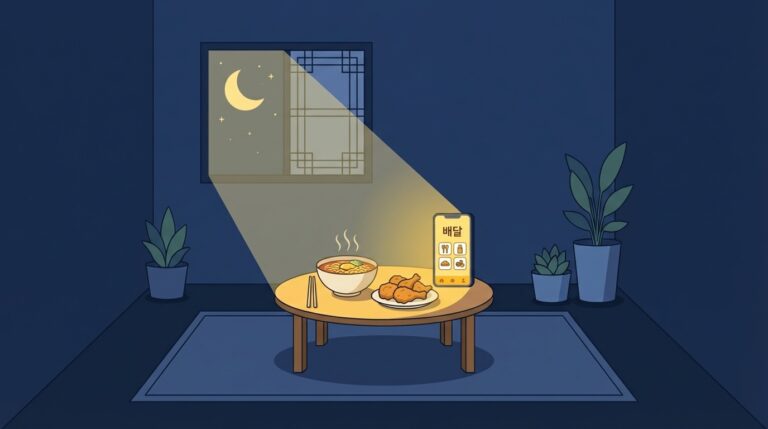
Picture this: You’re watching your favorite K-Drama. It’s 2 AM in the show, and the main characters are sitting at a Pocha (street tent bar) or their rooftop apartment. The steam rises from a pot of spicy Ramyeon, and they take that first loud slurp.
Suddenly, your stomach growls. You open a delivery app (Baemin or Yogiyo), and 30 minutes later, you’re in heaven. But then comes the morning sun… 😱
You look in the mirror. Who is this person? Your eyes are puffed shut, your jawline has vanished, and you feel heavy. Welcome to the “Yasik Syndrome” (Late-night Snack Syndrome).
In Korea, loving food is a virtue, but the battle against the bloat is a national sport—especially for K-Pop idols before a shoot! Today, let’s learn how to express that “delicious regret” and talk about the consequences of Korea’s irresistible night food culture.
Phase 2: Deep Dive – Key Expressions
Here are the phrases you need when the morning regret hits hard.
1. 얼굴이 붓다 [eolguri butda]
- Pronunciation: eolguri boot-da (Imagine stepping on a bug with a boot 👢 -> boot-da)
- Meaning: To have a swollen/puffy face.
- K-Culture Moment: You’ll see this in almost every variety show. An idol wakes up, covers their face, and screams, “Ah! My face is so swollen!” (eol-gul bu-eot-seo!).
- Editor’s Insight: Koreans distinguish between “gaining weight” (sal-jji-da) and “swelling” (but-da). Usually, if you look heavy in the morning, it’s just but-da from sodium! It’s a temporary, comforting excuse.
- Situation Spectrum:
[🚫 Boss (Formal)] ———— [⚠️ Colleagues] ———— [✅ Friends]
(It’s a personal physical complaint, so keep it casual or with close colleagues.)- 🤔 Think About It: Why is having a “V-line” (sharp jawline) so important in Korea that we have a specific verb for losing it temporarily?
2. 야식이 당기다 [yasigi danggida]
- Pronunciation: yasigi dang-gi-da (Sounds like “dangling” a carrot in front of you)
- Meaning: To crave late-night snacks (Literal: Late-night snacks are pulling me).
- K-Culture Moment: It’s 11 PM. Your friend looks at you with mischievous eyes and says, “Don’t you crave something spicy?” That’s the dang-gi-da moment.
- Editor’s Insight: You can use dang-gi-da for any strong craving. “Coffee-ga dang-gyeo” (I’m craving coffee). It implies an irresistible pull.
- Situation Spectrum:
[🚫 Formal] ———— [⚠️ Semi-formal] ———— [✅ Casual]
(Perfect for suggesting a post-work meal with close coworkers.)3. 소화시키다 [sohwasikida]
- Pronunciation: so-hwa-shi-ki-da
- Meaning: To digest (food).
- K-Culture Moment: After a heavy BBQ dinner, you’ll often see people walking along the Han River or hitting a coin karaoke (Noraebang). They aren’t just having fun; they are “digesting” (sohwasikida) before sleeping to avoid the puffy face!
- Editor’s Insight: If someone asks why you aren’t sleeping yet, you can say: “I need to digest first” (So-hwa jom si-ki-go-yo).
Phase 3: Textbook vs. Real Life
How do real Koreans complain about last night’s chicken?
| Situation | 📖 Textbook Korean | 🗣️ Real Korean | 💡 Why the difference? |
|---|---|---|---|
| Waking up swollen | 얼굴이 부었어요. (My face is swollen.) |
아, 눈이 안 떠져… (Ah, my eyes won’t open…) |
Real Koreans emphasize the symptom (eyes shut tight) rather than just stating the fact. |
| Regretting eating | 어제 너무 많이 먹었어요. (I ate too much yesterday.) |
나 어제 입 터졌어. (My mouth ‘exploded’ yesterday.) |
“Ip teo-jyeot-seo” is slang meaning you couldn’t control your appetite and ate everything. |
| Suggesting a walk | 소화시키러 갈까요? (Shall we go to digest?) |
배 좀 꺼트리자. (Let’s make the belly go down.) |
More visual and casual language is preferred among friends. |
Phase 4: Cultural Deep Dive
4-1. The “Pumpkin Juice” Ritual (K-Beauty Secret)
If you see K-Pop idols drinking a yellowish pouch drink backstage, it’s likely Hobak-jup (Pumpkin Juice). In Korean traditional medicine, old pumpkin is famous for reducing swelling (butgi).
- The Look: If you mention “I drank pumpkin juice today” to a Korean, they will immediately understand you are trying to de-bloat. It shows high Nunchi about self-care culture.
4-2. Why is delivery so easy?
Korea has the world’s most advanced Baedal (Delivery) culture. You can order a single cup of coffee or a full feast at 3 AM to a park bench. This convenience is the main culprit of Yasik Syndrome.
- Critical View: Is this convenience actually good for us? Or does it fuel the cycle of stress-eating -> swelling -> dieting?
Phase 5: Immersive Roleplay – The Temptation
Setting: It’s Friday night, 11:30 PM. You and your Korean friend, Minji, are in your living room watching Netflix. You promised to start a diet today.
Characters:
* YOU: Trying to resist food. (Target: B1 Level)
* Minji: The “Devil’s Advocate” who wants fried chicken.
(Dialogue)
Minji: 와, 드라마 주인공이 먹는 치킨 진짜 맛있겠다… 우리 딱 한 마리만 시킬까?
(Wa, drama juingongi meongneun chikin jinjja masitgetda… Uri ttak han mariman sikilkka?)
[Wow, the chicken the main character is eating looks so good… Should we order just one bird?]
YOU: (Hesitating) 음… 지금 먹으면 내일 얼굴 부을 텐데…
(Eum… jigeum meogeumyeon naeil eolgul bueul tende…)
[Hmm… if we eat now, my face will be swollen tomorrow…]
Minji: 에이, 괜찮아! 우유 마시고 자면 안 부어. 진짜 안 먹을 거야?
(Ei, gwaenchana! Uyu masigo jamyeon an bueo. Jinjja an meogeul geoya?)
[Ei, it’s fine! If you drink milk before sleeping, you won’t swell. Are you really not going to eat?]
🔀 Decision Point: How do you respond?
- A) “그래? 그럼 딱 한 조각만 먹을까?” (Really? Then shall we eat just one piece?)
- B) “안 돼! 나 다이어트 중이야. 참아야 해.” (No! I’m on a diet. I must endure it.)
- C) “야식은 살 안 쪄요. 살은 내가 쪄요.” (Late-night snacks don’t gain weight. I gain weight.)
✅ Best Choice: A or C.
* A is realistic (we always cave in!).
* C is a famous humorous quote in Korea that will make Minji crack up.
* B is respectable, but Minji might be sad eating alone!
Minji (if you chose A): 좋아! 내가 주문할게. 배달 오면 깨워!
(Joha! Naega jumunhalge. Baedal omyeon kkaewo!)
[Great! I’ll order. Wake me up when the delivery comes!]
Phase 6: 10-Second Shadowing Drill
Let’s practice the “Regret” tone. Sound sad and tired!
- Emotion: 😢 Regretful & Whiny
- Sentence: 아… / 어제 라면 먹고 자지 말걸! / 얼굴이 빵빵해!
- Romanization: A… / eoje ramyeon meokgo jaji malgeol! / eolguri ppangppanghae!
- Meaning: Ah… / I shouldn’t have slept after eating Ramyeon! / My face is huge (like a balloon)!
Phase 7: K-Culture Glossary (Yasik Edition)
| Korean | Romanization | Meaning | Context |
|---|---|---|---|
| 치느님 | Chi-neu-nim | Chicken + God | Fried chicken is so good it’s worshipped like God. |
| 붓기 | Butgi | Swelling | The enemy of K-Pop idols. You’ll hear “Butgi ppaeda” (remove swelling) often. |
| 먹방 | Mukbang | Eating Show | Watching these at night causes Yasik Syndrome. |
| 야식 | Yasik | Late-night snack | Food eaten specifically after dinner hours (usually 9 PM+). |
Phase 8: Traveler’s Survival Kit (Pharmacy Edition)
You ate too much Yasik and now your stomach hurts? Head to a convenience store (GS25, CU) or a pharmacy.
🆘 Survival Expression #1
* 🇰🇷 “소화제 있어요?” (Sohwaje isseoyo?)
* 🗣️ Sound: So-hwa-jay ee-ssuh-yo?
* 📍 Where: Pharmacy (Yakguk) or Convenience Store.
* 💡 Pro Tip: Convenience stores sell drinkable digestion medicine (like ‘Whal-myung-su’). Look for the fan-shaped logo!📌 Editor’s Travel Note
* Bloated face? Go to Olive Young and look for “Cooling patches” or “Pumpkin Tea” (Hobak-cha).
* Ordering Food: As a tourist, using apps like ‘Shuttle’ or ‘Uber Eats’ is easier, but hotel concierges can order generic ‘Baemin’ for you if you ask nicely!
Phase 9: Think Deeper – “Beauty Standards vs. Food Love”
Brain Teaser:
Korea has a massive food culture (Mukbang, endless side dishes), yet the pressure to be thin and have a small face is intense.
- The Paradox: Why do Korean media promote eating massive amounts of food (Mukbang) but simultaneously praise extreme dieting?
- Language Clue: Notice how we say “My face is swollen” (But-eot-seo) instead of “I got fat”? It frames the issue as a temporary, manageable health symptom rather than a permanent failure. It’s a linguistic shield for our self-esteem.
💬 Your Turn: Does your language have a “polite excuse” for looking tired or heavy in the morning?
Phase 10: FAQ & Troubleshooting
- Q: Can I tell a Korean friend “Your face is swollen”?
- STOP! 🛑 Unless you are extremely close family or best friends, commenting on someone’s physical appearance (even swelling) can be rude. Let them complain about it first, then you can agree sympathetically.
- Q: Is it true that drinking milk prevents swelling?
- K-Myth: Many Koreans believe drinking milk reduces the sodium effect of Ramyeon. Scientifically? Debatable. Culturally? A standard excuse to eat Ramyeon at 2 AM!
- ❌ Common Mistake: Saying “Fat” (Ttung-ttung-hae).
- Avoid: Don’t say “You look fat today.”
- Use instead: “You look a bit swollen today?” (Eolguri jom bueonne?) – This is much softer, implying it’s just fluid retention, not fat.
Phase 11: Wrap-up & Mission
Summary: Today we learned how to navigate the tempting world of Yasik and the morning regret of Butgi (swelling).
🚀 Action Mission:
* 🥉 Bronze: Look in the mirror tomorrow morning and say “Aigoo, eolguri bueot-neyo” (Oh dear, face is swollen).
* 🥈 Silver: Go to a Korean convenience store or Asian market and find a “Pumpkin juice” or tea.
* 🥇 Gold: Post a photo of your late-night snack on social media with the caption: “Naeil eolgul bueul-kkabwa geokjeong-dwaeyo” (I’m worried my face will swell tomorrow)!
K-Culture Mission: Watch an episode of a variety show like “I Live Alone”. Count how many times they mention swelling, bloating, or pumpkin juice in the morning!
See you next time, and don’t eat too much salty food tonight! 😉
Frequently Asked Questions (FAQ)
Q: What does "얼굴이 붓다 [eolguri butda]" mean in Korean and how do you pronounce it?
A: In Korean, "얼굴이 붓다 [eolguri butda]" is pronounced [eolguri boot-da (Imagine stepping on a bug with a boot 👢 -> boot-da] and means: To have a swollen/puffy face.
Q: What does "야식이 당기다 [yasigi danggida]" mean in Korean and how do you pronounce it?
A: In Korean, "야식이 당기다 [yasigi danggida]" is pronounced [yasigi dang-gi-da (Sounds like "dangling" a carrot in front of you] and means: To crave late-night snacks (Literal: Late-night snacks are pulling me).
Q: What does "소화시키다 [sohwasikida]" mean in Korean and how do you pronounce it?
A: In Korean, "소화시키다 [sohwasikida]" is pronounced [so-hwa-shi-ki-da] and means: To digest (food).







