

Phase 1: Immersive Hook
Greeting: 안녕하세요! This is your Daily Hangul Senior Editor.
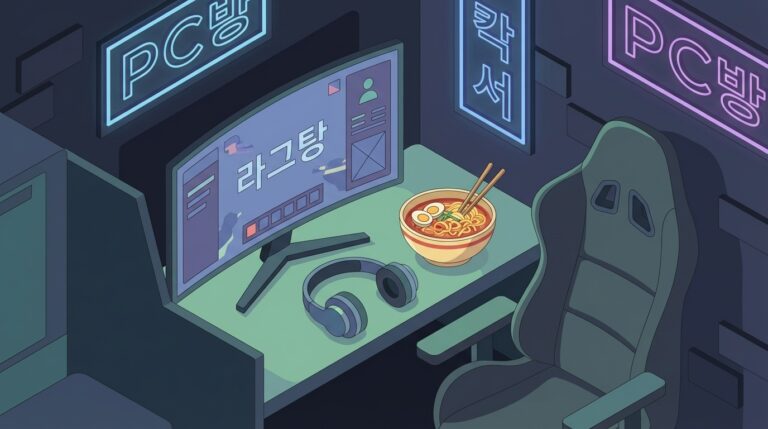
The Scene: Picture this. It’s 11:30 PM in Hongdae. You just missed the last subway train (막차 – makcha). A taxi home will cost a fortune due to the night surcharge. You see a neon sign flickering on the 3rd floor: PC.
You walk in. It’s not just a room with computers; it’s a glowing sanctuary. To your left, someone is slurping spicy ramen that smells better than anything you had for dinner. To your right, a student is curled up in a chair that looks more comfortable than a first-class airplane seat.
You’re not just here to play games. You’re here for the “Yagan Jeong-aek” (Nighttime Flat Rate)—the secret weapon of Korean night owls, gamers, and stranded travelers alike.
The ‘Why’: Why learn this? Because the Korean PC Bang (PC Room) is more than an internet café. It’s a restaurant, a movie theater, and sometimes, a temporary hotel. If you don’t know how to ask for the overnight plan, you might end up paying double the price by the hour.
Transparency: Today’s guide is based on real survival stories from my students who found themselves stranded in Seoul at night and discovered the magic of the $10 overnight stay.
Phase 2: Deep Dive (Core Expressions)
Here are the three keys to unlocking the PC Bang night culture.
1. 야간 정액권 (Yagan Jeong-aek-gwon)
- Pronunciation: [yagan jeong-aek-gwon] Sounds like “Ya-gan” (Night time) + “Jung-eck” (Fixed amount) + “Gwon” (Ticket/Coupon).
- Meaning: Literal: Nighttime fixed-amount ticket. Real nuance: The “Overnight Flat Rate Plan.”
- K-Culture Moment: You know those scenes in K-Dramas where a runaway teenager or a broke protagonist sleeps in a chair with headphones around their neck? They are running on a Yagan Jeong-aek-gwon.
- Editor’s Insight: This usually runs from 10 PM to 8 or 9 AM. It’s significantly cheaper (often around 10,000 KRW for 10 hours) than paying hourly.
- Situation Spectrum:
[🚫 Formal/Biz] ———— [⚠️ Semi-formal] ———— [✅ Casual/Service]
(Usage: Strictly used when purchasing time at the counter or kiosk.)- 🤔 Think About It: Why does Korea have such a developed “night plan” culture? Does it relate to the intense study/work culture that pushes leisure time late into the night?
2. 회원가입 하시겠어요? (Hoewon-gaip hasigesseoyo?)
- Pronunciation: [hoewon-gaip ha-shi-ge-sseo-yo]
- Meaning: Literal: Will you do member joining? Real nuance: “Do you want to sign up as a member?”
- K-Culture Moment: In variety shows like Infinite Challenge, members often struggle with logins. In Korea, being a “member” (Hoewon) usually gets you cheaper rates and saved game data compared to a “guest” (Bi-hoewon).
- Editor’s Insight: As a B2 learner, catch the -시겠어요? ending. It’s a polite suggestion used by staff. You will hear this everywhere, not just PC Bangs (gyms, websites, cafes).
- Situation Spectrum:
[🚫 Friends] ———— [✅ Service Staff] ———— [✅ Formal]- 🤔 Think About It: Korean services rely heavily on “membership” data. How does this compare to the privacy-focused culture of Western internet cafés?
3. 자리 좀 맡아주세요 (Jari jom mata-juseyo)
- Pronunciation: [jari jom ma-ta-ju-se-yo]
- Meaning: Literal: Please take charge of my seat a little. Real nuance: “Could you save my seat?”
- K-Culture Moment: Crucial when you need to use the restroom or go out for a smoke. If you don’t say this (or lock your screen), someone might assume you left.
- Editor’s Insight: The verb 맡다 (matda) here means to “look after” or “keep.” You use this when asking a friend to hold your bag, too.
- Situation Spectrum:
[✅ Friends] ———— [✅ Staff] ———— [⚠️ Elders]- 🤔 Think About It: In Korea, people often leave expensive phones on tables without worry. But requesting someone to “save a seat” is still a polite social protocol. Why?
Phase 3: Textbook vs. Real Life
| Situation | 📖 Textbook Korean | 🗣️ Real Korean | 💡 Why different? |
|---|---|---|---|
| Buying Time | “10시간 이용하고 싶습니다.” (I would like to use 10 hours.) | “사장님, 야간 정액 끊어주세요.” (Boss, cut me a night flat rate.) | Efficiency. “끊다” (to cut) here implies issuing a ticket/plan decisively. |
| Ordering Food | “라면 하나 주세요.” (Please give me one ramen.) | (Silent click on screen) “짜파구리에 치즈 추가요.” (Jjapaguri with cheese add, please.) | Digital Culture. Most ordering happens via the PC UI now, not verbally. |
| Leaving | “안녕히 계세요.” (Goodbye.) | “수고하세요~” (Work hard / Thank you for your effort.) | Empathy. Acknowledging the night shift worker’s effort is standard manners. |
Bottom Note: B2 learners, start using “수고하세요” instead of “안녕히 계세요” in service settings. It instantly makes you sound like a local.
Phase 4: Cultural Context — K-Culture Deep Dive
4-1. The “Kiosk” Barrier (Non-verbal)
Most modern PC Bangs are unmanned (muin) or automated at the entrance. You don’t talk to a human first; you face the Kiosk.
* Tip: Look for the button “비회원” (Non-member) if you don’t have a Korean phone number (often needed for membership).
* Nunchi Moment: If there’s a line behind you, don’t spend 5 minutes translating the menu. Pick a seat number on the map, pay, and sit. You can add time later.
4-2. K-Food Connection: The “PC Bang Mukbang”
In Korea, PC Bangs are jokingly called “the best budget restaurants.”
* Drama Trope: Remember in Weightlifting Fairy Kim Bok-joo? They go to the PC Bang not just to game, but to eat.
* The Menu: It’s not just snacks. You can order Kimchi Fried Rice (Kimchi-bokkeumbap), Pork Cutlet (Tonkatsu), and specialized sodas.
* Critical Perspective: Why is the food so good? Competition. PC Bangs make more margin on food than computer rental fees. It’s a culinary battleground!
Phase 5: Immersive Roleplay
Setting: 11:00 PM. A generic PC Bang near Gangnam Station. Dark room, blue LED lights, sound of mechanical keyboards clicking (Ttak-ttak-ttak). You are tired and hungry.
Characters:
* YOU: A foreign student who missed the bus.
* Staff (Alba-saeng): A university student working part-time, wearing a headset around his neck.
Dialogue:
Staff: (Looking at the monitor) 어서 오세요. 회원이세요?
(Eoseo oseyo. Hoewon-iseyo?)
(Welcome. Are you a member?)
YOU: 아니요, 비회원이에요. [ 1. Use the core expression ] 있나요?
(Aniyo, bihoewon-ieyo. _______ innayo?)
(No, I’m a non-member. Do you have the ________?)
Staff: 아, 야간 정액권이요? 네, 10시간에 만 원입니다. 몇 번 자리에 앉으시겠어요?
(Ah, yagan jeong-aek-gwon-iyo? Ne, 10-sigan-e man-won-imnida. Myeot-beon jari-e anjeu-sigesseoyo?)
(Ah, the night flat rate? Yes, it’s 10,000 won for 10 hours. Which seat number would you like?)
🔀 Decision Point! How do you choose your seat?
A) “아무 데나 주세요.” (Just give me anywhere.)
B) “구석진 자리로 주세요.” (Please give me a seat in the corner.)
C) “흡연실이랑 먼 곳으로 주세요.” (Please give me a spot far from the smoking room.)✅ Best Choice: C.
Why? Even though smoking is separated, the smell leaks. If you plan to sleep or stay long, being far from the smoking booth (Heub-yeon-sil) is crucial for air quality. Option B is also good if you want privacy.
(Dialogue Continues)
YOU: 흡연실이랑 먼 곳으로 부탁드려요. 아, 그리고 음식 주문은 어떻게 해요?
(Far from the smoking room, please. Ah, and how do I order food?)
Staff: 자리에 앉으셔서 컴퓨터로 주문하시면 됩니다. 후불이에요.
(Jari-e anjeu-syeoseo keompyuteo-ro jumun-hasimyeon doemnida. Hubul-ieyo.)
(Sit down and order via the computer. It’s post-paid.)
Phase 6: 10-Second Shadowing Drill
Let’s practice the most useful sentence for saving money.
😟 (Worried tone) / 사장님, / 야간 정액권 / 아직 남았나요?
(Sajangnim, / yagan jeong-aek-gwon / ajik namannayo?)
“Boss, are there any overnight flat-rate plans left?”
Check Points:
1. 사장님 (Sajangnim): Even if the staff is 20 years old, calling them “Boss” is the standard polite address.
2. 남았나요 (Namannayo): Raises the intonation at the end. Use a hopeful/worried face.
Phase 7: K-Culture Mini Glossary
| Korean | Romanization | Meaning | Context |
|---|---|---|---|
| 먹거리 | Meok-geori | Snacks/Food | The specific category for food items on the PC ordering screen. |
| 선불 / 후불 | Seonbul / Hubul | Prepaid / Postpaid | PC time is usually Seonbul (Kiosk), but food is often Hubul (pay when leaving) or card-at-seat. |
| 셧다운제 | Shutdown-je | Shutdown Law | The law (now abolished/changed) that forbade kids under 16 from playing late at night. |
| 팀플 | Tim-peul | Team Play | Often used when students come to PC bangs to work on group projects (or game together). |
| 헤드셋 | Hedeuset | Headset | Essential gear. Putting this on means “Do not disturb.” |
Phase 8: Traveler’s Survival Kit (PC Bang Edition)
Stranded in Seoul? The PC Bang is your refuge.
🆘 Survival Expression #1
– 🇰🇷 “핸드폰 충전기 있나요?” (Haendeupon chungjeon-gi innayo?)
– 🗣️ Meaning: “Do you have a phone charger?”
– 📍 Use: Most PC seats have multi-cables for iPhone/USB-C/Micro-USB. If not, ask the counter.🆘 Survival Expression #2
– 🇰🇷 “프린트 되나요?” (Peurinteu doenayo?)
– 🗣️ Meaning: “Can I print?”
– 📍 Use: Many travelers need to print flight tickets or visas. Not ALL PC bangs have printers. Ask first!📌 Editor’s Travel Note
– Safety: Korea is incredibly safe, and PC Bangs have CCTV everywhere. Sleeping there is generally safe, but keep your wallet in your pocket or hugged to your chest, just in case.
– Luggage: Big suitcases might be awkward. Ask the staff: “짐을 카운터에 맡겨도 될까요?” (Can I leave my luggage at the counter?)
Phase 9: Think Deeper — “Why 24 Hours?”
Topic: Media vs. Reality
In Western media, Korean PC Bangs are often depicted solely as “gaming addiction hubs.” While gaming is huge, for many Koreans, the PC Bang serves a different function: “The Third Space.”
Homes (First Space) can be small or crowded with family. Work/School (Second Space) is high-pressure. The PC Bang is a private, affordable space where you can eat, sleep, watch Netflix, or game without judgment. It is a symbol of the “Ppalli-Ppalli” (Hurry Hurry) internet infrastructure meeting the need for cheap personal space.
🧠 Think Deeper: In your country, where do young people go when they want to be alone but can’t go home? Is there an equivalent to the PC Bang?
Phase 10: FAQ & Troubleshooting
Q: Can I go to a PC Bang if I’m under 19?
A: Yes, BUT you must leave by 10:00 PM. This is a strict law. The computer will literally shut down or flash a warning telling minors to leave. If you look young, bring your passport to prove your age for the overnight plan.
Q: Is it rude to sleep there?
A: Not at all. During the night (Yagan), half the people are sleeping. Just don’t snore too loudly, or someone might wake you up!
❌ Common Mistake: Bringing outside food.
✅ Fix: Most PC Bangs profit from food sales. Bringing a burger from McDonald’s is considered rude (and often banned). Buy the Jjapaguri there; it tastes better anyway!
Phase 11: Wrap-up & Mission
One-Liner: The PC Bang is not just for gamers; it’s the most cost-effective 24/7 lounge in Korea if you know how to use the “Yagan Jeong-aek” plan.
Action Missions:
– 🥉 Bronze: Say “자리 좀 맡아주세요” out loud while pretending to stand up from your chair.
– 🥈 Silver: Go to a Korean BBQ or PC Bang website (if available) and look at the “Menu” section. Find “라면” (Ramen).
– 🥇 Gold: Visit a PC Bang in Korea, buy 1 hour (or a night plan!), and order a drink using the computer interface without talking to anyone.
K-Culture Mission: Watch the K-Drama “Strong Woman Do Bong-soon” (or similar) and find a scene where they play games at a PC Bang. Look at what they are eating!
Phase 12: Quiz — Interactive Challenge
1. Situation Judgment:
It is 10:30 PM. You want to stay until morning. Which phrase is best?
* A) 한 시간 주세요. (Give me one hour.)
* B) 야간 정액권 끊어주세요. (Cut me a night flat rate.)
* C) 컴퓨터 사고 싶어요. (I want to buy a computer.)
2. True or False:
“You must speak to the staff to order food in a modern PC Bang.”
3. Vocabulary:
What is the Korean word for “Post-paid” (pay later)?
Answers:
1. B. A is too short, C implies purchasing the machine itself!
2. False. You usually click on the screen UI to order.
3. 후불 (Hubul).
Frequently Asked Questions (FAQ)
Q: What does "야간 정액권 (Yagan Jeong-aek-gwon)" mean in Korean and how do you pronounce it?
A: In Korean, "야간 정액권 (Yagan Jeong-aek-gwon)" is pronounced [yagan jeong-aek-gwon] and means: Literal: Nighttime fixed-amount ticket. Real nuance: The "Overnight Flat Rate Plan."
Q: What does "회원가입 하시겠어요? (Hoewon-gaip hasigesseoyo?)" mean in Korean and how do you pronounce it?
A: In Korean, "회원가입 하시겠어요? (Hoewon-gaip hasigesseoyo?)" is pronounced [hoewon-gaip ha-shi-ge-sseo-yo] and means: Literal: Will you do member joining? Real nuance: "Do you want to sign up as a member?"
Q: What does "자리 좀 맡아주세요 (Jari jom mata-juseyo)" mean in Korean and how do you pronounce it?
A: In Korean, "자리 좀 맡아주세요 (Jari jom mata-juseyo)" is pronounced [jari jom ma-ta-ju-se-yo] and means: Literal: Please take charge of my seat a little. Real nuance: "Could you save my seat?"







