

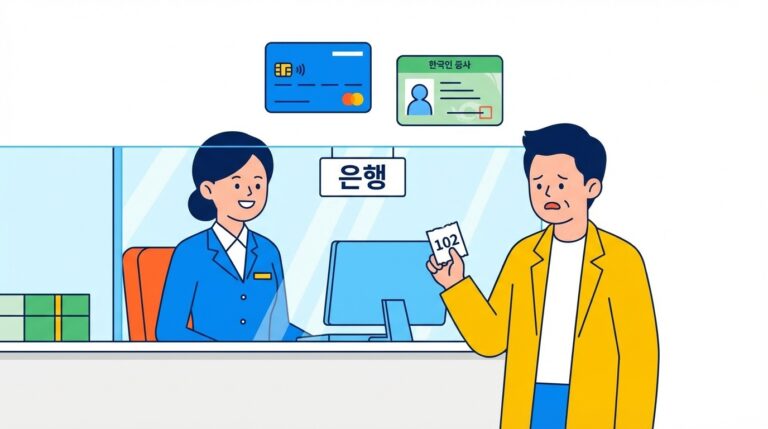
Phase 1: The Panic Moment 😱
Greeting: 안녕하세요 (Hello)! This is your Daily Hangul Editor, here to save your day.
Imagine this: You are in Hongdae, ready to pay for that delicious Samgyeopsal (pork belly). You reach into your pocket… and your heart stops. Your wallet is there, but your bank card is gone!
It’s a classic K-Drama scene: The protagonist stands at the counter, eyes wide, music stops, and the cashier is waiting with the card reader in hand. Awkward.
Don’t panic! Unlike in many countries where reissuing a card takes 2 weeks by mail, Korean banks operate at “K-Speed” (Palli-palli culture). You can walk into a bank and walk out with a new card in 10 minutes. Yes, really.
Today, we will learn the survival phrases to get your financial life back on track instantly. Let’s go to the bank! 🏦
Phase 2: Deep Dive into Key Phrases 🔍
Here are the 3 magical sentences you need to memorize.
1. 카드를 잃어버렸어요. (I lost my card.)
- Pronunciation: [Ka-deu-reul i-reo-beo-ryeo-sseo-yo]
- Sound-alike: “Ka-deu-reul” + “Ear-oh-buh-ryuh-sso-yo”
- Meaning:
- Literal: I completely lost the card.
- Real Nuance: “I made a mistake and lost it! Help!”
- K-Culture Moment: In K-Dramas, when a character loses their memory, they say “Gieok-eul (memory) i-reo-beo-ryeo-sseo-yo.” It’s the same verb! It implies a complete, unfortunate loss.
- Editor’s Insight: The ending part “~beo-ryeo-sseo-yo” adds a feeling of “Oops, it happened (and I’m sad/regretful about it).” It’s much more natural than just saying “I lost it.”
- Situation Spectrum:
[🚫 To Boss] ———— [⚠️ Standard/Polite] ———— [✅ To Bank Teller]- (Use this standard polite form with the teller!)
- 🤔 Think About It: Why does Korean grammar add an emotion of “regret” directly into the verb ending?
2. 재발급해 주세요. (Please reissue it.)
- Pronunciation: [Jae-bal-geup-hae ju-se-yo]
- Sound-alike: “Jae” (like Jay-Z) + “Bal” (like Ball) + “Geup” (like a hiccup) + “hae ju-se-yo”
- Meaning: Please do a re-issuance for me.
- Jae = Re / Again
- Bal-geup = Issue
- K-Culture Moment: You might hear “Jae” often in K-Pop songs like “Jae-hoe” (Reunion) or “Jae-si-jak” (Restart). It’s the prefix for second chances!
- Editor’s Insight: You can use this for ID cards, passwords, or certificates too. It’s a very high-utility word.
3. 신분증 여기 있어요. (Here is my ID.)
- Pronunciation: [Sin-bun-jeung yeo-gi i-sseo-yo]
- Sound-alike: “Sin-bun” + “Jeung” (rhymes with lung) + “Yuh-gi” + “E-sso-yo”
- Meaning: ID card is here.
- Editor’s Insight: In Korea, your ARC (Alien Registration Card) or Passport is mandatory for banking. No ID, no service.
Phase 3: Textbook vs. Real Life 🥊
| Situation | 📖 Textbook Korean | 🗣️ Real Korean (Survival) | 💡 Why the difference? |
|---|---|---|---|
| Explaining the loss | 신용카드를 분실하였습니다. (I have misplaced my credit card.) | 카드 잃어버렸어요. (I lost my card.) | “Bun-sil” is too formal, like speaking like a news anchor. “I-reo-beo-ryeo-sseo-yo” is how people actually talk. |
| Asking for a new one | 카드를 다시 만들어 주십시오. (Please make the card again.) | 재발급해 주세요. (Reissue, please.) | Use the specific banking term “Jae-bal-geup.” It’s faster and clearer to the teller. |
Bottom Note: Don’t try to be too fancy. Simple is best when you are stressed at the bank!
Phase 4: Cultural Context — The “Palli-Palli” Bank 🏦
4-1. Non-verbal: The Two-Hand Rule 👋
When you hand over your ID card or sign a document:
* Use two hands! Or support your right elbow with your left hand.
* Even if the teller is younger than you, this shows basic respect in a business setting.
4-2. K-Culture: The “Instant” Miracle ⏳
If you watch K-Dramas, you see people solving problems incredibly fast. This is real life.
* The Surprise: In the US or Europe, you wait 5-10 business days for a card.
* The Reality: In Korea, many major branches have machines that print the card right in front of you. You walk out using it immediately.
* Why? Korea is a high-trust, high-tech society that values efficiency above all else.
Phase 5: Roleplay Scenario 🎬
Setting: A bright, air-conditioned bank branch in Gangnam. Electronic beeps from the queue machine. You are holding ticket number 104.
Characters:
* YOU: A foreigner who lost a debit card.
* Teller: A professional bank employee.
(Ding dong! Number 104!)
Teller: 안녕하세요, 무슨 일로 오셨어요?
(An-nyeong-ha-se-yo, mu-seun il-lo o-syeo-sseo-yo?)
(Hello, what brings you here?)
YOU:
(Choose your response!)
🔀 Decision Point
* A) “카드 잃어버렸어요.” (I lost my card.)
* B) “돈 주세요.” (Give me money.)
* C) “카드 없어요.” (I don’t have a card.)
✅ Best Choice: A – Direct and explains the problem perfectly.
⚠️ Why not C? – “I don’t have a card” might make them think you want to open a new account, which takes much longer.
(Continuing with Choice A…)
Teller: 아, 그러세요? 신분증 있으세요?
(Ah, geu-reo-se-yo? Sin-bun-jeung i-sseu-se-yo?)
(Ah, really? Do you have your ID?)
YOU: 네, 신분증 여기 있어요.
(Ne, Sin-bun-jeung yeo-gi i-sseo-yo.)
(Yes, here is my ID.)
(Teller types furiously on the keyboard ⌨️)
Teller: 재발급해 드릴게요. 비밀번호 눌러주세요.
(Jae-bal-geup-hae deu-ril-ge-yo. Bi-mil-beon-ho nul-leo-ju-se-yo.)
(I will reissue it for you. Please press your password.)
YOU: 감사합니다!
(Gam-sa-ham-ni-da!)
(Thank you!)
Phase 6: 10-Second Shadowing Drill 🗣️
Repeat after me! Focus on the emotion.
- 😢 Worried: 저… / 카드를 / 잃어버렸어요.
(Jeo… / ka-deu-reul / i-reo-beo-ryeo-sseo-yo.) - 😤 Clear: 재발급 / 해 주세요.
(Jae-bal-geup / hae ju-se-yo.) - 😊 Relieved: 여기 / 신분증이요!
(Yeo-gi / sin-bun-jeung-i-yo!)
Phase 7: K-Culture Mini Glossary 📚
| Korean | Romanization | English | Context |
|---|---|---|---|
| 체크카드 | Che-keu-ka-deu | Debit Card | In Korea, most people use “Check Cards” linked to bank accounts rather than credit cards for daily use. |
| 번호표 | Beon-ho-pyo | Number Ticket | The ticket you pull at the entrance. Vital! No ticket, no service. |
| 비밀번호 | Bi-mil-beon-ho | Password (PIN) | Usually 4 digits for cards. Don’t forget it! |
| 서명 | Seo-myeong | Signature | You will sign on a digital pad, not paper. |
Phase 8: Traveler’s Survival Kit 🧳
Bank & Card Edition
🆘 Survival Phrase
* 🇰🇷 “영어 할 수 있는 분 계세요?” (Yeong-eo hal su it-neun bun gye-se-yo?)
* 🗣️ Pronunciation: [Young-uh hal-su-it-nun bun gye-se-yo?]
* 📍 Meaning: Is there anyone who can speak English?
* 💡 Pro Tip: Many major banks in tourist areas (Myeongdong, Itaewon, Hongdae) have “Global Desks” or designated English speakers. Look for the “Global” sign!
📌 Editor’s Note:
* Bank Hours: Usually 9:00 AM to 4:00 PM. They close early! Don’t go at 5 PM.
* Bring: Your Passport or ARC (Alien Registration Card). A photocopy won’t work.
Phase 9: Think Deeper — “Why is everything so fast?” 🧠
Have you noticed how Korean culture is obsessed with speed? We call it “Palli-palli” (Quick, quick) culture.
Getting a bank card instantly is a result of this mindset. In the post-war era, Korea had to rebuild quickly, embedding efficiency into the national DNA. While it can be stressful for workers, for customers (like you at the bank today), it is the ultimate convenience.
💬 Your Turn: Does your country issue cards instantly or by mail? How does that reflect your culture’s view on time and efficiency? Let me know in the comments!
Phase 10: FAQ & Troubleshooting 🛠️
Q: Can I use a photo of my passport on my phone?
A: No. Korean banks are very strict about security. You must bring the physical ID card or passport.
Q: I don’t speak Korean well. Should I just use a translation app?
A: Yes! Papago or Google Translate is very common. Just show the screen: “카드 재발급 (Card Reissue).” The teller will understand immediately.
❌ Common Mistake #1: Going to the bank at lunch time (12:00 PM – 1:00 PM).
✅ Fix: It is super crowded. Go at 9:00 AM sharp for the fastest service.
Phase 11: Wrap-up & Mission 🚀
One-Liner: To get a new card, just say “Card i-reo-beo-ryeo-sseo-yo” and hand over your ID!
Action Mission:
* 🥉 Bronze: Look in the mirror and practice saying “Jae-bal-geup-hae ju-se-yo” 3 times without stuttering.
* 🥈 Silver: Check your wallet right now. Do you know where your ID is? Put it in a safe spot.
* 🥇 Gold: Next time you pass a bank in Korea, look for the machine that says “공과금 수납기” or ATM and just observe the atmosphere (don’t lose your card on purpose though!).
K-Culture Mission: Watch a K-Drama scene where someone pays. Do they sign a receipt? Usually, no! For small amounts (under 50,000 KRW), signatures are often skipped. Efficiency again!
Phase 12: Quiz — Interactive Challenge 🧩
1. Which phrase should you use if your card is gone?
A) 카드 주세요. (Give me a card.)
B) 카드를 잃어버렸어요. (I lost my card.)
C) 카드 맛있어요. (The card is delicious.)
2. True or False?
You can usually get your debit card immediately at a Korean bank branch.
3. Situation Check:
The teller asks for “Sin-bun-jeung.” What do you give them?
A) Your credit card
B) Your phone number
C) Your Passport/ARC
(Scroll down for answers)
.
.
.
Answers:
1. B
2. True (It’s the Palli-palli magic!)
3. C (Sin-bun-jeung means ID Card)
See you in the next lesson! 안녕! 👋
Frequently Asked Questions (FAQ)
Q: What does "카드를 잃어버렸어요. (I lost my card.)" mean in Korean and how do you pronounce it?
A: In Korean, "카드를 잃어버렸어요. (I lost my card.)" is pronounced [Ka-deu-reul i-reo-beo-ryeo-sseo-yo] and means: a key conversational Korean expression covered in this lesson.
Q: What does "재발급해 주세요. (Please reissue it.)" mean in Korean and how do you pronounce it?
A: In Korean, "재발급해 주세요. (Please reissue it.)" is pronounced [Jae-bal-geup-hae ju-se-yo] and means: a key conversational Korean expression covered in this lesson.
Q: What does "신분증 여기 있어요. (Here is my ID.)" mean in Korean and how do you pronounce it?
A: In Korean, "신분증 여기 있어요. (Here is my ID.)" is pronounced [Sin-bun-jeung yeo-gi i-sseo-yo] and means: a key conversational Korean expression covered in this lesson.







