

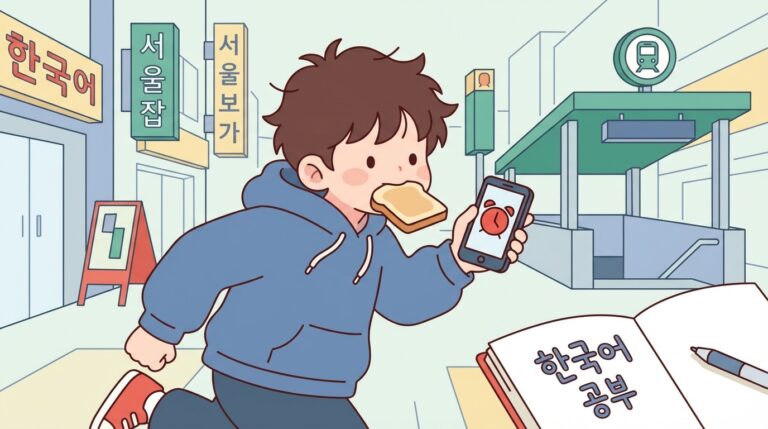
Phase 1: Immersive Hook — The “Toast Run” Moment
Annyeonghaseyo! This is your Daily Hangul Editor.
Picture this: You’ve seen it in at least 50 K-Dramas. The sun is shining, birds are chirping, and suddenly—GASP! The protagonist wakes up, looks at their phone, screams, and runs out of the house with a piece of toast hanging out of their mouth. 🍞🏃💨
We’ve all been there. Maybe you stayed up too late binge-watching the latest Netflix series, or maybe you were exploring the nightlife in Itaewon until 4 AM. Now, you have a lunch date or a meeting, and you are decidedly late.
In Korea, punctuality is huge, but mistakes happen. The key isn’t just arriving; it’s how you handle the message while you are running to the subway station. Do you blame the alarm? Do you beg for forgiveness?
Today, we’re going to learn how to say “I overslept” like a local, so you can turn a “disaster” into a “charming mistake.”
Phase 2: Deep Dive — The Survival Phrases
1. 늦잠 잤어요 (Neut-jam ja-sseo-yo)
- Pronunciation: [Neut-jam ja-sseo-yo] (Sound analogy: Neut sounds like ‘Newt’ + jam sounds like ‘jam’ you eat + ja-sseo-yo)
- Meaning: I overslept. (Literal: I slept a late sleep.)
- K-Culture Moment: Think of a reality show like I Live Alone (나 혼자 산다). When a celebrity wakes up at 2 PM with messy hair, the caption always says 늦잠 (Neut-jam).
- Editor’s Insight: This is the most honest and standard way to admit your fault. It’s polite enough for coworkers (A2 level) but casual enough for friends. It doesn’t sound like a heavy crime, just a mistake.
- Situation Spectrum:
[🚫 Formal Biz] ———— [⚠️ Colleagues] ———— [✅ Friends] - 🤔 Think About It: In English, we focus on the action “overslept.” In Korean, it’s a noun phrase “late sleep” + “slept.” Why do you think Korean turns the concept of “late sleep” into a specific noun?
2. 알람을 못 들었어요 (Allam-eul mot deu-reo-sseo-yo)
- Pronunciation: [Allam-eul mot deu-reo-sseo-yo]
- Meaning: I couldn’t hear the alarm.
- K-Culture Moment: The classic excuse used by every K-Pop idol when they are late for a morning practice in a variety show.
- Editor’s Insight: This shifts the blame slightly to the technology. It implies, “I wanted to wake up, but my ears failed me!” It’s a softer excuse than just saying you were lazy.
- Situation Spectrum:
[🚫 Strict Boss] ———— [⚠️ Colleagues] ———— [✅ Friends]
3. 지금 가고 있어요! (Ji-geum ga-go i-sseo-yo!)
- Pronunciation: [Ji-geum ga-go ee-sseo-yo!]
- Meaning: I am going now! (I’m on my way!)
- K-Culture Moment: You are in a taxi, texting your friend. In K-Dramas, this is usually a lie—the character is still putting on their shoes. But for us, let’s try to be honest!
- Editor’s Insight: Use this IMMEDIATELY after saying you overslept. It shows action. You messed up, but you are fixing it.
Phase 3: Textbook vs. Real Life
| Situation | 📖 Textbook Korean | 🗣️ Real Korean (Street Style) | 💡 Why the difference? |
|---|---|---|---|
| Texting a friend | 늦게 일어나서 미안해요. (I am sorry for waking up late.) | 헐… 나 지금 일어남 ㅠㅠ (Omg… I just woke up crying-face) | Texting requires speed and emotion. ‘ㅠㅠ’ represents crying eyes. |
| Running late | 지금 출발했습니다. (I have departed now.) | 지금 뛰어가는 중!!! (I am in the middle of running!!!) | Shows urgency. If you say you are “running,” friends forgive you faster. |
| Meeting a Senior | 죄송합니다. 늦잠을 잤습니다. | 죄송합니다! 알람이 안 울려서요… (Sorry! The alarm didn’t ring…) | Making a slight excuse (even if weak) softens the blow with seniors. |
💡 Editor’s Note: “ㅠㅠ” is the universal sign for “I’m sorry/sad/doomed.” Use it in texts when you are late!
Phase 4: Cultural Deep Dive — Nunchi (눈치) & The Art of Lateness
4-1. The “Korean Time” Paradox
In Korea, there is a concept sometimes called “Korean Time” regarding social gatherings where being 10 minutes late is often forgiven among friends. HOWEVER, this does not apply to business or formal appointments.
- Non-verbal Tip: When you finally arrive, do not stroll in slowly. Even if you are tired, run the last 10 meters. Show that you are out of breath. This is part of Nunchi (sensing the vibe). It visually demonstrates your regret and effort.
4-2. K-Food Connection: The “Brunch” Shift
If you overslept for a breakfast meeting, suggest moving it to “Brunch” (브런치) or lunch.
* “늦었으니까 제가 커피 살게요!” (Since I’m late, I’ll buy coffee!)
In Korea, buying the next round of food or coffee is the best way to erase a mistake. Food heals all wounds.
Phase 5: Immersive Roleplay Scenario
Setting: Saturday, 11:30 AM. Hongdae Station Exit 9 (The most crowded meeting spot in Seoul). You were supposed to meet your Korean friend, Minji, at 11:00 AM. You just woke up.
Characters:
* YOU: A foreign student who partied too hard last night.
* Minji (24): Your trendy, impatient but kind Korean friend.
The Scene: Your phone is buzzing. It’s Minji.
Minji: 야! 너 어디야? 나 30분째 기다리고 있어! 😡
(Ya! Neo eodi-ya? Na samsip-bun-jjae gidarigo isseo!)
(Hey! Where are you? I’ve been waiting for 30 minutes!)
YOU: (You need to reply quickly!)
🔀 Decision Point: What do you say?
- Option A: “미안해요. 늦잠 잤어요. 지금 가고 있어요!” (Honest & Polite)
- Option B: “거의 다 왔어!” (The Classic Lie)
- Option C: “어머! 오늘 약속이었어?” (Playing Dumb)
✅ Best Choice: Option A
* Reason: Minji is angry. Honesty + Action (“I’m coming now”) is the safest bet. Option B is dangerous because if she asks “Where are you exactly?”, you will get caught. Option C might end the friendship!
Dialogue Continues (Choosing A):
YOU: 미안해 Minji야 ㅠㅠ 늦잠 잤어. 지금 가고 있어! 😭
(Mianhae Minji-ya. Neut-jam ja-sseo. Ji-geum ga-go isseo!)
Minji: 진짜… 얼른 와. 커피 네가 사! ☕️
(Jinjja… Eolleun wa. Keopi ne-ga sa!)
(Seriously… Come quickly. You buy the coffee!)
(🎭 Stage Direction: You throw on clothes and run to the subway!)
Phase 6: 10-Second Shadowing Drill
Practice this sentence to use when you are running out the door.
😢 (Regretful Tone) -> 🏃 (Urgent Tone)
“죄송해요 / 늦잠 잤어요! / 지금 / 빨리 / 가고 있어요!”
(Joe-song-hae-yo / neut-jam ja-sseo-yo! / ji-geum / ppal-li / ga-go i-sseo-yo!)
“I’m sorry / I overslept! / Now / quickly / I am going!”
Phase 7: K-Culture Glossary
| Korean | Romanization | Meaning | Context |
|---|---|---|---|
| 멘붕 (멘탈 붕괴) | Men-bung | Mental Breakdown | Use this slang when you wake up and see the time. “Ah, total men-bung!” |
| 코리안 타임 | Korean Time | Korean Time | The habit of being slightly late for social gatherings (but don’t abuse it!). |
| 읽씹 | Ik-ssip | Read & Ignore | If you read a message asking “Where are you?” and don’t reply, that’s Ik-ssip. Very rude! |
Phase 8: Traveler’s Survival Kit
Scenario: You overslept and missed your KTX train or a guided tour bus.
🆘 Survival Phrases
1. 🇰🇷 “제가 늦잠을 자서 놓쳤어요.” (Je-ga neut-jam-eul ja-seo no-chyeo-sseo-yo.)
* “I overslept so I missed it.”
2. 🇰🇷 “다음 기차(버스) 있나요?” (Da-eum gi-cha [bus] innayo?)
* “Is there a next train (bus)?”
3. 🇰🇷 “환불 되나요?” (Hwan-bul doe-nayo?)
* “Is a refund possible?” (Likely no, but worth asking!)📌 Editor’s Travel Note:
If you are late for a tour, call the guide immediately. Do not text. Koreans prefer calls for urgent changes. Use KakaoTaxi if you need to chase the bus!
Phase 9: Think Deeper — “Wait, why apologize?”
Language & Culture:
In many Western cultures, “I overslept” is a factual statement. In Korea, it’s a confession of a lack of self-management. Punctuality in Confucian society is a form of respect towards the other person’s time. By being late, you are technically “lowering” the other person’s status.
🧠 Think Deeper:
Why do you think Korean uses specific honorifics (Jeo-song-ham-nida) heavily when late, even if it was just an accident? How does your culture handle lateness? Is it a joke or a sin?
Phase 10: FAQ & Troubleshooting
- Q: Can I tell my boss “늦잠 잤어요”?
- A: NO! Avoid saying you overslept to a superior. It sounds unprofessional. Instead, say “Coming down with a cold” or “Unforeseen urgent matter.” (But for this lesson, we stick to A2 level honesty!)
- Q: My friend is late. What do I say?
- A: Send them: “언제 와?” (When are you coming?) or “일어났어?” (Are you awake?).
❌ Common Mistake:
Don’t just say “No” (아니요) when asked if you are there. Say “아직 안 왔어요” (I haven’t arrived yet).
Phase 11: Wrap-up & Action Mission
One-Liner: Oversleeping happens, but a fast apology and a promise of coffee saves the day.
Your Mission:
* 🥉 Bronze: Look in the mirror, make a shocked face, and shout “Hul! Neut-jam ja-sseo-yo!”
* 🥈 Silver: Set an alarm on your phone and label it “기상! (Wake up!)”.
* 🥇 Gold: Next time you are 5 minutes late to meet a friend, buy them a convenience store drink and practice the apology.
K-Culture Mission: Watch an episode of “Running Man.” Count how many times the members run while shouting excuses. It’s the best listening practice!
Phase 12: Quiz — Did you wake up?
1. Situation: You wake up 1 hour late for a date with your boyfriend/girlfriend. What is the BEST text to send?
* A) 안녕? (Hello?)
* B) 헐… 늦잠 잤어 ㅠㅠ 지금 빨리 갈게!! (Omg… overslept. Coming fast!!)
* C) 날씨가 좋네. (The weather is nice.)
2. True or False:
* In Korea, it is polite to walk very slowly into the room if you are late so you don’t disturb people.
Answers:
1. B (Speed and emotion are key!)
2. False (You should look like you hurried! Walking slowly looks arrogant or like you don’t care.)
Frequently Asked Questions (FAQ)
Q: What does "늦잠 잤어요 (Neut-jam ja-sseo-yo)" mean in Korean and how do you pronounce it?
A: In Korean, "늦잠 잤어요 (Neut-jam ja-sseo-yo)" is pronounced [Neut-jam ja-sseo-yo] and means: I overslept. (Literal: I slept a late sleep.)
Q: What does "알람을 못 들었어요 (Allam-eul mot deu-reo-sseo-yo)" mean in Korean and how do you pronounce it?
A: In Korean, "알람을 못 들었어요 (Allam-eul mot deu-reo-sseo-yo)" is pronounced [Allam-eul mot deu-reo-sseo-yo] and means: I couldn't hear the alarm.
Q: What does "지금 가고 있어요! (Ji-geum ga-go i-sseo-yo!)" mean in Korean and how do you pronounce it?
A: In Korean, "지금 가고 있어요! (Ji-geum ga-go i-sseo-yo!)" is pronounced [Ji-geum ga-go ee-sseo-yo!] and means: I am going now! (I'm on my way!)







