

Phase 1: The Immersive Hook
Hello! This is your Daily Hangul Editor. 👋
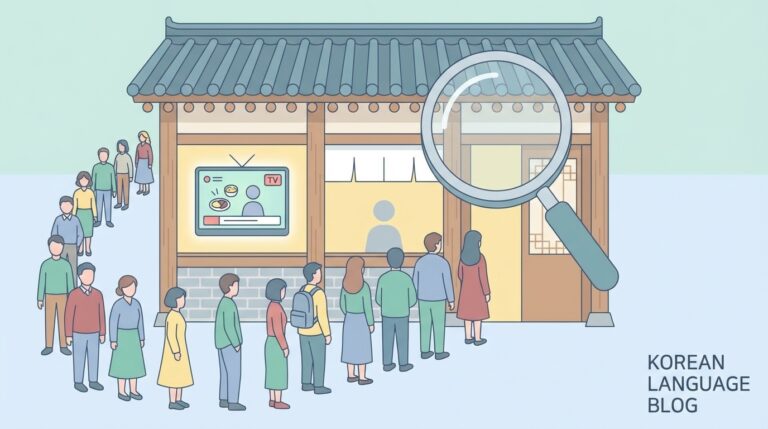
Picture this: You’re walking through Hongdae or Gangnam. You see a restaurant with a massive line winding around the block. The window is plastered with screenshots from famous Korean variety shows like Saturday Amazing (놀라운 토요일) or Baek Jong-won’s Alley Restaurant (골목식당). The captions scream “Korea’s Best Taste!”
You wait for an hour. You finally take a bite. And… silence.
In K-Dramas, food always looks life-changing. But in reality, not every place on TV is a 맛집 (Matjib – delicious restaurant). Some are just… marketing.
Today, we aren’t just learning how to order. We are learning how to be a food critic. At B2 (Intermediate) level, you need to express nuance—how to say something is “overhyped” or “actually worth the wait” without sounding rude. Let’s learn to separate the real deal from the tourist traps like a true Seoulite.
Phase 2: Deep Dive into Key Expressions
Here are three expressions to help you evaluate a dining experience like a pro.
1. 거품이 좀 낀 것 같아요. (Geopumi jom kkin geot gatayo.)
- Pronunciation: [Geo-pum-i / jom / kkin / geot / ga-ta-yo] (‘Geo’ sounds like ‘guh’, ‘pum’ sounds like ‘poom’)
- Meaning: Literal: “It seems like there are some bubbles in it.” → Real Nuance: “It is overhyped/overrated.”
- K-Culture Moment: Imagine a scene in a drama where a chaebol heir drinks cheap beer. The “foam” (bubbles) makes the beer look fuller than it is. In slang, 거품 (bubbles) represents exaggerated value or hype.
- Editor’s Insight: This is a sophisticated way to critique. You aren’t saying the food is bad; you’re saying the fame exceeds the quality.
- Situation Spectrum:
[🚫 Boss] ———— [⚠️ Colleagues] ———— [✅ Friends]- 🤔 Think About It: Why do we use “bubbles” to describe exaggeration? In English, you might say “inflated.” Bubbles burst and disappear—just like temporary trends.
2. 방송 탈 만하네요! (Bangsong tal manhaneyo!)
- Pronunciation: [Bang-song / tal / man-ha-ne-yo]
- Meaning: Literal: “It is worth riding a broadcast.” → Real Nuance: “It deserves to be on TV!”
- K-Culture Moment: You’ll hear this in food variety shows when the celebrity hosts take their first bite and their eyes go wide. It’s high praise.
- Editor’s Insight: The grammar point -(으)ㄹ 만하다 means “worth doing something.” usage suggests the quality justifies the media attention.
- Situation Spectrum:
[✅ Boss] ———— [✅ Colleagues] ———— [✅ Friends]3. 웨이팅까지 해서 먹을 맛은 아니에요. (Waiting-kkaji haeseo meogeul maseun anieyo.)
- Pronunciation: [Wei-ting-kka-ji / hae-seo / meo-geul / ma-seun / a-ni-e-yo]
- Meaning: “It’s not tasty enough to wait in line for.”
- Editor’s Insight: Koreans use the Konglish word “waiting” (웨이팅) specifically for lining up at restaurants. This sentence is the ultimate honest review. It acknowledges the food is edible, but the cost of time was too high.
- Situation Spectrum:
[🚫 Formal Business Dinner] ———— [⚠️ Close Colleagues] ———— [✅ Friends]
Phase 3: Textbook vs. Real Life
| Situation | 📖 Textbook Korean | 🗣️ Real Korean (Insa Style) | 💡 Why the difference? |
|---|---|---|---|
| When food is average | 맛이 그냥 그래요. (The taste is so-so.) | 생각보다 평범해요. (It’s more ordinary than I thought.) | “Just so-so” can sound dismissive. “Ordinary” focuses on your expectation vs. reality. |
| Skeptical about fame | 정말 맛있을까요? (Is it really delicious?) | 여기 광고빨 아닐까요? (Isn’t this just ad-power?) | 빨 (ppal) is a slang suffix meaning “powered by” or “thanks to.” It questions the authenticity. |
| Verifying the reviews | 인터넷에서 봤어요. (I saw it on the internet.) | 이거 ‘내돈내산’ 후기 맞아요? (Is this a ‘Naedonnaesan’ review?) | Koreans distrust paid ads. We look for reviews bought with “my own money” (Naedonnaesan). |
💡 Bottom Note: Use “광고빨” (Ad-power) only with close friends. It’s a bit cynical!
Phase 4: Cultural Deep Dive
4-1. The Art of “Nunchi” in Queues
If you see a long line, don’t just stand there! In Korea, famous spots often have a Tableling (테이블링) or CatchTable (캐치테이블) tablet at the entrance. You input your phone number to queue digitally. If you just stand in line without checking, you might be waiting for nothing. That is a failure of Nunchi (reading the room)!
4-2. K-Drama Connection: The “Solo Dining” Stigma
In older K-Dramas, eating alone was a sign of loneliness. However, recently, 혼밥 (Honbap – eating alone) has become a trend. Still, at famous TV restaurants (especially K-BBQ or Stew places), they might reject solo diners during peak hours. If the owner crosses their arms and says “2인분부터 돼요” (Only from 2 servings), don’t be offended—it’s just the business model of high-turnover spots.
Phase 5: Immersive Roleplay
Setting: It’s Saturday noon in Ikseon-dong (a trendy Hanok village). You and your Korean friend, Min-su, have been waiting for 40 minutes at a famous Mandu (dumpling) place seen on Netflix.
Characters:
* YOU: A foodie who trusts the internet but is getting hungry/cranky.
* Min-su: A local Seoulite who is skeptical of TV hype.
Dialogue:
Min-su: 와, 줄 진짜 안 줄어드네. 다른 데 갈까? 😓
(Wa, jul jinjja an jureodeune. Dareun de galkka?)
[Wow, the line really isn’t shrinking. Should we go somewhere else?]
YOU: (Determined) 조금만 더 기다려 보자. 방송 탈 만한 집인지 직접 확인하고 싶어!
(Jogeumman deo gidaryeo boja. Bangsong tal manhan jib-inji jikjeop hwaginhago sipeo!)
[Let’s wait a bit more. I want to verify myself if it’s a house worthy of being on TV!]
(Stage Direction: 20 minutes later, you finally eat the dumplings.)
Min-su: (Chewing thoughtfully) 음… 맛은 있네. 근데 1시간 기다릴 정도인가?
(Eum… maseun inne. Geunde han-sigan gidaril jeongdoinga?)
[Hmm… it has taste (it’s good). But is it to the degree of waiting 1 hour?]
🔀 Your Turn! What is your honest verdict?
- Option A: “Soljikhi… geopumi jom kkin geot gatayo.” (Honestly… it seems a bit overhyped.)
- Option B: “Wa! Igeo waiting-kkaji haeseo meogeul manhaneyo!” (Wow! This is worth the wait!)
- Option C: “Geunyang baegopaseo masinneun geot gatayo.” (I think it’s just tasty because I’m hungry.)
✅ Best Choice Analysis:
* Option A shows you have high standards and critical thinking (Very B2 level!).
* Option B shows you are an enthusiastic foodie.
* Option C is a very humble/funny Korean way to downplay the hype.
Phase 6: 10-Second Shadowing Drill
Practice this sentence to use when your friend asks, “Was it good?”
“Honestly, it was good, but not worth the 2-hour wait.”
🇰🇷 솔직히 / 맛은 있는데 / 웨이팅까지 해서 / 먹을 맛은 / 아니에요.
🗣️ [Soljikhi / maseun inneunde / waiting-kkaji haeseo / meogeul maseun / anieyo.]
🎭 Emotion: 😕 (Slightly disappointed, shrugging shoulders)
Phase 7: K-Culture Glossary
| Word | Romanization | Meaning | Context |
|---|---|---|---|
| 맛집 | Matjib | Delicious restaurant | Any restaurant famous for good food. |
| 내돈내산 | Naedonnaesan | My money, my buy | An honest review not sponsored by the restaurant. |
| 인생맛집 | Insaeng-matjib | Life restaurant | The best restaurant of your life (so far). |
| 인증샷 | Injeung-shot | Proof shot | Taking a photo to prove you visited a famous spot (for social media). |
Phase 8: Traveler’s Survival Kit
How to Verify a Restaurant Like a Local
🆘 Survival Phrases
1. “여기 브레이크 타임 있나요?” (Yeogi break time innayo?) – Do you have a break time here? (Many famous spots close from 3 PM to 5 PM!).
2. “대기 번호 받아야 해요?” (Daegi beonho badaya haeyo?) – Do I need to get a waiting number?
3. “포장은 바로 되나요?” (Pojang-eun baro doenayo?) – Can I get takeout immediately? (Pro Tip: Sometimes takeout skips the line!)📌 Editor’s Travel Note:
Don’t trust blogs blindly. Use Naver Map (네이버 지도). Look for the “Visitor Reviews” (방문자 리뷰) section. If you see many receipts verified (영수증 인증), it’s more trustworthy. Also, look for the keyword “재방문 의사 없음” (No intention to revisit) – that’s a major red flag!
Phase 9: Think Deeper — “Trust Issues”
Why is “Naedonnaesan” (My Money, My Buy) so important in Korea?
Korea is a hyper-connected society with incredibly fast trends. When a restaurant appears on TV, everyone rushes there (FOMO culture). Marketing agencies know this and pay for “viral” blog posts. In response, Koreans developed a strong skepticism towards “sponsored” content. The phrase “Naedonnaesan” emerged as a badge of honor—a declaration of truth in a sea of marketing bubbles. It reflects a desire for authenticity amidst the noise of digital influence.
💬 Your Turn: How do people in your country decide where to eat? Do you trust TV shows or Google Maps more?
Phase 10: FAQ & Troubleshooting
Q: Is it rude to take photos inside the restaurant?
A: Generally, no. Koreans love “Injeung-shot” (proof shots). However, avoid taking photos of other diners’ faces. And never, ever block the serving path of the staff—they are moving fast!
Q: Can I criticize the food to the owner?
A: ⚠️ Caution! Unlike Western culture where feedback is common, in Korea, it’s rare to complain directly about taste unless the food is spoiled. If asked, just say “Jal meogeosseumnida” (I ate well) and simply don’t go back. Direct criticism can be seen as very rude.
❌ Common Mistake: Saying “맛없어요” (It tastes bad) to the staff.
✅ Better Way: Just leave quietly. If a friend asks later, use the expressions we learned today!
Phase 11: Wrap-up & Mission
One-Liner Summary: Not all TV restaurants are Matjib, so look for Naedonnaesan reviews and don’t be afraid to say it was just Geopum (bubbles)!
🎯 Action Mission:
* 🥉 Bronze: Say “Waiting-kkaji haeseo…” out loud 3 times while imagining a long line.
* 🥈 Silver: Go to a Korean restaurant review site (or Google Maps for a Korean place in your city) and look for the word “웨이팅” (waiting) in the comments.
* 🥇 Gold: Visit a popular spot. If there is a line, ask the person behind you: “Do we have to wait long?” (in Korean: 웨이팅 길어요?)
📺 K-Culture Mission: Watch an episode of The Hungry and the Hairy (먹보와 털보) or Street Food Fighter on Netflix. Notice how they describe the flavor—do they say it’s worth the travel?
Phase 12: Interactive Quiz
- Situation Judgment: You ate at a famous place, but it was just average. Your boss asks, “How was it?” What is the SAFEST response?
- A) 거품이 심하던데요. (It was full of bubbles/hype.)
- B) 정말 맛있었어요! (It was delicious! – White lie)
- C) 웨이팅해서 먹을 맛은 아니에요. (Not worth the wait.)
- Editor’s Tip: With a boss, honesty can be risky. If you must be honest, soften it. But usually, B is socially safest, or say “분위기가 좋았어요” (The atmosphere was good).
- True or False: If a restaurant has a long line, you should always stand at the back immediately.
- Answer: False. Check for a waiting machine (tablet) first!
- Fill in the Blank: “This review is trustworthy because it is ________.”
- A) Advertising (광고)
- B) Naedonnaesan (내돈내산)
- Answer: B
Frequently Asked Questions (FAQ)
Q: What does "거품이 좀 낀 것 같아요. (Geopumi jom kkin geot gatayo.)" mean in Korean and how do you pronounce it?
A: In Korean, "거품이 좀 낀 것 같아요. (Geopumi jom kkin geot gatayo.)" is pronounced [Geo-pum-i / jom / kkin / geot / ga-ta-yo] and means: Literal: "It seems like there are some bubbles in it." → Real Nuance: "It is overhyped/overrated."
Q: What does "방송 탈 만하네요! (Bangsong tal manhaneyo!)" mean in Korean and how do you pronounce it?
A: In Korean, "방송 탈 만하네요! (Bangsong tal manhaneyo!)" is pronounced [Bang-song / tal / man-ha-ne-yo] and means: Literal: "It is worth riding a broadcast." → Real Nuance: "It deserves to be on TV!"
Q: What does "웨이팅까지 해서 먹을 맛은 아니에요. (Waiting-kkaji haeseo meogeul maseun anieyo.)" mean in Korean and how do you pronounce it?
A: In Korean, "웨이팅까지 해서 먹을 맛은 아니에요. (Waiting-kkaji haeseo meogeul maseun anieyo.)" is pronounced [Wei-ting-kka-ji / hae-seo / meo-geul / ma-seun / a-ni-e-yo] and means: "It’s not tasty enough to wait in line for."







