

Phase 1: The Binge-Watch Dilemma (Immersive Hook)
Greeting: 안녕하세요! It’s your Daily Hangul editor. Today, we’re diving deep into the screen.
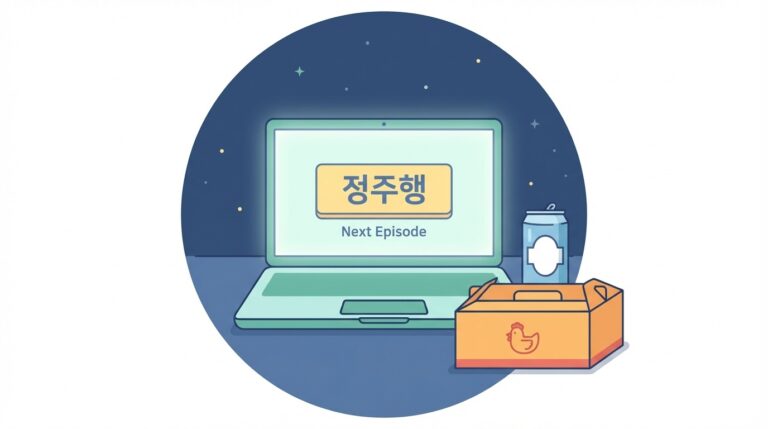
Picture this: It’s Friday night in Seoul. You’ve just finished a grueling week. You order “Kyochon Chicken” (honey combo, obviously), crack open a beer, and open Netflix. A new K-Drama just dropped—all 8 episodes at once.
Your Korean friend texts you: “야, 너 그거 봤어? 나 어제 밤새서 정주행했어.” (Ya, neo geugeo bwasseo? Na eoje bamsaeseo jeongjuhaenghaesseo.)
Wait, Jeongjuhaeng? Did they drive somewhere?
In the era of OTT (Over-The-Top) media, the way Koreans consume content has shifted drastically, and the language has evolved to match. If you rely on textbook Korean like “I watched the whole series,” you’re missing the intense, adrenaline-fueled nuance of modern K-Culture. Let’s upgrade your vocabulary to C1 level so you can debate the latest plot twists like a true local.
Phase 2: Deep Dive into OTT Vocabulary
1. 정주행하다 (Jeongjuhaenghada)
- Pronunciation: [Jeong-ju-haeng-ha-da] + (Sounds like “Jung-ju” like jungle without ‘le’ + “haeng” like hang)
- Meaning:
- Literal: To drive at the speed limit / To drive straight without stopping.
- Real Nuance: To binge-watch. It implies starting from Episode 1 and not stopping until the end, often sacrificing sleep.
- K-Culture Moment: When a drama ends, you’ll see comments online: “이번 주말에 정주행 각이다” (This weekend is the angle/time for a binge-watch).
- Editor’s Insight: The root is 정 (Correct/Straight) + 주행 (Driving). Conversely, skipping around is called ‘띄엄띄엄 보다’ (watching sporadically).
- Situation Spectrum:
[🚫 Formal Presentation] ———— [⚠️ Colleagues] ———— [✅ Friends/Internet]- 🤔 Think About It: Why use a driving metaphor for watching TV? It suggests momentum and focus. In your language, is binge-watching associated with eating (binge) or moving (marathon)?
2. 스포(일러) 당하다 (Seupo-danghada)
- Pronunciation: [Seu-po dang-ha-da]
- Meaning:
- Literal: To suffer a spoiler.
- Real Nuance: To accidentally see a spoiler against your will.
- K-Culture Moment: You open Twitter/X, and the top trending hashtag reveals who died in Squid Game. You scream, “아! 스포 당했어!” (Ah! I got spoiled!)
- Editor’s Insight: Notice the verb 당하다 (to suffer/undergo). Koreans rarely say “I saw a spoiler.” They say they suffered it, positioning themselves as a victim of information violence. It emphasizes the loss of the ‘first-watch’ experience.
- Situation Spectrum:
[🚫 CEO Report] ———— [✅ Colleagues] ———— [✅ Friends]- 🤔 Think About It: The use of the passive voice ‘당하다’ (usually used for accidents or robbery) for spoilers shows how seriously Koreans take their entertainment. Do you treat spoilers as ‘unfortunate info’ or a ‘crime’?
3. 역주행하다 (Yeokjuhaenghada)
- Pronunciation: [Yeok-ju-haeng-ha-da]
- Meaning:
- Literal: To drive in reverse (against traffic).
- Real Nuance: Climbing back up the charts. When an old song or drama suddenly becomes viral and popular again.
- K-Culture Moment: Like the group Brave Girls with “Rollin'”, or when an old drama lands on Netflix Top 10 years later. “이 드라마 요즘 넷플릭스에서 역주행 중이야.”
- Editor’s Insight: This word perfectly captures the algorithmic nature of modern content consumption. It defies the linear flow of time.
- Situation Spectrum:
[⚠️ Formal News] ———— [✅ Industry Talk] ———— [✅ Friends]
Phase 3: Textbook vs. Real Life
| Situation | 📖 Textbook Korean | 🗣️ Real Korean (C1 Level) | 💡 Why the difference? |
|---|---|---|---|
| Finishing a series quickly | 드라마를 처음부터 끝까지 다 봤어요. (I watched the drama from start to finish.) |
주말에 몰아보기 했어요. / 정주행 완료했어요. (I did ‘molabogi’ / I completed the ‘straight drive’.) |
‘다 봤다’ is factual. ‘몰아보다’ captures the intensity of consumption. |
| Waiting for live broadcast | 생방송을 기다리고 있어요. (I am waiting for the live broadcast.) |
본방 사수 대기 중! (Standby to ‘defend the live broadcast’! 🛡️) |
Shows loyalty. ‘Sasu’ (deadly defense) is a military term used in fandoms. |
| Complaining about spoilers | 줄거리 미리 말하지 마세요. (Please don’t tell me the plot in advance.) |
스포 금지! 안 본 눈 삽니다. (No Spoilers! I’m buying eyes that haven’t seen it yet.) |
‘Buying eyes’ is a common meme expressing regret over seeing something. |
💡 Editor’s Note: “안 본 눈 삽니다 (I’m buying unseeing eyes)” is a hilarious C1-level phrase. Use it when you saw a spoiler (or something ugly) and wish you could unsee it.
Phase 4: Cultural Deep Dive — The Death of ‘Bonbang’?
4-1. The “Fast-Forward” Culture (빨리감기 문화)
In the past, Koreans valued 본방 사수 (Bonbang sasu)—watching the original broadcast live to boost ratings. But with OTT, the culture has shifted to 몰아보기 (Molabogi – Binge-watching) and even 배속 시청 (Baesok sicheong – Watching at 1.25x or 1.5x speed).
If you tell a Korean, “I’m watching The Glory at 1.5x speed because I’m busy but curious,” they won’t judge you. They’ll nod and say, “Efficient!” This reflects the ‘Pali-Pali’ (Hurry Hurry) culture bleeding into leisure. We want the dopamine hit of the story without the time investment.
4-2. Critical Connection: The “Spoiler” Etiquette
In Korea, posting spoilers without a warning (called 스포 주의 – Spoiler Alert) is considered extremely rude, almost like cutting in line. When discussing a popular show offline, people often ask first: “혹시 어디까지 봤어요?” (By any chance, how far have you watched?) before speaking. This is the ‘Nunchi’ (social sensing) required in the OTT era.
Phase 5: Interactive Roleplay — The Water Cooler Chat
Setting: Monday morning in the office pantry (탕비실). Everyone is making coffee. The topic is the hit drama that dropped on Friday.
Characters:
* YOU: Marketing Manager (watched 3 episodes).
* Minji: A coworker who watches everything instantly (watched all 10 episodes).
Dialogue:
Minji: (Eyes wide, whispering) 과장님, 주말에 ‘오징어 게임 2’ 보셨어요? 진짜 대박이죠?
(Manager, did you watch Squid Game 2 over the weekend? Isn’t it crazy?)
YOU: 아, 주말에 바빠서 아직 3화까지밖에 못 봤어요.
(Ah, I was busy so I only watched up to episode 3.)
Minji: 헐, 진짜요? 4화 마지막 장면이 진짜 충격인데… 말하고 싶어서 입이 간질간질해요.
(Heol, really? The last scene of ep 4 is shocking… My mouth is itching to tell you.)
🔀 Decision Point: How do you stop her?
- A) “제발 말하지 마세요. 나중에 볼게요.” (Polite, standard)
- B) “아, 스포 하지 마세요! 저 아직 정주행 중이라고요!” (Natural, urgent)
- C) “다 듣고 싶어요. 그냥 말해주세요.” (Rare, but possible)
✅ Best Choice: B
* Reason: It uses the key vocabulary (스포, 정주행) and matches the urgent, playful tone of a close colleague chat.
Minji’s Reaction (to B): (Zipping her lips gesture 🤐) 알겠어요, 쉿! 빨리 정주행 끝내고 오세요. 토론해야 하니까!
(Okay, shh! Hurry up and finish your binge-watch. We need to debate!)
Phase 6: 10-Second Shadowing Drill
Let’s practice the sentence you’ll use when you look tired on Monday morning.
😫 Exhausted but satisfied tone:
어제 / 드라마 정주행하느라 / 한숨도 못 잤어.
(Eoje / deurama jeongjuhaenghaneura / hansumdo mot jasseo.)
Yesterday / because I was binge-watching a drama / I couldn’t sleep a wink.
Phase 7: K-Culture Mini Glossary (Media Edition)
| Korean | Rom | Meaning | Context |
|---|---|---|---|
| 떡밥 | Tteokbap | Plot bait/Foreshadowing | Literally “rice bait” for fishing. Used for clues dropped by writers. “떡밥 회수” means answering those clues. |
| 엔딩 요정 | Ending Yojeong | Ending Fairy | The person (usually idol) who gets the final close-up shot. Now used ironically in shows too. |
| 입덕 | Ipdeok | Entering fandom | Falling in love with a show/actor. “This drama made me ‘ipdeok’.” |
| 쿠키 영상 | Kuki Yeongsang | Post-credits scene | Derived from “Cookie.” Marvel movies made this term famous in Korea. |
| 티저 | Tijeo | Teaser | Same as English, but essential vocabulary for pre-release hype. |
Phase 8: Digital Traveler’s Survival Kit
You are traveling in Korea, and you want to watch Netflix on your phone, or maybe visit a PC Bang (Internet Cafe) to check your email/watch content.
🆘 Survival Expressions
1. “와이파이 비밀번호가 뭐예요?” (Waipai bimilbeonhoga mwoyeyo?)
– What is the Wi-Fi password? (Crucial for OTT streaming!)
2. “여기 충전기 좀 빌릴 수 있나요?” (Yeogi chungjeongi jom billil su innayo?)
– Can I borrow a charger here? (Binge-watching drains battery.)
3. “넷플릭스 되는 PC방인가요?” (Netpeullikseu doeneun PC-bang-ingayo?)
– Is this a PC bang that has Netflix? (Many PC bangs offer free OTT accounts on their seats.)📌 Editor’s Travel Note:
In Korea, PC Bangs are not just for gaming. They are high-end media centers. You can order amazing food (Ramyun, Kimchi Fried Rice) right to your seat while watching OTT content on a curved 32-inch monitor. It’s a must-do cultural experience!
Phase 9: Think Deeper — Media vs. Reality
Topic: The “K-Drama Standard” Trap
In OTT dramas, characters often live in spacious officetels with view of the Han River, drinking soju every night without getting a hangover. When you use words like 정주행 (binge-watch), consider how the content itself shapes our view of Korea.
Real Korean life is often more competitive and tired (hence the need for the ‘healing’ genre). The language of media consumption (스포 당하다 – feeling victimized, 본방 사수 – fighting to watch) reflects a society that is intense even in its relaxation. We treat leisure as another mission to complete efficiently.
💬 Your Turn: Does your culture view watching TV as “doing nothing” or as an active hobby? Do you have a word for “binge-watching” that implies guilt or pride?
Phase 10: FAQ & Troubleshooting
Q: Can I use ‘정주행’ for reading books or webtoons?
A: YES! 웹툰 정주행 (Binge-reading webtoons) is a very common phrase. You can even use it for reading through a long blog post or comment thread.
Q: Is ‘스포’ (Spoiler) slang? Can I use it with my boss?
A: It is technically a loanword/slang, but it is so widely used that it’s acceptable in semi-formal settings (like team lunches). However, in a formal meeting, say “내용 유출” (content leak) or “줄거리 공개” (plot reveal) instead.
❌ Common Mistake: Saying “I watched the shooting” (촬영을 봤어요) when you mean you watched the show.
✅ Correction: “촬영” means the filming process (the camera crew working). You watched the “방송” (broadcast) or “작품” (work/piece).
Phase 11: Wrap-up & Action Mission
One-Liner: Use 정주행 when you binge, and 스포 when you want to protect the plot!
🚀 Action Mission:
– 🥉 Bronze: Look at your Netflix history. Point to a show and say aloud: “나 이거 정주행했어.”
– 🥈 Silver: Go to a K-Drama clip on YouTube. Read the comments and find the word “스포” or “정주행.”
– 🥇 Gold: Ask a Korean friend (or language partner): “요즘 정주행할 만한 드라마 추천해 주세요!” (Please recommend a drama worth binge-watching these days!)
Phase 12: Quiz — Are you an OTT Master?
1. Situation: You are watching a drama that ended 10 years ago, but suddenly everyone is talking about it again.
– This drama is doing what?
– A) 정주행 (Jeongjuhaeng)
– B) 역주행 (Yeokjuhaeng)
– C) 서행 (Seohaeng – Slow driving)
2. Fill in the blank:
– “Oh no! I accidentally read the ending on Twitter.”
– “아! 트위터에서 ( ) 당했어!”
3. True or False:
– Koreans generally appreciate it when you tell them the ending of a show to save them time.
– (True / False)
Answers:
1. B (역주행) – Going back up the charts against the flow of time.
2. 스포 (Seupo) – Remember, you suffered (당하다) it!
3. False – Never! It is considered very rude. You might lose a friend! 🙅♂️
Frequently Asked Questions (FAQ)
Q: What does "정주행하다 (Jeongjuhaenghada)" mean in Korean and how do you pronounce it?
A: In Korean, "정주행하다 (Jeongjuhaenghada)" is pronounced [Jeong-ju-haeng-ha-da] and means: Literal: To drive at the speed limit / To drive straight without stopping.
Q: What does "스포(일러) 당하다 (Seupo-danghada)" mean in Korean and how do you pronounce it?
A: In Korean, "스포(일러) 당하다 (Seupo-danghada)" is pronounced [Seu-po dang-ha-da] and means: Literal: To suffer a spoiler.
Q: What does "역주행하다 (Yeokjuhaenghada)" mean in Korean and how do you pronounce it?
A: In Korean, "역주행하다 (Yeokjuhaenghada)" is pronounced [Yeok-ju-haeng-ha-da] and means: Literal: To drive in reverse (against traffic).







