

Don’t Just Argue, “Read the Air”: Advanced Conflict Resolution in Korea
Phase 1: The Hook — The Silence in the Boardroom
Hello! This is your Daily Hangul Editor.
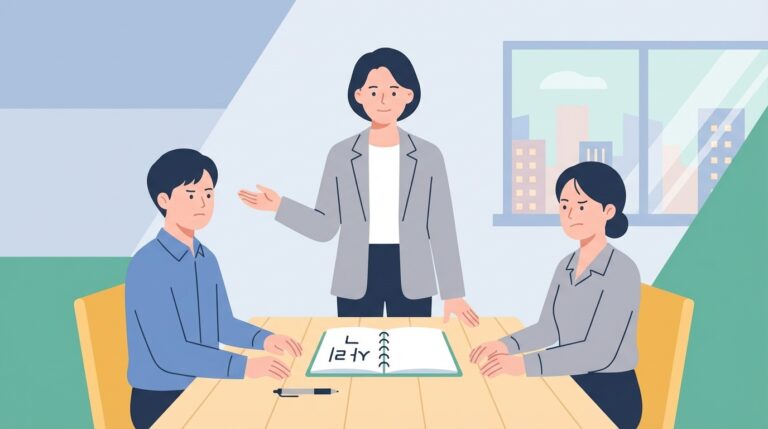
Picture this: You’re watching a tense scene in a K-Drama like Misaeng or Itaewon Class. The boardroom is freezing cold. A subordinate has just made a critical error, or perhaps two executives are locking horns over a strategy. But there’s no shouting. No table flipping.
Instead, the senior leader takes a slow sip of water, looks down at their papers, and says a sentence that sounds polite on the surface but sends a shiver down everyone’s spine. Conflict in Korea isn’t always a thunderstorm; often, it’s a drop in temperature.
If you are aiming for C2 proficiency, simply knowing how to say “I disagree” isn’t enough. You need to know how to navigate Chemyon (face) and Nunchi (sensing the mood) to resolve issues without burning bridges. Today, we diagnose conflict styles and equip you with the linguistic tools to lead through the storm.
Phase 2: Deep Dive — The Art of Diplomatic Warfare
Here are three high-level expressions used by leaders to manage friction.
1. 입장을 충분히 이해합니다만… (Ipjangeul chungbunhi ihaehamnidaman…)
- Pronunciation: [Ip-jang-eul chung-bun-hi i-hae-ham-ni-da-man]
- Meaning: “I fully understand your position, but…”
- K-Culture Moment: Think of a senior manager in a drama gently rejecting a proposal. They never start with “No.” They start with validation. This is the “Sandwich Method” of Korean rhetoric.
- Editor’s Insight: The suffix -만 (man) here carries the weight of the world. It signals a transition from empathy to executive decision. Use this to soften the blow before delivering a contrary opinion.
- Situation Spectrum:
[🚫 Friends] ———— [⚠️ Colleagues] ———— [✅ Formal/Leadership]- 🤔 Think About It: Why does Korean require such a long buffer before a refusal? It’s about preserving the listener’s dignity (Chemyon).
2. 허심탄회하게 이야기해 봅시다. (Heosimtanhoe-hage iyagihae bopsida.)
- Pronunciation: [Heo-sim-tan-hoe-ha-ge i-ya-gi-hae bop-si-da]
- Meaning: “Let’s speak frankly/openly without reservation.”
- K-Culture Moment: This is the classic Hoesik (Company Dinner) line. When the tie comes off and the Soju is poured, a leader uses this idiom (derived from Hanja) to signal a “Safe Zone” where hierarchy is temporarily suspended to solve conflicts.
- Editor’s Insight: Heosimtanhoe implies opening one’s heart and leaving nothing hidden. It is a powerful tool for de-escalation.
- Situation Spectrum:
[✅ Deep Conflict] ———— [✅ Team Building] ———— [🚫 Casual Chat]3. 접점을 찾아보시죠. (Jeopjeomeul chajabosijyo.)
- Pronunciation: [Jeop-jeom-eul cha-ja-bo-si-jyo]
- Meaning: “Let’s try to find a point of contact (common ground/compromise).”
- Editor’s Insight: Instead of focusing on who is right or wrong, this phrase focuses on geometry—finding where two lines meet. It shifts the frame from “You vs. Me” to “Us vs. The Problem.”
Phase 3: Textbook vs. Real Life
| Situation | 📖 Textbook Korean | 🗣️ Real Leadership Korean | 💡 Why the difference? |
|---|---|---|---|
| Disagreeing | 저는 반대합니다. (I oppose this.) | 현실적으로 고려해볼 부분이 있습니다. (There are realistic parts to consider.) | Direct opposition challenges authority. Indirect suggestion invites collaboration. |
| Asking for a solution | 어떻게 해결할까요? (How shall we solve this?) | 대안이 있을까요? (Is there an alternative?) | “Alternative” sounds more strategic and less like you’re lost for answers. |
| Calming someone down | 진정하세요. (Calm down.) | 잠시 숨 좀 고르고 하시죠. (Let’s catch our breath for a moment.) | Telling someone to “calm down” usually makes them angrier. Suggesting a physical pause is effective leadership. |
Phase 4: Cultural Deep Dive — Nunchi & Hierarchy
4-1. The Non-Verbal “Glance” (Nun-bit)
In high-context cultures like Korea, what is not said is often louder than words. A leader might manage conflict simply by staying silent or giving a specific look (Nun-bit). If you interrupt a heated argument with a calm, low-tone voice, it signals authority. Tip: When mediating, avoid prolonged eye contact with the person who is “losing” the argument to save their face.
4-2. The “Sul-jari” (Drinking Seat) Resolution
K-Dramas often show conflicts being resolved over Soju. This isn’t just a trope; it’s a social institution. The rigid hierarchy of the office blocks honest communication. Alcohol acts as a social lubricant that allows the “blocked Ki” (energy) of conflict to flow. If a leader says, “Let’s have a drink tonight,” read between the lines: “We have a conflict to resolve that cannot be solved in the office.”
Phase 5: Immersive Roleplay — The Project Crisis
Setting: A conference room in Yeouido, Seoul. 4:00 PM. The deadline is tomorrow, but Team Leader Kim and Manager Park are clashing over the direction.
Characters:
* YOU: Director (Isa-nim). The mediator and final decision-maker.
* Manager Park: Passionate but stressed. Wants to delay for quality.
* Team Leader Kim: Focused on the deadline and client promise.
Dialogue:
Manager Park: 지금 이 상태로 납품하면 우리 브랜드 이미지 다 망가집니다! (If we deliver like this, our brand image is ruined!)
Team Leader Kim: 고객사와의 약속이 더 중요해! 신용 문제라고! (The promise to the client is more important! It’s a matter of trust!)
(Tension rises. Everyone looks at YOU.)
YOU: (Raising a hand gently) 두 분 말씀 일리가 있습니다. 잠시만요.
(Both points have validity. Hold on.)
YOU: 박 과장님 우려도 이해하고, 김 팀장님 입장도 알겠습니다.
(I understand Manager Park’s concern and know Team Leader Kim’s position.)
🔀 Decision Point! How do you proceed?
- A) “둘 다 그만 싸워요. 그냥 내 말대로 하세요.” (Stop fighting both of you. Just do as I say.)
- B) “지금 당장 결론 내리기보다, 잠시 환기 좀 하고 접점을 찾아봅시다.” (Rather than concluding right now, let’s air out the room and find a point of contact.)
- C) “김 팀장 말이 맞아요. 박 과장이 따르세요.” (Kim is right. Park, you follow.)
✅ Best Choice: B — This utilizes the “Let’s catch our breath” tactic and uses the keyword Jeopjeom (common ground). It respects both parties before guiding them.
⚠️ Choice A & C Analysis: While efficient, these create lingering resentment (Ang-geum), which is fatal for long-term leadership.
Phase 6: 10-Second Shadowing Drill
Practice this sentence to sound like a rational, cool-headed leader.
😤 Authoritative yet Soft:
감정적인 대응보다는 / 실리적인 해결책을 / 고민해 봅시다.
(Gamjeong-jeogin dae-eung-bodaneun / silli-jeogin haegyeol-chaek-eul / gomin-hae bopsida.)
“Rather than an emotional response, let’s think about a pragmatic solution.”
Phase 7: K-Culture Mini Glossary
| Korean | Romanization | Meaning | Context |
|---|---|---|---|
| 체면 | Chemyon | Face / Reputation | The most critical currency in conflict. Never destroy someone’s Chemyon in public. |
| 앙금 | Ang-geum | Sediment / Grudge | The bad feelings left over after a fight. Good leaders dissolve this. |
| 총대 메다 | Chongdae meda | To bear the gun stock | To take the fall or take responsibility for a difficult task/conflict on behalf of the group. |
Phase 8: Traveler’s Survival Kit (Conflict Edition)
Even as a traveler, you might face friction—a double-booked hotel room or a taxi dispute. Conflict resolution applies here too.
🆘 Survival Expression: The “Ask, Don’t Accuse” Technique
* 🇰🇷 “혹시 착오가 있었던 것 같은데요…” (Hoksi chago-ga isseot-deon geo gateundeyo…)
* 🗣️ Meaning: “By any chance, it seems there might have been a mistake…”
* 💡 Pro Tip: Never say “You made a mistake.” Using “There was a mistake” (passive nuance) and “Hoksi” (by any chance) removes blame and makes the staff much more willing to help you.
Phase 9: Think Deeper — Language & Power
Topic: The Buffer of Honorifics
In English, anger often leads to louder volume and direct wording. In Korean, oddly enough, conflict can sometimes make the language more formal. When two strangers argue in traffic, they might aggressively use extremely polite honorifics (Jondaemal) to maintain distance and icy superiority.
🧠 Think Deeper:
Does the complex system of Korean honorifics prevent conflict by enforcing respect, or does it merely suppress it until it explodes? How does your native language handle hierarchy during a fight?
Phase 10: FAQ & Troubleshooting
- Q: Can I use “Sorry” (Mianhamnida) to end a conflict?
- A: Be careful. In Western culture, “sorry” can express empathy. In a Korean professional context, it is an admission of fault/liability. Don’t apologize unless you intend to take full responsibility. Use “Yugam-imnida” (It is regrettable) for empathy instead.
- Q: Is it okay to stay silent during a conflict?
- A: Yes. In Korea, silence is an active part of the conversation. It can signify that you are contemplating the other person’s words deeply. Immediate rebuttals can be seen as lacking thoughtfulness.
Phase 11: Wrap-up & Mission
One-Liner: True leadership in Korea isn’t about winning the argument; it’s about winning the people (Insim).
Action Mission:
* 🥉 Bronze: Shadow the phrase “입장을 충분히 이해합니다만” 3 times.
* 🥈 Silver: Watch a K-Drama scene where a boss scolds a subordinate. Observe their body language and eye contact.
* 🥇 Gold: Next time you disagree with a friend or colleague, start your sentence with “I understand your position fully, but…” in Korean!
💬 Your Turn: Have you ever experienced a “silent conflict” in a high-context culture? How did you handle it? Tell us below!
Phase 12: Interactive Quiz
Scenario: A junior team member challenges your idea in front of the CEO.
- Directly prove them wrong with data immediately.
- Smile, nod, say “That’s a creative angle,” and address it later privately.
- Scold them for being rude.
Correct Answer: 2. Publicly shutting them down hurts the team harmony (Inwha). Acknowledging the effort while deferring the debate is the advanced leadership move.
Frequently Asked Questions (FAQ)
Q: What does "입장을 충분히 이해합니다만... (Ipjangeul chungbunhi ihaehamnidaman...)" mean in Korean and how do you pronounce it?
A: In Korean, "입장을 충분히 이해합니다만... (Ipjangeul chungbunhi ihaehamnidaman...)" is pronounced [Ip-jang-eul chung-bun-hi i-hae-ham-ni-da-man] and means: "I fully understand your position, but..."
Q: What does "허심탄회하게 이야기해 봅시다. (Heosimtanhoe-hage iyagihae bopsida.)" mean in Korean and how do you pronounce it?
A: In Korean, "허심탄회하게 이야기해 봅시다. (Heosimtanhoe-hage iyagihae bopsida.)" is pronounced [Heo-sim-tan-hoe-ha-ge i-ya-gi-hae bop-si-da] and means: "Let's speak frankly/openly without reservation."
Q: What does "접점을 찾아보시죠. (Jeopjeomeul chajabosijyo.)" mean in Korean and how do you pronounce it?
A: In Korean, "접점을 찾아보시죠. (Jeopjeomeul chajabosijyo.)" is pronounced [Jeop-jeom-eul cha-ja-bo-si-jyo] and means: "Let's try to find a point of contact (common ground/compromise)."







