

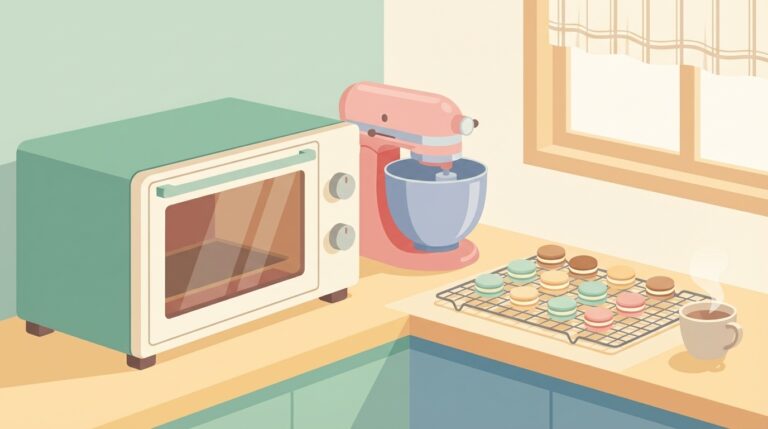
Phase 1: The “Home Cafe” Reality Check
Greeting: Hello! This is your Daily Hangul Senior Editor.
K-Culture Cold Open: Picture this. You’ve been binge-watching Korean “Home Cafe” (홈카페) vlogs on YouTube. The aesthetic involves pastel-colored mixers, perfectly risen soufflés, and sunlight hitting a glass of iced Americano just right. Inspired, you decide to bake cookies in your Seoul Airbnb or apartment. But wait—the oven looks like a microwave, the buttons are in Korean, and your cookies turn into charcoal bricks.
The ‘Why’: In Korea, the “Fatcaron” (Fat Macaron) craze didn’t happen by accident. Baking here is a serious hobby, almost a science. If you want to impress your Korean friends (or just not starve), knowing how to discuss “Oven Temperature” is about more than just numbers. It’s about describing texture, timing, and that elusive “golden brown.”
Transparency: This guide combines technical baking terms used by professional pâtissiers in Gangnam with the slang you’ll hear in Hongdae one-day classes.
Phase 2: Deep Dive into Texture & Heat
At the C1 level, we move beyond simple commands like “Turn it on.” We need to talk about the result of the heat.
1. 겉바속촉 (Geot-ba-sok-chok)
- Pronunciation: [Geot-ba-sok-chok] + Think of the crisp sound of biting into fried chicken, then the soft chew.
- Meaning: Strictly: An abbreviation for “Crispy outside, moist inside” (겉은 바삭하고 속은 촉촉하다). Real Nuance: The holy grail of Korean food texture. It applies to scones, bread, fried chicken, and even pork belly.
- K-Culture Moment: In food variety shows like Wednesday Food Talk, if a panelist describes a pastry without using this word, did they even eat it? It’s the ultimate compliment for a baker.
- Editor’s Insight: This is a “portmanteau.” Koreans love shortening long descriptive phrases into four-syllable idioms.
- Situation Spectrum:
[🚫 Formal Reports] ———— [⚠️ Semi-formal] ———— [✅ Casual/Foodies]- 🤔 Think About It: Why does Korean prioritize texture (mouthfeel) so heavily in food vocabulary compared to flavor?
2. 예열하다 (Yeyeol-hada)
- Pronunciation: [Ye-yeol-ha-da] + Sounds like ‘Yay-yall’ (Texas slang) + ha-da.
- Meaning: Literal: To pre-heat. Real Nuance: In Korea, where many homes use small electric convection ovens (gwangpa-oven) rather than gas ovens, 예열 is a religion. If you skip this, your baking fails.
- K-Culture Moment: Watching a baking YouTuber like Cooking Tree, you will hear “180도로 예열해주세요” (Please preheat to 180) in the first 10 seconds of every video.
- Situation Spectrum:
[🚫 None] ———— [⚠️ None] ———— [✅ All Situations]- 🤔 Think About It: The word consists of ‘예’ (in advance) and ‘열’ (heat). Can you think of other Korean words starting with ‘예’ that mean “in advance”? (Hint: 예약 – reservation).
3. 구움색이 나다 (Gu-um-saek-i nada)
- Pronunciation: [Gu-um-sae-gi na-da]
- Meaning: Literal: “Baking color comes out.” Real Nuance: To achieve that perfect golden-brown finish. We don’t just say “it’s cooked.” We say the “color has appeared.”
- Editor’s Insight: Note the use of ‘나다’ (to emerge/happen). The oven does the work; the color emerges. If you forced the color (maybe by using a torch), you might use ‘내다’ (to make/create).
- Situation Spectrum:
[🚫 Casual Chat] ———— [⚠️ Baking Class] ———— [✅ Professional]
Phase 3: Textbook vs. Real Life – The Baking Class Edition
| Situation | 📖 Textbook Korean | 🗣️ Real Korean (In a One-Day Class) | 💡 Why the difference? |
|---|---|---|---|
| Checking if done | 다 구워졌나요? (Is it all baked?) | 색깔 나왔나요? (Did the color come out?) | Koreans judge doneness visually (color) first. |
| Temperature drop | 온도가 내려갔어요. (Temp went down.) | 열이 확 떨어졌어요. (Heat dropped drastically.) | Adverbs like ‘확’ add the emotional urgency of baking. |
| Burning food | 빵이 탔어요. (Bread burned.) | 오버쿡 됐어요 / 윗면이 그을렸어요. (Overcooked / Top is scorched.) | C1 speakers use specific verbs like ‘grill/scorch’ (그을리다) or Konglish (overcook) for nuance. |
Bottom Note: In advanced baking contexts, using Konglish like “Overcook” (오버쿡) or “Underbaked” (언더베이크) is actually considered more professional/trendy than pure Korean in some Seoul circles.
Phase 4: Cultural Deep Dive – The “Ppalli-Ppalli” Paradox
4-1. Non-verbal: The Oven Stare
Even in the land of Ppalli-ppalli (Hurry, hurry), baking requires patience. However, look at a Korean baking class. Students will often crouch in front of the oven, staring intensely. If the teacher says “Don’t open it!” (열지 마세요!), it’s because the fluctuating temperature of small Korean ovens is a common pain point. The non-verbal cue here is restrained anxiety.
4-2. K-Culture Connection: The “Gwangpa” Oven (광파오븐)
Unlike Western kitchens with massive gas ranges, most Koreans living in apartments (officetels) use a “Gwangpa Oven” (Light Wave Oven). It’s a hybrid microwave/convection oven/air fryer.
- The Struggle: These heat up fast but lose heat instantly if you open the door.
- The C1 Expression: “열기를 가두다” (To trap/lock in the heat). You’ll hear recipes emphasize this because of the equipment limitations.
Phase 5: Immersive Roleplay – The Macaron Crisis
Setting: A trendy “One-Day Baking Class” in Mangwon-dong on a Saturday afternoon. The smell of almond flour and sugar fills the air. You are paired with a strict but skilled instructor.
Characters:
* YOU: An expat trying to bake macarons for a friend’s birthday.
* Teacher Kim: A perfectionist pâtissier who treats macarons like diamonds.
(Dialogue Start)
Teacher Kim: (Checking the oven display) 회원님, 지금 오븐 온도 150도로 맞추신 거 맞아요?
(Hoewonnim, jigeum obeun ondo 150-doro matchusin geo majayo?)
(Member [Student], did you really set the oven to 150 degrees just now?)
YOU: 네, 레시피대로 했는데요. 왜요?
(Ne, resipidaero haenneundeyo. Waeyo?)
(Yes, I did it according to the recipe. Why?)
Teacher Kim: (Pointing at the shells) 삐에(pied)가 주저앉고 있어요. 예열을 충분히 안 하신 것 같은데요.
(Ppie-ga jujeo-ango isseoyo. Yeyeoreul chungbunhi an hasin geot gateundeyo.)
(The ‘pied’ [macaron feet] is collapsing. It seems you didn’t preheat enough.)
🔀 Decision Point: How do you respond?
A) “아, 죄송해요. 다시 할게요.” (Sorry, I’ll do it again.)
B) “어? 분명히 예열 버튼 눌렀는데… 오븐이 좀 약한가 봐요.” (Huh? I definitely pressed the preheat button… maybe the oven is weak.)
C) “망했다! 어떡하죠?” (I’m screwed! What do I do?)
✅ Best Choice: B
* Why: Option A is too submissive for a paid class. Option C is too panicky. Option B uses C1 level ” blaming the machine” (weak oven) while asserting you followed the procedure. This invites the teacher to solve the technical issue.
Teacher Kim: 아, 이 오븐이 열이 좀 빨리 빠져요. 온도를 10도만 더 높여서 구움색 좀 더 내볼게요.
(Ah, this oven loses heat quickly. Let’s raise it by 10 degrees and try to get more browning color.)
Phase 6: 10-Second Shadowing Drill
Let’s practice explaining a texture preference. Koreans love specifics!
Emotion: 😤 Firm/Specific (You know exactly what you want!)
저는 / 너무 바삭한 것보다 / 속이 쫄깃한 식감을 / 선호해요.
(Jeo-neun / neomu basakan geot-boda / sogi jjolgit-han sikgameul / seonhohaeyo.)
Translation: I prefer a texture that is chewy on the inside rather than too crispy.
Phase 7: K-Culture Mini Glossary (Baking Edition)
| Korean | Romanization | English | Context |
|---|---|---|---|
| 홈베이킹 | Hom-be-i-king | Home Baking | A huge trend since the pandemic. |
| 식감 | Sik-gam | Food Texture | Literally “eating feeling.” Crucial for describing food. |
| 똥손 | Ddong-son | Clumsy Hands | Literally “Poop hands.” Someone who ruins everything they make. |
| 금손 | Geum-son | Golden Hands | Someone very talented at making things. |
| 겉바속촉 | Geot-ba-sok-chok | Crispy out, moist in | The ultimate texture compliment. |
Phase 8: Survival Kit – The Airbnb/Officetel Oven
If you are staying in Korea, you will likely encounter the Samsung or LG “Smart Oven.” It is a microwave, toaster, and oven in one. It is confusing.
🆘 Survival Guide for the “Smart Oven”
1. Button to find: 오븐 (Oven) or 발효/구이 (Ferment/Grill).
2. The Dial: Usually, you turn a dial to set the temperature, then press 선택 (Select) or 시작 (Start).
3. Pro Tip: If you see 레인지 (Range/Microwave), do NOT put metal in it. Ensure it is in 오븐 (Oven) mode before sliding in your baking tray.
Phase 9: Think Deeper – Sensory Language
Topic: The Sound of Taste
Korean language relies heavily on onomatopoeia and mimesis (sound symbolism) for food. We don’t just say “crispy”; we have 바삭 (light crisp), 빠삭 (hard crunch), 아삭 (crunchy vegetables). In baking, we have 포슬포슬 (crumbly/soft like steamed potatoes) vs. 꾸덕꾸덕 (dense/fudgy like brownies).
🧠 Think Deeper:
Why does Korean need 5 different words for “chewy” (쫄깃, 쫀득, 질깃…)? It reflects a culinary culture that values texture as much as taste. In your language, how many specific words do you have for the texture of bread?
Phase 10: FAQ & Troubleshooting
Q: I’m watching a Korean recipe video. What is “180도”? Fahrenheit?
A: No! Korea uses Celsius (°C) exclusively. 180°C is roughly 350°F. If you set a US oven to 180°F, you will be waiting forever.
Q: Can I use the word “굽다” (to bake/grill) for everything?
A: Mostly, yes. You “굽다” bread, cookies, and even meat (Samgyeopsal). But for steaming (like steamed buns), use 찌다 (jji-da).
❌ Common Mistake #1: Saying “hot” (뜨겁다) for the oven temperature setting.
✅ Fix: Use 높다 (high) or 낮다 (low) for temperature levels. “온도가 너무 높아요” (The temp is too high).
Phase 11: Wrap-up & Action Items
One-Liner: Mastering “Oven Temperature” in Korean is actually mastering the art of describing the perfect Geot-ba-sok-chok (texture).
Action Missions:
* 🥉 Bronze: Look at your toaster or oven. Say “180도로 예열하자” (Let’s preheat to 180) out loud.
* 🥈 Silver: Watch a Korean “Home Cafe” vlog and try to catch the word “식감” (texture) or “꾸덕하다” (fudgy).
* 🥇 Gold: Go to a Korean bakery. Ask the staff, “이 빵은 겉바속촉인가요?” (Is this bread crispy outside and moist inside?)
💬 Your Turn: Have you ever tried using a Korean microwave/oven combo? Did you burn anything? Tell us in the comments!
Phase 12: Quiz – The Baker’s Challenge
1. Situational Judgment:
You are baking brownies. You want them to be dense and fudgy, not like a sponge cake. Which word describes your goal?
* A) 바삭바삭 (Basak-basak)
* B) 꾸덕꾸덕 (Kkudeok-kkudeok)
* C) 아삭아삭 (Asak-asak)
2. Fill in the Blank:
“오븐 문을 자꾸 열면 “______”이 떨어져서 빵이 잘 안 부풀어요.”
(If you keep opening the door, the [_____] drops, so the bread won’t rise well.)
* A) 전기 (Electricity)
* B) 온도 (Temperature)
* C) 기분 (Mood)
3. True or False:
Most Korean home recipes use Fahrenheit (°F).
Answers:
1. B) 꾸덕꾸덕 is the specific sound-word for dense, fudgy textures.
2. B) 온도 (Temperature). Although opening the door might drop your mood too!
3. False. Korea uses Celsius (°C).
Frequently Asked Questions (FAQ)
Q: What does "겉바속촉 (Geot-ba-sok-chok)" mean in Korean and how do you pronounce it?
A: In Korean, "겉바속촉 (Geot-ba-sok-chok)" is pronounced [Geot-ba-sok-chok] and means: Strictly: An abbreviation for "Crispy outside, moist inside" (겉은 바삭하고 속은 촉촉하다). Real Nuance: The holy grail of Korean food texture. It applies to scones, bread, fried chicken, and even pork belly.
Q: What does "예열하다 (Yeyeol-hada)" mean in Korean and how do you pronounce it?
A: In Korean, "예열하다 (Yeyeol-hada)" is pronounced [Ye-yeol-ha-da] and means: Literal: To pre-heat. Real Nuance: In Korea, where many homes use small electric convection ovens (gwangpa-oven) rather than gas ovens, 예열 is a religion. If you skip this, your baking fails.
Q: What does "구움색이 나다 (Gu-um-saek-i nada)" mean in Korean and how do you pronounce it?
A: In Korean, "구움색이 나다 (Gu-um-saek-i nada)" is pronounced [Gu-um-sae-gi na-da] and means: Literal: "Baking color comes out." Real Nuance: To achieve that perfect golden-brown finish. We don't just say "it's cooked." We say the "color has appeared."







