

Phase 1: The Immersive Hook
안녕하세요! This is your Daily Hangul Editor.
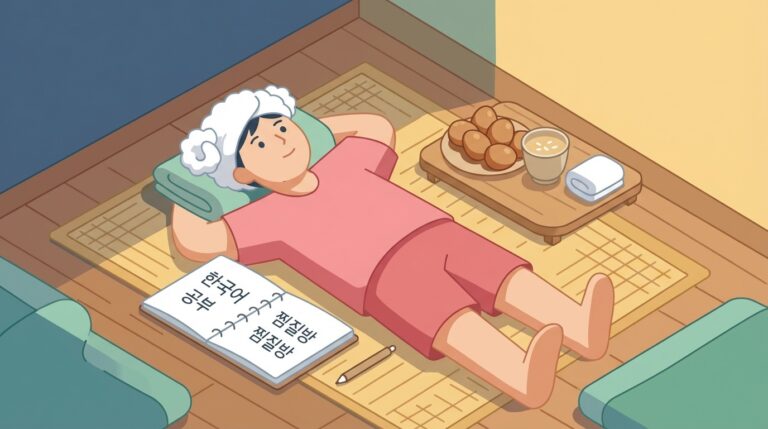
Picture this: You’ve seen it in countless K-Dramas like Crash Landing on You or Legend of the Blue Sea. The protagonist runs away from home (or has no money), enters a warm, spacious building, wraps a towel around their head like a sheep, and cracks a hard-boiled egg on their friend’s forehead. Yes, we are talking about the Jjimjilbang (찜질방).
But for a foreigner, walking into a place where everyone is sleeping on the floor—and being naked in the bathing area—can be terrifying. How do you ask to stay the night? How do you buy food without a wallet? If you don’t know the rules, you might end up standing awkwardly in the locker room. But don’t worry! Today, we’ll turn you into a Jjimjilbang pro.
Phase 2: Deep Dive into Key Expressions
1. 여기서 자고 갈 수 있어요? (Can I sleep here overnight?)
- Pronunciation: [Yeogi-seo jago gal su isseoyo?]
(Sounds like: Yogi-saw jah-go gal soo is-saw-yo?)- Meaning:
- Literal: Can I sleep here and go?
- Real Nuance: “Is this place open 24 hours for overnight stay?” (Not all saunas are 24/7!)
- K-Culture Moment: In dramas, when a character misses the last bus, they rush to a sauna counter and ask this with a desperate face.
- Editor’s Insight: The verb ‘자고 가다’ (sleep and go) is very common. It implies a temporary stay, not moving in. It’s softer than just “자요?” (Sleep?).
- Situation Spectrum:
[🚫 Formal Business] ———— [✅ Casual/Service] ———— [✅ Friends]- 🤔 Think About It: Why does Korean add “ga-da” (go) after “ja-da” (sleep)? It emphasizes the process of staying and then leaving, highlighting the temporary nature of the visit.
2. 락커 키로 결제할게요. (I’ll pay with my locker key.)
- Pronunciation: [Rak-keo ki-ro gyeol-je-hal-ge-yo]
- Meaning: I will pay using the locker key.
- K-Culture Moment: You’re at the snack bar craving Sikhye (sweet rice punch). You don’t have cash because you’re in gym clothes. You just tap your wristband. Beep! Magic.
- Editor’s Insight: In most modern Jjimjilbangs, your key is your credit card. You pay the total bill at the exit. Warning: It’s easy to overspend because it doesn’t feel like real money!
- Situation Spectrum:
[🚫 Rare] ———— [⚠️ Standard Saunas] ———— [✅ Modern Jjimjilbangs]- 🤔 Think About It: This system requires high social trust and advanced IT integration. How would this system work in your country? Would people trust the calculation?
3. 양머리 어떻게 해요? (How do I make the sheep head?)
- Pronunciation: [Yang-meo-ri eo-tteo-ke hae-yo?]
- Meaning: How do I do the sheep head (towel)?
- K-Culture Moment: The ultimate cute selfie moment. If you ask a Korean friend or the Ajumma next to you, they will laugh and happily fold it for you.
- Editor’s Insight: ‘Yang’ means sheep, ‘Meori’ means head. It’s not a rule, but it’s a culture. It also keeps your head cool in hot saunas!
- Situation Spectrum:
[🚫 Elders/Boss] ———— [✅ Friends/Date] ———— [✅ Solo Fun]
Phase 3: Textbook vs. Real Life
| Situation | 📖 Textbook Korean | 🗣️ Real Korean | 💡 Why is it different? |
|---|---|---|---|
| Checking In | 하룻밤 묵을 수 있습니까? (Can I stay for a night?) | 야간 돼요? (Is “night time” okay?) | “Muk-da” (stay/lodge) sounds like you are at a hotel. “Yagan” (night shift/time) is the industry term. |
| Ordering Food | 식혜 주세요. (Give me Sikhye.) | 식혜 하나, 계란 두 개요! (One Sikhye, two eggs!) | Efficiency. We often drop the verb “juseyo” slightly or say it very quickly in busy snack bars. |
| Leaving | 계산해 주세요. (Please calculate the bill.) | 정산이요. (Settlement, please.) | “Jeongsan” implies settling the accumulated tab from your locker key. |
Bottom Note: Use “야간 (Yagan)” when entering late at night. The staff will immediately know you mean the overnight price (which is usually slightly more expensive).
Phase 4: Cultural Deep Dive
4-1. The “Naked” Truth (Non-verbal)
Let’s address the elephant in the room. Before you put on the pajamas (Jimjil-bok), you must shower. Completely naked.
* The Gaze: Do not stare. Koreans are used to this communal nudity. Act casual. If you cover yourself too much with a towel while walking, you actually draw more attention.
* The Scrub: If you see people scrubbing each other’s backs aggressively, don’t be alarmed. This is “Seshin” (exfoliation), a bonding activity.
4-2. K-Drama Connection: The “Homeless” Trope
Why do runaway characters always go here?
1. Cost: It’s cheap (around 10,000 ~ 15,000 KRW).
2. Anonymity: No reservation needed.
3. Community: It feels safer than a cheap motel because there are families and people around.
Critique: In dramas, it looks romantic. In reality, someone will be snoring loudly next to you, and a baby might cry at 2 AM. Bring earplugs!
Phase 5: Immersive Roleplay
Setting: It is 11 PM. You are hungry after sweating in the “Ice Room.” You approach the snack bar (Maejeom). The Ajumma (staff) is watching TV.
Characters:
* YOU: Hungry traveler.
* Ajumma: Friendly but busy staff member.
(Dialogue Start)
Ajumma: (Doesn’t look away from TV) 뭐 드릴까요? 🍙
(Mwo deurilkkayo?)
(What can I get you?)
YOU: 식혜 하나랑 맥반석 계란 주세요.
(Sikhye hanarang maekbanseok gyeran juseyo.)
(One Sikhye and stone-roasted eggs, please.)
Ajumma: (Puts eggs on counter) 키 대세요. 🔑
(Ki daeseyo.)
(Touch [your] key [to the sensor].)
YOU: 아, 락커 키요? 여기요.
(Ah, rak-keo ki-yo? Yeogiyo.)
(Ah, the locker key? Here it is.)
Ajumma: (Beep!) 계란은 머리로 깨야 맛있는 거 알지? ㅋㅋ
(Gyeraneun meoriro kkaeya masinneun geo alji? haha)
(You know eggs taste better if you crack them on your head, right? haha)
(Dialogue End)
🔀 Decision Point: How do you respond to her joke?
- A) “아프잖아요! 안 할래요.” (It hurts! I won’t do it.)
- B) “진짜요? 한번 해볼게요!” (Really? I’ll try it!)
- C) “한국 드라마에서 봤어요!” (I saw it in a K-Drama!)
✅ Best Choice: B or C. Jjimjilbangs are spaces of Jeong (affection). Playing along with the joke makes the atmosphere fun. Option A is too serious!
Phase 6: 10-Second Shadowing Drill
Emotion: Refreshed and happy after a sip of cold drink.
😊 찜질하고 먹는 / 식혜가 / 최고예요!
(Jjimjil-hago meong-neun / sikhye-ga / choego-yeyo!)
Translation: The Sikhye I drink after sweating / is / the best!
Phase 7: K-Culture Mini Glossary
| Korean | Romanization | Meaning | Context |
|---|---|---|---|
| 양머리 | Yangmeori | Sheep Head | The iconic towel folding style found in K-Dramas. |
| 식혜 | Sikhye | Sweet Rice Punch | The official drink of saunas. Aids digestion and hydration. |
| 맥반석 계란 | Maekbanseok Gyeran | Stone-roasted Eggs | Brown, chewy eggs cooked in the sauna heat. |
| 온돌 | Ondol | Heated Floor | The traditional heating system. You sleep directly on this floor. |
| 이모 | Imo | Auntie | A friendly way to call the female staff at the snack bar. |
Phase 8: Traveler’s Survival Kit
🆘 Survival Phrases for Sleeping
* 🇰🇷 “콘센트 어디 있어요?” (Konsenteu eodi isseoyo?)
* English: Where is the power outlet? (Essential for charging phones!)
* 🇰🇷 “매트 좀 더 가져가도 돼요?” (Maeteu jom deo gajyeogado dwaeyo?)
* English: Can I take one more mat? (The floor can be hard.)
* 🇰🇷 “여탕/남탕은 어디예요?” (Yeotang/Namtang-eun eodi-yeyo?)
* English: Where is the women’s/men’s bath? (Don’t enter the wrong one!)📌 Editor’s Travel Note
* Luggage: Most places have a counter for big luggage (suitcases). Don’t try to shove a 28-inch suitcase into the locker.
* Gender Split: The sleeping area is usually mixed (families together), but there are often “Female/Male Only” sleeping caves if you are uncomfortable.
Phase 9: Think Deeper — “Skinship” and Community
Topic: Space and Intimacy (Ondol Culture)
Why do Koreans feel comfortable sleeping on the floor next to strangers? It stems from Ondol (floor heating) culture. Traditionally, the whole family slept together in one warm room. This created a culture where physical proximity isn’t seen as an invasion of privacy, but a sign of warmth and community. A Jjimjilbang is essentially a massive, public version of a traditional Korean living room.
💬 Your Turn: In your culture, is sleeping in the same room with friends or strangers acceptable? Or is sleep a strictly private activity?
Phase 10: FAQ & Troubleshooting
- Q: Can I go if I have tattoos?
- Editor: This is tricky. In the past, it was a hard NO (associated with gangs). Nowadays, small tattoos are okay, but if you have full-body tattoos, some traditional places might deny entry or ask you to cover up with a rash guard. Check beforehand.
- Q: Is it safe to sleep there?
- Editor: Generally, yes. CCTV is everywhere in common areas. However, do not leave your phone charging unattended while you sleep. Theft does happen. Keep valuables in your locker.
- ❌ Common Mistake: Wearing shoes inside the locker room.
- ✅ Fix: You must take off your shoes at the entrance (shoe locker) before stepping onto the floor. Walking in with shoes is a major taboo!
Phase 11: Wrap-up & Mission
One-Liner: Sleeping at a Jjimjilbang is the cheapest, most authentic way to experience Korean communal culture—just don’t forget your hard-boiled eggs!
🔥 Action Missions:
* 🥉 Bronze: Search “How to make Korean Sheep Towel” on YouTube and try folding one with a towel at home.
* 🥈 Silver: Go to a Korean grocery store and buy a can of Sikhye to taste it.
* 🥇 Gold: Visit a Jjimjilbang (in Korea or K-towns abroad), order eggs using the key, and say “Yagan dwaeyo?” at the counter!
K-Culture Mission: Watch an episode of the variety show Running Man or Happy Together (Sauna special). Notice how they talk and interact in that space!
Phase 12: Interactive Quiz
- Situational Judgment: You are leaving the Jjimjilbang. You try to open the shoe locker, but it won’t open. Why?
- A) You are not strong enough.
- B) You haven’t paid your bill (settled the locker key) yet.
- C) The shoe locker is broken.
- (Answer: B! The shoe locker only unlocks AFTER you pay for the food/services you used.)
- True or False: You should wear your swimsuit in the bathing area (hot tubs).
- (Answer: False! You must be completely naked in the gender-segregated bath areas. Swimsuits are only for water parks.)
Frequently Asked Questions (FAQ)
Q: What does "여기서 자고 갈 수 있어요? (Can I sleep here overnight?)" mean in Korean and how do you pronounce it?
A: In Korean, "여기서 자고 갈 수 있어요? (Can I sleep here overnight?)" is pronounced [Yeogi-seo jago gal su isseoyo?] and means: Literal: Can I sleep here and go?
Q: What does "락커 키로 결제할게요. (I'll pay with my locker key.)" mean in Korean and how do you pronounce it?
A: In Korean, "락커 키로 결제할게요. (I'll pay with my locker key.)" is pronounced [Rak-keo ki-ro gyeol-je-hal-ge-yo] and means: I will pay using the locker key.
Q: What does "양머리 어떻게 해요? (How do I make the sheep head?)" mean in Korean and how do you pronounce it?
A: In Korean, "양머리 어떻게 해요? (How do I make the sheep head?)" is pronounced [Yang-meo-ri eo-tteo-ke hae-yo?] and means: How do I do the sheep head (towel)?







