

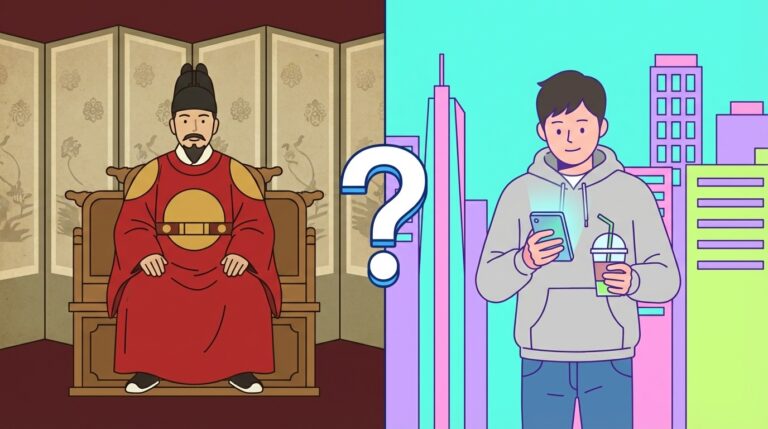
Is Your K-Drama Lying to You? Real History vs. Sageuk Fantasy
Phase 1: Immersive Hook
Greeting: 안녕하세요! Hello, Daily Hangul family! This is your Senior Editor, ready to travel back in time with you.
K-Culture Cold Open: Picture this: You are watching a hit historical drama (Sageuk). The handsome Crown Prince stares deeply into the eyes of the heroine amidst falling cherry blossoms. He whispers a poetic confession. You’re swooning, right? But hold on. If a real Joseon Dynasty historian saw this, they would probably drop their calligraphy brush in shock. “Wait, a prince talking like a modern K-Pop idol? In broad daylight? Impossible!”
The ‘Why’: We all love Kingdom, The Red Sleeve, or Mr. Queen. But relying on dramas to learn Korean history or language can be tricky. You might end up speaking like a person from the 1600s at a Gangnam café, or believing myths that never happened. Knowing the difference between “Drama Magic” and “Real History” is what separates a casual viewer from a true Korean culture insider.
Transparency: Today, we are analyzing the “Sageuk vs. Reality” gap based on questions from students who actually tried using drama lines in real life (and got laughed at!).
Phase 2: Deep Dive into Core Expressions
Here are the phrases you hear in dramas vs. what they mean for us today.
1. 성은이 망극하옵니다 (Seongeuni manggeukaomnida)
- Pronunciation: [Seong-eun-i mang-geuk-ha-om-ni-da] + Think of a very low, trembling voice bowing down.
- Meaning: Literal: “Your grace is immeasurable/infinite.” Real Nuance: “Thank you so much, your Majesty (and I am unworthy).”
- K-Culture Moment: In almost every episode, when the King grants a favor or spares someone’s life, the subjects bow until their foreheads touch the ground and shout this.
- Editor’s Insight: This is the ultimate “Thank You,” but it is only for the King. If you say this to a taxi driver who gives you a discount, you are being extremely sarcastic or trying to be a comedian.
- Situation Spectrum:
[🚫 Boss/Elders] ———— [⚠️ Friends (Joking)] ———— [🚫 Strangers]- 🤔 Think About It: Why does Korean have a specific “Thank you” just for the King? How does this reflect the absolute power structure of the Confucian Joseon society?
2. ~하옵소서 / ~하거라 (~haopsoseo / ~hageora)
- Pronunciation: [~ha-op-so-seo] / [~ha-geo-ra]
- Meaning: ~Haopsoseo: Extremely polite request (Old Korean). ~Hageora: Authoritative command to a subordinate (Old Korean).
- K-Culture Moment: The villain plotting treason whispers, “Please die, Your Majesty” (Jugeosiopsoseo). Or the King commands his guard, “Go forth!” (Gageora).
- Editor’s Insight: These are archaic sentence endings. Using ~Haopsoseo at a restaurant (“Water please-haopsoseo”) makes you sound like a time traveler. Modern Korean uses ~Juseyo or ~Sipsio.
- Situation Spectrum:
[🚫 Everyday Life] ———— [⚠️ Costume Party] ———— [✅ Historical Reenactment]- 🤔 Think About It: Modern Korean is all about efficiency, but these old endings are very long. What does the length of a phrase tell us about the formal slow pace of court life?
3. 마마 (Mama)
- Pronunciation: [Ma-ma] + Sounds like ‘Mama’ in English, but with a flat, respectful tone.
- Meaning: Literal: His/Her Highness. Real Nuance: A title attached to royalty (e.g., Jeonha for King, Jungjeon Mama for Queen).
- K-Culture Moment: Servants running frantically shouting “Mama! Big trouble!” (Mama! Keun-il nasseumnida!).
- Editor’s Insight: Do not call your Korean mother “Mama.” She is Eomma or Eomeoni. “Mama” in Korea immediately signals royalty (or smallpox in very old contexts, oddly enough!).
- Situation Spectrum:
[🚫 Your Mom] ———— [🚫 Your Boss] ———— [✅ Talking about Drama Characters]
Phase 3: Textbook vs. Real Life
How we talk about history today vs. how dramas sound.
| Situation | 📺 Sageuk Tone (Drama) | 🗣️ Real Modern Korean | 💡 Why the difference? |
|---|---|---|---|
| Apologizing | “Jukeul joereul jieot-saomnida!” (I committed a sin worthy of death!) | “Jeongmal joesonghamnida.” (I am really sorry.) | Archaic society was about life/death obedience; modern society is about politeness. |
| Yes/Agreed | “Yun-heo-ha-op-so-seo.” (Please grant permission.) | “Ne, algesseumnida.” (Yes, I understand.) | Efficiency. We don’t need royal permission to drink coffee anymore. |
| Addressing | “Mama / Daegam” (Highness / Lord) | “Sajang-nim / Seonsaeng-nim” (Boss / Teacher) | Titles changed from feudal ranks to job positions. |
Bottom Note: Unless you are acting in a play, stick to the Real Modern Korean column!
Phase 4: Cultural Deep Dive
4-1. Non-verbal: The Deep Bow (Keun-jeol)
In dramas, people perform Keun-jeol (big bow on the floor) constantly. In reality? We only do this on two occasions: Lunar New Year (Seollal) to elders, and ancestral rites (Jesa). If you do a Keun-jeol to your boss on a Monday morning, they will think you are asking for a huge loan or apologizing for a terrible mistake.
4-2. K-Drama Connection: The “Romantic King” Trope
Drama fans often think Joseon Kings were romantic lovers like in The Red Sleeve.
* Drama: King ignores politics to chase his first love.
* History: The King’s schedule was brutal. He woke up at 5 AM, studied all day, met officials, and “meeting the Queen” was a scheduled official duty, not a date. Public displays of affection (PDA) were strictly forbidden.
* Critical View: Dramas humanize historical figures to make them relatable, but they often erase the strict Confucian constraints they lived under.
Phase 5: Immersive Roleplay
Scenario: You are sitting in a modern Seoul café with your friend Ji-min (28, History major, loves fact-checking dramas). You are watching a clip of a new Sageuk drama on a tablet.
YOU: (Pointing at screen) Wow, the King looks so cool fighting with that sword!
Ji-min: (Laughs) 야, 저거 다 거짓말이야. (Ya, jeogeo da geojinmariya.) Hey, that’s all a lie.
YOU: Really? But he is shouting “Come at me!” so heroically.
Ji-min: Kings rarely fought on the front lines like that. And look at his hair! It’s too perfect.
🔀 Decision Point: How do you respond?
A) “But he said ‘Seong-eun-i mang-geuk-ha-om-ni-da’ to his father. That’s true, right?”
B) “Jona, please forgive me-haopsoseo!” (Imitating the drama tone)
C) “Why do you hate fun, Ji-min? It’s just a show.”
✅ Best Choice: A – Shows you are distinguishing language from action. Ji-min will explain that the language is somewhat accurate, but the action is fantasy.
⚠️ Choice B Analysis: This is funny and Ji-min will laugh, but it’s a “joke” response. Good for bonding, but confirms you know it’s silly.
Ji-min: (Responding to A) Yeah, the language is okay. But that sword skill? No way.
Phase 6: 10-Second Shadowing Drill
Let’s practice the difference between Drama Tone and Reality.
1. The Drama Way (Melodramatic & Serious) 😠
“네 죄를 / 네가 / 알렸다!”
(Ne joereul / nega / allyeot-da!)
“Do you know / your own / sin?!” (Sound like a judge!)
2. The Reality Way (Polite & Calm) 😐
“혹시 / 제가 / 실수했나요?”
(Hoksi / jega / silsu-haennayo?)
“By any chance, / did I / make a mistake?”
Phase 7: K-Culture Mini Glossary
| Word | Romanization | Meaning | Context |
|---|---|---|---|
| 사극 | Sageuk | Historical Drama | Dramas set in the past (usually Joseon or Goryeo). |
| 퓨전 사극 | Fusion Sageuk | Fusion Historical Drama | Shows like Alchemy of Souls that mix history with fantasy/modern vibes. |
| 한복 | Hanbok | Traditional Clothes | The colorful dress worn in dramas. |
| 궁 | Gung | Palace | E.g., Gyeongbokgung, Changdeokgung. |
| 세자 | Seja | Crown Prince | The male lead character usually called this. |
Phase 8: Traveler’s Survival Kit (Palace Edition)
Since we are talking about history, you will likely visit a Palace in Seoul.
🆘 Survival Expression #1
– 🇰🇷 “한복 입으면 무료예요?” (Hanbok ibeumyeon muryoyeyo?)
– 🗣️ Sounds like: Han-bok ee-beu-myeon moo-ryo-ye-yo?
– Meaning: “Is it free if I wear Hanbok?”
– 📍 Where: Ticket booth at Gyeongbokgung Palace.
– 💡 Pro Tip: Yes! Wearing Hanbok gets you free entry to major palaces in Seoul. It’s the best way to feel like a drama character without speaking like one.📌 Editor’s Travel Note
– Rentals: There are hundreds of Hanbok rental shops near Gyeongbokgung. Pick a “Traditional” style for a classic look, or “Fusion” style for sparkles.
– Shoes: Wear comfortable sneakers under the skirt/pants. You will walk a lot on dirt paths!
Phase 9: Critical Thinking — “Think Deeper”
Media vs. Reality:
Many global fans fall in love with Korea through Sageuk. But these dramas often reflect modern desires more than past realities. For example, modern Sageuk features strong, independent female characters who challenge the King. While inspiring, historical records show women in the Joseon court had extremely limited freedom.
🧠 Think Deeper: Does knowing the harsh reality of history spoil the fun of the drama, or does it make you appreciate how much society has changed?
💬 Your Turn: Does your country have historical dramas? Do they tell the truth, or do they “Hollywood-ize” history? Share in the comments!
Phase 10: FAQ & Troubleshooting
Q: Can I use “Gongju-nim” (Princess) to call my girlfriend?
A: Maybe… in a very cheesy, playful context. But if you say it in front of others, everyone will cringe (their fingers will curl up!). It implies you treat her like a spoiled child or you are overly obsessed.
Q: Why do characters in dramas call the King “Jeonha” but sometimes “Mama”?
A: It’s complex! Jeonha is specific to the King. Mama is a suffix for royalty (Queen = Jungjeon Mama). Think of it like “Your Majesty” vs. “Highness.”
❌ Common Mistake #1: Bowing like a Sageuk character (hands hidden in sleeves, deep bow) at a convenience store.
✅ Fix: Just a slight nod of the head is enough for modern greetings!
Phase 11: Wrap-up & Action Items
One-Liner: Sageuk is for entertainment, not for history class—enjoy the romance, but leave the archaic language in the Joseon Dynasty!
Action Missions:
– 🥉 Bronze: Stand before a mirror and practice the “Reality Way” of asking if you made a mistake (from Phase 6).
– 🥈 Silver: Watch your favorite Sageuk episode and count how many times they say “Mama.” (It will be dozens!).
– 🥇 Gold: Visit a Korean palace (or a virtual tour online) and take a photo imagining you are the King/Queen, but caption it with modern Korean slang!
Phase 12: Interactive Quiz
1. Which phrase should you use to apologize to your Korean boss?
– A) Seong-eun-i mang-geuk-ha-om-ni-da.
– B) Jukeul joereul jieot-saomnida.
– C) Joesonghamnida.
2. True or False?
– You should bow until your head touches the floor when you meet a Korean elder for the first time. (True / False)
3. Situation Check:
– You are at Gyeongbokgung Palace wearing Hanbok. You want to ask for a ticket. You say: “I command thee to give me a ticket!” (Geu pyo-reul nae-ge da-o!). Is this appropriate?
– (Yes / No / Only if you want the ticket seller to laugh at you)
(Answers: 1-C, 2-False [Just a polite bow is fine], 3-No [Use modern polite Korean: Pyo juseyo])
Frequently Asked Questions (FAQ)
Q: What does "성은이 망극하옵니다 (Seongeuni manggeukaomnida)" mean in Korean and how do you pronounce it?
A: In Korean, "성은이 망극하옵니다 (Seongeuni manggeukaomnida)" is pronounced [Seong-eun-i mang-geuk-ha-om-ni-da] and means: Literal: "Your grace is immeasurable/infinite." Real Nuance: "Thank you so much, your Majesty (and I am unworthy)."
Q: What does "~하옵소서 / ~하거라 (~haopsoseo / ~hageora)" mean in Korean and how do you pronounce it?
A: In Korean, "~하옵소서 / ~하거라 (~haopsoseo / ~hageora)" is pronounced [~ha-op-so-seo] and means: ~Haopsoseo: Extremely polite request (Old Korean). ~Hageora: Authoritative command to a subordinate (Old Korean).
Q: What does "마마 (Mama)" mean in Korean and how do you pronounce it?
A: In Korean, "마마 (Mama)" is pronounced [Ma-ma] and means: Literal: His/Her Highness. Real Nuance: A title attached to royalty (e.g., Jeonha for King, Jungjeon Mama for Queen).







