

Winter Magic in Your Pocket: How to Enjoy Korean Roasted Chestnuts (Gunbam)
Phase 1: The Immersive Hook 🌰
안녕하세요! This is your Daily Hangul Editor.
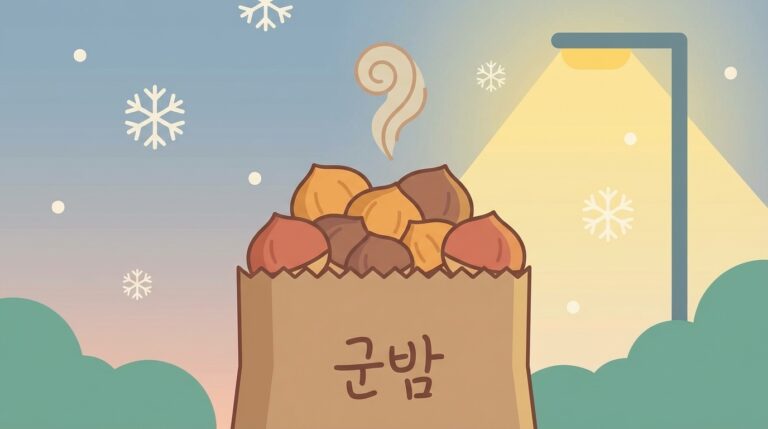
Imagine this: It’s a freezing December night in Seoul. You’re walking near Myeongdong station, your hands are numb from the cold, and suddenly, a sweet, nutty aroma hits your nose. You see a small truck with a spinning machine and a warm yellow light.
In K-Dramas, this is the classic moment where the main characters stop to buy Gunbam (군밤 – Roasted Chestnuts). They blow on their hands, peel the hot nuts for each other, and create a romantic memory. But wait—have you ever tried to peel a hot chestnut while looking graceful? It’s harder than it looks!
If you don’t know the right words, you might end up burning your fingers or missing out on the extra “Service” (freebie) the vendor wants to give you. Today, let’s learn the survival Korean for the ultimate winter street snack.
(Transparency Note: This guide is based on real struggles my students faced when trying to navigate Korean street food vendors for the first time!)
Phase 2: Deep Dive into Key Expressions 🧠
Here are the 3 essential expressions you need for your Gunbam adventure.
1. 뜨거워요 (Tteu-geo-wo-yo)
- Pronunciation: [Tteu-geo-wo-yo]
Sound Analogy: “Tteu” sounds like the disgust sound you make when you step in gum, followed by “Go-Away-Yo”.- Meaning: It’s hot (to the touch).
- K-Culture Moment: You will hear this in every K-Food eating show (Mukbang). The host takes a bite of steaming food and waves their hand in front of their mouth saying, “Ah! Tteugeowoyo!”
- Editor’s Insight: 🚨 Crucial Warning: Do not confuse this with “The weather is hot” (Deowoyo). If you say “Tteugeowoyo” about the weather, people will look at you strangely. This word is only for objects (food, pans, water).
- Situation Spectrum:
[🚫 Formal Speech] ———— [⚠️ Polite/Standard] ———— [✅ Casual]
Use “Tteugeowoyo” safely with vendors and strangers (⚠️).- 🤔 Think About It: Why does Korean distinguish between “hot weather” and “hot objects” while English uses one word? How does this reflect the Korean focus on sensory details?
2. 까다 (Kka-da)
- Pronunciation: [Kka-da]
Sound Analogy: Like a crow sound “Caw” + “Da”.- Meaning: To peel / To crack open.
- K-Culture Moment: In variety shows, you often see games where idols have to “Kka-da” boiled eggs or chestnuts as fast as possible.
- Editor’s Insight: You use this for fruits with skins (oranges, bananas) and nuts. In slang, it can also mean “to diss/criticize someone,” but let’s stick to chestnuts today!
- Situation Spectrum:
[🚫 Boss] ———— [⚠️ Stranger] ———— [✅ Friends]
“Kka-juseyo” (Please peel it for me) is polite.- 🤔 Think About It: In many Western cultures, street food is ready-to-eat. In Korea, some foods (like Gunbam or shrimp) require effort (peeling) before eating. Does this effort make the food taste better?
3. 호호 불다 (Ho-ho bul-da)
- Pronunciation: [Ho-ho bul-da]
- Meaning: To blow on food to cool it down.
- K-Culture Moment: The iconic “Ho-ho” sound is so associated with winter snacks that a famous bun is called “Hoppang” (Bread you blow on).
- Editor’s Insight: This isn’t just a verb; it’s a cultural mannerism. Eating loud, hot food quickly is a skill!
Phase 3: Textbook vs. Real Life 🗣️
| Situation | 📖 Textbook Korean | 🗣️ Real Street Korean | 💡 Why the difference? |
|---|---|---|---|
| Asking price | 이거 가격이 얼마입니까? (How much is the price of this?) |
이거 얼마예요? (How much is this?) |
Street food is casual. Formal sentences feel stiff and awkward here. |
| It’s too hot | 온도가 매우 높습니다. (The temperature is very high.) |
아, 진짜 뜨거워! (Ah, really hot!) |
Reactions to pain or sensation are usually short and emotional. |
| Giving thanks | 대단히 감사합니다. (Thank you very much.) |
많이 파세요! (Sell a lot!) |
This is a special greeting for vendors, wishing them business success. |
💡 Bottom Note: “많이 파세요” (Mani pa-se-yo) is the ultimate insider phrase. If you say this instead of just “Gamsahamnida,” the vendor will love you!
Phase 4: Cultural Deep Dive 🇰🇷
4-1. The Art of “Nunchi” (Non-verbal cues)
When eating Gunbam, don’t eat the yellow skin if it’s stuck! Watch the locals. They might use their front teeth to scrape the nut out, or use their fingers. If you see a pile of shells nearby, that’s your trash can. Do not throw shells on the street—Korean streets are clean for a reason!
4-2. K-Food Connection: The “Service” Culture
If you buy a bag of chestnuts and the vendor suddenly tosses 3-4 extra nuts into your bag with a smile, don’t panic! You didn’t buy extra.
This is Service (서비스). It’s a gesture of “Jeong” (affection/connection).
Think Deeper: Why do Korean vendors give free food? It’s not just marketing; it’s about building a human connection, even for a brief transaction.
Phase 5: Immersive Roleplay 🎭
Setting: A snowy evening in Insadong. Steam is rising from a street cart. The smell of roasted nuts is everywhere.
Characters:
* YOU: A hungry traveler craving a warm snack.
* Aju-meo-ni (Auntie Vendor): Wearing a thick puffy jacket and a visor.
Start Dialogue:
Aju-meo-ni: 어서 오세요! 군밤 드실래요? 🌰
(Eoseo oseyo! Gunbam deusillaeyo?)
(Welcome! Would you like some roasted chestnuts?)
YOU: 네, 냄새가 너무 좋아요. 이거 얼마예요?
(Ne, naemsaega neomu joayo. Igeo eolmayeyo?)
(Yes, the smell is so good. How much is this?)
Aju-meo-ni: 한 봉지에 5천 원이에요. 따뜻할 때 드세요.
(Han bongji-e o-cheon won-ieyo. Ttatteuthal ttae deuseyo.)
(It’s 5,000 won for one bag. Eat them while they are warm.)
(🎭 Stage Direction: She hands you a paper bag. It feels burning hot!)
🔀 Decision Point: How do you react?
- A) Scream “Hot!” in English and drop the bag.
- B) Say “Ah! Tteugeowoyo!” and juggle the bag between your hands.
- C) Say “Gamsahamnida” and put it directly in your pocket.
✅ Best Choice: B
Showing a natural reaction like “Ah! Tteugeowoyo!” (It’s hot!) makes you relatable. The vendor might even laugh and say, “Ho-ho bul-eo deuseyo” (Blow on it and eat).
⚠️ Why not C? Putting a steaming hot bag in your pocket might burn you! Cool it down first.
Phase 6: 10-Second Shadowing Drill 📢
Practice this sentence to describe your snack perfectly.
“Winter roasted chestnuts are really hot but tasty!”
겨울 군밤은 / 진짜 뜨거운데 / 맛있어요!
(Gyeoul gunbameun / jinjja tteugeounde / masisseoyo!)
- 😊 Emotion: Excited and happy (because it’s delicious).
- 🎵 Intonation: Go UP on “Tteugeounde” (hot but…), and land softly on “Masisseoyo”.
Phase 7: K-Culture Mini Glossary 📖
| Korean | Romanization | Meaning | Context |
|---|---|---|---|
| 군밤 | Gunbam | Roasted Chestnuts | A classic winter street snack. |
| 포장마차 | Pojangmacha | Street Stall | The tented carts selling food and drinks. |
| 현금 | Hyeon-geum | Cash | Essential for street food. Cards are often not accepted. |
| 계좌이체 | Gyejwa-iche | Bank Transfer | If you have no cash, locals use this (but hard for tourists). |
| 덤 | Deom | Extra/Freebie | A small extra amount given out of kindness. |
Phase 8: Traveler’s Survival Kit 🧳
When buying Gunbam or any street food, keep these in mind!
🆘 Survival Expression TOP 3
- “이거 맵나요?” (Igeo maem-nayo?)
- Is this spicy? (Important for other snacks nearby!)
- “휴지 있어요?” (Hyuji isseoyo?)
- Do you have a tissue? (Your hands WILL get dirty peeling chestnuts.)
- “계좌이체 돼요?” (Gyejwa-iche dwaeyo?)
- Can I do a bank transfer? (Use only if you have a Korean bank app.)
📌 Editor’s Travel Note:
Cash is King! Always carry 1,000 won and 5,000 won bills in winter. You never know when you’ll meet a Gunbam truck or a Bungeoppang (fish bread) stand. They rarely take credit cards.
Phase 9: Think Deeper — Food & Identity 🧠
Why do we share a single bag?
In Korea, you will rarely see someone buying a bag of Gunbam and eating it all alone while walking with friends. The bag is placed in the middle, or the buyer offers a chestnut to everyone in the group. This is the concept of “Woori” (Us/We). Food isn’t just fuel; it’s a social glue. Even a small chestnut is meant to be shared.
💬 Your Turn: In your country, is it common to share street food with friends, or does everyone buy their own? Tell us in the comments!
Phase 10: FAQ & Troubleshooting 🛠️
- Q: Can I eat the chestnut skin?
- A: No! The hard shell is inedible. Sometimes the inner thin skin sticks—that’s okay to eat, but it might be bitter. Peel it as much as you can.
- Q: Is it rude to eat while walking?
- A: In crowded areas like Myeongdong, it’s fine. But generally, older Koreans prefer stopping to eat. For Gunbam, since you have to peel it, it’s safer to stop!
- ❌ Common Mistake: Throwing the shells on the ground.
- ✅ Fix: Ask the vendor, “Sseuregi eodi-eyo?” (Where is the trash?) or carry a small plastic bag with you.
Phase 11: Wrap-up & Action Mission 🚀
Summary: Today we learned how to say “It’s hot” (Tteugeowoyo), how to peel (Kka-da), and that carrying cash is essential for winter snacks.
Your Mission:
* 🥉 Bronze: Look in the mirror and practice the “Ho-ho” blowing face while saying “Tteugeowoyo!”
* 🥈 Silver: Watch a YouTube video of “Korean Street Food Gunbam” and listen for the machine sounds.
* 🥇 Gold: If you are in Korea, find a Gunbam truck. Buy a bag and say “Mani paseyo!” (Sell a lot) when you leave.
K-Culture Mission:
Search for the song “Roasted Chestnuts” (Gunbam Taryeong). It’s a very famous traditional Korean folk song. The rhythm is catchy!
Phase 12: Quiz — Interactive Challenge 🧩
1. Which phrase should you use if the chestnut burns your finger?
* A) Deowoyo! (The weather is hot!)
* B) Tteugeowoyo! (It’s hot to touch!)
* C) Chuwoyo! (It’s cold!)
2. True or False?
* “If a vendor gives you extra chestnuts, they made a mistake and you should return them.”
* (True / False)
3. Situation: You finished eating, and you have shells in your hand. What do you do?
* A) Drop them on the street.
* B) Ask for a trash bin or put them in your pocket/bag.
🔑 Answers:
1. B (A is for weather/air).
2. False (It’s “Service”! Enjoy the love).
3. B (Keep the streets clean!).
Frequently Asked Questions (FAQ)
Q: What does "뜨거워요 (Tteu-geo-wo-yo)" mean in Korean and how do you pronounce it?
A: In Korean, "뜨거워요 (Tteu-geo-wo-yo)" is pronounced [Tteu-geo-wo-yo] and means: It's hot (to the touch).
Q: What does "까다 (Kka-da)" mean in Korean and how do you pronounce it?
A: In Korean, "까다 (Kka-da)" is pronounced [Kka-da] and means: To peel / To crack open.
Q: What does "호호 불다 (Ho-ho bul-da)" mean in Korean and how do you pronounce it?
A: In Korean, "호호 불다 (Ho-ho bul-da)" is pronounced [Ho-ho bul-da] and means: To blow on food to cool it down.







