

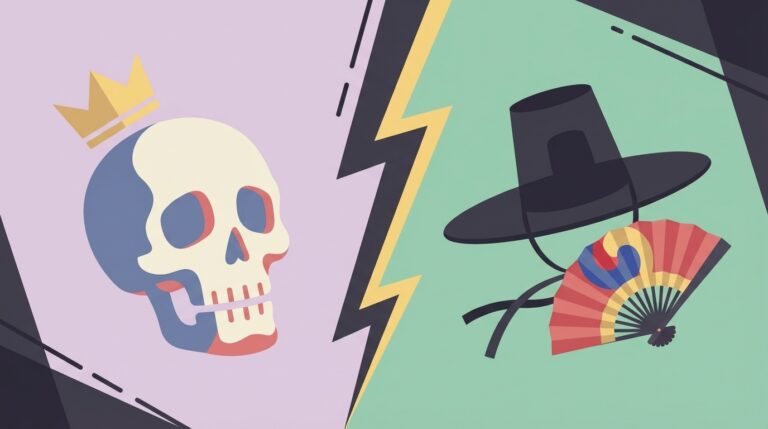
Phase 1: Immersive Hook — The “Han” of Hamlet
안녕하세요! This is your Daily Hangul Editor.
Picture this: You are watching a K-Drama finale. The protagonist, after 16 episodes of struggle, stands in the pouring rain. They aren’t just crying; they are wailing with a deep, guttural sound that seems to tear their soul apart. The subtitles might just say “(Sobbing)”, but every Korean viewer feels a specific, heavy emotion weighing down the screen.
Is it just sadness? No. Is it anger? Not exactly.
In Western literature, we look to Shakespeare’s tragedies—Hamlet, Macbeth, Othello, King Lear—to understand the depths of human suffering. In Korea, we look at “Han (한)”.
Today, we are bridging the gap between the Globe Theatre and Gwanghwamun. We will analyze the “Big 4” Shakespearean tragedies through the lens of high-level Korean vocabulary (C1). Knowing these terms won’t just help you discuss literature; it will help you understand the soul of Korean storytelling, from historical sageuk dramas to the lyrics of Pansori.
Ready to get a little tragic? Let’s dive in.
Phase 2: Deep Dive — The Vocabulary of Tragedy
1. 고뇌 (Gonoe)
- Pronunciation: [go-noe] (Sounds like ‘go’ + ‘no’ with a short ‘eh’ at the end)
- Meaning: Agony / Anguish / Deep existential distress
- Context: This isn’t for when you can’t decide what to eat for lunch. This is Hamlet’s territory. It implies a mental struggle involving deep philosophical or moral pain.
- K-Culture Moment: In the movie The Throne (사도), King Yeongjo feels deep gonoe before locking his son in the rice chest. It’s the face the CEO makes in a drama when he must choose between saving the company or his family.
- Editor’s Insight: Use this when the suffering is internal and intellectual. “To be or not to be” is the ultimate expression of gonoe.
- Situation Spectrum:
[🚫 Casual Chat] ———— [⚠️ Serious Debate] ———— [✅ Literature/Formal] - 🤔 Think About It: Why does Korean distinguish between physical pain (고통) and mental anguish (고뇌)? Does your language make this distinction so clearly?
2. 파국 (Paguk)
- Pronunciation: [pa-guk] (Sounds forceful: ‘Pa’ like ‘Papa’, ‘guk’ like ‘kook’)
- Meaning: Catastrophe / Ruin / A tragic end
- Context: Perfect for Macbeth or King Lear. It refers to a situation breaking down completely, usually due to a fatal flaw or event.
- K-Culture Moment: The famous meme from the drama Goblin (Dokkaebi) where the villain screams, “파국이다!” (It is ruin!). It’s used when a situation has passed the point of no return.
- Editor’s Insight: It literally means “broken board” (like a chessboard overturned). It’s a very dramatic word.
- Situation Spectrum:
[🚫 Ordering Food] ———— [⚠️ Describing a failed project] ———— [✅ Discussing plots]
3. 인과응보 (Ingwa-eungbo)
- Pronunciation: [in-gwa-eung-bo]
- Meaning: Causal Retribution / Poetic Justice / Karma
- Context: The core theme of Macbeth and Othello. You reap what you sow.
- K-Culture Moment: Every villain in a Makjang drama (soap opera) eventually faces ingwa-eungbo. Korean audiences crave this moment (often called “Cider” because it feels refreshing).
- Editor’s Insight: This is a Saja-seong-eo (4-character idiom). Using this instantly upgrades your Korean level to “Intellectual.”
- 🤔 Think About It: In Shakespeare, tragedy often comes from a “Fatal Flaw” (Hamartia). In Korean culture, tragedy often comes from failing relationships or destiny (Palja). How does Ingwa-eungbo fit into both?
Phase 3: Textbook vs. Real Life
| Situation | 📖 Textbook Korean | 🗣️ Real Korean (C1 Level) | 💡 Why the difference? |
|---|---|---|---|
| Describing a sad ending | 슬픈 결말이었어요. (It was a sad ending.) | 완전 새드 엔딩이었어. / 먹먹한 결말이었어. | “Mokmok-han” (stifled/heavy heart) describes the physical sensation of grief better than just “sad.” |
| Talking about betrayal | 그가 배신했어. (He betrayed.) | 믿는 도끼에 발등 찍혔어. (Axed by a trusted axe.) | Koreans love proverbs to soften the blow or add imagery to the betrayal. |
| Describing a crazy plot | 이야기가 말이 안 돼. (The story makes no sense.) | 완전 막장이야. (It’s a total makjang.) | “Makjang” is the specific cultural term for chaotic, unrealistic tragic plots (like soap operas). |
💡 Bottom Note: At a C1 level, don’t just say “sad” (슬프다). Use words like 비극적 (tragic), 처절한 (desperate/gruesome), or 허무한 (futile/empty) to describe Shakespearean endings.
Phase 4: Cultural Context — Nunchi and Tragedy
4-1. The Tragedy of No Nunchi
If we analyze King Lear through a Korean lens, Cordelia’s tragedy wasn’t just honesty; it was a lack of Nunchi (눈치) and Hyo (효 – Filial Piety).
In Korea, telling a harsh truth to an elder (even if you are right) can be seen as a character flaw. A Korean King Lear would expect his daughter to read the room (Atmosphere) and offer a “white lie” to save his face (Chemyon). Cordelia’s refusal to play the social game led to Paguk (Ruin).
4-2. Han (한) vs. Anger
Othello’s jealousy turns into rage. But in Korean tragedy, characters often develop Han. It is an internalized sense of injustice and unresolved grief that knots up in the stomach. When you discuss Shakespeare with Koreans, try comparing Hamlet’s hesitation not to cowardice, but to the overwhelming weight of Han regarding his father’s death.
Phase 5: Immersive Roleplay — The Book Club Debate
Setting: A quiet book café in Yeonnam-dong on a rainy Sunday. Jazz music is playing softly. You are discussing Macbeth with your Korean friend, Jisoo (30, Literature Major, intense personality).
Characters:
– YOU: A foreign literature enthusiast who loves Korean history.
– Jisoo: Passionate about comparing Western and Eastern classics.
(Dialogue)
Jisoo: 맥베스는 결국 자신의 야망 때문에 파멸한 거잖아. 전형적인 인과응보라고 생각해.
(Macbeth-neun gyeolguk jasin-ui yamang ttaemune pamyeolhan geojana. Jeonhyeong-jeogin ingwa-eungbo-rago saeng-gak-hae.)
(Macbeth was ruined by his own ambition in the end. I think it’s typical poetic justice.)
YOU: (Nodding thoughtfully) 맞아요. 하지만 부인의 역할도 컸다고 봐요.
(Majayo. Hajiman buin-ui yeokhal-do keotdago bwayo.)
(True. But I think his wife played a big role, too.)
Jisoo: 그렇지. 레이디 맥베스의 죄책감… 그게 진짜 비극이지. 손을 씻어도 씻기지 않는 피라니.
(Geureotji. Lady Macbeth-ui joechaekgam… geuge jinjja biguek-iji. Son-eul ssiseodo ssitgiji anneun pirani.)
(Right. Lady Macbeth’s guilt… that is the real tragedy. Blood that won’t wash off even if you wash your hands.)
🔀 Decision Point: How do you respond to the theme of guilt?
Option A: “She went crazy in the end.” (Too simple for C1)
Option B: “Her mental agony (gonoe) eventually led to her destruction.” (Perfect C1 usage)
Option C: “That’s just like the drama Penthouse!” (Fun, but risky if the mood is serious)
YOU (Choosing B): 그녀의 고뇌가 결국 그녀를 파괴한 거죠. 양심의 가책을 이길 수 없었으니까요.
(Geunyeo-ui gonoe-ga gyeolguk geunyeo-reul pagoehan geojyo. Yangsim-ui gachaek-eul igil su eopseosseunikkayo.)
(Her mental agony eventually destroyed her. Because she couldn’t overcome the pangs of conscience.)
Jisoo: (Impressed) 와, ‘양심의 가책’이라는 표현을 아네요? 정확해요.
(Wow, you know the expression ‘pangs of conscience’? Exactly.)
Phase 6: 10-Second Shadowing Drill
Let’s practice a line you can use when discussing a tragic ending or a difficult life situation. Focus on the emotional weight.
“비극은 / 끝이 아니라 / 새로운 시작일지도 몰라요.”
Pronunciation: Biguek-eun / kkeut-i anira / saeroun sijak-iljido mollayo.
Translation: Tragedy / might not be the end / but a new beginning.
Emotion: 😟 Melancholic but hopeful (Try to sound philosophical)
Phase 7: K-Culture Mini Glossary
| Korean | Romanization | Meaning | Context |
|---|---|---|---|
| 막장 | Makjang | Extreme/Crazy Plot | Used for dramas with adultery, birth secrets, and revenge. Modern Shakespeare? |
| 신파 | Shinpa | Tear-jerker | Stories designed specifically to make you cry (often excessive). |
| 해피 엔딩 | Happy Ending | Happy Ending | Koreans use the English term directly. |
| 권선징악 | Gwonseon-jingak | Good triumphs over evil | The opposite of tragedy, often the standard ending for Korean folk tales. |
Phase 8: Traveler’s Survival Kit — The “Palace” Edition
While this lesson is about literature, you will encounter these “Tragedy” terms when visiting Korean Palaces (Gung) where real historical tragedies occurred (like Prince Sado at Changgyeonggung).
🆘 Survival Expression for Culture Lovers
– 🇰🇷 “여기에 슬픈 역사가 있나요?” (Yeogi-e seulpeun yeoksa-ga innayo?)
– 🗣️ Meaning: “Is there a sad history here?”
– 📍 Where: Palaces, Museums, Memorial Halls.
– 💡 Pro Tip: Korean tour guides LOVE telling the tragic backstory of kings. Asking this will get you the premium storytelling experience.
Phase 9: Critical Thinking — “Han” vs. “Angst”
🧠 Think Deeper:
Western “Angst” is often about individual anxiety and dread about the world. Korean “Han” (한) is collective and relational—it’s sorrow caused by injustice, oppression, or unfulfilled duty to others.
When Hamlet hesitates, is it Angst (fear of action) or Han (grief for his father and anger at his mother)? How does interpreting Hamlet through “Han” change your view of his madness?
💬 Your Turn: Does your culture have a word for “sorrow that stays in your bones”? Tell us in the comments!
Phase 10: FAQ & Troubleshooting
Q: Can I use “파국 (Catastrophe)” when I drop my ice cream?
A: You can as a joke (hyperbole), but it’s very dramatic. It’s like saying “This is my doom” when you spill water. People will laugh, but know it’s an exaggeration.
❌ Common Mistake: Confusing 복수 (Revenge) with 보복 (Retaliation).
– 복수 (Boksu): Can be personal, emotional, and epic (Hamlet style).
– 보복 (Bobok): Usually political, military, or petty (Tit-for-tat).
– Fix: If talking about Shakespeare or K-Dramas, use 복수.
Phase 11: Wrap-up & Action Mission
Summary: Today we explored the heavy hitters of Korean emotion: 고뇌 (Agony), 파국 (Ruin), and 인과응보 (Karma) through the lens of Shakespeare.
🎬 Action Missions:
– 🥉 Bronze: Say “이건 비극이야 (This is a tragedy)” when you see a sad scene in a movie today.
– 🥈 Silver: Watch a clip of the Korean movie The Throne (사도) on YouTube and identify the moment of 고뇌 (Agony) on the King’s face.
– 🥇 Gold: Explain the plot of Romeo and Juliet to a Korean friend using the word “파국 (Ruin/Catastrophe)”.
Phase 12: Interactive Quiz
1. Which word best describes the ending of Macbeth where the villain gets punished?
– A) 해피 엔딩 (Happy Ending)
– B) 인과응보 (Ingwa-eungbo)
– C) 신파 (Shinpa)
2. Fill in the blank: “Hamlet’s endless thinking is a sign of his deep ______.”
– A) 눈치 (Nunchi)
– B) 고뇌 (Gonoe)
– C) 회식 (Hoesik)
3. True or False: You should use “파국이다!” seriously when you are slightly late for a meeting.
– (True / False)
Answers: 1. B (Poetic Justice/Karma), 2. B (Agony), 3. False (That’s too dramatic! Use ‘망했다’ instead).
Frequently Asked Questions (FAQ)
Q: What does "고뇌 (Gonoe)" mean in Korean and how do you pronounce it?
A: In Korean, "고뇌 (Gonoe)" is pronounced [go-noe] and means: Agony / Anguish / Deep existential distress
Q: What does "파국 (Paguk)" mean in Korean and how do you pronounce it?
A: In Korean, "파국 (Paguk)" is pronounced [pa-guk] and means: Catastrophe / Ruin / A tragic end
Q: What does "인과응보 (Ingwa-eungbo)" mean in Korean and how do you pronounce it?
A: In Korean, "인과응보 (Ingwa-eungbo)" is pronounced [in-gwa-eung-bo] and means: Causal Retribution / Poetic Justice / Karma







