

Phase 1: Immersive Hook
Greeting: 안녕하세요! This is your Daily Hangul Senior Editor, back with another deep dive into the Korean psyche.
The K-Drama Cold Open: Picture this common K-Drama scene: The hardworking protagonist sits alone at a convenience store (pyeoneijeom), staring at their banking app on their phone. They let out a deep sigh. The screen shows their salary came in just yesterday, but the balance is already nearing zero. They mutter, “월급이 스쳐 지나가네…” (My salary just breezed past me…).
Have you ever felt this in Korea? You work hard, but after paying rent (wolse), transport, and one too many iced Americanos, your bank account feels like a hollow shell. In Korea, we jokingly call an empty bank account a ‘텅장’ (Teong-jang)—a pun combining ‘통장’ (bank book) and ‘텅 비다’ (to be empty).
Today, we aren’t just learning words; we are tackling a survival skill. We’re going to master “통장 쪼개기” (Tongjang Jjogaegi)—the art of account splitting. This is the C2-level financial strategy that separates the ‘financially literate’ from the ‘perpetually broke’ in Seoul.
This isn’t just about money; it’s about discipline, future planning, and understanding the intense pressure of the Korean housing market that drives this obsession with efficiency.
Phase 2: Deep Dive into Core Expressions
1. 통장 쪼개기 (Tongjang Jjogaegi)
- Pronunciation: [Tong-jang Jjo-gae-gi] Sounds like ‘Tong-jang’ (Bank book) + ‘Jjo-gae-gi’ (Splitting/Cracking open)
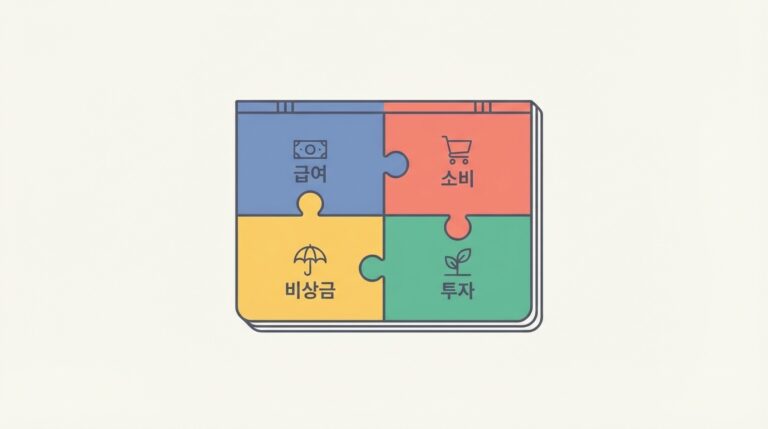
- Meaning: Literal: Splitting bank books / Real Nuance: The strategic allocation of funds into four distinct accounts (Salary, Consumption, Emergency, Investment) to prevent overspending.
- K-Culture Moment: On variety shows like I Live Alone, you often see celebrities visiting the bank to reorganize their finances. The banker will sternly suggest, “Customer, you need to start tongjang jjogaegi immediately.”
- Editor’s Insight: The verb 쪼개다 (jjogaeda) is visceral. You aren’t just ‘dividing’ (나누다); you are splitting or breaking down the lump sum to assert control over it. It implies an active, almost aggressive management style.
- Situation Spectrum:
[🚫 Formal Reports] ———— [✅ Semi-formal/Casual]
(In a formal banking report, use ‘자금 분산 관리’ (Diversified Fund Management). In conversation, use ‘통장 쪼개기’.)- 🤔 Think About It: Why does Korea use the word “Tongjang” (Paper Bank Book) even though everyone uses apps? The physical booklet is still a powerful symbol of financial stability in the Korean psyche.
2. 선저축 후지출 (Seon-jeochuk Hu-jichul)
- Pronunciation: [Seon-jeo-chuk Hu-ji-chul]
- Meaning: Literal: First Saving, After Spending / Real Nuance: Pay yourself first. The golden rule of Korean personal finance.
- K-Culture Moment: Listen to interviews with K-Pop idols who bought buildings. They often credit their parents or financial advisors who enforced this rule: “Whatever comes in, 70% goes to savings immediately.”
- Editor’s Insight: This follows the Sino-Korean structure often found in four-character idioms (Saja-seong-eo). ‘Seon’ (First/Pre) and ‘Hu’ (After/Post) are powerful prefixes. Using this phrase makes you sound incredibly disciplined and educated.
- Situation Spectrum:
[✅ Formal/Advice] ———— [✅ Self-talk]3. 비상금 (Bisang-geum)
- Pronunciation: [Bi-sang-geum]
- Meaning: Literal: Emergency Gold/Money / Real Nuance: Emergency Fund (or Secret Stash).
- K-Culture Moment: In family dramas, the husband often hides his bisang-geum inside a book or under the floorboards, only for the wife to find it. In a financial context, it’s the safety net (CMA account) for unexpected medical bills or weddings.
- Editor’s Insight: While officially ‘emergency fund,’ in casual conversation, bisang-geum implies money that is “untouchable” until absolutely necessary.
- 🤔 Think About It: Why is cash liquidity so valued in Korea? Perhaps it stems from the rapid economic changes (IMF crisis) where cash was king and credit was dangerous.
Phase 3: Textbook vs. Real Life
| Situation | 📖 Textbook Korean | 🗣️ Real Korean (Insa Style) | 💡 Why the difference? |
|---|---|---|---|
| Spending too much | 돈을 너무 많이 썼어요. (I spent too much money.) | “지름신이 강림했어.” (The God of Spending descended upon me.) | Koreans personify the impulse to buy as a ‘deity’ to humorously deflect blame. |
| Saving money | 돈을 아껴야 해요. (I must save money.) | “오늘부터 숨만 쉬고 산다.” (From today, I only breathe and live.) | Hyperbole is key in Korean humor to express desperation. |
| Investment Goal | 집을 사고 싶어요. (I want to buy a house.) | “내 집 마련의 꿈…” (The dream of preparing my own house…) | Owning a home is treated as a distant, sacred ‘dream’ due to high real estate prices. |
💡 Editor’s Note: At C2 level, try using “소비 통제” (Consumption Control) instead of just “saving.” It sounds more proactive and strategic.
Phase 4: Cultural Deep Dive — The “Salty” Reality
4-1. The Rise of “Jjan-tech” (짠테크)
In recent years, a new term has emerged: 짠테크 (Jjan-tech). It combines 짠돌이 (penny-pincher/salty person) and 재테크 (financial technology/investment). It refers to extreme frugality not out of poverty, but as a strategic choice to survive high inflation.
- Non-verbal Cue: When discussing Jjan-tech, you might see Koreans making a resolute fist gesture, symbolizing holding onto money tight.
4-2. K-Culture Connection: The “Fangirl” Savings Account
Even in Tongjang Jjogaegi, passion has a place. Many K-Pop fans have a specific account labeled “덕질 통장” (Deok-jil Tongjang – Fandom Activity Account).
- Critical Perspective: While older generations saved for survival, the younger generation (MZ) saves for experience. They will eat convenience store ramyeon for weeks (Jjan-tech) to afford a VIP concert ticket (Flex). This dichotomy defines modern Korean consumption.
Phase 5: Immersive Roleplay Scenario
Setting: A quiet Izakaya in Yeouido (Korea’s financial district), Friday, 8:00 PM. You are having drinks with Min-su (34, Finance Manager at a major firm, very realistic).
Characters:
* YOU: An expat professional earning a decent salary but unable to save.
* Min-su: Your financially savvy Korean friend who owns an apartment.
(The Dialogue)
YOU: 민수야, 나 진짜 이해가 안 돼. 월급 받은 지 일주일 지났는데 벌써 잔고가 바닥이야.
(Min-su-ya, na jinjja ihaega an dwae. I barely got paid a week ago, and the balance is already hitting rock bottom.)
Min-su: (Sipping sake calmly) 너 혹시 급여 통장에서 바로 카드 대금 나가게 해뒀어?
(Did you set it up so your credit card bill goes straight out of your salary account?)
YOU: 응, 당연한 거 아니야? 귀찮잖아.
(Yeah, isn’t that obvious? It’s a hassle otherwise.)
Min-su: 그러니까 돈이 안 모이지. 통장 쪼개기 안 했구나? 급여 통장은 그냥 ‘스쳐 지나가는’ 정거장일 뿐이야.
(That’s why you can’t save. You haven’t done ‘account splitting’, have you? The salary account should just be a ‘bus stop’ where money briefly passes through.)
YOU: 정거장? 그럼 어떻게 해야 하는데?
(A bus stop? Then what should I do?)
Min-su: 일단 소비 통장을 따로 만들어. 그리고 월급 들어오자마자 선저축 후지출! 강제로 70%는 다른 통장으로 보내버려.
(First, make a separate consumption account. And as soon as the salary hits, save first, spend later! Forcibly send 70% to other accounts.)
🔀 Decision Point: How do you respond to this harsh advice?
- A) “70%나요? 그럼 나 굶어 죽으라는 거야?” (React with shock/hyperbole – Natural reaction)
- B) “오, 좋은데? 당장 은행 가야겠다.” (Too enthusiastic/Unrealistic)
- C) “역시… 금융맨은 다르네. 한 수 배워갑니다.” (Respectful flattery – Socially smart)
✅ Best Choice: C) Acknowledging his expertise strokes his ego and will likely lead to him buying this round of drinks. A is also acceptable for close friends.
Phase 6: 10-Second Shadowing Drill
Let’s practice the golden rule. Say this with determination (😤), as if you are making a New Year’s resolution.
🇰🇷 월급이 들어오면 / 무조건 반은 뚝 떼서 / 저축부터 해야 해!
(Wolgeubi deureoomyeon / mujogeon baneun ttuk tteseo / jeochukbuteo haeya hae!)Meaning: When the salary comes in / unconditionally cut off half / and you must save it first!
- Focus: Emphasize ‘무조건’ (unconditionally) and ‘뚝’ (sound of snapping/cutting) to show resolve.
Phase 7: K-Culture Mini Glossary
| Korean | Romanization | Meaning | Context |
|---|---|---|---|
| 재테크 | Jae-tech | Investment/Finance | A portmanteau of 재무 (Finance) + Technology. |
| 자동이체 | Jadong-iche | Automatic Transfer | The engine of account splitting. Essential banking vocab. |
| 영끌 | Yeong-kkeul | All-in investing | Short for “Pulling together even your soul” to buy a house/stock. |
| 소확행 | So-hwak-haeng | Small but certain happiness | Buying a small treat (coffee, stickers) because a house is too expensive. |
| 가심비 | Ga-sim-bi | Price-to-heart ratio | Buying something not because it’s cheap/efficient, but because it satisfies your heart. |
Phase 8: Traveler’s & Expat’s Survival Kit
Even if you aren’t opening 4 accounts, you need to handle money in Korea. Here is the Pro-Level Banking Kit.
🆘 Survival Phrases for the Bank
* 🇰🇷 “입출금 통장 하나 만들려고 왔어요.” (I came to open a deposit/withdrawal account.)
* 🇰🇷 “체크카드에 후불 교통카드 기능 넣어주세요.” (Please add the postpaid transport card function to my debit card.) -> Crucial for expats!
* 🇰🇷 “인터넷 뱅킹 한도(limit)를 높이고 싶어요.” (I want to raise my online banking transfer limit.)📌 Editor’s Note: The ‘Certificates’ Nightmare
To do online banking in Korea, you will face the 공동인증서 (Joint Certificate). It is a digital ID file. Keep this file on a USB or your phone’s secure folder. Losing it is a headache you do not want to experience.
Phase 9: Think Deeper — “Why the Obsession?”
Topic: The “Yeong-kkeul” (Soul-Pulling) Phenomenon
Why are young Koreans so obsessed with Jae-tech and Tongjang Jjogaegi? It’s not just greed. It’s fear. The term 영끌 (Yeong-kkeul)—pulling even your soul to scrape together money—reflects the despair regarding real estate prices in Seoul. For many, a salary alone is no longer enough to secure a future.
Learning these terms allows you to understand the underlying anxiety in modern Korean society. When your Korean colleague sighs looking at their phone, they aren’t just being dramatic; they are navigating a high-pressure economic reality.
💬 Your Turn: In your country, is real estate considered the only “real” success? How do young people feel about buying a home? Let me know in the comments!
Phase 10: FAQ & Troubleshooting
Q: Can I use the word ‘짠돌이’ (Penny-pincher) to my boss if he saves money?
A: 🚫 NO. ‘짠돌이’ has a slightly negative nuance of being stingy. Use “검소하시네요” (You are frugal/thrifty) instead. That is a compliment.
Q: Is it rude to talk about stocks/money at dinner?
A: ✅ Surprisingly, No. In the past, it was taboo. But nowadays, discussing stocks (주식) and coins (코인) is a very common ice-breaker among friends and even colleagues. It shows you are ‘awake’ to reality.
❌ Common Mistake: Confusing 신용카드 (Credit Card) and 체크카드 (Debit/Check Card).
* Koreans use ‘Card’ for both. But for budgeting, stick to the Check Card (money leaves account immediately). If you say “Card,” people assume Credit Card.
Phase 11: Wrap-up & Action Mission
One-Liner Summary: Efficient Korean finance starts with Tongjang Jjogaegi and the discipline of Seon-jeochuk Hu-jichul.
🚀 Action Mission:
* 🥉 Bronze: Look at your bank app and sigh, saying “Logeueu-in… Teong-jang-ine…” (Login… it’s an empty account…)
* 🥈 Silver: Go to a Korean bank (or app) and set up one ‘Auto-transfer’ (Jadong-iche) to a savings pot.
* 🥇 Gold: Use the phrase “요즘 숨만 쉬고 살아요” (I’m only breathing these days to save money) when a Korean friend asks why you haven’t traveled lately.
K-Culture Mission: Watch a clip of the show <Kim Saeng-min’s Receipt> (김생민의 영수증) on YouTube. It’s a show where a host roasts people’s spending habits. Try to catch the word “Stupid!” or “Great!”
Phase 12: Interactive Quiz
- Situational Judgment: Your friend suggests going to a very expensive Omakase dinner. You are practicing Tongjang Jjogaegi. What is the most witty, “Insa” way to decline?
- A) 돈이 없습니다. (Too dry)
- B) 이번 달은 ‘거지방’ 모드라서 안 돼. 떡볶이 먹자. (Correct! Referring to ‘Beggar’s Room’ – an open chat trend where people scold each other for spending.)
- C) 너 미쳤어? (Too rude)
- True or False: The word ‘가계부’ (Household account book) is only used by housewives in their 50s.
- False! Many Gen Z Koreans use ‘Gagyebu’ apps to track every penny for their ‘Jjan-tech’ goals.
(Scroll down for answers)
Answers: 1. B, 2. False
Frequently Asked Questions (FAQ)
Q: What does "통장 쪼개기 (Tongjang Jjogaegi)" mean in Korean and how do you pronounce it?
A: In Korean, "통장 쪼개기 (Tongjang Jjogaegi)" is pronounced [Tong-jang Jjo-gae-gi] and means: Literal: Splitting bank books / Real Nuance: The strategic allocation of funds into four distinct accounts (Salary, Consumption, Emergency, Investment) to prevent overspending.
Q: What does "선저축 후지출 (Seon-jeochuk Hu-jichul)" mean in Korean and how do you pronounce it?
A: In Korean, "선저축 후지출 (Seon-jeochuk Hu-jichul)" is pronounced [Seon-jeo-chuk Hu-ji-chul] and means: Literal: First Saving, After Spending / Real Nuance: Pay yourself first. The golden rule of Korean personal finance.
Q: What does "비상금 (Bisang-geum)" mean in Korean and how do you pronounce it?
A: In Korean, "비상금 (Bisang-geum)" is pronounced [Bi-sang-geum] and means: Literal: Emergency Gold/Money / Real Nuance: Emergency Fund (or Secret Stash).







