

Phase 1: Immersive Hook (공감)
Hello! This is your Daily Hangul Editor. 👋
Picture this: You are in Hongdae, surrounded by the cutest stickers, neon pens, and pastel notebooks at a giant Artbox or Kyobo Hottracks. It’s K-Stationery heaven. You want to buy a specific eraser to fix a mistake in your Korean textbook, but you can only find 50 different types of pens.
In a K-Drama, this is the moment the handsome main character reaches over your shoulder and grabs it for you. 😍 But in reality? You’re standing there, lost.
You need to ask the staff. But how? If you stay silent, you leave empty-handed. If you know this one magic pattern, you become the master of the store.
Today, we aren’t just learning words; we are unlocking the K-Culture survival skill of “asking for existence.” Let’s dive in!
Phase 2: Deep Dive (핵심 표현 심층 분석)
Here are the 3 essential phrases to survive a Korean stationery store.
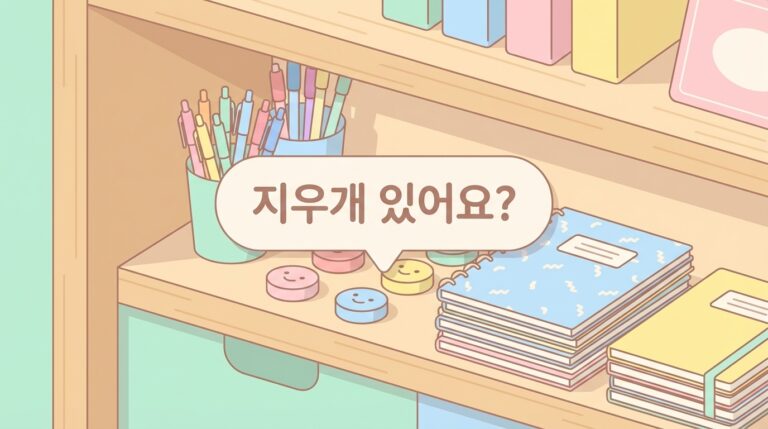
1. [지우개 있어요?]
- Pronunciation: [Ji-u-gae i-sseo-yo?]
- Ji (like Gee whiz) + u (like ooh) + gae (like game)
- i-sseo-yo (sounds like “E-saw-yo”?)
- Meaning: Do you have an eraser? (Literal: Eraser exists?)
- K-Culture Moment: Think of a K-Pop fan meeting. Fans often ask staff, “Poster isseoyo?” (Do you have posters?) The structure is identical!
- Editor’s Insight: The verb 있어요 (isseoyo) is magic. You can put any noun before it. Coffee isseoyo? Kimchi isseoyo? BTS album isseoyo?
- Situation Spectrum:
[🚫 Formal Biz] ———— [⚠️ Polite/Daily] ———— [✅ Friends]
- Used with strangers/staff: ✅ (Perfectly polite)
- Used with close friends: ⚠️ (Drop the ‘yo’ for friends -> Isseo?)
- 🤔 Think About It: Why does Korean focus on the existence of the object (“Does an eraser exist?”) rather than the person having it (“Do you have an eraser?”)? It puts the focus on the object, not the person!
2. [이거 얼마예요?]
- Pronunciation: [I-geo eol-ma-ye-yo?]
- I-geo (like Eagle without ‘le’)
- Eol-ma (like Wal-mart without ‘W’ and ‘rt’)
- Meaning: How much is this?
- K-Culture Moment: Every shopping scene in a variety show involving a traditional market!
- Editor’s Insight: If you don’t know the name of the item, just point and say this phrase. It is the ultimate survival tool.
3. [봉투 주세요]
- Pronunciation: [Bong-tu ju-se-yo]
- Meaning: Please give me a bag.
- Editor’s Insight: In Korea, plastic bags are not free (usually 50-100 KRW) due to environmental laws. The clerk will often ask you about this first. If you need one, say this!
Phase 3: Textbook vs. Real Life (교과서 vs 진짜 한국어)
| Situation | 📖 Textbook Korean | 🗣️ Real Korean | 💡 Why different? |
|---|---|---|---|
| Asking for an item | 지우개 있습니까? (Jiugae itseumnikka?) | 지우개 있어요? (Jiugae isseoyo?) | “-mnikka” is military/news anchor style. Too stiff for a cute shop! |
| Searching | 지우개를 찾고 있습니다. (I am looking for an eraser.) | (Showing picture on phone) 이거 있어요? | Koreans value speed (Pali-pali culture). Showing a picture is faster. |
| Paying | 영수증을 주세요. (Give me a receipt.) | 영수증은 됐어요. (Receipt is done/fine.) | Most people nowadays throw away receipts immediately. “됐어요” implies “No thanks.” |
Bottom Note: As an A1 learner, stick to “Item + Isseoyo?” It works 100% of the time without being rude.
Phase 4: Cultural Deep Dive (문화적 맥락)
4-1. The Art of “Daku” (다꾸)
Have you heard of 다꾸 (Dakku)? It is short for Da-ieo-ri Kku-mi-gi (Diary Decorating).
In Korea, going to a stationery store isn’t just about buying school supplies. It’s a hobby. K-Pop fans buy stickers to decorate their “top loaders” (plastic cases for photocards). This is why Korean stationery stores are massive and full of cute characters. When you ask “Sticker isseoyo?”, you are participating in a huge subculture!
4-2. Non-verbal Tip: The “Two Hands” Rule
When you pay or receive your receipt/card:
– Don’t: Snatch it with one hand.
– Do: Use one hand, but support your elbow/wrist with the other hand.
– Why? It shows respect. Even a slight nod helps!
Phase 5: Immersive Roleplay (실전 시나리오)
Setting: Inside Artbox in Myeongdong. It’s crowded, K-Pop music is playing loudly. You found a cute notebook, but you can’t find a pen.
Characters:
– YOU: A foreign student looking for a black pen.
– Clerk: A part-time worker (wearing a red vest), busy stocking shelves.
Dialogue:
YOU: (Approaching the clerk) 저기요… 검은색 펜 있어요?
(Jeogiyo… geomeun-saek pen isseoyo?)
(Excuse me… do you have a black pen?)
Clerk: 네, 저쪽에 있어요.
(Ne, jeojjog-e isseoyo.)
(Yes, it’s over there.)
(🎭 Stage Direction: Clerk points to the aisle behind you)
YOU: 아! 감사합니다.
(Ah! Gamsahamnida.)
(Ah! Thank you.)
(You grab the pen and go to the counter)
Clerk: 봉투 필요하세요?
(Bongtu piryo-haseyo?)
(Do you need a bag?)
🔀 Decision Point: What do you say?
- A) “네, 주세요.” (Ne, juseyo – Yes, please.)
- B) “아니요, 괜찮아요.” (Aniyo, gwaenchanayo – No, it’s okay.)
- C) “No.” (English)
✅ Best Choice: B (If you have a backpack). It saves money and the environment.
⚠️ Choice C Analysis: They will understand, but trying in Korean makes them smile!
Phase 6: 10-Second Shadowing Drill
Listen to the rhythm! Korean is not flat; it has waves.
- 🤔 Curious: 지우개 / 있어요? (Ji-u-gae / i-sseo-yo?)
- 😲 Surprised at price: 너무 / 비싸요! (Neo-mu / bi-ssa-yo!) -> Too expensive!
- 😊 Happy: 이거 / 주세요! (I-geo / ju-se-yo!) -> Please give me this!
Phase 7: K-Culture Mini Glossary
| Korean | Romanization | English | Context |
|---|---|---|---|
| 문구점 | Mungujeom | Stationery Store | The holy land for students and decorators. |
| 다꾸 | Dakku | Diary Decorating | A massive trend involving stickers and washi tape. |
| 품절 | Pumjeol | Sold Out | The saddest word you can see on a shelf. |
| 득템 | Deuk-tem | Rare Item Get | Slang for finding something great/cheap. |
| 직원 | Jigwon | Staff/Employee | The person you ask “Isseoyo?” to. |
Phase 8: Traveler’s Survival Kit
Stationery stores are the best places to buy cheap, high-quality souvenirs (pens, stickers, socks).
🆘 Survival Card: Buying Souvenirs
– 🇰🇷 “이거 인기 많아요?” (Igeo ingi manayo?)
– 🗣️ Meaning: Is this popular?
– 📍 Where: Artbox, Olive Young, Convenience Stores.
– 💡 Pro Tip: If you see a tag saying “BEST” or “HOT”, just buy it. Koreans follow trends closely, so those items are usually good quality.📌 Editor’s Travel Note:
Most large bookstores (Kyobo, Youngpoong) have huge stationery sections. If you spend over 30,000 KRW, bring your passport! You can get an Immediate Tax Refund right at the counter.
Phase 9: Think Deeper (한 발 더 깊이)
Topic: The “Ask Culture” vs. “Search Culture”
In many Western stores, customers try to find things themselves to avoid bothering staff. In Korea, we have a strong “Ask Culture.” Stores are crowded, and inventory changes fast (Pali-pali!). Asking “Where is it?” or “Do you have it?” immediately is seen as efficient, not rude. The staff expects you to ask!
🧠 Think Deeper:
Does asking for help feel uncomfortable to you? In Korean culture, quick interaction is valued over independent searching. How does this compare to shopping in your country?
Phase 10: FAQ & Troubleshooting
Q: Can I use “Isseoyo?” for people?
A: Yes! “Jennie isseoyo?” (Is Jennie here?). It works for things and people.
Q: What if I can’t pronounce the item name?
A: Just use “Igeo” (This) + “Isseoyo?” while showing a picture. It is the ultimate cheat code.
❌ Common Mistake #1: Saying “You” (Dangsin) to the staff.
✅ Fix: Just say “Jeogiyo” (Excuse me) to get attention. Never use “Dangsin” in a store.
Phase 11: Wrap-up & Action Items
One-Liner: To buy anything in Korea, you just need the Noun + Isseoyo? pattern!
🚀 Your Mission:
– 🥉 Bronze: Look at your desk. Pick 3 items and ask “[Item] isseoyo?” out loud.
– 🥈 Silver: Go to a Korean website (like Gmarket or Coupang), search for an item, and type “[Item] 있어요?” in the search bar just to see the hangul.
– 🥇 Gold: Go to a Korean mart or stationery store in your city. Ask the staff “Kimchi isseoyo?” or “Pen isseoyo?”
✨ K-Culture Mission:
Watch a “What’s in my pencil case” (필통 소개) video on YouTube by a Korean student. Count how many times they say “이거” (Igeo)!
Phase 12: Interactive Quiz
1. You are in a store. You want to ask if they have a “notebook” (gongchaek). What do you say?
– A) Gongchaek juseyo. (Give me a notebook.)
– B) Gongchaek isseoyo? (Do you have a notebook?)
– C) Gongchaek annyeong? (Hello notebook?)
2. True or False?
– In Korea, plastic bags are always free. (T/F)
3. Situation Check:
– The staff asks: “Bongtu piryo-haseyo?” (Do you need a bag?). You have a backpack and don’t want to pay extra. You say:
– “Aniyo, gwaenchanayo.” (No, it’s okay.)
Answers:
1. B (A is for buying, B is for checking existence)
2. False (They cost money!)
3. Correct!
Frequently Asked Questions (FAQ)
Q: What does "[지우개 있어요?]" mean in Korean and how do you pronounce it?
A: In Korean, "[지우개 있어요?]" is pronounced [Ji-u-gae i-sseo-yo?] and means: a key conversational Korean expression covered in this lesson.
Q: What does "[이거 얼마예요?]" mean in Korean and how do you pronounce it?
A: In Korean, "[이거 얼마예요?]" is pronounced [I-geo eol-ma-ye-yo?] and means: a key conversational Korean expression covered in this lesson.
Q: What does "[봉투 주세요]" mean in Korean and how do you pronounce it?
A: In Korean, "[봉투 주세요]" is pronounced [Bong-tu ju-se-yo] and means: Please give me a bag.







