

Phase 1: The “Sold Out” Nightmare – Are You Ready?
Hello! This is your Daily Hangul Editor.
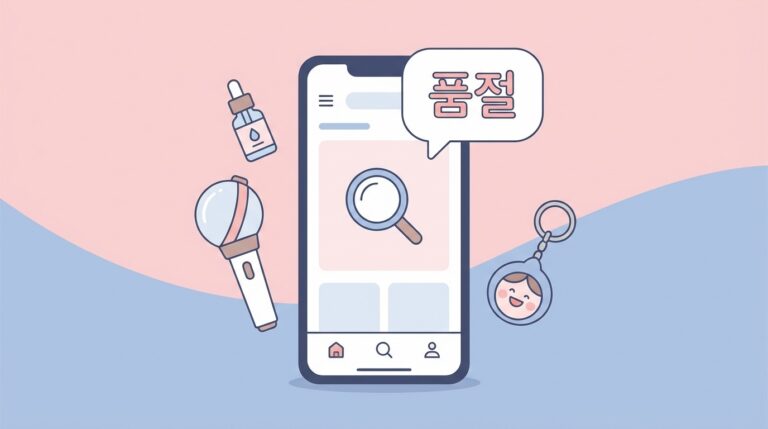
Picture this: You just saw your favorite K-Pop idol wearing a specific hoodie in a dance practice video. You rush to a Korean online store (or run into a shop in Hongdae), type in the brand name in English, and… nothing. Or worse, you see the dreaded text: ‘품절’ (Poomjeol – Sold Out).
Searching for products in Korea isn’t just about typing words; it’s a speed game. Whether you are hunting for limited edition merch on Weverse Shop or trying to find that viral toner at Olive Young, knowing exactly how to ask and what to type determines whether you get the goods or go home empty-handed.
Today, we aren’t just learning vocabulary; we are learning how to secure your K-treasures before anyone else.
Phase 2: Core Expressions Deep Dive
Here are the three weapons you need for your shopping cart.
1. ~ 있어요? (Is there / Do you have…?)
- Pronunciation: [~ is-seo-yo?]
- Sound Analogy: ‘Is’ like Island + ‘seo’ like Saw + ‘yo’ like Yo-yo.
- Meaning: Do you have…? / Is there…?
- K-Culture Moment: Think of a scene in a K-Drama where the main character runs into a convenience store late at night. They don’t say “I wish to purchase water.” They pant and ask, “물 있어요?” (Do you have water?)
- Editor’s Insight: This is the Swiss Army Knife of Korean. You can use it for objects (“Kimchi isseoyo?”) or even people (“Manager isseoyo?”).
- Situation Spectrum:
[🚫 Formal Meetings] ———— [⚠️ Polite] ———— [✅ Casual/Shopping]- (Perfect for talking to store clerks or messaging sellers online.)
- 🤔 Think About It: Why is the subject “you” or “I” omitted? In Korean, if the context is obvious (we are in a store), we skip the pronouns to be efficient.
2. ~ 찾고 있어요 (I am looking for…)
- Pronunciation: [~ chat-go is-seo-yo]
- Sound Analogy: ‘Chat’ like Chatroom + ‘Go’.
- Meaning: I am in the middle of looking for…
- K-Culture Moment: You enter a cosmetics store, and a staff member approaches you aggressively (friendly, but intense!). Instead of panicking, you calmly say, “립스틱 찾고 있어요” (I’m looking for lipstick).
- Editor’s Insight: This shows you have a purpose. It stops the clerk from recommending random items and makes them lead you to exactly what you want.
3. 이거랑 같은 거 (The same one as this)
- Pronunciation: [igeorang gateun geo]
- Meaning: The same thing as this.
- Usage: You show a picture of Blackpink’s Jennie on your phone to the clerk. You point to her hairpin and say this phrase.
- Situation Spectrum:
[🚫 Writing Essays] ———— [⚠️ Daily Life] ———— [✅ Shopping]
Phase 3: Textbook vs. Real Life
| Situation | 📖 Textbook Korean | 🗣️ Real Korean | 💡 Why is it different? |
|---|---|---|---|
| Asking for an item | “이 화장품을 사고 싶습니다.” (I want to buy this cosmetic.) | “이거 있어요?” (Do you have this?) | Koreans value speed. “Buying” is implied; availability is the real question. |
| Online Search | “무료 배송 상품” (Free shipping product) | “무배” (Mu-bae) | Online, everything is abbreviated to save typing time. |
| Asking the price | “가격이 얼마입니까?” (What is the price?) | “얼마예요?” (How much?) | Full sentences sound like a news anchor. Keep it short. |
Bottom Note: Don’t try to be too formal in a bustling market or online chat. It creates distance!
Phase 4: Cultural Deep Dive — The Art of “Son-min-su”
4-1. Non-verbal: The “Phone Thrust”
In Korea, it is 100% acceptable to walk into a store, say nothing immediately, and show the clerk a screenshot on your phone. In fact, clerks love this because it saves time. Don’t worry about grammar; just prepare your screenshot!
4-2. K-Culture Connection: What is “Son-min-su” (손민수)?
Originally a character from the webtoon/drama Cheese in the Trap who copied the main character’s style, the term “손민수하다” (to Son-min-su) has been reclaimed by K-Pop fans.
- Context: If you buy the same hat your bias (favorite idol) wore at the airport, you are “doing Son-min-su.”
- Usage: “I want to Son-min-su Jungkook’s kombucha!” (meaning: I want to buy it because he drank it).
🧠 Critical Thinking: Why do Koreans love following trends so quickly? Unlike some individualistic cultures, Korean culture values ‘shared experiences’ (gong-gam). Buying what is popular is a way to feel connected to the current social wave.
Phase 5: Immersive Roleplay – The Olive Young Mission
Setting: It’s Saturday afternoon at a crowded Olive Young (Korean beauty store) in Myeongdong. K-Pop hits are blasting. You are holding your phone with a picture of a viral sunscreen.
Characters:
* YOU: A smart shopper trying to find the item before your flight.
* Staff (Unnie): wearing a headset, moving very fast.
Dialogue:
Staff: (Brightly) 어서오세요! 찾으시는 거 있으세요?
(Eoseo-oseyo! Chajeusineun geo isseuseyo?)
(Welcome! Is there something you are looking for?)
YOU: (Showing phone screen)
네, 이거 있어요?
(Ne, igeo isseoyo?)
(Yes, do you have this?)
Staff: 아! 잠시만요. (Checks the shelf) 죄송해요, 이거 품절이에요.
(Ah! Jamsimanyo… Joesonghaeyo, igeo poomjeol-ieyo.)
(Ah! One moment… I’m sorry, this is sold out.)
🔀 DECISION POINT: How do you react?
- A) “아… 네, 알겠습니다.” (Ah… okay, understood.) → You leave sadly.
- B) “비슷한 거 있어요?” (Do you have something similar?) → Smart shopper move!
- C) “언제 들어와요?” (When does it come in?) → Determined local vibe.
✅ Best Choice: B or C. If you choose B, the staff will immediately show you the #2 best-seller. If you choose C, you might find out it arrives tomorrow!
Phase 6: 10-Second Shadowing Drill
Let’s practice the “magic phrase” for finding things. Repeat this while imagining showing your phone screen.
- Emotion: 🥺 Desperate (I really need this!)
- Sentence: 혹시 / 이거랑 / 똑같은 거 / 있어요?
- Romanization: Hoksi / igeorang / ttok-gateun geo / isseoyo?
- Meaning: By any chance / this one / the exact same thing / do you have?
Phase 7: K-Culture Mini Glossary
| Korean | Romanization | Meaning | Context |
|---|---|---|---|
| 품절 | Poomjeol | Sold Out | The word you hate seeing the most on shopping apps. |
| 최저가 | Choejeoga | Lowest Price | Koreans always sort search results by this. |
| 배송 | Baesong | Delivery | Korean delivery is world-famous for speed (often 1 day). |
| 1+1 | One-plus-one | Buy 1 Get 1 | Pronounced “won-ppeul-won”. Crucial for convenience store shopping. |
| 득템 | Deuk-tem | Great Find | Slang for getting a good item (Item + Get). |
Phase 8: Traveler’s Survival Kit
When you are physically in a store or browsing a Korean app, keep these handy.
🆘 Survival Card: Finding Products
- 🇰🇷 “이거 찾아주세요.” (Igeo chaja-juseyo)
- “Please find this for me.” (Use when showing a photo).
- 🇰🇷 “사이즈 있어요?” (Sai-jeu isseoyo?)
- “Do you have the size?”
- 💡 Pro Tip: In Korean search bars (Naver/Coupang), specific model numbers often work better than English product names. If you can, copy-paste the Korean name of the product from a translation app.
Phase 9: Think Deeper — The Culture of “Palli-Palli”
The Speed of Desire: Why is delivery so fast?
When you search for products in Korea, you will often see “새벽 배송” (Dawn Delivery) — order by midnight, arrive by 7 AM. This reflects Korea’s ‘Palli-palli’ (Hurry, hurry) culture. It’s not just about impatience; it’s about efficiency and the intense competitive nature of Korean society. If a seller is slow, they lose.
💬 Your Turn: In your country, is 2-day delivery considered fast or slow? How does delivery speed affect your shopping habits?
Phase 10: FAQ & Troubleshooting
- Q: Can I use “Isseoyo?” to an elder?
- A: Yes, because it ends in ‘~yo’, it is polite enough for most service interactions. For very formal situations, ‘iss-eushin-gayo?’ is used, but as a foreigner, ‘isseoyo’ is perfectly safe.
- Q: I searched in English on a Korean app, but no results.
- A: Many Korean apps (like Coupang or Baemin) don’t have perfect English indexing. Try searching the brand name in English first, but if that fails, you must use the Korean spelling (Hangul). Use Papago to translate the keyword first.
❌ Common Mistake: Saying “Where is [item]?” (“[Item] eodi-eyo?”) to a clerk.
✅ Better: While understandable, “[Item] eodi-eyo?” asks for the location. “[Item] isseoyo?” (Do you have…?) is more natural because if they don’t have stock, knowing the location doesn’t help!
Phase 11: Wrap-up & Action Mission
One-Liner: To find anything in Korea, just show the picture and ask “Igeo isseoyo?”
🎯 Action Mission:
* 🥉 Bronze: Say “~ isseoyo?” three times while looking for items in your room.
* 🥈 Silver: Go to a Korean online store (like Global Olive Young or Yes24) and practice typing simple Korean keywords like ‘로션’ (Lotion) or ‘앨범’ (Album).
* 🥇 Gold: Find an item your favorite Korean celebrity uses (Son-min-su item!) and find its Korean price using a search engine.
Phase 12: Interactive Quiz
- Situation: You are at a convenience store. You want to know if they have banana milk. What do you say?
- a) Banana uyu chaja-juseyo.
- b) Banana uyu isseoyo?
- c) Banana uyu annyeonghaseyo?
- True or False: When searching online in Korea, “1+1” means you get one extra item for free.
(Scroll down for answers)
.
.
.
Answers:
1. b) “Chaja-juseyo” (Please find it) is okay, but “Isseoyo?” is the standard way to ask availability.
2. True. It is the holy grail of Korean shopping!
Frequently Asked Questions (FAQ)
Q: What does "~ 있어요? (Is there / Do you have...?)" mean in Korean and how do you pronounce it?
A: In Korean, "~ 있어요? (Is there / Do you have...?)" is pronounced [~ is-seo-yo?] and means: a key conversational Korean expression covered in this lesson.
Q: What does "~ 찾고 있어요 (I am looking for...)" mean in Korean and how do you pronounce it?
A: In Korean, "~ 찾고 있어요 (I am looking for...)" is pronounced [~ chat-go is-seo-yo] and means: a key conversational Korean expression covered in this lesson.
Q: What does "이거랑 같은 거 (The same one as this)" mean in Korean and how do you pronounce it?
A: In Korean, "이거랑 같은 거 (The same one as this)" is pronounced [igeorang gateun geo] and means: The same thing as this.







