

Phase 1: The Immersive Hook
Greeting: 안녕하세요! This is your Daily Hangul Editor, reporting not from a desk, but mentally from the rocky trails of Bukhansan!
K-Culture Cold Open: Picture this scene. You’re on the Seoul subway line 3 on a Sunday morning. Suddenly, a wave of neon colors floods the carriage. It looks like a K-Pop idol group’s costume closet exploded, but no—it’s the Ajummas and Ahjussis (middle-aged men and women) geared up for their weekly hike. In K-Dramas like Work Later, Drink Now, hiking isn’t just exercise; it’s where secrets are spilled over cucumber slices and business deals are sealed with Makgeolli (rice wine).
The ‘Why’: Hiking in Korea is less about conquering nature and more about social belonging. If you don’t understand the dynamics of a Sanakhoe (산악회 – Hiking Club), you’re missing out on half the conversation. You might think they are just walking, but they are actually engaging in a complex ritual of sharing food, showing off gear, and building Jeong (affection/bond).
Transparency: Today’s lesson comes from my own experience of accidentally joining a local hiking club and realizing I was the only one without a $300 windbreaker. Let’s get you ready so you don’t make the same mistake!
Phase 2: Deep Dive into Expressions
Here are the three phrases that will make you sound like a veteran hiker (even if your legs are shaking).
1. [정상 찍고 내려옵시다]
- Pronunciation: [Jeongsang jjik-go naerye-opsida] + (Sounds like: Jong-sang like a gong ringing, jjik-go like taking a picture/stamping)
- Meaning:
- Literal: Let’s stamp the summit and come down.
- Real Nuance: Let’s hit the peak quickly and get to the real main event (lunch/drinking).
- K-Culture Moment: In reality shows like I Live Alone, you often see celebrities rushing to the peak just to take that “proof shot” (inyjeung-shot) for Instagram. The word 찍다 (jjik-da) here implies efficiency.
- Editor’s Insight: This phrase captures the Korean “Ppalli-Ppalli” (Hurry-Hurry) culture even in leisure. Hiking is often goal-oriented.
- Situation Spectrum:
[🚫 Formal Boss] ———— [⚠️ Colleagues] ———— [✅ Hiking Buddies]
(Safe to use with the group leader to show enthusiasm)- 🤔 Think About It: Why do you think Korean hikers focus so much on “tagging” the summit rather than just enjoying the walk? Does this reflect a competitive society?
2. [장비가 장난 아니시네요]
- Pronunciation: [Jangbiga jangnan anisineyo]
- Meaning:
- Literal: Your equipment is not a joke.
- Real Nuance: Wow, your gear is professional/expensive! (The ultimate compliment).
- K-Culture Moment: You’ll see this in everyday life. Koreans take hobbies seriously. If someone buys a camera, it’s the best DSLR. If they hike, they look like they are climbing Everest.
- Editor’s Insight: 장난 아니다 (It’s no joke) is a B2/C1 essential phrase. It can be used for delicious food, hot weather, or in this case, impressive gear.
- Situation Spectrum:
[🚫 Grandfather] ———— [⚠️ Stranger] ———— [✅ Fellow Hiker]
(Use the honorific -sineyo ending to make it polite enough for strangers)- 🤔 Think About It: Is the emphasis on expensive brand-name gear (The North Face, Black Yak) purely for function, or is it a form of ‘Face’ (Chemyon) culture?
3. [뒷풀이 가셔야죠?]
- Pronunciation: [Dwit-puri gasyeo-ya-jyo?]
- Meaning:
- Literal: You have to go to the ‘after-solving’, right?
- Real Nuance: You’re coming to the after-party for food and drinks, right? (Refusal is difficult).
- K-Culture Moment: This is the K-Drama trope where the protagonist tries to go home, but the team drags them to a restaurant. 뒷풀이 (Dwit-puri) is the holy grail of Korean social life.
- Editor’s Insight: The grammar ~죠? (~jyo?) assumes the answer is “Yes.” It’s a soft pressure. The hiking is just the appetizer; the Dwit-puri is the main course.
- Situation Spectrum:
[🚫 Formal Meeting] ———— [⚠️ Elders] ———— [✅ Club Members]
(Standard polite suggestion)- 🤔 Think About It: Why is eating together after an activity considered mandatory in Korea? How does it relate to the concept of “We” (Uri)?
Phase 3: Textbook vs. Real Life
| Situation | 📖 Textbook Korean | 🗣️ Real Korean (Hiking Ver.) | 💡 Why different? |
|---|---|---|---|
| Suggesting a break | 좀 쉬었다가 가요. (Let’s rest a bit and go.) | 당 좀 충전하고 가죠! (Let’s recharge some sugar/glucose!) | Hikers focus on energy management. Giving chocolate/fruit is a love language. |
| Asking distance | 얼마나 남았어요? (How much is left?) | 다 왔어요? (Are we there yet?) | “How much” is abstract. “Are we there?” begs for hope (even if it’s a lie). |
| Encouraging | 힘내세요. (Cheer up / Strength up.) | 거의 다 왔어요! (We are almost there!) | Spoiler: It’s a lie. You are never “almost there” until you see the rock. It’s a white lie to motivate you. |
Bottom Note: If a passing hiker tells you “Geoui da wasseoyo” (Almost there), assume you have at least 30 more minutes. Trust no one on the mountain! 😂
Phase 4: Cultural Deep Dive
4-1. Non-verbal Communication: The “Sharing” Rule
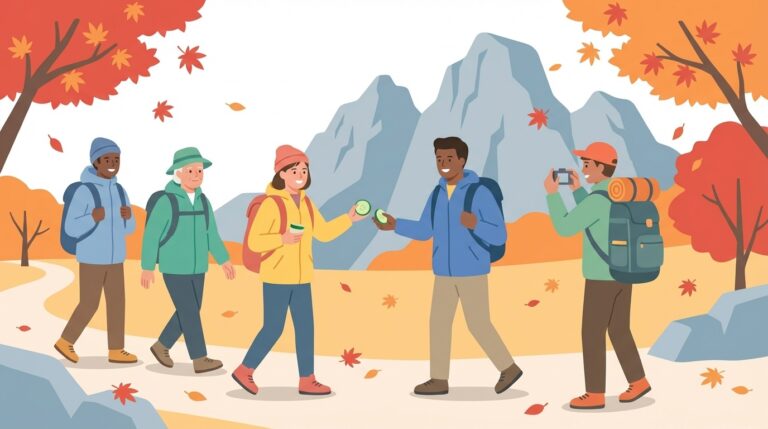
In a Sanakhoe, eating alone is almost rude. If you bring a kimbap, bring an extra one to share, or at least offer a piece. You will often see strangers handing out slices of cucumber or cherry tomatoes to people they just met.
* Gesture: When accepting food/drink on the trail, even if it’s casual, receive it with two hands (or support your right arm with your left hand) to show respect for the effort.
4-2. K-Culture Connection: K-Food (Makgeolli & Pajeon)
Why is Makgeolli (milky rice wine) the official drink of hikers? In K-Dramas, you’ll see characters descending the mountain and immediately hitting a restaurant at the base.
* The Logic: Hiking makes you sweat and thirsty. Makgeolli is cold, carbonated, and filling (it’s rice!). Paired with Pajeon (green onion pancake) or Dotori-muk (acorn jelly salad), it’s the ultimate reward.
* Critical View: The consumption of alcohol during or after hiking is huge. While fun, it poses safety risks, which is a frequent debate topic in Korean news.
Phase 5: Immersive Roleplay
Setting: Saturday, 11:00 AM. Bukhansan National Park. You are halfway up the trail, panting. You joined a “2030 Hiking Crew” (a younger, hip version of Sanakhoe). Minji (29, club leader, very energetic) approaches you.
Dialogue:
Minji: (Handing you a cucumber) 회원님, 얼굴이 너무 빨개요! 이거 드시고 힘내세요.
(Hoewonnim, eolguri neomu ppalgaeyo! Igeo deusigo himnaeseyo.)
[Member, your face is too red! Eat this and cheer up.]
(🎭 Minji smiles brightly but looks concerned)
YOU: (Taking the cucumber with two hands) 아, 감사합니다. 평소에 운동을 안 해서… 죽겠네요.
(Ah, gamsahamnida. Pyeongso-e undong-eul an haeseo… jukgenneyo.)
[Ah, thank you. I don’t exercise usually… I feel like dying.]
Minji: 에이, 엄살이 심하시네요! 장비는 완전 프로신데?
(Ei, eomsari simhasineyo! Jangbineun wanjeon peurosinde?)
[Ey, you’re exaggerating! Your gear is totally pro though?]
🔀 Decision Point! How do you respond to the compliment?
- A) “돈 좀 썼습니다. 하하.” (I spent some money. Haha.) — Honest & Confident
- B) “아니에요, 다 세일할 때 샀어요.” (No, I bought it all on sale.) — Humble & Modest
- C) “제가 좀 멋있죠?” (I’m kinda cool, right?) — Too arrogant
✅ Best Choice: B — Koreans value humility (Gyeom-son). Even if it’s a lie and you bought it yesterday at full price, downplaying the cost makes you more likeable.
Minji: 겸손하시기까지! 자, 정상이 코앞이에요. 정상 찍고 내려가서 막걸리 한잔하시죠!
(Gyeomsonhasigikkaji! Ja, jeongsang-i ko-apieyo. Jeongsang jjik-go naeryeogaseo makgeolli hanjan hasijyo!)
[You’re humble too! Okay, the peak is right in front of our noses. Let’s hit the peak and go down for a Makgeolli!]
Phase 6: 10-Second Shadowing Drill
Let’s practice the sentence you will use when you finally sit down at the restaurant after the hike.
😢 (Pain) + 🤩 (Joy) Mixed Emotion:
등산하고 먹는 / 파전이 / 진짜 / 꿀맛이네요!
(Deungsanhago meongneun / pajeoni / jinjja / kkulmasineyo!)
[The green onion pancake / eaten after hiking / is truly / honey-taste (delicious)!]
- Tip: Stretch the word “Jin-jja” (Realllllly) to emphasize the flavor.
Phase 7: K-Culture Glossary (Hiking Edition)
| Korean | Romanization | Meaning | Context |
|---|---|---|---|
| 등린이 | Deung-rin-i | Hiking Novice | A combination of Hiking (Deungsan) + Child (Eorini). Used by beginners to lower expectations. |
| 도시락 | Dosirak | Packed Lunch | Eating Kimbap or Cup Ramyun on a rock is the highlight of the trip. |
| 야호 | Yaho | Yaho! | The sound Koreans historically shouted at the peak. (Note: Nowadays often discouraged to protect wildlife!) |
| 오이 | Oi | Cucumber | The essential hiking snack in Korea for hydration. |
Phase 8: Traveler’s Survival Kit
Even if you aren’t joining a club, you will likely hike Namsan or Bukhansan while traveling.
🆘 Survival Expression #1
* 🇰🇷 “여기서 얼마나 더 가야 돼요?” (Yeogiseo eolmana deo gaya dwaeyo?)
* 🗣️ Pronunciation: [Yeo-gi-seo ol-ma-na daw ga-ya dwe-yo?]
* 📍 Use when: You think you might collapse if the peak isn’t near.
* 💡 Pro Tip: Whatever they answer, double it.📌 Editor’s Travel Note
* Apps: Use KakaoMap or Naver Map. They have detailed trail maps that Google Maps lacks.
* Etiquette: Keep to the RIGHT side of the trail. Walking on the left can cause “traffic jams” on narrow ridges.
Phase 9: Think Deeper — “Equipment & Face”
Topic: Why do Koreans dress like they are climbing the Himalayas for a 2-hour hike?
In Korea, hiking is a runway. It connects to the concept of Chemyon (Face/Social Reputation). Being well-prepared implies you are a diligent, successful person. Also, Koreans love communal trends; if everyone wears The North Face, you feel a sense of belonging by wearing it too. It’s not just consumerism; it’s a visual language of “I belong to this group.”
💬 Your Turn: In your country, do people dress up for hobbies, or is it more casual? Do you wear old t-shirts or buy new gear? Let us know!
Phase 10: FAQ & Troubleshooting
- Q: Can I wear jeans to hike in Korea?
- A: Technically yes, but you will get stared at. 😳 People might ask, “Are you okay?” It’s considered unprepared and dangerous. Wear athletic pants.
- Q: Can I drink alcohol on the mountain?
- A: NO. It is illegal to drink alcohol in National Parks (like Bukhansan/Seoraksan) and you can be fined. The Makgeolli culture happens at the restaurants at the bottom of the mountain, not the top!
❌ Common Mistake #1: Playing music on a Bluetooth speaker while hiking.
✅ Fix: Don’t be that person. Koreans value the sounds of nature (and their own gossip). Use headphones.
Phase 11: Wrap-up & Mission
Summary: Today we learned how to survive a Korean hiking club: compliment their gear, share your cucumbers, and never believe them when they say “we’re almost there.”
Action Missions:
* 🥉 Bronze: Say “장비가 장난 아니시네요” to your reflection in the mirror.
* 🥈 Silver: Go to a Korean supermarket and buy a Makgeolli. Check the label!
* 🥇 Gold: Find a hiking trail (or a park with a hill). When you reach the top/end, take a photo and caption it: “정상 찍고 갑니다!” (Hitting the peak and going!)
Phase 12: Interactive Quiz
- Situation: You are hiking and an older hiker offers you a cherry tomato. What is the best response?
- A) “No, I have my own.” (Polite refusal)
- B) Take it with one hand and eat it immediately.
- C) Take it with two hands, smile, and say “Gamsahamnida!”
- True or False (K-Culture): It is socially acceptable to refuse the “Dwit-puri” (After-party) because you are tired.
- ( ) True
- ( ) False
Answers:
1. C (Refusing food can be seen as rejecting Jeong (affection). Taking it with two hands is the polite norm.)
2. False (Technically you can, but in a club setting, it’s considered antisocial. The hike is just the commute to the party!)
Frequently Asked Questions (FAQ)
Q: What does "[정상 찍고 내려옵시다]" mean in Korean and how do you pronounce it?
A: In Korean, "[정상 찍고 내려옵시다]" is pronounced [Jeongsang jjik-go naerye-opsida] and means: Literal: Let's stamp the summit and come down.
Q: What does "[장비가 장난 아니시네요]" mean in Korean and how do you pronounce it?
A: In Korean, "[장비가 장난 아니시네요]" is pronounced [Jangbiga jangnan anisineyo] and means: Literal: Your equipment is not a joke.
Q: What does "[뒷풀이 가셔야죠?]" mean in Korean and how do you pronounce it?
A: In Korean, "[뒷풀이 가셔야죠?]" is pronounced [Dwit-puri gasyeo-ya-jyo?] and means: Literal: You have to go to the 'after-solving', right?







