

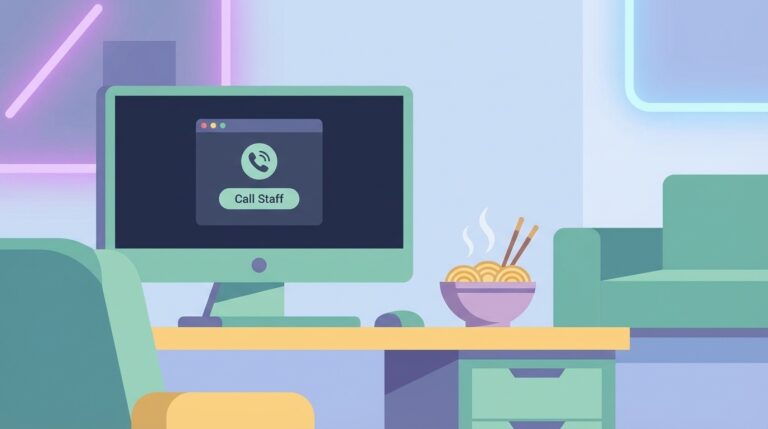
Phase 1: The Hook — Welcome to the Gamer’s Paradise! 🎮
Annyeonghaseyo! It’s your Daily Hangul Senior Editor here.
Imagine this: You’ve just walked into a neon-lit PC Bang (Internet Cafe) in Hongdae. It looks exactly like the scenes from the K-Drama Twenty-Five Twenty-One or where professional gamers like Faker practice. You can smell the delicious scent of spicy Ramyeon (instant noodles) in the air. You found the perfect seat with a curved monitor, but wait…
😱 Disaster! The person before you left a greasy Ramyeon bowl and sticky soda stains on the keyboard. Yuck.
You want to sit down and buy those BLACKPINK concert tickets or play League of Legends, but you can’t sit there. You see a staff member (Alba) passing by. What do you say?
If you stay silent, you might ruin your expensive white shirt. If you know the right phrase, you’ll get a VIP-level clean seat in seconds. Today, we are learning the magic spell to clear the mess: “Please clean this seat.”
Phase 2: Deep Dive — The Magic Cleaning Spell 🧹
Here are the 3 essential expressions you need to survive a sticky situation.
1. 여기 좀 치워 주세요 (Yeogi jom chiwo juseyo)
- Pronunciation: [Yeo-gi jom chi-wo ju-se-yo]
- Sound-alike: Yuh-ghee (like ghee butter) + Jom (rhymes with home) + Chee-woah + Ju-say-yo.
- Meaning:
- Literal: Please remove/tidy here a little.
- Real Nuance: “Could you please clean this spot for me?”
- K-Culture Moment: You’ll see this in K-Dramas when characters are at a Pocha (street food tent) and want to change tables. It’s the universal phrase for “reset this table, please.”
- Editor’s Insight: The word 좀 (jom) is crucial here. Literally, it means “a little,” but in Korean culture, it acts as a politeness softener. Without it, you sound like a bossy king ordering a servant. With it, you sound like a mannerly modern citizen.
- Situation Spectrum:
[🚫 Formal Speech/Grandparents] ———— [✅ Strangers/Staff] ———— [✅ Friends]- 🤔 Think About It: Why do Koreans add “a little” (jom) even when they want the whole table cleaned? It’s about indirectness—we don’t want to burden the other person too much.
2. 물티슈 있어요? (Multisyu isseoyo?)
- Pronunciation: [Mul-ti-syu i-sseo-yo?]
- Sound-alike: Mool-tea-shoe + E-saw-yo?
- Meaning: Do you have wet wipes?
- K-Culture Moment: In Korean restaurants (and PC Bangs), Multisyu (Wet Tissue) is life. Before eating fried chicken or touching a mouse, this is step one.
- Editor’s Insight: If the mess is small (just a few crumbs), asking for a wipe and doing it yourself gets you major “cool person” points. It shows you are considerate.
3. 죄송한데… (Joesonghande…)
- Pronunciation: [Joe-song-han-de…]
- Sound-alike: Jay-song-han-day…
- Meaning: I am sorry, but…
- Editor’s Insight: This isn’t an apology for a crime! It’s the Korean equivalent of “Excuse me…” before asking a favor. Always start with this to grab the staff’s attention gently.
Phase 3: Textbook vs. Real Life 🥊
How does a classroom student speak vs. a Seoul local?
| Situation | 📖 Textbook Korean | 🗣️ Real Korean | 💡 Why the difference? |
|---|---|---|---|
| Asking to clean | 청소해 주십시오. (Cheongso-hae jusipsio) |
여기 좀 치워 주실래요? (Yeogi jom chiwo jusillaeyo?) |
The textbook version sounds like a military command. Real life favors softer suggestions. |
| Calling Staff | 저기요! (Jeogiyo!) |
(Clicking the UI Button) 🖱️ | In modern PC Bangs, we use the computer screen to order food or request cleaning. Silence is golden! |
| Small mess | 행주 주세요. (Haengju juseyo) |
물티슈 좀요. (Multisyu jom-yo) |
Haengju is an old rag. Multisyu is hygienic and disposable. Also, ending with “-yo” makes it short but polite. |
Bottom Note: If you haven’t logged in yet, you can’t use the UI button. That’s when you must use your voice!
Phase 4: Cultural Deep Dive — Nunchi & The System 🧠
4-1. The “System UI” Culture
Korean PC Bangs are high-tech. Once you log in, there is usually a toolbar on the screen where you can order food (Ramyeon, Iced Americano) and even request staff assistance (“Call Staff”).
* K-Culture Connection: Just like in K-Pop fan voting apps, everything is digitized for efficiency. Using the button is often preferred over shouting because it doesn’t disturb other gamers who are focusing on their ranked matches.
4-2. Non-verbal Nunchi (Eye Measure)
If you see the Alba (part-timer) running around with 5 trays of Ramyeon, don’t stop them just to wipe a tiny speck of dust. That is bad Nunchi. In that case, find a clean seat yourself or grab a tissue. But if there is a leftover bowl? Absolutely ask them!
Phase 5: Roleplay Scenario — Friday Night Gaming 🎭
Setting: A bustling PC Bang in Gangnam. It’s Friday, 8 PM. The air is filled with the sound of mechanical keyboards clicking and people shouting “Nice!”
Characters:
* YOU: Desperate to play games, holding your bag.
* Alba (Staff): A college student wearing a red vest, looking slightly tired but polite.
(Scene Start)
YOU: (You find a seat, but there is an empty soda can and crumbs on the desk. You approach the counter.)
저기요, 죄송한데…
(Jeogiyo, joesonghande…)
(Excuse me, sorry to bother you…)
Alba: 네, 손님? 무슨 일이세요?
(Ne, sonnim? Museun iruseyo?)
(Yes, customer? What’s the matter?)
🔀 Decision Point: What do you say?
A) 청소해! (Cheongso-hae!) – “Clean it!”
B) 여기 좀 치워 주세요. (Yeogi jom chiwo juseyo.) – “Please clean this place a little.”
C) 더러워요. (Deoreowoyo.) – “It’s dirty.”
🛑 STOP! Choose before reading below.
.
.
.
✅ Best Choice: B
* Why: It is polite, clear, and uses the magic softener “jom”.
⚠️ Analysis of C: Saying “It’s dirty” is a statement, not a request. It can sound like a complaint. The staff might just say “Okay…” and wait for you to ask them to clean it.
(Dialogue Continues with Choice B)
YOU: 저기 45번 자리, 여기 좀 치워 주세요.
(Jeogi 45-beon jari, yeogi jom chiwo juseyo.)
(Over there at seat 45, please clean it a little.)
Alba: 아, 네! 바로 치워 드릴게요. 잠시만요!
(Ah, ne! Baro chiwo deuril-geyo. Jamsimanyo!)
(Ah, yes! I’ll clean it right away. Just a moment!)
(🎭 Stage Direction: The Alba rushes over with a spray bottle and a towel. Swish swish! The desk is now shiny.)
YOU: 감사합니다!
(Gamsahamnida!)
(Thank you!)
Phase 6: 10-Second Shadowing Drill 🗣️
Let’s practice the rhythm. Korean is not robotic; it flows!
Emotion: 🥺 Polite and slightly apologetic (requesting a favor)
저기요~ / 여기 좀 / 치워 주세요.
(Jeogiyo~ / yeogi jom / chiwo juseyo.)
Excuse me~ / here a little / please clean.
Key Point: Stretch the “yo~” in Jeogiyo slightly to sound softer. Don’t say it sharply like a bark!
Phase 7: K-Culture Mini Glossary 📚
| Korean | Romanization | English | Context |
|---|---|---|---|
| 알바 | Alba | Part-timer | Short for “Arbeit” (German). The staff at PC Bangs, Convenience stores, etc. |
| 피시방 | PC Bang | Internet Cafe | Literally “PC Room.” A social hub for gaming and eating. |
| 라면 | Ramyeon | Instant Noodles | The soul food of PC Bangs. It tastes 200% better here than at home. |
| 선불 | Seonbul | Prepaid | Most PC Bangs require you to pay first at a kiosk machine (Kiosuku). |
Phase 8: Traveler’s Survival Kit 🧳
Walking into a PC Bang for the first time? Keep these cards in mind.
🆘 Survival Expression #1: Signing In
– 🇰🇷 “비회원이에요.” (Bi-hoe-won-i-e-yo.)
– 🗣️ Sounds like: Bee-hway-won-e-eh-yo.
– Meaning: “I am a non-member.”
– Why: You usually need a Korean phone number to be a “member.” Tourists use the “Guest/Non-member” login on the kiosk.🆘 Survival Expression #2: Where is the restroom?
– 🇰🇷 “화장실 어디예요?” (Hwajangsil eodiyeyo?)
– 🗣️ Sounds like: Hwa-jang-shill uh-dee-yay-yo?
– Context: PC Bang restrooms are usually near the entrance or outside in the hallway.📌 Editor’s Travel Note:
Most PC Bangs are “Self-Service” for payment (Kiosk). But food ordering is done at your seat via the computer. You don’t need to go to the counter to buy a Coke; just click, and the Alba brings it to you! 🥤
Phase 9: Think Deeper — “Palli Palli” Service 🧠
Topic: The Speed of Service
In Korea, you will notice that when you ask for a seat to be cleaned, the staff usually runs or walks very fast to do it. Why?
This is part of Korea’s “Palli Palli” (Hurry Hurry) culture. Efficiency and speed are considered a form of kindness and competence. In some cultures, moving too fast might seem frantic or rude, but in a Korean PC Bang, speed is a sign of respect for your gaming time.
💬 Your Turn: Does your culture prefer relaxed, slow service, or speedy, efficient service? How would you feel if the waiter started running?
Phase 10: FAQ & Troubleshooting 🛠️
- Q: Can I use “Chiwo juseyo” at a coffee shop too?
- Answer: Yes! If you find a nice table at Starbucks but it has crumbs, you can ask the staff. But in self-service cafes, it’s often polite to grab a napkin and wipe small spots yourself.
- Q: Can I bring my own snacks to a PC Bang?
- Answer: No! ❌ PC Bangs make most of their money from selling food. Bringing outside food is considered rude. Try the PC Bang food—it’s surprisingly gourmet (Kimchi Fried Rice is a must!).
- ❌ Common Mistake: Shouting “YAH!” (Hey!) to call staff.
- Correction: This is very rude and usually seen in gangster movies. Always use “Jeogiyo” (Excuse me) or “Sajangnim” (Boss – if they look older).
Phase 11: Wrap-up & Action Mission 🚀
One-Liner Summary: To get a clean seat without awkwardness, use the magic softener “Jom” (Yeogi jom chiwo juseyo)!
🎯 Your Mission:
* 🥉 Bronze: Say “Yeogi jom chiwo juseyo” out loud 3 times while imagining a dirty desk.
* 🥈 Silver: Watch a YouTube video of a “Korean PC Bang Tour” and identify the “Call Staff” button on the screen UI.
* 🥇 Gold: Go to a Korean restaurant or cafe. If there is an empty plate taking up space, ask the waiter: “Yeogi jom chiwo juseyo?” (Can you clear this?)
Phase 12: Quiz — Interactive Challenge 📝
1. Which item helps you sound polite, not bossy?
A) Adding “Yo!” loudly at the end.
B) Using the word “Jom” (a little).
C) Bowing 90 degrees while gaming.
2. True or False (K-Culture):
You should bring your own burger to a PC Bang because they only have computers.
(True / False)
3. Scenario: You spilled your Coke. The keyboard is sticky. The Alba is busy. What is the best immediate move?
A) Scream “HELP!”
B) Ask for “Multisyu” (Wet wipes) and start dabbing it yourself to show effort.
C) Switch seats without telling anyone.
Answers:
1. B (“Jom” is the magic softener.)
2. False (PC Bangs are famous restaurants in disguise! They sell amazing food.)
3. B (Showing initiative with ‘Multisyu’ is great manners, then ask for help if it’s too messy.)
Frequently Asked Questions (FAQ)
Q: What does "여기 좀 치워 주세요 (Yeogi jom chiwo juseyo)" mean in Korean and how do you pronounce it?
A: In Korean, "여기 좀 치워 주세요 (Yeogi jom chiwo juseyo)" is pronounced [Yeo-gi jom chi-wo ju-se-yo] and means: Literal: Please remove/tidy here a little.
Q: What does "물티슈 있어요? (Multisyu isseoyo?)" mean in Korean and how do you pronounce it?
A: In Korean, "물티슈 있어요? (Multisyu isseoyo?)" is pronounced [Mul-ti-syu i-sseo-yo?] and means: Do you have wet wipes?
Q: What does "죄송한데... (Joesonghande...)" mean in Korean and how do you pronounce it?
A: In Korean, "죄송한데... (Joesonghande...)" is pronounced [Joe-song-han-de...] and means: I am sorry, but...






