

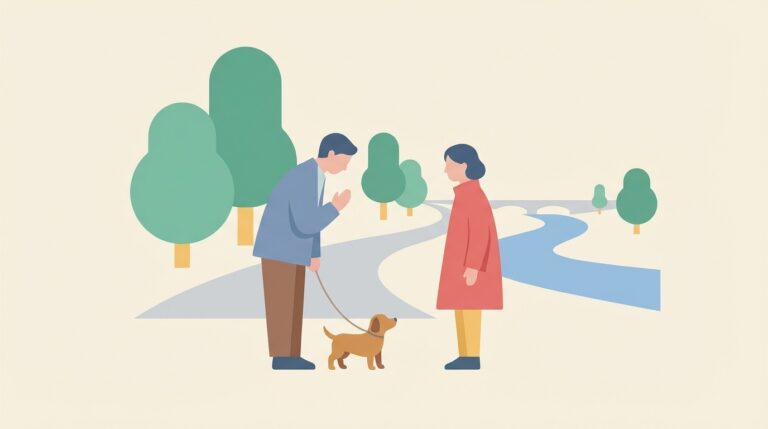
Navigating the “Petiquette” Minefield: Advanced Conflict Resolution for Pet Owners in Korea
Phase 1: Immersive Hook — The “My Dog Doesn’t Bite” Paradox
Greeting: 안녕하세요! This is your Daily Hangul Senior Editor.
The Scene: Picture a tense scene in a K-Drama. We are in a crowded elevator in a high-rise Gangnam apartment complex. The protagonist is holding a small Poodle. Suddenly, the elevator door opens, and a neighbor steps in. The dog lets out a sharp yap! The neighbor flinches, visibly annoyed.
In this suffocating silence, the protagonist mutters the most controversial sentence in Korean pet culture: “우리 개는 안 물어요” (My dog doesn’t bite).
The ‘Why’: Did you know this phrase is often considered the ultimate trigger for conflict? In Korea, where population density is high and personal space is scarce, saying “My dog is safe” is seen as dismissing the other person’s fear. Today, we aren’t just learning how to say “Sit.” We are diving into C2-level conflict resolution—how to apologize with dignity, explain behavior logically, and navigate the complex web of K-Petiquette without becoming the villain of the neighborhood.
Transparency: This guide is built on real complaints posted in Korean apartment community apps (like ‘Apartment Nerd’) regarding pet noise and safety.
Phase 2: Deep Dive — Critical Expressions for De-escalation
1. 양해를 부탁드립니다 (Yanghae-reul butak-deurimnida)
- Pronunciation: [Yang-hae-reul bu-tak-deu-rim-ni-da] + Sounds like: “Yang” (like Yin-Yang) + “Hae” (hair without ‘r’) + “Reul” + “Bu-tak” (boo-tock) + “Deu-rim-ni-da.”
- Meaning: Literal: I ask for your understanding. / Real Nuance: “I acknowledge this situation is less than ideal, and I humbly ask for your patience and generosity to overlook it.”
- K-Culture Moment: You’ll see this on signs everywhere—construction sites, subway delays, and even when a K-Pop idol’s flight is delayed. In a pet context, it’s the shield you use before or immediately after your dog causes a disturbance.
- Editor’s Insight: This is a C2-level magic wand. Simple “Sorry” (죄송합니다) admits a fault. “양해를 부탁드립니다” elevates the listener by asking for their benevolence. It shifts the power dynamic in your favor by making them the “generous understanding person.”
- Situation Spectrum:
[🚫 Friends] ———— [⚠️ Colleagues] ———— [✅ Strangers/Elders] - 🤔 Think About It: Why does Korean culture value “asking for understanding” (process) sometimes more than the actual apology (result)? How does this relate to the concept of Jeong (bond) and communal living?
2. 제가 더 주의시키겠습니다 (Jega deo juu-i-sikigetseumnida)
- Pronunciation: [Je-ga deo ju-ui-si-ki-get-seum-ni-da]
- Meaning: Literal: I will make (the dog) be more careful. / Real Nuance: “I take full responsibility for this behavior and I will discipline/train my dog strictly to prevent this from happening again.”
- K-Culture Moment: Think of a parent in a K-Drama apologizing for their child’s mistake at school. They don’t just say sorry; they promise correction. This phrase signals to the angry neighbor that you are a responsible owner, not a passive observer.
- Editor’s Insight: The verb 주의시키다 (to caution/warn someone) implies an active hierarchy. You are the master; the dog is the follower. This reassures fearful neighbors that you are in control.
- Situation Spectrum:
[🚫 Friends] ———— [⚠️ Casual] ———— [✅ Formal/Conflict] - 🤔 Think About It: Notice the causative verb form (-시키다). Why is it important in Korean phrasing to explicitly state who is causing the action or correction?
3. 사회성이 좀 부족해서요 (Sahoeseong-i jom bujok-haeseoyo)
- Pronunciation: [Sa-hoe-seong-i jom bu-jok-hae-seo-yo]
- Meaning: Literal: Because (he/she) lacks sociality. / Real Nuance: “He’s not aggressive, just socially awkward/scared. Please don’t take it personally.”
- K-Culture Moment: On Korean TV shows like “The Dog Is Incredible” (개는 훌륭하다), famous trainer Kang Hyung-wook often diagnoses dogs with “lack of sociality” rather than “bad personality.” It’s a softer, more clinical way to explain barking or shying away.
- Editor’s Insight: Instead of saying “He is scared” (겁이 많아요), using the Sino-Korean word 사회성 (Sociality) makes you sound more educated and objective about your pet’s condition. It turns a nuisance into a “training in progress.”
- Situation Spectrum:
[✅ Friends] ———— [✅ Strangers] ———— [⚠️ Angry Mobs]
Phase 3: Textbook vs. Real Life
| Situation | 📖 Textbook Korean | 🗣️ Real Korean (C2 Context) | 💡 Why different? |
|---|---|---|---|
| Dog barks at someone | 죄송합니다. (I’m sorry.) | 놀라게 해 드려서 죄송합니다. (Sorry for startling you.) | Specificity matters. Acknowledging startled feelings (놀라다) shows higher empathy (Nunchi). |
| Explaining snapping | 물지 않아요. (It doesn’t bite.) | 겁이 많아서 입질이 좀 있어요. (He has some ‘nipping’ tendency because he’s scared.) | “Doesn’t bite” is a lie if they snap. 입질 (Mouth-action/Nipping) is the precise technical term used by responsible owners. |
| Stopping a stranger from touching | 만지지 마세요. (Do not touch.) | 지금 훈련 중이라 눈으로만 봐주세요. (He’s training, so please look with your eyes only.) | Direct commands (Do not X) can feel rude. Using “Training” as an excuse is the socially acceptable “Soft No.” |
Bottom Note: In advanced Korean, the reason (excuse) often precedes the request to soften the blow.
Phase 4: Cultural Context — The “Pet Fam” vs. “Nuisance” Tension
4-1. Non-verbal: The “Short Leash” Etiquette
In Korea, the concept of 펫티켓 (Petiquette) is legally and socially rigorous. When passing someone on a sidewalk or in an elevator, you must shorten the leash significantly (often holding the dog close to your legs). This physical gesture signals, “I am respecting your space.” Failure to do this before a conflict arises is seen as a lack of Nunchi.
4-2. K-Culture Connection: The “Minpye” (민폐) Phobia
Why is everyone so sensitive? In K-Dramas or reality shows, you might notice people obsessed with not causing 민폐 (Minpye – nuisance/inconvenience) to others. This stems from high-density living. In an apartment building where walls are thin, a barking dog isn’t just noise; it’s an invasion of the collective peace.
– Critical View: Unlike in some Western cultures where a dog barking is “natural,” in Korea, it is often viewed as a failure of the owner’s management. This is why the phrase “I will discipline him” (Phase 2) is so powerful—it restores social order.
Phase 5: Immersive Roleplay — The Han River Standoff
Setting: Sunday afternoon at Han River Park (Hangang Park). It’s crowded with cyclists and picnic mats. You are walking your dog. Suddenly, your dog lunges slightly toward a passerby eating chicken. The passerby (Male, 50s, looks grumpy) jumps back.
Characters:
– YOU: An expat who speaks C2 Korean.
– Ahjussi: A startled and irritated local man.
Dialogue:
Ahjussi: (Frowning deeply) 아! 깜짝이야! 개 관리를 어떻게 하는 거야? 목줄 좀 짧게 잡아요!
(Ah! You scared me! How are you managing your dog? Hold the leash shorter!)
🔀 Decision Point: How do you respond?
A) “안 물어요. 그리고 목줄 하고 있잖아요.”
(He doesn’t bite. And I am using a leash.)B) “아이고, 선생님! 정말 죄송합니다. 많이 놀라셨죠?”
(Oh dear, Sir! I am truly sorry. You were very surprised, right?)C) “우리 개가 치킨 냄새를 좋아해서요. 이해 좀 해주세요.”
(My dog likes the smell of chicken. Please understand.)
✅ Best Choice: B
– Reason: In a conflict with an elder or stranger, empathy comes first, logic second. You must validate his shock (“You were surprised”) before explaining anything. This de-escalates his anger immediately.
(Dialogue Continues with Choice B)
YOU: 아이고, 선생님! 정말 죄송합니다. 많이 놀라셨죠? 제가 줄을 더 짧게 잡았어야 했는데, 부주의했습니다.
(Oh dear, Sir! I am truly sorry. You were very surprised, right? I should have held the leash shorter; I was careless.)
Ahjussi: (Smoothing his ruffled shirt, voice softening) 아니, 공공장소에서는 좀 조심해야지. 애가 물면 어쩔 뻔했어?
(No, I mean, you need to be careful in public places. What if the kid bit me?)
YOU: 네, 맞으신 말씀입니다. 제가 앞으로 더 확실하게 주의시키겠습니다. 좋은 주말 보내시는데 방해드려 죄송합니다.
(Yes, your words are correct. I will discipline/caution him more certainly in the future. Sorry for disturbing your nice weekend.)
Ahjussi: (Nods) 에휴, 알겠어요. 가보세요.
(Sigh, alright. Go on.)
Phase 6: 10-Second Shadowing Drill
Context: Your dog barked in the elevator. You are bowing slightly to the neighbors.
Emotion: 😓 Apologetic but poised (Not pathetic, just polite)
많이 놀라셨죠? / 제가 더 / 주의시키겠습니다.
(Mani nollasyeotjyo? / Jega deo / ju-ui-si-ki-get-seum-ni-da.)
“You must have been very startled, right? / I will / make sure to be more careful (discipline him).”
Phase 7: K-Culture Mini Glossary
| Korean | Romanization | Meaning | Context |
|---|---|---|---|
| 펫티켓 | Petchiket | Petiquette | Portmanteau of Pet + Etiquette. A major social campaign in Korea. |
| 개모차 | Gaemocha | Dog Stroller | 개 (Dog) + 유모차 (Stroller). Essential for entering malls/cafes. |
| 입질 | Ipjil | Nipping/Biting | Used to describe a dog’s tendency to bite. More specific than just “biting.” |
| 분리불안 | Bulli-buran | Separation Anxiety | A common term used by owners to explain barking when left alone. |
| 맹견 | Maeng-gyeon | Fierce/Registered Dog | Breeds legally required to wear muzzles (e.g., Rottweilers, Tosas). |
Phase 8: Traveler’s Survival Kit (Pet Edition)
Traveling to Korea with a pet? Or just interacting with them?
🆘 Survival Expression: The “Permission” Check
– 🇰🇷 “혹시 반려동물 동반 가능한가요?” (Hoksi banyeong-dongmul dongban ganeunghan-gayo?)
– 🗣️ Sounds like: Hok-shi ban-yeo-dong-mul dong-ban ga-neung-han-ga-yo?
– 📍 Where: Cafes, Hotels, Taxis.
– 💡 Pro Tip: Look for the sticker “Pets Welcome” or search for “애견 동반” (Dog-friendly) on Naver Maps. Note that “Dog Cafe” (where dogs live) and “Dog-friendly Cafe” (where you bring yours) are different!
📌 Editor’s Travel Note:
– Taxis: Regular taxis may refuse pets without a carrier. Use Kakao T Pet service if possible.
– Parks: Most parks require leashes. Off-leash is only allowed in designated fenced dog playgrounds (놀이터).
Phase 9: Think Deeper — Space & Tolerance
Why is Korean Petiquette so strict?
🧠 Think Deeper:
In Korea, the explosive growth of pet ownership (Pet Fam) clashed with a high-density urban environment where people already suffer from noise and lack of space. The strict rules about leashes and barking aren’t just about safety; they are about “Social Hygiene.” Just as you take off shoes to keep a floor clean, you control your dog to keep the social atmosphere clean. In your culture, is a barking dog seen as a personal failing of the owner, or just nature?💬 Your Turn: Have you ever experienced a “Culture Shock” regarding pets in another country? Share in the comments!
Phase 10: FAQ & Troubleshooting
Q: Can I bring my dog into a convenience store (GS25, CU) if I hold him?
A: Generally, NO. Unless it is a designated pet-friendly store, food hygiene laws prohibit pets. Tie the leash to the hook outside (often provided) or have a friend wait outside.
Q: My dog is small/cute. Does he still need a leash?
A: YES. Absolutely. There is no size exemption for leashes in Korea. In fact, many conflicts happen because owners of small dogs say “He’s just a baby,” while passersby feel threatened regardless of size.
❌ Common Mistake #1: letting the leash extend fully (3~5 meters) on a sidewalk.
✅ Fix: Keep the leash fixed at 2 meters or less in public. It’s actually a legal requirement in many zones now.
Phase 11: Wrap-up & Action Mission
Summary: Conflict resolution in Korea is about acknowledging the other person’s discomfort first (Nunchi) and taking active responsibility (Juu-i-sikida).
🚀 Action Missions:
– 🥉 Bronze: Practice saying “양해를 부탁드립니다” in a low, apologetic tone 3 times.
– 🥈 Silver: Watch a clip of the show “The Dog Is Incredible” (개는 훌륭하다) on YouTube and catch the word “보호자님” (Guardian/Owner).
– 🥇 Gold: If you are in Korea, find a “Pet Friendly” cafe on Naver Map, go there, and ask “강아지랑 같이 앉아도 돼요?” (Can I sit with the puppy?)
K-Culture Mission: Search for “강형욱” (Kang Hyung-wook) on YouTube. He is the “Dog President” of Korea. Watching his body language when he scolds owners will teach you more about Korean hierarchy and manners than any textbook!
See you next time! 우리 강아지랑 행복하세요! (Be happy with your puppy!)
Phase 12: Interactive Quiz
- Situational Judgment: You are in an elevator. A neighbor looks scared of your dog. What is the worst thing to say?
- A) (Holding dog tight) 죄송합니다. (Sorry.)
- B) 우리 개는 착해서 안 물어요. (My dog is nice, he won’t bite.)
- C) (Moving to corner) 먼저 내리세요. (Please get off first.)
- Vocabulary Check: Which word implies a dog’s tendency to bite/nip?
- A) 입맛 (Appetite)
- B) 입질 (Nipping/Biting habit)
- C) 입김 (Breath/Influence)
Answers:
1. B (This dismisses their fear and is considered rude.)
2. B (입질 is the specific term.)
Frequently Asked Questions (FAQ)
Q: What does "양해를 부탁드립니다 (Yanghae-reul butak-deurimnida)" mean in Korean and how do you pronounce it?
A: In Korean, "양해를 부탁드립니다 (Yanghae-reul butak-deurimnida)" is pronounced [Yang-hae-reul bu-tak-deu-rim-ni-da] and means: Literal: I ask for your understanding. / Real Nuance: "I acknowledge this situation is less than ideal, and I humbly ask for your patience and generosity to overlook it."
Q: What does "제가 더 주의시키겠습니다 (Jega deo juu-i-sikigetseumnida)" mean in Korean and how do you pronounce it?
A: In Korean, "제가 더 주의시키겠습니다 (Jega deo juu-i-sikigetseumnida)" is pronounced [Je-ga deo ju-ui-si-ki-get-seum-ni-da] and means: Literal: I will make (the dog) be more careful. / Real Nuance: "I take full responsibility for this behavior and I will discipline/train my dog strictly to prevent this from happening again."
Q: What does "사회성이 좀 부족해서요 (Sahoeseong-i jom bujok-haeseoyo)" mean in Korean and how do you pronounce it?
A: In Korean, "사회성이 좀 부족해서요 (Sahoeseong-i jom bujok-haeseoyo)" is pronounced [Sa-hoe-seong-i jom bu-jok-hae-seo-yo] and means: Literal: Because (he/she) lacks sociality. / Real Nuance: "He’s not aggressive, just socially awkward/scared. Please don't take it personally."







