

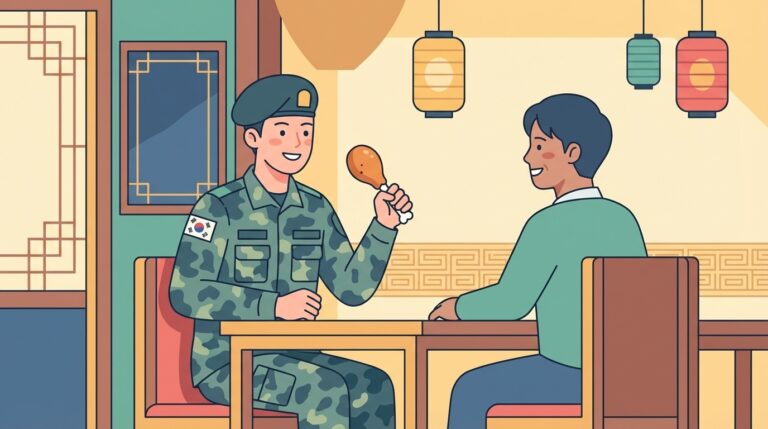
Phase 1: The Immersive Hook 👋
Hello, Daily Hangul family! It’s your editor here.
Imagine you are walking down the streets of Hongdae or sitting in a subway in Seoul. You see a young man wearing a camouflage uniform, a beret tucked in his belt, looking at his smartphone with intense focus, or perhaps eating a hamburger like it’s the most delicious thing on Earth.
Have you seen this scene in a K-Drama? Like in Crash Landing on You or Descendants of the Sun? Or maybe you remember the day your favorite K-Pop idol (like BTS members!) shaved their head and said goodbye for 18 months.
In Korea, Military Service (Gun-dae) is a huge part of the culture. Every healthy Korean man must serve. So, when they finally get a few days off, it is called “Hyu-ga” (Vacation/Leave). It is a precious, golden time.
If you meet a Korean friend who is visiting from the army, or you bump into someone in uniform, knowing how to talk about this “vacation” makes you an instant insider. They aren’t just “on holiday”; they are tasting freedom! Let’s learn how to share this special moment with them.
Phase 2: Deep Dive into Key Expressions 🤿
Here are the top 3 phrases you need when talking about military leave.
1. 휴가 나왔어요 (Hyu-ga na-was-seo-yo)
- Pronunciation: [Hyu-ga na-wat-seo-yo]
Sound Analogy: ‘Hyu’ like Hugh Jackman + ‘ga’ like Lady Gaga + ‘na-wat’ (sounds like ‘now what’) + ‘seo-yo’.- Meaning:
- Literal: I came out on vacation.
- Real Nuance: “I am currently on leave from the military (and I am so happy).”
- K-Culture Moment: In a variety show, when a soldier-guest appears, the MC asks, “Are you discharged?” and they shyly say, “No, 휴가 나왔어요.”
- Editor’s Insight: We use the verb “na-oda” (to come out) because the military base is a closed society. You are literally “coming out” to the world!
- Situation Spectrum:
[🚫 Formal Boss] ———— [✅ Friendly/Casual] ———— [✅ Strangers]
(Safe to use with almost anyone to explain your status.)- 🤔 Think About It: Why do Koreans distinguish between “vacation” (yeo-haeng) and military “leave” (hyu-ga)? It shows that for soldiers, this isn’t just travel; it’s a break from duty.
2. 언제 복귀해요? (Eon-je bok-gwi-hae-yo?)
- Pronunciation: [Eon-je bok-gwi-hae-yo]
Sound Analogy: ‘Eon-je’ (When) + ‘Bok’ (like Bok choy) + ‘gwi’ (sounds like Gwen Stefani without the ‘n’) + ‘hae-yo’.- Meaning:
- Literal: When do you return?
- Real Nuance: “When do you have to go back to the base?” (The saddest question for a soldier).
- K-Culture Moment: The dramatic scene at the bus terminal or train station. The girlfriend asks this with teary eyes.
- Editor’s Insight: Asking this shows you care about their schedule. But don’t ask it too happily! Look a bit sad when you say it.
- Situation Spectrum:
[⚠️ Caution] ———— [✅ Friendly] ———— [✅ Close Friends]
(Don’t ask this the moment they arrive! It ruins the mood. Ask it near the end.)3. 고생 많았어요 (Go-saeng ma-nas-seo-yo)
- Pronunciation: [Go-seng man-at-seo-yo]
Sound Analogy: ‘Go’ + ‘saeng’ (like sang a song) + ‘man-at’ + ‘seo-yo’.- Meaning:
- Literal: You had a lot of hardship.
- Real Nuance: “Thank you for your hard work/service.” or “You’ve been through a lot.”
- K-Culture Moment: When a soldier takes off his cap and sits down for a meal, the restaurant owner (Ajumma) might give him extra service (free food) and say this phrase.
- Editor’s Insight: This is the magic phrase. If you say this to a soldier, they will be very touched. It acknowledges their sacrifice.
Phase 3: Textbook vs. Real Life 🥊
| Situation | 📖 Textbook Korean | 🗣️ Real Korean (Insa Style) | 💡 Why the difference? |
|---|---|---|---|
| Greeting | 군인입니까? (Are you a soldier?) | 군인이세요? (Are you a soldier?) | “~입니까?” sounds like a robot or an interrogation. “~세요?” is softer. |
| Cheering up | 힘내세요. (Cheer up.) | 맛있는 거 먹자! (Let’s eat something good!) | In Korea, food is the best way to say “I love you” or “Cheer up.” |
| Asking about leave | 휴가 기간이 어떻게 됩니까? | 몇 박 며칠이야? (How many nights/days?) | Specific phrasing “X nights Y days” is the standard way to count travel time. |
💡 Editor’s Note: If you are talking to a friend, drop the “yo” at the end for the Real Korean column (e.g., “군인이야?”, “몇 박 며칠이야?”).
Phase 4: Cultural Deep Dive — The “Gom-sin” Culture 🌸
4-1. The Art of Waiting (Gom-sin)
In K-Pop fandoms or K-Dramas, you might hear the word “Gom-sin” (곰신). It is short for “Gomu-sin” (rubber shoes).
* Origin: In the past, women wore rubber shoes. The phrase “wearing rubber shoes backwards” meant running away (cheating) while the boyfriend was in the army.
* Modern Meaning: Now, a girl waiting for her boyfriend in the army is called a “Gom-sin.” If she waits until he finishes, she becomes a “Flower Shoes” (Kkot-sin / 꽃신).
4-2. Food is Everything
When a soldier comes out on Hyu-ga, their stomach is the priority. In the base, food is healthy but repetitive. Outside, they crave:
1. Greasy food: Fried Chicken, Pizza, Pork Belly (Samgyeopsal).
2. Sweet food: Donuts, Chocolate, Fancy coffee.
* Tip: If you meet a soldier friend, do not suggest a salad. Take them to a meat restaurant!
Phase 5: Roleplay Scenario 🎬
Setting: A Friday evening at a noisy Korean Fried Chicken restaurant in Hongdae. You are meeting your Korean friend Min-su, who just came out on military leave. He is wearing a cap to hide his short hair.
Characters:
* YOU: An expat living in Seoul.
* Min-su (21): Your friend, currently a Private First Class. Hungry and excited.
(Dialogue Start)
Min-su: 와! 드디어 나왔다! 치킨 냄새 대박이다.
(Wa! Deu-di-eo na-wat-da! Chi-kin naem-sae dae-bak-i-da.)
(Wow! I’m finally out! The chicken smell is amazing.)
YOU:
(Smiling) 축하해! 휴가 나왔어요?
(Chuk-ha-hae! Hyu-ga na-was-seo-yo?)
(Congrats! You came out on leave?)
Min-su: 응, 3일 동안 자유야! 진짜 너무 행복해.
(Eung, sam-il dong-an ja-yu-ya! Jin-jja neo-mu haeng-bok-hae.)
(Yeah, freedom for 3 days! I’m seriously so happy.)
YOU:
고생 많았어. 오늘 내가 살게! 언제 복귀해요?
(Go-saeng ma-nas-seo. O-neul nae-ga sal-ge! Eon-je bok-gwi-hae-yo?)
(You worked hard. It’s on me today! When do you return?)
Min-su: 일요일 저녁에 들어가야 해… 그 이야기 하지 말자. 슬프니까.
(Il-yo-il jeo-nyeok-e deul-eo-ga-ya hae… geu i-ya-gi ha-ji mal-ja. Seul-peu-ni-kka.)
(I have to go back Sunday evening… Let’s not talk about it. It’s sad.)
(🎭 Decision Point!)
🔀 Min-su looks a bit depressed about Sunday. What do you say?
- Option A: “그래도 3일이나 남았잖아! 먹자!” (Hey, you still have 3 days! Let’s eat!)
- Option B: “군대 생활은 어때? 힘들어?” (How is army life? Is it hard?)
- Option C: “미안, 미안. 빨리 먹자.” (Sorry, sorry. Let’s eat quickly.)
✅ Best Choice: Option A. Shift the focus to the positive present. Soldiers want to forget the army while on leave.
⚠️ Why not B? Asking about army life is okay later, but right now, he wants to enjoy the chicken, not report for duty!
Phase 6: 10-Second Shadowing Drill 🗣️
Let’s practice feeling the emotion. Don’t just read it, act it!
1. Greeting a soldier friend (😊 Bright & Welcoming)
휴가 / 나왔어요? / 얼굴이 / 좋아 보여요!
(Hyu-ga / na-was-seo-yo? / Eol-gul-i / jo-a bo-yeo-yo!)
Did you come out on leave? You look good!
2. Showing Empathy (🥺 Warm & Soft)
그동안 / 고생 / 진짜 / 많았어요.
(Geu-dong-an / go-saeng / jin-jja / ma-nas-seo-yo.)
You really suffered/worked hard during that time.
Phase 7: K-Culture Mini Glossary 📘
| Korean | Romanization | Meaning | Context |
|---|---|---|---|
| 군대 | Gun-dae | Military/Army | Every Korean man’s duty and burden. |
| 복귀 | Bok-gwi | Return to base | The saddest word for a soldier on leave. |
| 전역 | Jeon-yeok | Discharge | Finishing service completely. The ultimate goal! |
| 초코파이 | Choco-Pie | Choco Pie | A snack famous in the army. Often used as a symbol of military snacks. |
| PX | P-X | Post Exchange | The convenience store inside the base. Cheap and tax-free. |
Phase 8: Traveler’s Survival Kit 🎒
Even if you aren’t meeting a soldier, you will see them in Korea, especially at bus terminals or train stations (Seoul Station, Yongsan Station).
🆘 Survival Tip: Seeing Soldiers
* 👀 Don’t Stare: It’s common to see soldiers in uniform everywhere. It’s not an emergency; they are just going home or back to base.
* 📸 No Photos: Do not take photos of military bases if you hike near them. Taking photos of random soldiers in the street is also rude/uncomfortable for them.
* 🚍 TMO: You might see a sign saying “TMO” at train stations. This is the “Transportation Movement Office” for soldiers to get tickets. It’s not for tourists!📌 Editor’s Pro Tip:
If you are close friends with a soldier, ask them to buy you snail cream (dal-paeng-i cream) from the PX. It’s a famous, cheap, and high-quality souvenir that only soldiers can buy!
Phase 9: Think Deeper — Youth & Time 🧠
Why is “Hyu-ga” so emotional?
Korean men spend about 18 months of their golden youth (usually age 19-22) in the military. This is a time when their international peers are traveling, studying, or dating freely.
Think About It:
In your country, is military service mandatory? If you had to pause your life for 1.5 years, what would you miss the most? This helps you understand why Koreans place such high value on “efficiency” and “speed” (Pali-pali culture)—they feel they have to catch up on lost time.
Phase 10: FAQ & Troubleshooting 🛠️
Q: Can I talk to a soldier I don’t know in the subway?
A: Generally, No. Koreans usually keep to themselves on transit. However, if you are an older person, you might say “Thank you for your service,” but as a foreigner or young person, a simple nod or smile is enough.
Q: Do I bow to a soldier?
A: You can just do a normal slight bow (head nod). You don’t need to salute! Saluting is for soldiers.
❌ Common Mistake: Asking “Did you kill anyone?” or “Is war coming?”
✅ Fix: Most soldiers are conscripts doing peaceful training. These questions are too heavy and often irrelevant. Stick to “What food do you miss?”
Phase 11: Wrap-up & Mission 🚀
One-Liner Summary:
“Hyu-ga” is a celebration of freedom—greet them with ‘Go-saeng ma-nas-seo-yo’ and buy them some fried chicken!
🔥 Action Missions:
* 🥉 Bronze: Look in the mirror and practice saying “휴가 나왔어요?” with a happy face.
* 🥈 Silver: Watch the K-Drama D.P. or Crash Landing on You and spot the scenes where they are on leave.
* 🥇 Gold: If you have a Korean male friend, ask him, “When did you go to the army?” (Gun-dae eon-je gat-da was-seo-yo?). Watch his reaction!
💬 Your Turn:
Does your country have a specific food people crave when they return home from a long trip? Tell us in the comments!
Phase 12: Interactive Quiz 📝
1. Situation: Your friend Min-su is going back to the base (Bok-gwi) in 1 hour. He looks sad. What is the WORST thing to say?
– A) “Go-saeng ma-nas-seo.” (You worked hard.)
– B) “Da-eum-e ddo bwa!” (See you next time!)
– C) “Wa! Na-neun oneul nol-geo-ya!” (Wow! I’m going to play today!)
2. True or False?
– “Gom-sin” refers to the soldier serving in the army. (T/F)
3. Fill in the blank:
– Soldier: “I only have 3 days of leave.”
– You: “Let’s eat
____ !” (Salad / Fried Chicken)
Answers:
1. C (Don’t brag about your freedom to someone losing theirs!)
2. False (Gom-sin is the partner waiting for the soldier.)
3. Fried Chicken (Always choose the greasy/delicious food!)
Frequently Asked Questions (FAQ)
Q: What does "휴가 나왔어요 (Hyu-ga na-was-seo-yo)" mean in Korean and how do you pronounce it?
A: In Korean, "휴가 나왔어요 (Hyu-ga na-was-seo-yo)" is pronounced [Hyu-ga na-wat-seo-yo] and means: Literal: I came out on vacation.
Q: What does "언제 복귀해요? (Eon-je bok-gwi-hae-yo?)" mean in Korean and how do you pronounce it?
A: In Korean, "언제 복귀해요? (Eon-je bok-gwi-hae-yo?)" is pronounced [Eon-je bok-gwi-hae-yo] and means: Literal: When do you return?
Q: What does "고생 많았어요 (Go-saeng ma-nas-seo-yo)" mean in Korean and how do you pronounce it?
A: In Korean, "고생 많았어요 (Go-saeng ma-nas-seo-yo)" is pronounced [Go-seng man-at-seo-yo] and means: Literal: You had a lot of hardship.







