

Phase 1: Immersive Hook
Hello! This is your Daily Hangul Editor. 👋
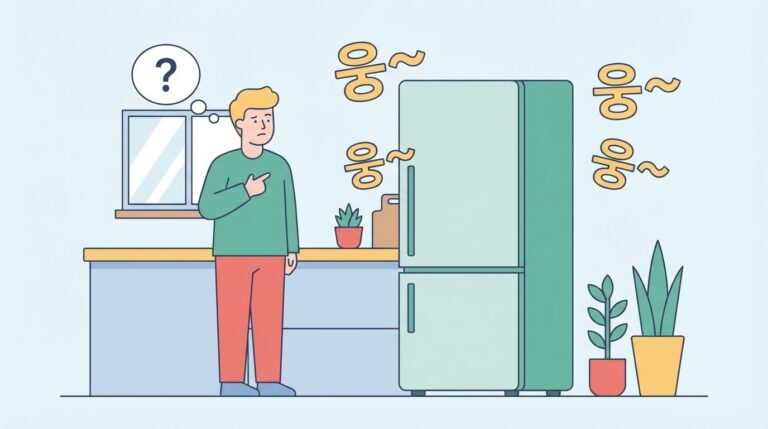
Imagine this scene: It’s 2 AM in your Seoul apartment. You’ve just finished binge-watching the latest K-Drama, and the room is dead silent. Suddenly, you hear a strange sound coming from the kitchen.
“Woong… Chik… Kkigik…”
Is it a ghost? 👻 No, it’s just your refrigerator acting up. But in that moment, it feels like the suspenseful soundtrack of a thriller movie. You realize you need to call someone to fix it, but how do you describe that sound in Korean? Do you just say “Noise”?
In Korea, home of appliance giants like Samsung and LG, getting things fixed is fast and efficient—if you know the right words. If you don’t, you might end up living with a beat-boxing fridge for weeks. Let’s learn how to get your peace and quiet back, K-style!
Phase 2: Deep Dive into Key Expressions
Here are the top 3 expressions you need when your appliances betray you.
1. 소리가 너무 커요 (Sori-ga neomu keoyo)
- Pronunciation: [Sori-ga neomu kuh-yo] + (Think of ‘Sor’ as in ‘Sorry’, and ‘Kuh’ like the sound you make when lifting something heavy.)
- Meaning: The sound is too loud. (Direct & Effective)
- K-Culture Moment: Think of a variety show where the MC shouts because the background music or game is too loud. It’s a complaint, but a factual one.
- Editor’s Insight: This is your entry-level phrase. It doesn’t describe what kind of sound, just the volume. It’s polite enough for a landlord or a technician.
- Situation Spectrum:
[🚫 Formal Report] ———— [✅ Landlord/Technician] ———— [✅ Friends]- 🤔 Think About It: Koreans distinguish between ‘소리’ (sound/voice) and ‘소음’ (noise). Why do you think we usually say “The sound is big” instead of “There is noise” in this context? (Hint: It sounds less aggressive!)
2. 냉장고가 이상해요 (Naengjanggo-ga isanghaeyo)
- Pronunciation: [Naeng-jang-go-ga ee-sang-hae-yo]
- Meaning: The refrigerator is acting strange. (Literal: The fridge is strange.)
- K-Culture Moment: In K-Dramas, when a character acts out of character, someone asks, “너 오늘 좀 이상해” (You are a bit strange today). We treat machines like people here—it’s “acting weird.”
- Editor’s Insight: This is the magic phrase when you don’t know the technical terms. It invites the listener to ask, “How is it strange?” giving you a chance to explain or mimic the sound.
- Situation Spectrum:
[🚫 Military] ———— [✅ Service Center] ———— [✅ Friends]3. A/S 신청하고 싶어요 (A/S sincheong-hago sipeoyo)
- Pronunciation: [A-S sin-cheong-ha-go shi-puh-yo]
- Meaning: I want to request After Service (repair).
- Editor’s Insight: Korea uses the term “A/S” (After Service) for almost all repairs and warranties. If you look for the word “Repair” (수리), you might find it, but “A/S” is the universal keyword on every website and hotline.
- Situation Spectrum:
[✅ Service Center] ———— [✅ Customer Service App] ———— [⚠️ Friends (Too formal)]
Phase 3: Textbook vs. Real Life
| Situation | 📖 Textbook Korean | 🗣️ Real Korean | 💡 Why is it different? |
|---|---|---|---|
| Describing noise | 소음이 발생했습니다. (Noise has occurred.) | 소리가 장난 아니에요. (The sound is no joke.) | “Has occurred” sounds like a police report. “No joke” conveys your stress level better! |
| Calling for help | 수리 기사를 보내주세요. (Please send a repair technician.) | 기사님 좀 불러주세요. (Please call the ‘Knight’ for me.) | ‘Gisa-nim’ is a respectful title. Koreans prioritize titles over functions. |
| Asking for cost | 수리비는 얼마입니까? (How much is the repair fee?) | 견적 얼마나 나올까요? (How much will the estimate come out to?) | Usually, you want to know the estimate before they start fixing, right? |
💡 Bottom Note: In B1 level, using “장난 아니다” (No joke) is a great way to sound like a local, but use it with friends or close landlords, not the official Samsung service center hotline immediately.
Phase 4: Cultural Deep Dive
4-1. Non-verbal: The “Recording” Culture 📱
In Korea, efficiency (Palli-Palli) is king. If you tell a technician “It makes a noise sometimes,” they might not be able to fix it if it’s silent when they arrive. Pro Tip: Record a video or audio of the fridge making the noise on your phone. Showing this to the technician saves 20 minutes of explanation and transcends language barriers!
4-2. K-Culture Connection: The “Gisa-nim” (Technician) 🛠️
You will hear the word 기사님 (Gisa-nim) everywhere in Korea—taxi drivers, delivery drivers, and repair technicians. It literally translates to “Knight” or “Engineer.”
– K-Drama Trope: Have you seen those dramas where the main character can fix anything? In reality, Korean technicians are often treated with high respect because they are the “experts” saving your home. Always greet them brightly and offer a drink (juice or water) when they visit. It’s distinct Korean etiquette!
Phase 5: Immersive Roleplay
Setting: It’s Monday morning. You are calling the customer service center. The background noise of the fridge is annoying you.
Characters:
– YOU: A foreign resident in Seoul. Slightly stressed.
– Consultant (상담원): Professional, speaks fast but polite.
Dialogue:
Consultant: 안녕하세요, 무엇을 도와드릴까요?
(Annyeonghaseyo, mueoseul dowadeurilkkayo?)
“Hello, how may I help you?”
YOU: 안녕하세요. 냉장고 때문에 전화했는데요.
(Annyeonghaseyo. Naengjanggo ttaemune jeonhwahaetneundeyo.)
“Hello. I called because of the refrigerator.”
Consultant: 네, 고객님. 어떤 문제가 있나요?
(Ne, gogaeknim. Eotteon munjega innayo?)
“Yes, customer. What seems to be the problem?”
YOU: [ 🔀 Your Turn! Pick your response! ]
A) 냉장고가 고장 났습니다. (The fridge is broken.)
B) 냉장고에서 ‘웅~’ 하는 소리가 너무 커요. (There is a loud ‘Woong~’ sound from the fridge.)
C) 빨리 와주세요! (Come quickly!)✅ Best Choice: B — describing the specific sound (onomatopoeia) helps them diagnose the issue immediately.
⚠️ Choice A Analysis: Too vague. They will ask “How?” anyway.
🚫 Choice C Analysis: Too rude/demanding for the start of a conversation.
Consultant: 아, 모터 소리 같네요. 기사님 방문 예약을 도와드릴까요?
(Ah, moteo sori gatneyo. Gisa-nim bangmun yeyageul dowadeurilkkayo?)
“Ah, sounds like the motor. Shall I help you book a technician visit?”
Phase 6: 10-Second Shadowing Drill
Let’s practice complaining politely but effectively!
Emotion: 😟 Worried & Slightly Annoyed
Sentences:
1. 밤마다 / 소리가 / 너무 / 커요!
(Bam-mada / sori-ga / neomu / keoyo!)
Every night / the sound / is too / loud!
- 언제 / 방문해 / 주실 수 / 있나요?
(Eonje / bangmun-hae / jusil su / innayo?)
When / can you / visit (me)?
Phase 7: K-Culture Mini Dictionary
| Korean | Romanization | English | Context |
|---|---|---|---|
| A/S (에이에스) | A-S | Repair Service | Konglish for “After Service.” Used everywhere for warranties/repairs. |
| 기사님 | Gisa-nim | Technician | Respectful title. Never call them “Hey” or “Ahjussi” (too casual). |
| 출장비 | Chuljang-bi | Call-out fee | The fee just for the technician coming to your house (even if they don’t fix it). |
| 접수 | Jeop-su | Registration | Used when you officially file a complaint or request. |
| 무상 / 유상 | Musang / Yusang | Free / Paid | Critical to check if your repair is free (warranty) or paid. |
Phase 8: Traveler’s Survival Kit
Even if you don’t live in Korea, you might encounter this in an Airbnb or Hotel.
🆘 Survival Phrases for Travelers
– 🇰🇷 “냉장고 소리가 시끄러워요.” (Naengjanggo sori-ga sikkeureowoyo.)
– “The fridge sound is noisy.”
– 🇰🇷 “방 좀 바꿔주세요.” (Bang jom bakkwo-juseyo.)
– “Please change my room.”
– 📍 Where to use: Hotel Front Desk, Airbnb Message.
– 💡 Pro Tip: If you are in an Airbnb, message the host through the app first. Don’t try to fix it yourself! Korean appliances are high-tech and complicated.
Phase 9: Think Deeper — Language & Society
Topic: Why “A/S” and not “Repair”?
Did you notice we use the English acronym “A/S” (After Service) more than the Korean word “Suri” (Repair)? This reflects Korea’s rapid industrialization era. Buying a product wasn’t the end; the “service after the sale” became a massive competitive advantage for Korean companies like Samsung and LG. It symbolizes a culture where the relationship between company and customer continues.
🧠 Think About It: In your country, is repair service considered a “right” included in the purchase, or an extra hassle? Does the language reflect that?
Phase 10: FAQ & Troubleshooting
- Q: Can I just text the technician?
- A: Often, yes! Once a request is filed (접수), the technician (Gisa-nim) will often text you to confirm the time. You can reply with the door code or details using a translator app. It’s very convenient.
- Q: Is it rude to complain about noise?
- A: Not at all. Koreans are sensitive to noise (층간소음 – noise between floors is a huge social issue). Reporting appliance noise is seen as maintaining the harmony of the home.
- ⚠️ Common Mistake:
- ❌ Don’t say: “너네 냉장고 나빠요!” (Your fridge is bad!) — This sounds like a child scolding the fridge.
- ✅ Do say: “냉장고 상태가 안 좋아요.” (The fridge’s condition is not good.)
Phase 11: Wrap-up & Action Mission
One-Liner: To get peace and quiet, respect the “Gisa-nim” and use the magic word “A/S”! 🤫
🚀 Action Mission:
– 🥉 Bronze: Look at your fridge and say “소리가 커요?” (Is the sound loud?) to practice the pronunciation.
– 🥈 Silver: Find the customer service number (usually a sticker) on your appliances and see if you can find the word “A/S”.
– 🥇 Gold: If you have a noisy appliance, try recording the sound and describing it in Korean to a friend using onomatopoeia like “Woong~” or “Kkigik”.
💬 Your Turn: Have you ever had a breakdown (emotional or appliance-related) in a foreign country? How did you solve it? Tell us in the comments! 👇
Phase 12: Interactive Quiz
1. What is the most respectful way to address the repairman?
a) 아저씨 (Ahjussi)
b) 기사님 (Gisa-nim)
c) 야! (Ya!)
2. True or False: K-Culture Edition
“In Korea, it is common to offer a small drink to a technician who visits your home.”
3. Fill in the blank:
“I want to request a repair.” -> “_______ 신청하고 싶어요.”
⬇️ Scroll for Answers
.
.
.
.
.
Answers:
1. b) 기사님 (Gisa-nim) – ‘Ahjussi’ is okay but ‘Gisa-nim’ acknowledges their expertise.
2. True – It’s a sign of ‘Jeong’ (affection/connection). They might refuse, but the offer matters.
3. A/S (or 에이에스)
Frequently Asked Questions (FAQ)
Q: What does "소리가 너무 커요 (Sori-ga neomu keoyo)" mean in Korean and how do you pronounce it?
A: In Korean, "소리가 너무 커요 (Sori-ga neomu keoyo)" is pronounced [Sori-ga neomu kuh-yo] and means: The sound is too loud. (Direct & Effective)
Q: What does "냉장고가 이상해요 (Naengjanggo-ga isanghaeyo)" mean in Korean and how do you pronounce it?
A: In Korean, "냉장고가 이상해요 (Naengjanggo-ga isanghaeyo)" is pronounced [Naeng-jang-go-ga ee-sang-hae-yo] and means: The refrigerator is acting strange. (Literal: The fridge is strange.)
Q: What does "A/S 신청하고 싶어요 (A/S sincheong-hago sipeoyo)" mean in Korean and how do you pronounce it?
A: In Korean, "A/S 신청하고 싶어요 (A/S sincheong-hago sipeoyo)" is pronounced [A-S sin-cheong-ha-go shi-puh-yo] and means: I want to request After Service (repair).







