

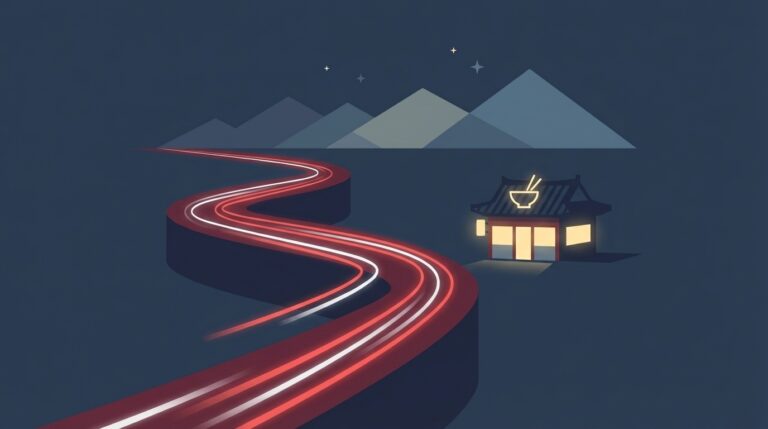
Phase 1: The Infinite Red Lights 🚗🚨
안녕하세요! Daily Hangul’s Senior Editor here.
Imagine this scene: You’re watching a K-Drama or a reality show like I Live Alone (나 혼자 산다) during the Chuseok or Seollal special. The camera pans out to a highway view from a drone. What do you see? A river of red lights stretching to the horizon on one side, and a river of white lights on the other. The celebrity in the car sighs deeply, rubs their neck, and says something that sounds like despair.
Welcome to “Minjok-ui Daiedong” (민족의 대이동 – The Great Migration of the People).
In Korea, heading to one’s hometown during major holidays isn’t just travel; it’s a battle. If you only know “차가 많아요” (There are many cars), you are missing the intense emotion of this moment. Today, we will learn how to complain about traffic like a true Korean local, understand why we do this to ourselves, and find the joy hidden in highway rest stops.
Buckle up (literally). It’s going to be a long ride.
Phase 2: Core Expressions (Deep Dive)
1. 차가 막히다 (Chaga makhida)
- Pronunciation: [cha-ga ma-ki-da] Sounds like ‘Cha’ (Tea) + ‘Ga’ + ‘Ma-key’ + ‘Da’
- Meaning: Traffic is blocked / Traffic is jammed.
- K-Culture Moment: In almost every romantic comedy, when the male lead is late to stop the female lead from leaving at the airport, he hits the steering wheel and yells this.
- Editor’s Insight: The verb 막히다 means ‘to be blocked’ or ‘clogged’. It’s passive. We don’t say “cars are slow”; we say the road itself is blocked. It implies a sense of helplessness.
- Situation Spectrum:
[🚫 Formal: Use '지체되다'] ———— [✅ Casual: Just say '아, 막혀!'] - 🤔 Think About It: Why do we focus on the “blockage” rather than the speed? Does this reflect a feeling of being trapped by external circumstances?
2. 거북이걸음 (Geobugi-georeum)
- Pronunciation: [geo-bu-gi-geo-reum]
- Meaning: A turtle’s pace (Moving very slowly).
- K-News Moment: Every holiday morning, news anchors stand in front of a highway map and say, “Currently, cars are moving at a turtle’s pace on the Gyeongbu Expressway.”
- Editor’s Insight: This is a B2-level idiom. Use this instead of “느리게 가요” (going slowly) to sound much more sophisticated and descriptive.
- Situation Spectrum:
[✅ Daily Conversation] ———— [✅ News/Formal]
3. 귀성 전쟁 (Gwiseong jeonjaeng)
- Pronunciation: [gwi-seong jeon-jaeng]
- Meaning: Homecoming War.
- Breakdown: ‘Gwiseong’ (Returning to home/province) + ‘Jeonjaeng’ (War).
- Editor’s Insight: Koreans love using the word ‘War’ (전쟁) for intense competition. We have ‘Ticketing War’ (for K-Pop concerts), ‘Registration War’ (for classes), and ‘Homecoming War’. It highlights the intensity and strategy needed to survive.
- Situation Spectrum:
[✅ Common Metaphor] - 🤔 Think About It: Labeling a family visit as a “war” is ironic, isn’t it? What does this suggest about the stress levels associated with traditional holidays in modern Korea?
4. 주차장이다 (Juchajang-ida)
- Pronunciation: [ju-cha-jang-i-da]
- Meaning: (The highway) is a parking lot.
- Nuance: It’s an exaggeration used when cars are completely stopped on the highway.
- Real Life Usage: You look out the window, sigh, and tell your friend on the phone: “완전 주차장이야.” (It’s totally a parking lot.)
Phase 3: Textbook vs. Real Life
| Situation | 📖 Textbook Korean | 🗣️ Real Korean (Insa Style) | 💡 Why the difference? |
|---|---|---|---|
| Describing traffic | 교통이 혼잡합니다. (Traffic is congested.) |
답도 없다. (There is no answer/It’s hopeless.) |
“Hopeless” captures the emotional fatigue better than “congested.” |
| Estimated time | 5시간 걸릴 것 같습니다. (It seems it will take 5 hours.) |
부산까지 5시간? 양호하네. (5 hours to Busan? That’s decent.) |
During holidays, our standards for “fast” change drastically. 5 hours becomes “fast.” |
| Moving slowly | 차가 천천히 움직입니다. (Cars are moving slowly.) |
가다 서다 반복 중이야. (Repeating ‘go and stop’.) |
This specifically describes the annoying “stop-and-go” motion. |
💡 Editor’s Note: “양호하다” (to be satisfactory/decent) is a great B2 word. Use it when a situation is bad, but not as bad as you expected.
Phase 4: Cultural Deep Dive — The Art of the “Rest Stop” (휴게소)
4-1. The Oasis in the Traffic Desert
While the traffic is hell, the Service Area (휴게소 – Hyugeso) is heaven. In K-Variety shows like Omniscient Interfering View (전지적 참견 시점), the cast often gets more excited about the food here than the destination.
- The Food: You MUST try So-tteok So-tteok (Sausage + Rice Cake skewer). It became famous thanks to comedian Lee Young-ja. Also, Walnut Cakes (호두과자) are the classic staple.
- The Vibe: It’s the only place where everyone—CEOs, students, grandmas—is doing the same stretch exercises and waiting in line for the bathroom. It’s a great equalizer.
4-2. Nunchi Game on the Road
“When should we leave?”
This is the ultimate Nunchi (reading the room) game. Families try to predict when others will leave to avoid the jam.
* “If we leave at 3 AM, maybe it’s empty?”
* Spoiler: Everyone else thought the same thing. You will meet them all at 3 AM on the highway.
Phase 5: Immersive Roleplay 🎭
Setting: It is Chuseok eve. You are in a car on the Gyeongbu Expressway heading to Busan. You’ve moved 1km in the last 30 minutes. Your Korean friend, Min-ji, is driving and looks stressed.
Min-ji: 아, 진짜 미치겠다. 네비게이션이 도착 시간을 계속 늘리고 있어.
(Ah, jinja michigetta. Nebigeisyeoni dochak siganeul gyesok neulligo isseo.)
(Ah, I’m going crazy. The navigation keeps increasing the arrival time.)
🔀 YOUR TURN! How do you react?
Choice A: “운전하느라 힘들죠? 휴게소 들를까요?” (Hard driving, right? Shall we stop at a rest area?)
Choice B: “교통 체증이 정말 심각하네요.” (The traffic congestion is very serious.)
Choice C: “와… 이 정도면 그냥 걸어가는 게 빠르겠다.” (Wow… at this rate, walking would be faster.)
Analysis:
- Choice A (The Angel): ✅ Best Choice. You acknowledge her suffering and offer a reward (food/rest). This is highly considerate.
- Choice B (The Robot): Grammatically correct, but sounds like a news anchor. A bit cold for a friend.
- Choice C (The Joker): Good for a laugh, but risky if the driver is genuinely angry. Use with caution!
Let’s go with A:
YOU: 민지야, 운전하느라 힘들지? 우리 휴게소 들를까?
(Min-ji-ya, unjeonhaneura himdeulji? Uri hyugeso deulleulkka?)
Min-ji: (Face brightening) 그럴까? 나 사실 소떡소떡 너무 먹고 싶었어. 🍡
(Geureolkka? Na sasil sotteok-sotteok neomu meokgo sipeosseo.)
(Shall we? Actually, I really wanted to eat Sotteok-Sotteok.)
Phase 6: 10-Second Shadowing Drill 🗣️
Practice describing the frustration with the right emotion.
- (😤 Frustrated sigh) 명절이라 그런지 / 도로가 / 완전 주차장이에요.
(Myeongjeol-ira geureonji / doro-ga / wanjeon juchajang-ieyo.)
(Maybe because it’s a holiday / the road / is totally a parking lot.) -
(😒 Resigned sarcasm) 서울에서 부산까지 / 8시간이라니 / 실화예요?
(Seoul-eseo Busan-kkaji / yeodeol-sigan-irani / silhwa-yeyo?)
(From Seoul to Busan / 8 hours / is this real life?)
Phase 7: K-Culture Mini Glossary 📙
| Korean | Romanization | Meaning | Context |
|---|---|---|---|
| 귀성길 | Gwiseong-gil | The way home | The journey from the city to the hometown. |
| 귀경길 | Gwigyeong-gil | The way back | The journey returning to Seoul/City. Traffic is usually worse here. |
| 효도 | Hyo-do | Filial Piety | The Confucian value that forces millions to endure this traffic to see parents. |
| KTX | KTX | Korea Train Express | The high-speed train. If you get a ticket, you are a winner. If not, you drive. |
Phase 8: Traveler’s Survival Kit 🧳
Even if you aren’t visiting family, you might travel during holidays. Here is how to survive.
🆘 Survival Expression #1: Bathroom Emergency
* 🇰🇷 “휴게소 아직 멀었어요?” (Hyugeso ajik meoreosseoyo?)
* 🗣️ Meaning: Is the rest stop still far?
* 💡 Pro Tip: If the answer is “Yes,” don’t drink any more water. Traffic jams have no mercy.📌 Editor’s Travel Note: Navigation Apps
Do not rely solely on Google Maps for driving in Korea. It doesn’t update real-time traffic well here.
* Download Naver Map or KakaoMap.
* If you are driving, T Map is the local favorite for predicting traffic accurately.
Phase 9: Think Deeper — Why do we do this? 🧠
Topic: Efficiency vs. Tradition
Every year, the news calculates the economic loss caused by holiday traffic. It’s inefficient, exhausting, and expensive. Yet, millions of Koreans hit the road. Why?
It connects to Jeong (정 – affection/bonding) and Hyo (효 – filial piety). Enduring the traffic together is almost seen as part of the ritual. Suffering on the road proves your dedication to your family.
💬 Your Turn: In your country, is there a tradition that is inefficient but everyone does it anyway because “it’s tradition”? How do you say “traffic jam” in your language?
Phase 10: FAQ & Troubleshooting 🛠️
Q: Can’t I just take the train (KTX) instead of driving?
A: Theoretically, yes. Realistically? Maybe. KTX tickets for Chuseok/Seollal open a month early at 7 AM. They sell out in seconds. We call this “Pyojjaeng” (Ticket War). If you don’t have the clicking speed of a pro-gamer, you are likely driving.
Q: Is it rude to sleep if I’m a passenger?
A: ⚠️ YES. If it’s a friend or family member driving, sleeping while they suffer is considered bad manners (unless you take turns driving). You should act as the “Co-pilot DJ” or keep talking to keep them awake.
Phase 11: Wrap-up & Mission 🚀
One-Liner: Holiday traffic in Korea isn’t just a jam; it’s a cultural event of patience, snacks, and filial piety.
🎯 Action Missions:
* 🥉 Bronze: Look at a map of Korea and trace the route from Seoul to Busan. Say “아, 멀다…” (Ah, it’s far…) out loud.
* 🥈 Silver: Watch a YouTube video of “Korean Rest Stop Food Mukbang” (search: 휴게소 먹방) and leave a comment in Korean: “소떡소떡 먹고 싶어요!”
* 🥇 Gold: Next time you are in traffic (anywhere in the world), send a message to a Korean friend: “여기도 지금 주차장이야.” (It’s a parking lot here too.)
Phase 12: Quiz — Traffic Survival Check ✅
1. Which expression is the most natural way to exaggerate heavy traffic to a friend?
A) 도로에 차가 다수 존재해. (There are a plurality of cars on the road.)
B) 완전 주차장이야. (It’s totally a parking lot.)
C) 차들이 휴식을 취하고 있어. (The cars are taking a rest.)
2. True or False (Culture):
It is considered polite to sleep comfortably in the passenger seat while your older relative drives for 6 hours.
(True / False)
3. Fill in the blank:
“Hungry? Should we stop at the ______ for some Sotteok-Sotteok?”
(Hint: The oasis of the highway)
👀 Click for Answers
- B) A is too formal/robotic. C is poetic but weird.
- False. Keep them awake! Offer gum, water, or conversation.
- 휴게소 (Hyugeso / Rest Stop)
Frequently Asked Questions (FAQ)
Q: What does "차가 막히다 (Chaga makhida)" mean in Korean and how do you pronounce it?
A: In Korean, "차가 막히다 (Chaga makhida)" is pronounced [cha-ga ma-ki-da] and means: Traffic is blocked / Traffic is jammed.
Q: What does "거북이걸음 (Geobugi-georeum)" mean in Korean and how do you pronounce it?
A: In Korean, "거북이걸음 (Geobugi-georeum)" is pronounced [geo-bu-gi-geo-reum] and means: A turtle's pace (Moving very slowly).
Q: What does "귀성 전쟁 (Gwiseong jeonjaeng)" mean in Korean and how do you pronounce it?
A: In Korean, "귀성 전쟁 (Gwiseong jeonjaeng)" is pronounced [gwi-seong jeon-jaeng] and means: Homecoming War.
Q: What does "주차장이다 (Juchajang-ida)" mean in Korean and how do you pronounce it?
A: In Korean, "주차장이다 (Juchajang-ida)" is pronounced [ju-cha-jang-i-da] and means: (The highway) is a parking lot.







