

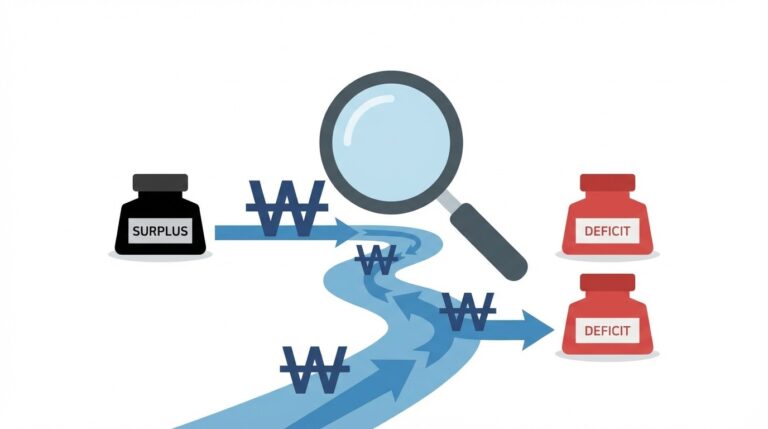
Sherlock Holmes of the Ledger: Reading the ‘Flow’ in Korean Finance
Phase 1: The Immersive Hook
Greeting: 안녕하세요! Welcome back to Daily Hangul. I’m your editor, and today we are trading our casual hoodies for business suits. 👔
Picture this scene from a gripping K-Drama: The young, ambitious CEO walks into the boardroom. The atmosphere is icy. The antagonist—usually an old, grumpy director—slams a document on the table and shouts, “So where is the money? We made a profit, but the coffers are empty!”
The protagonist sweats. The background music intensifies. 🎻
This isn’t just drama; it’s the classic Cash Flow (자금 흐름) dilemma. In Korea, understanding where the money is going is just as important as how much you made. Whether you are analyzing a K-company’s stock report or just trying to understand why your Korean friend says they are “broke” despite a high salary, today’s lesson is crucial.
We are going to learn how to interpret the flow of money like a true Korean insider. Let’s dive in!
Phase 2: Deep Dive into Core Expressions
Here are the top 3 expressions you need to survive a financial discussion in Korea.
1. 자금 흐름 (Jageum Heureum)
- Pronunciation: [Jageum Heureum] + Imagine saying “Jag” like ‘Jaguar’ and “eum” like you’re thinking ‘umm’. “Heu-reum” sounds like a soft purring cat.
- Meaning: Cash Flow (Literal: Fund Flow)
- K-Culture Moment: You’ll hear this on the news (YTN/KBS) every morning. “자금 흐름이 원활하지 않습니다” (The cash flow is not smooth). It’s the heartbeat of a business.
- Editor’s Insight: Koreans often treat money like water or blood. It needs to flow. If it stops, the business dies. It’s not just a number; it’s a movement.
- Situation Spectrum:
[🚫 Casual Friends] ———— [⚠️ Colleagues] ———— [✅ Business/Formal]
(Use this in meetings or serious news discussions. Not for buying tteokbokki.) - 🤔 Think About It: Why does Korean use the word “Flow” (흐름)? It reflects the Taoist/Confucian idea that energy (and money) must circulate to be healthy. Stagnation is death.
2. 흑자 / 적자 (Heukja / Jeokja)
- Pronunciation: [Heukja / Jeokja] + “Heuk” sounds like a hiccup; “Jeok” sounds like ‘Junk’ without the n.
- Meaning: Surplus (Black ink) / Deficit (Red ink)
- K-Culture Moment: In K-Sports news, a team might be in jeokja (deficit) and can’t buy new players. Or a K-Pop agency announces their first heukja (surplus) after a successful world tour!
- Editor’s Insight: These words are powerful. Heukja brings relief; Jeokja brings tension. You can even use it metaphorically: “My life is in jeokja this month” (I spent too much).
- Situation Spectrum:
[✅ Casual Friends (Metaphor)] ———— [✅ Colleagues] ———— [✅ Business/Formal] - 🤔 Think About It: The color coding (Black=Plus, Red=Minus) is fairly universal, but in Korean culture, Red ink is traditionally taboo for writing names (associated with death). Yet, in accounting, it just means loss. Interesting contradiction, right?
3. 부도 (Budo)
- Pronunciation: [Budo] + Sounds like ‘Boo-doh’.
- Meaning: Bankruptcy / Default / Bouncing a check
- K-Culture Moment: The climax of many retro K-Dramas set in the late 90s (during the IMF crisis). “회사가 부도났어!” (The company went bankrupt!). It is a trauma trigger for the older generation.
- Editor’s Insight: This is a heavy word. It’s not just “we are out of money”; it implies a collapse of trust and a failure to meet obligations.
- Situation Spectrum:
[🚫 Joking] ———— [⚠️ Serious News] ———— [✅ Legal/Finance] - 🤔 Think About It: The 1997 Asian Financial Crisis is called the “IMF Crisis” in Korea. The word Budo carries the collective trauma of that era. When you use this word, know that it carries emotional weight for Koreans over 40.
Phase 3: Textbook vs. Real Life
In the boardroom vs. at the Hweshik (Company Dinner).
| Situation | 📖 Textbook Korean | 🗣️ Real Korean (Insider Slang) | 💡 Why the difference? |
|---|---|---|---|
| Cash is stuck | 현금 유동성에 문제가 생겼습니다. (Cash liquidity has a problem.) | 돈맥경화 왔어요. (Don-maek-gyeong-hwa) | Combines Money (Don) + Arteriosclerosis (Dong-maek-gyeong-hwa). A witty medical metaphor for a financial heart attack. |
| Spending recklessly | 자금을 낭비하고 있습니다. (We are wasting funds.) | 돈을 물 쓰듯 하네요. (Spending money like water.) | A classic idiom. Water was once considered abundant/free, implying carelessness. |
| Emergency Loan | 긴급 자금을 조달해야 합니다. (We need emergency funds.) | 급전 좀 땡겨야겠는데요. (Need to ‘pull’ some quick cash.) | “Taeng-gyeo” (Pull) implies grabbing money from the future or anywhere possible. It sounds desperate and urgent. |
💡 Bottom Note: Use “돈맥경화” (Money-sclerosis) with your close colleagues to sound like a witty financial expert. Avoid using it in a formal report to the CEO!
Phase 4: Cultural Context — The “Nunchi” of Numbers
4-1. Non-verbal Communication: The “Sigh” 😤
In a Korean financial meeting, silence is loud. If you present a cash flow statement with a Jeokja (Deficit), don’t smile or look confident. You should look grave, slightly lower your head, and perhaps let out a small, troubled sigh. This shows you understand the gravity of the situation. Attitude is part of the reporting.
4-2. K-Drama Connection: The “IMF” Trauma
Why are Koreans so obsessed with Cash Flow specifically? Watch the movie “Default” (국가부도의 날). It depicts the 1997 crisis. Many profitable companies went bankrupt simply because they didn’t have cash on hand (liquidity).
So, when you say “Revenue is high, but cash is low,” a Korean boss might panic. This historical context explains why “Cash is King” is taken very literally in Korean corporate culture.
Phase 5: Immersive Roleplay
Setting: Yeouido, Seoul (Korea’s Wall Street). Tuesday, 2 PM. A glass-walled meeting room. You are analyzing the Q3 report with your strict Team Leader.
Characters:
* YOU: A foreign financial analyst working in Seoul.
* Manager Park: 45, serious, lived through the 1997 crisis, hates surprises.
Dialogue:
Manager Park: 이번 분기 매출은 좋은데, 통장 잔고가 왜 이래요? 😟
(Ibeon bungi maechul-eun joeunde, tongjang jango-ga wae iraeyo?)
(Sales are good this quarter, but why is the bank balance like this?)
YOU: (Looking at the tablet) 아, 그게… 매출 채권 회수가 늦어지고 있습니다.
(Ah, geuge… maechul chaegwon hoesu-ga neujeojigo isseumnida.)
(Ah, well… the collection of accounts receivable is being delayed.)
Manager Park: 이러다가 흑자 부도 나는 거 아니에요?
(Ireodaga heukja budo naneun geo anieyo?)
(Are we going to go bankrupt while making a profit at this rate?)
🔀 Decision Point! How do you reassure him?
- A) “걱정 마세요. 다음 달에 들어옵니다.” (Don’t worry. It comes in next month.) – Too casual.
- B) “자금 흐름표를 다시 분석해서 보고드리겠습니다.” (I will re-analyze the cash flow statement and report back.) – Standard & Professional.
- C) “돈맥경화가 좀 왔네요, 하하!” (We have a bit of money-sclerosis, haha!) – Risky humor.
✅ Best Choice: B. In a crisis conversation involving the word “Budo” (Bankruptcy), professionalism is your safety net. B shows you are taking action.
⚠️ Choice C Analysis: Humor is good, but NOT when the boss mentions bankruptcy. That’s a “read the room” (Nunchi) failure.
Phase 6: 10-Second Shadowing Drill
Let’s practice reporting the status. Focus on the intonation.
Emotion: Professional & Calm (😐)
“현재 / 자금 흐름에는 / 문제가 / 없습니다.”
(Heon-jae / Ja-geum Heu-reum-e-neun / Mun-je-ga / Eop-seum-ni-da.)
Currently, there are no problems with the cash flow.
Emotion: Concerned & Urgent (😟)
“현금 유입이 / 예상보다 / 많이 / 부족합니다.”
(Hyeon-geum Yu-ib-i / Ye-sang-bo-da / Ma-ni / Bu-jok-ham-ni-da.)
Cash inflow is much lower than expected.
Phase 7: K-Culture Mini Glossary
| Korean | Romanization | English | Context |
|---|---|---|---|
| 결재 | Gyeol-jae | Approval/Sign-off | The act of a boss signing your expense report. |
| 법인카드 | Beop-in Card | Corporate Card | Often called “Beop-ka” (법카). The magic card in K-Dramas. |
| 영수증 | Yeong-su-jeung | Receipt | You need this for reimbursement. “Receipt, please!” |
| 정산 | Jeong-san | Settlement/Calculation | K-Pop idols wait for “Jeong-san” day to get paid. |
| n빵 | N-bbang | Dutch Pay | Splitting the bill 1/N. Slang but widely used. |
Phase 8: Traveler’s Survival Kit — Financial Edition
Even if you aren’t doing business, you have your own “Travel Cash Flow” to manage!
🆘 Survival Expression: The “Receipt” Request
* 🇰🇷 “영수증 주세요.” (Yeong-su-jeung ju-se-yo.)
* 🗣️ Sound guide: Young-sue-juhng joo-seh-yo.
* 📍 Where: Cafes, Taxis, Convenience Stores.
* 💡 Pro Tip: In Korea, many places ask “영수증 버려 드릴까요?” (Shall I throw away the receipt?) automatically. If you need to track your spending, say “아니요, 주세요!” (No, give it to me!) quickly.📌 Editor’s Travel Note: Cash vs. Card
* Card is King: Korea has one of the highest credit card usage rates in the world. Even for a 1,000 KRW water bottle, cards are okay.
* Cash is Queen: However, for street food (Tteokbokki) or recharging your T-Money (Subway) card, Cash (Hyun-geum) is still necessary. Keep 50,000 KRW in your pocket for liquidity!
Phase 9: Think Deeper — Money & Relationships
Topic: The ambiguity of “Buying” (Han-teok)
In Western finance, money is yours or mine. In Korea, cash flow is often communal. The concept of “Han-teok sson-da” (Shooting a treat) means if something good happens to you (promotion, bonus), you must create a cash outflow to your friends/colleagues.
🧠 Think Deeper:
Why is spending money on others considered a social duty in Korea? It flows back to the agrarian society where sharing harvest ensured collective survival. Your “Personal Surplus” (Heukja) is expected to be shared to prevent social friction.💬 Your Turn: Does your culture have a rule about who pays when you get a promotion? Tell us in the comments!
Phase 10: FAQ & Troubleshooting
Q: Can I use the word “Heukja” (Surplus) to describe my personal savings?
A: Yes, humorously! You can say “This month, my household account is finally in heukja!” It sounds smart and funny.
Q: I heard the word “Don” (Money) is rude?
A: It’s not rude, but it’s direct. In a formal business setting, use “Ja-geum” (Funds) or “Ye-san” (Budget) instead of just “Don”. It sounds more professional.
❌ Common Mistake:
Don’t confuse 매출 (Maechul – Sales/Revenue) with 이익 (I-ik – Profit).
* “Sales rose” = 매출이 올랐어요.
* “We made money” = 이익이 났어요.
Mixing these up in a meeting will confuse everyone about the cash flow!
Phase 11: Wrap-up & Action Mission
One-Liner Summary:
Don’t just look at the profit; watch the Jageum Heureum (Cash Flow) to avoid Don-maek-gyeong-hwa (Money-sclerosis)!
🚀 Action Mission:
* 🥉 Bronze: Look at your last receipt and say “Igeo-neun Jeokja-ya!” (This is a deficit!) if it was expensive.
* 🥈 Silver: Watch a K-Drama scene involving a company meeting. Listen for the word “Jageum” or “Budo”.
* 🥇 Gold: Go to a Korean convenience store, buy a “2+1” item, and jokingly tell your friend, “This is good for my cash flow (Jageum Heureum).”
Phase 12: Interactive Quiz
- Situation: Your company made a huge profit, but the money hasn’t arrived in the bank account yet. Which expression fits best?
- A) 흑자 부도 (Heukja Budo)
- B) 자금 세탁 (Money Laundering)
- C) n빵 (Dutch Pay)
- True or False: It is polite to smile broadly when reporting a Jeokja (Deficit) to show optimism.
- (True / False)
- Vocabulary: What is the “slang” term for a credit crunch (money stopping)?
- Don – [ ] – Gyeong – Hwa
Answers:
1. A (Profitable Bankruptcy – scary but accurate!)
2. False (Read the room! Look serious.)
3. Maek (Don-maek-gyeong-hwa)
See you next time, and may your accounts always be in Heukja! 💸
Frequently Asked Questions (FAQ)
Q: What does "자금 흐름 (Jageum Heureum)" mean in Korean and how do you pronounce it?
A: In Korean, "자금 흐름 (Jageum Heureum)" is pronounced [Jageum Heureum] and means: Cash Flow (Literal: Fund Flow)
Q: What does "흑자 / 적자 (Heukja / Jeokja)" mean in Korean and how do you pronounce it?
A: In Korean, "흑자 / 적자 (Heukja / Jeokja)" is pronounced [Heukja / Jeokja] and means: Surplus (Black ink) / Deficit (Red ink)
Q: What does "부도 (Budo)" mean in Korean and how do you pronounce it?
A: In Korean, "부도 (Budo)" is pronounced [Budo] and means: Bankruptcy / Default / Bouncing a check







