

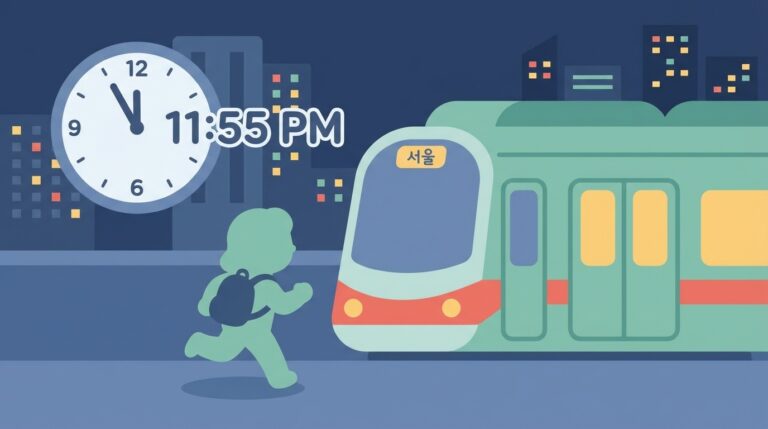
Phase 1: The “Cinderella” Moment in Korea 🕛
Hello! This is your Daily Hangul Editor.
Picture this: You are in a bustling pocha (tent bar) in Hongdae. The vibe is electric. K-Pop is blasting, green soju bottles are lining up on the table, and your Korean friends just shouted, “Let’s go to Noraebang (Karaoke)!” for the second round (2cha).
But then, you look at your phone. 11:30 PM.
In K-Dramas, this is the moment the protagonist looks at their watch, gasps, and runs into the night while emotional ballad music plays. Why? Because of “Makcha” (막차 – The Last Train).
In Seoul, missing the subway isn’t just an inconvenience; it’s a crisis. Taxis can be impossible to catch (or very expensive) after midnight. Knowing how to use the “Makcha excuse” is your social survival card. It allows you to leave a fun gathering politely without being a party pooper.
Today, let’s learn how to make your exit like a polite, regretful Cinderella.
Phase 2: Deep Dive — Key Expressions 🧐
Here are the three most natural ways to say you need to run.
1. 막차 시간 때문에 가 봐야 할 것 같아요.
(Makcha sigan ttaemune ga bwaya hal geot gatayo)
- Pronunciation: [Mak-cha she-gan ttae-moon-eh ga bwa-ya hal got ga-ta-yo]
- Meaning: “I think I need to get going because of the last train time.”
- Context: This is the standard, B1-level phrase. It blames the situation (the train), not your desire to leave.
- Editor’s Insight: Notice we use “~을 것 같아요” (I think…). In Korea, saying “I am going now” can sound too abrupt or cold. Softening it with “I think I have to…” shows you are reluctant to leave.
- Situation Spectrum:
[🚫 Formal Boss] ———— [⚠️ Colleagues] ———— [✅ Friends]
(Perfect for colleagues or friends. For a boss, you might need to apologize more profusely first.)🤔 Think About It: Why do Koreans prefer indirect speech like “I think I have to go” instead of “I’m going”? How does this relate to maintaining group harmony (Kibun)?
2. 아쉽지만 먼저 일어날게요.
(Aswipjiman meonjeo ireonalkkeyo)
- Pronunciation: [Ah-ship-ji-man mon-juh ear-uh-nal-kkay-yo]
- Meaning: “It’s a shame/sad, but I’ll get up (leave) first.”
- K-Culture Moment: You often see this in variety shows or dramas when a guest has a busy schedule. They put on a sad face, bow slightly to everyone, and back away.
- Editor’s Insight: ‘아쉽다’ (Aswipta) is a crucial emotion in Korea. It means “lacking” or “regretful” in a social context. It signals, “I want to stay, but I can’t.”
- Situation Spectrum:
[🚫 Strict Elders] ———— [✅ Colleagues] ———— [✅ Friends]3. 막차 끊기기 전에 가야 해요.
(Makcha kkeunkigi jeone gaya haeyo)
- Pronunciation: [Mak-cha kkeun-ki-gi juh-neh ga-ya hae-yo]
- Meaning: “I have to go before the last train gets cut off.”
- Editor’s Insight: The verb 끊기다 (kkeunkida) means “to be cut off.” We don’t say the train “leaves”; we say the service is “cut.” It sounds more urgent!
Phase 3: Textbook vs. Real Life 📖 vs. 🗣️
| Situation | 📖 Textbook Korean | 🗣️ Real Korean (In the streets) | 💡 Why is it different? |
|---|---|---|---|
| Checking the time | 지금 몇 시예요? (What time is it?) | 헐, 지금 몇 시야? (Heol, what time is it now?) | “Heol” adds the dramatic realization that time passed too fast. |
| Leaving | 안녕히 계세요. (Goodbye/Stay in peace.) | 저 먼저 들어가 볼게요! (I will try ‘entering’ [home] first!) | “Going in” (들어가다) implies going into one’s personal space/home. It’s softer than “Leaving.” |
| Reason | 집에 가야 합니다. (I must go home.) | 망했다, 막차 놓치겠다. (I’m doomed, I’m gonna miss the last train.) | Using “doomed” (mang-haet-da) emphasizes the urgency to close friends. |
Bottom Note: If you are with close friends (same age), drop the “yo” at the end, but keep the “regretful” face!
Phase 4: Cultural Context — The “Nunchi” Exit 🧠
4-1. The Art of the Exit
Leaving a Korean gathering isn’t just about walking out. It requires Nunchi (sensing the atmosphere).
* Do not: Stand up abruptly while someone is telling a story.
* Do: Wait for a lull in conversation. Check your phone visibly with a worried expression. When someone asks, “What’s wrong?” THAT is your cue!
4-2. K-Drama Connection: The Wrist Grab
In dramas, when a character says “Makcha kkeunkyeosseo” (The last train is cut off), it’s often a romantic trope implying “I guess we have to spend the night together” or “We have to talk all night.” But in reality? It means a struggle to find a taxi or waiting at a 24-hour Lotteria until the Cheotcha (First train at 5 AM).
Phase 5: Immersive Roleplay 🎭
Setting: A noisy BBQ restaurant in Gangnam. It is Friday, 11:20 PM. You have been eating Samgyeopsal with your Korean friend, Minji.
Characters:
* YOU: An expat who lives 40 minutes away by subway.
* Minji (27): Loves to party, slightly tipsy, wants to go for Round 2.
(Dialogue Start)
Minji: (Pouring Soju) 야! 오늘 기분이다! 노래방 가자! 🎤
(Ya! Oneul gibunida! Noraebang gaja!)
(Hey! I feel great today! Let’s go to Karaoke!)
YOU: (Checking watch nervously) 🕙 …
Minji: 왜 그래? 무슨 일 있어?
(Wae geurae? Museun il isseo?)
(Why? Is something wrong?)
🔀 YOUR TURN! How do you respond?
Option A: “노래방 싫어. 집에 갈래.” (I hate Karaoke. I want to go home.)
Option B: “아… 가고 싶은데, 막차 시간이 다 돼서 가 봐야 할 것 같아.” (Ah… I want to go, but the last train time is near, so I think I should go.)
Option C: “택시 타면 돼! 가자!” (I can take a taxi! Let’s go!)
Analysis:
* Option A: 🚫 Too direct. You might hurt Minji’s feelings.
* Option B: ✅ Perfect Choice! You validated her suggestion (“I want to go”) but used the external excuse (“Makcha”) to decline politely.
* Option C: ⚠️ Risky. Taxis in Gangnam on Friday night? You might wait on the street for an hour. Only choose this if you are rich or brave!
Phase 6: 10-Second Shadowing Drill 🗣️
Practice this sentence to get the rhythm and emotion right. Don’t be a robot!
Sentence: “Ah, I really want to stay, but the train is cutting off!”
😢 Emotion: Regretful, apologetic, urgent.
🇰🇷 Korean: 아~ / 더 놀고 싶은데 / 막차가 / 끊길 것 같아요!
Romanization: Ah~ / deo nolgo sipeunde / makchaga / kkeungil geot gatayo!
(Repeat 3 times focusing on the “Ah~” at the beginning!)
Phase 7: K-Culture Glossary 📚
| Korean | Romanization | Meaning | Context |
|---|---|---|---|
| 막차 | Makcha | Last Train | The ultimate curfew for most commuters. Usually around 11:30 PM – 12:30 AM. |
| 첫차 | Cheotcha | First Train | The train that starts around 5:00 AM. The goal of all-nighters. |
| 2차 | I-cha | Round 2 | Going to a second location (usually a bar) after dinner. |
| 할증 | Haljeung | Surcharge | The extra fee (20-40%) taxis charge late at night. |
Phase 8: Traveler’s Survival Kit 🧳
Situation: You are in Seoul and it’s late.
🆘 Survival Expression #1
* 🇰🇷 “지금 지하철 끊겼나요?” (Jigeum jihacheol kkeungyeonnayo?)
* 🗣️ Meaning: “Is the subway cut off now?”
* 📍 Where: To a passerby or station staff.📌 Editor’s Travel Note
* The App is God: Download KakaoMetro or Naver Map. They tell you the exact second the last train arrives at your specific station. “Last Train” times vary by line!
* Taxi Shift: Around 11 PM – 1 AM, taxi drivers often change shifts or pick long-distance passengers only. Apps like Kakao T or Uber (UT) are essential; hailing from the street is very hard.
Phase 9: Think Deeper — “Jeong” and the Difficulty of Goodbye 🧠
Why is it so hard to leave a Korean party?
In Western cultures, “Irish exits” (leaving quietly) or saying “I’m tired” is often acceptable. In Korea, the concept of Jeong (정 – deep connection/attachment) means that doing things together is paramount. Leaving early can sometimes be interpreted as “breaking the mood” (bunwigi kkaeda).
This is why the “Makcha” is such a useful cultural tool. It is an objective, external force that separates the group, absolving you of the guilt of choosing to leave your friends. It preserves the Jeong while saving your sleep schedule.
💬 Your Turn: In your country, what is the best excuse to leave a party early? Share in the comments!
Phase 10: FAQ & Troubleshooting 🛠️
Q: Can I use these phrases with my boss?
A: Generally, yes, but add more bows. With a boss, it’s better to say: “부장님, 너무 즐거운데 막차 때문에 먼저 일어나 보겠습니다. 죄송합니다.” (Manager, I’m having so much fun, but because of the last train, I will try leaving first. I’m sorry.)
Q: What if they say “Take a taxi! I’ll pay!”?
A: This is a power move. If a senior says this, you might have to stay for Round 2. If you really must go, say: “내일 아침 일찍 일이 있어서요…” (I have work early tomorrow morning…).
❌ Common Mistake:
Don’t just say “Bye” (안녕) and walk away. In Korea, the “Goodbye” process is a ritual that can take 10 minutes at the door!
Phase 11: Wrap-up & Action Mission 🎬
Summary: Today we learned that blaming the Makcha (Last Train) is the most polite, culturally accepted way to escape a late-night gathering.
🚀 Action Mission:
* 🥉 Bronze: Open a Korean map app and find out what time the last train is for your nearest station.
* 🥈 Silver: Practice the “regretful face” in the mirror while saying “Ah… Makcha…”
* 🥇 Gold: Next time you are with Korean friends, be the one to remind them: “Guys, Makcha is coming!” (얘들아, 막차 시간 다 됐어!)
Phase 12: Quiz — Can You Go Home? 📝
Scenario: Your friend holds your arm and says, “Just one more drink!” It is 11:50 PM.
- True or False: You should say “No, I don’t want to.” (True/False)
- Fill in the blank: “________ 때문에 가 봐야 해요.”
- a) 배고픔 (Hunger)
- b) 막차 (Last train)
- c) 소주 (Soju)
Answers:
1. False. Too direct! Use the “Makcha” excuse.
2. b) 막차. Blame the train!
See you next time! Don’t miss your train! 🚇👋
Frequently Asked Questions (FAQ)
Q: What does ""~을 것 같아요"" mean in Korean and how do you pronounce it?
A: In Korean, ""~을 것 같아요"" is pronounced [I think...] and means: . In Korea, saying "I am going now" can sound too abrupt or cold. Softening it with "I think I have to..." shows you are reluctant to leave.
Q: What does "'아쉽다'" mean in Korean and how do you pronounce it?
A: In Korean, "'아쉽다'" is pronounced [Aswipta] and means: is a crucial emotion in Korea. It means "lacking" or "regretful" in a social context. It signals, "I want to stay, but I can't."
Q: What does "끊기다" mean in Korean and how do you pronounce it?
A: In Korean, "끊기다" is pronounced [kkeunkida] and means: means "to be cut off." We don't say the train "leaves"; we say the service is "cut." It sounds more urgent!







