

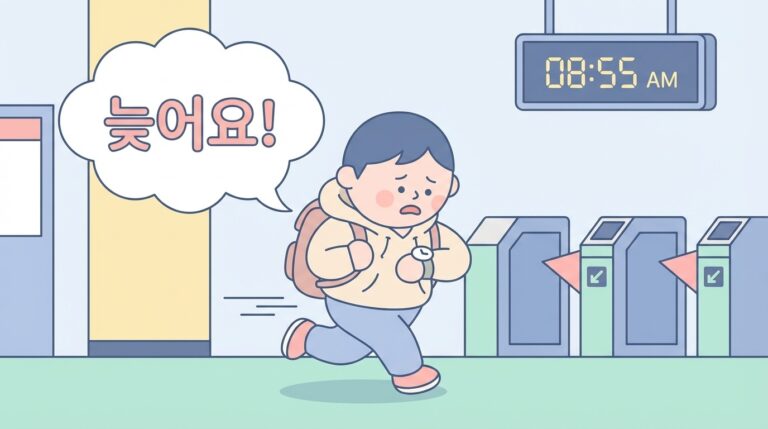
Running Late like a K-Drama Protagonist? Don’t Panic! 🏃💨
Phase 1: The Hook — Welcome to “Korean Time”
Annyeonghaseyo! This is your Daily Hangul editor.
Picture this: You are the main character in a K-Drama. The background music is getting faster. You are running through a busy Seoul subway station, dodging people left and right. Why? Because you have a dinner date at a K-BBQ spot in 10 minutes, but you are still three stops away! 😱
In Korea, being on time is important, but life happens. The subway gets delayed, or you get lost in the maze of Gangnam station. The problem isn’t being late; it’s how you handle it.
Saying “I am late” directly can sound too blunt. Today, we will learn the art of breaking the news softly, just like a local. Knowing these phrases might save your table reservation!
Phase 2: Deep Dive — Core Expressions
1. 조금 늦을 것 같아요 (Jogeum neujeul geot gatayo)
- Pronunciation: [Jo-geum neu-jeul got ga-ta-yo]
- Jo-geum: Sounds like “Jo” in “Joe” + “geum” (gum).
- neu-jeul: “Neu” sounds like the start of “New” jersey.
- Meaning: “I think I’ll be a little late.”
- Literal: It seems like I will be a little late.
- Real Nuance: “I am definitely late, but I am softening the blow by saying ‘it seems like’.”
- K-Culture Moment: In variety shows like Running Man, when a member is late for the opening, they call and say this in a guilty voice. It’s the universal “oops” phrase.
- Editor’s Insight: Koreans rarely say “I will be late” (늦겠습니다). That sounds like a military report. Using “~것 같아요” (it seems like) makes you sound polite and apologetic.
- Situation Spectrum:
[🚫 Boss/Formal] ———— [✅ Colleagues] ———— [✅ Friends]
(Note: For a very strict boss, just say “Juesonghamnida” (I’m sorry) first!)
🤔 Think About It: Why do Koreans prefer “I think I will be late” over “I will be late”? It shows you aren’t trying to be late on purpose—it’s out of your control!
2. 거의 다 왔어요 (Geoui da wasseoyo)
- Pronunciation: [Go-we da wa-sso-yo]
- Geoui: Sounds like “Go-we”.
- Meaning: “I’m almost there.”
- K-Culture Moment: This is the most common lie in Korean history! In K-Dramas, a character says this while they are still waking up in bed. 🛌
- Editor’s Insight: Use this when you are actually close (or when you just want to calm your friend down). It gives hope!
- Situation Spectrum:
[⚠️ Boss] ———— [✅ Colleagues] ———— [✅ Friends]
3. 먼저 들어가세요 (Meonjeo deureogaseyo)
- Pronunciation: [Mon-jo deu-ro-ga-se-yo]
- Meaning: “Please go in first.”
- K-Culture Moment: You are meeting for coffee or food. It’s freezing cold or raining. Don’t make your friend wait outside! Tell them to get a table first.
- Editor’s Insight: This shows you have Ssenseu (Sense). You care about their comfort more than your arrival.
Phase 3: Textbook vs. Real Life
| Situation | 📖 Textbook Korean | 🗣️ Real Korean (Street Style) | 💡 Why the difference? |
|---|---|---|---|
| Running 5 mins late | 늦어서 죄송합니다. (I apologize for being late.) | 미안! 5분만! (Sorry! Just 5 mins!) | Efficiency! Friends minimize words to save time. |
| Stuck in traffic | 길이 많이 막힙니다. (The road is very blocked.) | 차 너무 막혀 ㅠㅠ (Traffic is crazy ㅠㅠ) | Showing emotion (stress) is more important than grammar here. |
| Almost arrived | 곧 도착합니다. (I will arrive soon.) | 다 왔어! (I’m all here! / Arrived!) | Even if you are 5 mins away, saying “arrived” keeps the vibe positive. |
Bottom Note: If you are A1 level, stick to the polite forms ending in “-yo” to be safe with everyone!
Phase 4: Cultural Deep Dive — The “Korean Time” Paradox
4-1. Nunchi (Eye-measure)
If you are late, don’t just walk in casually. You need to show “Latenss Nunchi”. Even if you run into the cafe, look a little out of breath and apologetic. If you look too relaxed, your friend might think you didn’t care about the appointment.
4-2. K-Food Connection: The “Gogi” (Meat) Rule 🥩
If you are late to a Korean BBQ (Samgyeopsal) dinner:
1. Text “먼저 드세요” (Eat first).
2. Meat cooks fast! Koreans hate overcooked, dry meat. Telling them to start without you is the ultimate act of kindness.
3. Critical Question: Why is eating together so important? In Korea, eating alone is historically sad. By making them wait, you are forcing them to be hungry and lonely. Tell them to start!
Phase 5: Immersive Roleplay
Setting: It’s Friday night at Hongdae Station Exit 9 (The busiest meeting spot in Seoul). It’s crowded, loud, and you are 10 minutes late to meet your Korean friend, Minji.
Characters:
* YOU: A foreign student, lost in the station.
* Minji: Your Korean friend, waiting in the cold.
Start Dialogue:
Minji: (Phone Call) 야! 어디야? 사람들 진짜 많아.
(Ya! Eodi-ya? Saramdeul jinjja mana.)
(Hey! Where are you? There are so many people.)
YOU: (Pant, pant…)
🔀 YOUR TURN! How do you answer?
- A) “지금 가요! 조금 늦을 것 같아요.” (I’m coming! I think I’ll be a little late.)
- B) “미안해요. 먼저 집에 가세요.” (Sorry. Please go home first.)
- C) “거의 다 왔어요!” (I’m almost there!)
Analysis:
* Choice A (Safe): ✅ Honest and polite. Good for a standard friendship.
* Choice B (Weird): ❌ “Go home”? No! That cancels the plan. Minji will be confused.
* Choice C (The “Korean” Way): ⚠️ Use this ONLY if you are actually less than 10 minutes away. If you arrive 30 minutes later, Choice C becomes a lie!
(Dialogue continues assuming Choice A):
YOU: 미안해요 Minji! 조금 늦을 것 같아요.
(Mianhaeyo Minji! Jogeum neujeul geot gatayo.)
Minji: 알았어. 천천히 와. 너무 추워서 나 먼저 카페에 있을게.
(Arasseo. Cheoncheonhi wa. Too cold, so I’ll be in the cafe first.)
YOU: 네! 먼저 들어가세요! 금방 갈게요!
(Ne! Meonjeo deureogaseyo! Geumbang galkkeyo!)
Phase 6: 10-Second Shadowing Drill
Read these aloud with the emotions indicated!
- 😰 (Apologetic & Breathless)
죄송해요 / 조금 / 늦을 것 같아요!
(Juesong-haeyo / jogeum / neujeul geot gatayo!) -
🏃 (Urgent & Hopeful)
거의 / 다 / 왔어요!
(Geo-ui / da / wasseo-yo!) -
🙏 (Considerate)
추우니까 / 먼저 / 들어가세요.
(Chu-u-nikka / meonjeo / deureo-gaseyo.)
Phase 7: Traveler’s Survival Kit
Running late because you got lost? It happens to everyone in Korea.
🆘 Survival Expression #1
* 🇰🇷 “여기 어디예요?” (Yeogi eodi-yeyo?)
* 🗣️ Pronunciation: [Yuh-gi uh-di-yay-yo?]
* Meaning: Where is this place?
* Use when: You are in a taxi or lost on the street and need to tell your friend your location.📌 Editor’s Travel Note: The Map Trap
* Google Maps does NOT work well for walking directions in Korea (due to local laws).
* Download: Naver Map or KakaoMap. They have English interfaces and show real-time subway schedules. This will save you from being late in the first place!
Phase 8: Think Deeper — Language & Culture
🧠 One Step Deeper: The Indirect Apology
In many Western cultures, “I am late” is a fact. In Korean, adding “~것 같아요” (I think/it seems) softens the fact. It implies, “I don’t want to be late, but the situation is making me late.” It reduces the conflict. Korean communication often values harmony over direct facts.💬 Your Turn: In your country, is it better to be 100% honest about how late you are, or is a “white lie” (I’m almost there!) acceptable? Let me know in the comments!
Phase 9: FAQ & Troubleshooting
- Q: Can I use “Sorry” (Mianhae) to an older person?
- A: 🚫 NO! Use “Joesong-hamnida” (Formal). “Mianhae” is strictly for friends/same age. If you are late to meet a professor or boss, bow and say “Joesong-hamnida.”
- Q: How late is “too late” in Korea?
- A:
- Business: 0 minutes. Be 5 minutes early.
- Friends: 5-10 minutes is usually forgiven with a smile (
- A:
Frequently Asked Questions (FAQ)
Q: What does "조금 늦을 것 같아요 (Jogeum neujeul geot gatayo)" mean in Korean and how do you pronounce it?
A: In Korean, "조금 늦을 것 같아요 (Jogeum neujeul geot gatayo)" is pronounced [Jo-geum neu-jeul got ga-ta-yo] and means: a key conversational Korean expression covered in this lesson.
Q: What does "거의 다 왔어요 (Geoui da wasseoyo)" mean in Korean and how do you pronounce it?
A: In Korean, "거의 다 왔어요 (Geoui da wasseoyo)" is pronounced [Go-we da wa-sso-yo] and means: a key conversational Korean expression covered in this lesson.
Q: What does "먼저 들어가세요 (Meonjeo deureogaseyo)" mean in Korean and how do you pronounce it?
A: In Korean, "먼저 들어가세요 (Meonjeo deureogaseyo)" is pronounced [Mon-jo deu-ro-ga-se-yo] and means: "Please go in first."







